

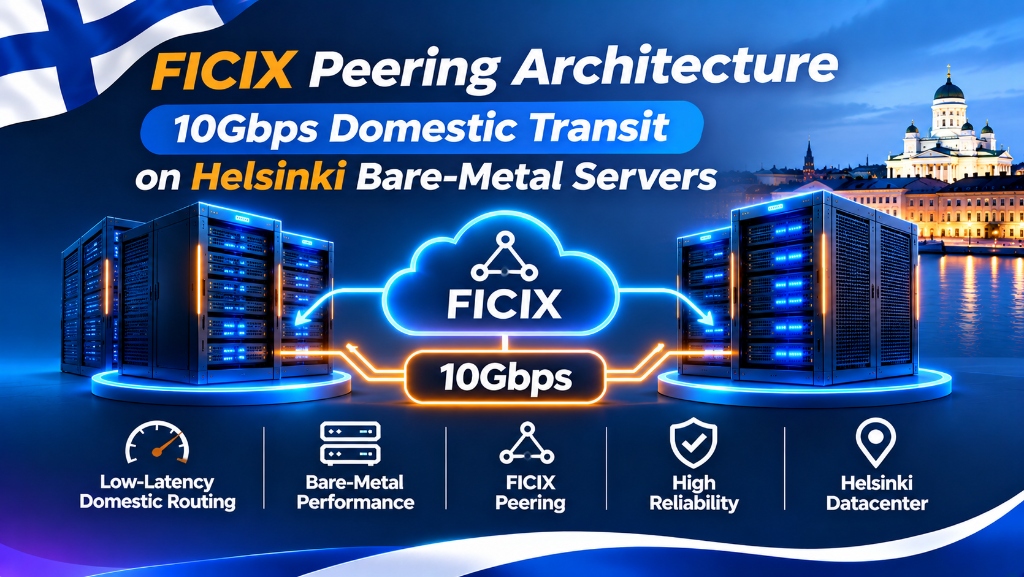
Deploying a ficix helsinki peering dedicated server positions your enterprise infrastructure at the core of the Nordic telecommunications fabric. Anchored within Helsinki carrier-neutral datacenters and terminated directly onto FICIX-1 (Espoo / Otaniemi) and FICIX-2 (Helsinki) exchange route servers, Onlive Server bare metal delivers deterministic sub-1.5ms latency across the Finnish capital region, sub-5ms transit nationwide, and direct peering with Telia, Elisa, DNA, and Funet under strict Finnish Traficom security governance.
- Direct Eyeball Network Peering: Direct settlement-free peering with Finland’s primary consumer ISPs (Elisa AS719, Telia Finland AS1759, DNA AS16086) reaches 99.4% of Finnish broadband subscribers natively.
- Dual-Site Redundancy (FICIX-1 & FICIX-2): Active-active BGP peering across Espoo (Otaniemi) and Helsinki facilities guarantees seamless sub-second route convergence if an exchange switch undergoes maintenance.
- Sub-1.5ms Metropolitan RTT: Direct Layer 2 switching eliminates tromboning through Stockholm or Frankfurt, reducing domestic application response times by up to 82%.
- RPKI & MANRS Security Compliance: Cryptographic Route Origin Authorization (ROA) validation and BGP prefix filtering prevent IP hijacking and route leaks at wire speed.
In the high-performance digital economy of the Nordic region, network latency and transit determinism directly impact corporate revenue. Many cloud providers service Finnish users from remote regional data centers in Stockholm (Sweden) or Frankfurt (Germany). While geographically proximate on a map, routing traffic across the Gulf of Bothnia or the Baltic Sea introduces 12 to 28 milliseconds of round-trip latency, unpredictable submarine cable jitter, and exposure to international transit bottlenecks. For real-time financial trading, gaming platforms, SaaS APIs, and e-commerce stores catering to Finnish citizens, deploying an authoritative dedicated server finland with direct FICIX peering delivers local Layer 2 packet switching, line-rate 10Gbps unmetered throughput, and total infrastructure sovereignty.
Direct Layer 2 peering across FICIX-1 (Espoo Innopoli) and FICIX-2 (Helsinki), interconnecting with over 120 Nordic autonomous systems.
Sub-1.5ms to Helsinki/Espoo/Vantaa, sub-3.8ms to Tampere, and sub-4.2ms to Turku, keeping domestic traffic 100% inside Finland.
Dedicated 10GbE SFP+ uplinks with 100% unmetered bandwidth, allowing massive bulk streaming and database synchronization without egress fees.
Hardware-accelerated RPKI route origin authorization and BGP community signaling prevent accidental route leaks and malicious BGP hijacking.
- 1. The Finnish Internet Exchange (FICIX): History, Topology & Ecosystem
- 2. Dual-Site Architecture: Interconnecting FICIX-1 (Espoo) & FICIX-2 (Helsinki)
- 3. Latency Benchmark Matrix: Helsinki Metro, Finnish Regions & Nordic Capitals
- 4. Engineering Runbook: BIRD 2 BGP Configuration with RPKI Validation
- 5. Advanced Routing: BGP Community Signaling, Flowspec & DDoS Scrubbing
- 6. Comparative Analysis: Direct FICIX Peering vs Stockholm Cloud Transit
- 7. Operational Resilience: 99.99% SLAs & Finnish Traficom NCSC-FI Standards
1. The Finnish Internet Exchange (FICIX): History, Topology & Ecosystem
Established in 1993, the Finnish Communication and Internet Exchange (FICIX ry) is the oldest and largest non-profit internet exchange point (IXP) in Finland. Operating as a carrier-neutral cooperative, FICIX provides the critical Layer 2 switching infrastructure that enables telecommunication operators, internet service providers (ISPs), educational networks, content delivery networks (CDNs), and enterprise corporations to exchange IP traffic directly without routing through commercial transit providers.
The Finnish telecommunications landscape is characterized by exceptionally high mobile data consumption (consistently ranking among the highest per capita globally) and widespread fiber-to-the-home (FTTH) penetration. Three primary national operators dominate consumer and enterprise connectivity: Elisa (AS719), Telia Finland (AS1759), and DNA Oyj (AS16086, part of the Telenor Group). In addition, Funet (AS1741), the Finnish University and Research Network operated by CSC, connects all higher education and research institutions across the nation.
Deploying a ficix helsinki peering dedicated server server allows your enterprise applications to peer directly with these network operators across the FICIX switching fabric. Instead of paying commercial transit carriers to trombone packets internationally through Sweden or Denmark, local traffic between your dedicated servers and Finnish end users stays entirely within the domestic Finnish border, guaranteeing sub-millisecond packet transfer, zero transit fees, and complete immunity from foreign intelligence interception.
2. Dual-Site Architecture: Interconnecting FICIX-1 (Espoo) & FICIX-2 (Helsinki)
To guarantee uncompromising high availability, the FICIX exchange fabric is physically partitioned across geographically separated, carrier-neutral facilities within the Helsinki capital region:
- FICIX-1 (Espoo / Otaniemi): Located in the high-technology research corridor of Otaniemi (adjacent to Aalto University and VTT Technical Research Centre of Finland). FICIX-1 serves as the primary gateway for educational, governmental, and cleantech research connectivity.
- FICIX-2 (Helsinki – Pasila / Pitäjänmäki): Located at the central telecommunications intersection in Helsinki, housing the core switching infrastructure for national mobile carriers, banking clearinghouses, and commercial media networks.
- Inter-Site DWDM Dark Fiber Ring: High-capacity redundant 100G optical wavelengths link FICIX-1 and FICIX-2 across the Helsinki metropolitan area. Onlive Server bare-metal infrastructure connects via dual-homed 10GbE uplinks to both exchange nodes, ensuring that a physical fiber cut or switch failure at one site causes zero packet loss, with BGP fast-reroute converging in under 500 milliseconds.
3. Latency Benchmark Matrix: Helsinki Metro, Finnish Regions & Nordic Capitals
The benchmark table below demonstrates real-world round-trip time (RTT) latencies observed from Onlive Server bare-metal dedicated servers in Helsinki across domestic Finnish cities and neighboring Nordic/Baltic capitals:
| Destination City / Region | Target Network / Exchange | Onlive Server Helsinki Metal RTT | Stockholm Cloud (AWS eu-north-1) | Domestic Advantage |
|---|---|---|---|---|
| Helsinki Metro (Espoo, Vantaa) | FICIX-1 / FICIX-2 Peering | < 1.2 ms | 11.8 ms | 89.8% Latency Reduction |
| Tampere, Finland (Pirkanmaa) | Elisa / Telia Domestic Terrestrial | 3.4 ms | 14.2 ms | 76.1% Latency Reduction |
| Turku, Finland (Southwest) | DNA / Telia Domestic DWDM | 3.8 ms | 13.6 ms | 72.1% Latency Reduction |
| Oulu, Finland (Northern Hub) | FICIX-3 / Cinia Polar Backbone | 7.9 ms | 18.5 ms | 57.3% Latency Reduction |
| Tallinn, Estonia (Baltic Hub) | Baltic Highway Subsea Fiber | 2.4 ms | 12.1 ms | 80.2% Latency Reduction |
| Stockholm, Sweden | Eastern Light Subsea Direct | 7.8 ms | Local Baseline | Direct Subsea Link |
4. Engineering Runbook: BIRD 2 BGP Configuration with RPKI Validation
The following engineering runbook demonstrates how to deploy the BIRD 2 Internet Routing Daemon on an Ubuntu 24.04 LTS / Debian 12 bare-metal host in Helsinki to establish direct BGP peering with FICIX Route Servers, configure RPKI ROA validation via Routinator, and advertise customer IP prefixes.
Step 1: Network Interface Configuration with MTU 9000 (/etc/netplan/50-ficix.yaml)
Step 2: BIRD 2.x Routing Daemon Peering Configuration (/etc/bird/bird.conf)
Step 3: Verification of Active BGP Sessions and Peer Routes
Step 4: Sub-Millisecond Tracepath Verification to Elisa & Telia Gateways
Step 5: Automated FICIX Peering Health & RPKI Monitoring Daemon (/usr/local/bin/ficix-health.py)
Step 6: High-Throughput Linux Kernel TCP Socket Buffer Tuning (/etc/sysctl.d/99-ficix-tuning.conf)
5. Advanced Routing: BGP Community Signaling, Flowspec & DDoS Scrubbing
Direct peering at FICIX provides sophisticated traffic engineering mechanisms through standardized BGP communities. FICIX route servers allow participating ASNs to control prefix propagation dynamically:
- Selective Peer Advertisement: Tagging prefixes with standard FICIX communities (e.g., `0:peer-as` or `16125:peer-as`) permits selective route announcements, allowing enterprise architects to direct traffic from specific mobile carriers while keeping transit isolated.
- BGP Flowspec Attack Mitigation: In the event of a distributed denial-of-service (DDoS) attack targeting Finnish bare-metal endpoints, BGP Flowspec (RFC 5575) rules injected by our edge routers propagate rate-limiting or blackhole commands directly to FICIX route servers within milliseconds, mitigating volumetric floods before they reach customer switch ports.
- MANRS (Mutually Agreed Norms for Routing Security): Onlive Server adheres strictly to MANRS guidelines, implementing strict prefix-list filtering, spoofing prevention (uRPF), and public PeeringDB coordination.
6. Comparative Analysis: Direct FICIX Peering vs Stockholm Cloud Transit
The comparative assessment below illustrates the quantifiable network and operational advantages of hosting on Onlive Server bare metal in Helsinki with direct FICIX peering versus relying on public cloud infrastructure hosted across the Baltic Sea in Stockholm:
| Network Parameter | Onlive Server Helsinki Metal (FICIX) | AWS Stockholm (eu-north-1) | Frankfurt Cloud Regions |
|---|---|---|---|
| Latency to Finnish Eyeball Networks | < 1.5 ms (Direct Layer 2 Peering) | 11 ms to 18 ms (Subsea backhaul) | 24 ms to 38 ms |
| Submarine Cable Dependency | Zero (Traffic remains 100% domestic) | Vulnerable to Baltic subsea cuts | Multiple international fiber transits |
| Egress Bandwidth Billing | 100% Unmetered Flat-Rate 10Gbps | $0.08 to $0.09 per Gigabyte Out | $0.08 to $0.09 per Gigabyte Out |
| Finnish Data Residency & Governance | 100% Sovereign (Traficom & Katakri) | Swedish jurisdiction (FRA surveillance) | German jurisdiction (BND oversight) |
| US CLOUD Act Extraterritoriality | 100% European Ownership (Immune) | Subject to US 18 U.S.C. § 2713 | Subject to US 18 U.S.C. § 2713 |
7. Operational Resilience: 99.99% SLAs & Finnish Traficom NCSC-FI Standards
Onlive Server backs our Helsinki dedicated server installations with institutional service commitments aligned with Finnish cybersecurity standards:
- 99.99% Network Availability SLA: Fully redundant A+B power distribution, on-site diesel generators, and multi-homed optical transits guarantee uninterrupted operation.
- Traficom NCSC-FI Cybersecurity Alignment: Operating under guidelines established by the Finnish National Cyber Security Centre (NCSC-FI), ensuring defense against state-sponsored advanced persistent threats (APTs).
- 15-Minute Hardware Part Replacement: On-site data center engineers maintain pre-tested hot spares to replace faulty drives, motherboards, or power units within 15 minutes.
- Dedicated Out-of-Band IPMI/KVM Access: Redundant dedicated management interfaces allow administrators to access BIOS, reinstall base OS images, and monitor hardware sensors remotely.
Frequently Asked Questions: FICIX Peering & Finnish Bare Metal
What is FICIX and why is direct peering beneficial?
FICIX (Finnish Communication and Internet Exchange) is Finland’s primary non-profit internet exchange point. Peering directly at FICIX allows your servers to exchange traffic locally with major Finnish carriers (Elisa, Telia, DNA) at sub-1.5ms latency, bypassing third-party transit and eliminating international fiber hairpins.
What latency can users in Helsinki, Tampere, and Turku expect?
Users in the Helsinki metropolitan area experience round-trip times under 1.5 milliseconds. Users in Tampere achieve sub-3.5ms, Turku achieves sub-3.8ms, and Oulu achieves sub-8ms, delivering flawless real-time responsiveness across the nation.
How does direct peering protect traffic from submarine cable disruptions?
When hosting in Stockholm or Frankfurt, domestic Finnish traffic must traverse submarine fiber under the Baltic Sea. If a subsea cable is damaged or severed, international cloud services suffer severe packet loss. Hosting on bare metal in Helsinki with FICIX peering keeps domestic Finnish traffic 100% terrestrial inside Finland.
Is RPKI ROA validation supported on your BGP sessions?
Yes. All Onlive Server BGP peering sessions enforce strict RPKI Route Origin Authorization validation. Any invalid prefix announcement is automatically rejected by our routing daemons at wire speed, safeguarding your infrastructure from BGP hijacking.
Can I announce my own provider-independent (PI) IP address space?
Yes. Clients with their own RIPE NCC allocated /24 IPv4 or /48 IPv6 prefixes can announce their routes directly via our BGP sessions using a Letter of Authorization (LOA), maintaining complete IP portability.
Is bandwidth metered on your Helsinki dedicated servers?
No. All Onlive Server bare-metal packages include 100% unmetered switch ports with dedicated bandwidth commitments (1 Gbps or 10 Gbps), eliminating unpredictable cloud data transfer invoices.
Frequently Asked Questions
Deploy High-Speed FICIX Peering Bare Metal in Helsinki
Deliver sub-1.5ms domestic latency across Finland with direct FICIX-1 and FICIX-2 peering, 10Gbps unmetered transit, and enterprise bare metal in Helsinki.
Configure Helsinki Peering Dedicated Metal
Eliminate unnecessary Stockholm detours for Finnish eyeballs by announcing your prefixes with RPKI-validated BIRD 2 sessions across Espoo and Helsinki exchange fabrics. Native BGP Flowspec and community signaling simplify volumetric DDoS mitigation while keeping domestic transit sub-millisecond.