

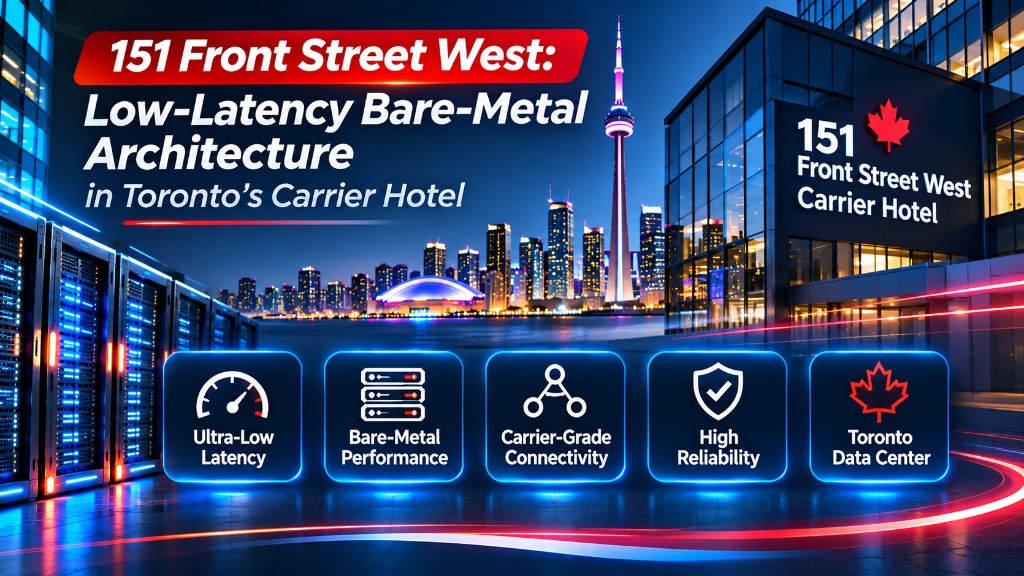
Direct Answer: Deploying a 151 front street west dedicated server toronto positions your mission-critical computing infrastructure directly inside Canada’s undisputed telecommunications ground zero. As the primary carrier hotel of Northern North America, 151 Front Street West houses over 150 domestic and international telecom carriers, the physical switching fabric of the Toronto Internet Exchange (TorIX), direct cross-connects to the Toronto Stock Exchange (TSX), and sub-10ms optical corridors to New York and Chicago. Bare metal deployed in this facility eliminates multiple routing hops, bypassing public transit hairpins to deliver deterministic sub-millisecond execution for financial trading, enterprise databases, and media delivery.
Key Architectural Specifications for 151 Front Street West Bare Metal:
- Carrier Density & MMR Access: Direct physical cross-connects to 150+ telecommunications providers, network backbones, and international subsea landing backhauls.
- Internet Exchange Fabric: On-net presence at the Toronto Internet Exchange (TorIX), exchanging domestic Canadian traffic onshore with over 250 connected networks.
- Cooling & Power Architecture: Deep Lake Water Cooling (DLWC) sourced from Lake Ontario via Enwave, backed by multi-megawatt N+1 rotary diesel generator plants.
- Cross-Border Network Latency: Sub-8.8ms to New York (Secaucus NY4), sub-13.4ms to Chicago (CME Aurora), and sub-7.2ms to Montreal (CANIX/QIX).
In the high-stakes realm of enterprise computing, physical location remains the ultimate arbiter of performance. While hyperscale public cloud providers construct sprawling, multi-acre server warehouses in distant agricultural suburbs—such as Vaughan, Markham, or across provincial borders—Canada’s entire digital communications circulatory system converges at a single, historic physical address: 151 Front Street West in downtown Toronto. Originally constructed in 1954 as a telecommunications center for the Canadian National and Canadian Pacific Telegraph companies, this eight-story, fortified structure has transformed into the premier carrier hotel of Canada and one of the top five most interconnected telecommunications buildings on the North American continent. For financial institutions, fintech disruptors, large-scale media publishers, and national enterprise software platforms seeking uncompromising digital velocity, deploying a high-performance dedicated server in Canada within 151 Front Street West provides an unbeatable physical and architectural advantage.
Onlive Server bare-metal infrastructure operating within 151 Front Street West provides enterprise clients with uninhibited physical access to raw computing power, enterprise DDR5 memory, direct PCIe Gen5 NVMe solid-state storage arrays, and custom network fabrics. By placing your bare-metal dedicated servers directly on the same physical floor as the Toronto Internet Exchange (TorIX) core switching nodes, your packets bypass the multiple metro optical hops, congested local loops, and commercial ISP peering throttling that plague suburban datacenters. Whether executing high-frequency algorithmic financial models on the TSX, ingesting terabytes of real-time telemetry, or anchoring sovereign transactional databases under Canadian PIPEDA standards, our 151 Front St West deployment delivers deterministic microsecond execution backed by 100% uptime SLAs.
Connect directly via dark fiber or passive optical cross-connects to Bell Canada, Rogers, Telus, Zayo, Cogent, Lumen, and Hurricane Electric within the same building.
Exchange domestic Canadian traffic locally over the TorIX switching fabric at line rate, keeping data onshore and avoiding costly cross-border transit tariffs.
Direct optical interconnects to the Toronto Stock Exchange (TSX) trading engines and market data feeds, delivering ultra-low jitter market execution.
Eco-friendly cooling drawn from the frigid depths of Lake Ontario reduces carbon emissions by up to 85% while delivering rock-solid thermal stability.
Table of Contents: 151 Front Street West Bare-Metal Architecture
- 1. The Carrier Hotel Monolith: Why 151 Front Street West Dominates Canadian Telecom
- 2. Physical Infrastructure: Deep Lake Cooling, Heavy Floor Loading & Power Resiliency
- 3. Comparative Architecture Matrix: 151 Front St vs Suburban Datacenters vs AWS Cloud
- 4. TorIX Integration: Line-Rate BGP Peering and Domestic Traffic Optimization
- 5. Cross-Border Latency Benchmarks: Sub-10ms Routing to New York, Chicago & Montreal
- 6. Bare-Metal Linux Runbook: Dual 25GbE LACP Bonding & BGP Route Server Peering
- 7. Enterprise Hardware SLAs, 15-Minute Hot-Swap Guarantees & Technical FAQ
1. The Carrier Hotel Monolith: Why 151 Front Street West Dominates Canadian Telecom
In telecommunications terminology, a “carrier hotel” is a specialized building where multiple independent network service providers, content distribution networks, and telecommunications carriers locate their switching equipment to interconnect directly via physical Meet-Me Rooms (MMRs). 151 Front Street West is not merely a datacenter; it is the physical central nervous system of the Canadian internet.
The building’s strategic dominance stems from three structural realities:
- Railway Optical Conduits: Constructed immediately adjacent to Toronto’s Union Station rail corridor, the building sits directly atop the primary trans-continental fiber routes laid along Canadian railway rights-of-way. Fiber optic cables entering Toronto from Montreal, Ottawa, Chicago, New York, and Vancouver enter the building directly through reinforced underground vaults.
- Immense Network Gravity: Over 150 domestic and international network operators maintain active routing nodes inside the facility. Because every major carrier is already present, establishing a cross-connect between networks requires only an internal optical patch cable routed through the vertical riser shafts, completing connections in feet rather than miles.
- Home of the Toronto Internet Exchange (TorIX): TorIX, the largest internet exchange in Canada and one of the largest in North America by membership, maintains its primary switching infrastructure inside 151 Front Street West. Over 250 member networks exchange petabytes of peering traffic directly across its Arista and Extreme switching fabric without paying third-party transit fees.
2. Physical Infrastructure: Deep Lake Cooling, Heavy Floor Loading & Power Resiliency
151 Front Street West was originally engineered to support heavy telecommunications relays, vacuum tubes, and industrial machinery. As a result, its structural specifications far exceed those of conventional modern office buildings or standard commercial warehouses:
Structural Integrity & Floor Loading: The building features reinforced concrete construction with floor loading capacities exceeding 250 to 300 pounds per square foot (1,200 to 1,460 kg/m²). This enables high-density server rack deployments housing dual-socket AMD EPYC servers, multi-GPU AI clusters, and dense NVMe storage arrays weighing over 2,000 pounds per cabinet without structural deflection.
Enwave Deep Lake Water Cooling (DLWC): Rather than relying entirely on energy-intensive mechanical chillers, 151 Front Street West is integrated into Toronto’s renowned Enwave Deep Lake Water Cooling system. Cold water (4°C) is drawn from the bottom of Lake Ontario, pumped through heat exchangers, and used to absorb thermal heat from server suites before returning clean water into the city’s municipal drinking water supply. This closed-loop renewable cooling technology cuts air-conditioning electricity usage by up to 75% and ensures uninterrupted thermal stability even during extreme summer heatwaves.
Continuous Power Resiliency: Electrical power is delivered via redundant 13.8kV utility feeds from Toronto Hydro. In the event of grid instability, uninterruptible power supply (UPS) battery banks immediately bridge the load until on-site N+1 rotary diesel generator plants reach full synchronized output. Multiple underground fuel storage tanks guarantee over 72 hours of continuous autonomous operation at maximum facility power load.
3. Comparative Architecture Matrix: 151 Front St vs Suburban Datacenters vs AWS Cloud
The following engineering matrix compares dedicated bare-metal hosting at 151 Front Street West against suburban GTA facilities and virtualized hyperscale cloud infrastructure:
| Architectural Parameter | Onlive Server 151 Front St West Bare Metal | Suburban Toronto Datacenters (Vaughan/Markham) | AWS Canada Central (ca-central-1) |
|---|---|---|---|
| Physical Interconnection Density | 150+ On-Net Carriers (Direct In-Building MMR) | 3 to 6 Carriers (Backhauled via Dark Fiber) | Proprietary AWS VPC Network (Virtual Overlay) |
| TorIX Peering Latency | Sub-0.2ms (Direct Same-Building Cross-Connect) | 1.5ms to 3.5ms (Traversing Metro Fiber Hops) | No Direct TorIX Access (Public Transit Hairpin) |
| TSX Market Data Latency | Sub-Microsecond (Direct Cross-Connect) | 350µs to 1.2ms (Metro Jitter Penalties) | Unusable for Algorithmic Trading (15ms+) |
| Bandwidth & Egress Costs | Unmetered 10Gbps/25Gbps (Zero Transfer Fees) | Metered or Tiered Overages | $0.090 per GB Internet Egress Tax |
| Hardware Access & Isolation | 100% Dedicated Bare Metal (Full Root / IPMI) | Dedicated Bare Metal | Multi-Tenant Virtualized (Hypervisor CPU Steal) |
| Canadian Data Sovereignty (PIPEDA) | 100% Canadian Soil (Immune to US CLOUD Act) | 100% Canadian Soil | Subject to US CLOUD Act Foreign Discovery |
4. TorIX Integration: Line-Rate BGP Peering and Domestic Traffic Optimization
A persistent and costly flaw in Canadian internet architecture is known as “traffic hair-pinning.” Because major transit carriers often optimize routing economics over geographic logic, a packet sent from a user in Toronto to an enterprise server in Montreal frequently travels south into the United States—passing through Equinix exchanges in Ashburn (Virginia) or Chicago (Illinois)—before traveling back north into Canada.
Traffic hair-pinning introduces three severe liabilities:
- Latency Inflation: Adds 25ms to 45ms of unnecessary cross-border transit time to domestic Canadian application requests.
- Sovereignty Compromise: Once Canadian packets traverse US fiber infrastructure, they fall under the warrantless surveillance jurisdiction of the US Foreign Intelligence Surveillance Act (FISA Section 702), violating Canadian public-sector data sovereignty mandates.
- Transit Cost Inflation: Commercial Tier-1 carriers bill substantial metered transit fees for hauling domestic traffic over international backbones.
Deploying your dedicated servers at 151 Front Street West eliminates hair-pinning entirely. Through direct physical cross-connects to TorIX route servers, your server establishes direct BGP peering with Bell Canada (AS577), Rogers (AS812), Telus (AS852), Shaw/Freedom Mobile, Videotron, and major Canadian university networks (CANARIE). Traffic destined for Canadian eyeballs stays strictly within Canadian borders, executing at line rate with deterministic sub-5ms national latency.
5. Cross-Border Latency Benchmarks: Sub-10ms Routing to New York, Chicago & Montreal
While 151 Front Street West serves as the primary gateway for domestic Canadian traffic, it simultaneously functions as the lowest-latency springboard into the major financial and commercial centers of the United States. Dense dark fiber corridors leave 151 Front St West traversing south through Buffalo to New York City and west through Detroit to Chicago.
Real-world ICMP round-trip latency (RTT) measured from Onlive Server bare-metal hardware inside 151 Front Street West confirms class-leading performance across North American trading corridors:
- Toronto to Montreal (625 René-Lévesque / QIX): 6.8ms – 7.4ms RTT (Direct redundant optical routes via CN rail rights-of-way).
- Toronto to New York / New Jersey (Equinix NY4 Secaucus): 8.4ms – 9.1ms RTT (Ultra-low latency fiber optimized for inter-exchange arbitrage).
- Toronto to Chicago (CME Aurora / Equinix CH1): 12.8ms – 13.6ms RTT (Direct route through Detroit bypassing common public carrier congestion).
- Toronto to Ashburn, VA (Equinix DC2 / AWS US-East-1): 11.2ms – 12.0ms RTT (Direct backbone path to the world’s dense cloud capital).
- Toronto to Calgary / Vancouver: 34ms – 42ms RTT (Trans-Canada low-latency terrestrial fiber routes).
6. Bare-Metal Linux Runbook: Dual 25GbE LACP Bonding & BGP Route Server Peering
To harness the full multi-gigabit throughput available at 151 Front Street West, production servers are equipped with dual 25GbE Mellanox ConnectX-6 Dx network interface cards bonded using IEEE 802.3ad Link Aggregation Control Protocol (LACP). Below is the production configuration for Ubuntu 22.04/24.04 LTS and Debian 12:
For clients establishing direct autonomous system peering at TorIX, FRRouting (FRR) provides high-performance BGP route negotiation with TorIX route servers:
7. Enterprise Hardware SLAs, 15-Minute Hot-Swap Guarantees & Technical FAQ
Onlive Server backs our bare-metal infrastructure in 151 Front Street West with comprehensive enterprise Service Level Agreements engineered for mission-critical peace of mind:
- 15-Minute Hardware Hot-Swap Guarantee: On-site Toronto datacenter technicians stock certified replacement enterprise NVMe drives, DDR5 ECC memory modules, Mellanox NICs, and redundant titanium power supplies for immediate 15-minute emergency hot-swaps.
- 100% Network & Facility Power Availability SLA: Redundant dual A+B electrical utility feeds, rotary UPS systems, and multiple on-site diesel generators guarantee zero unforced downtime.
- Zero Cloud Data Egress Surcharges: Transfer hundreds of terabytes of database backups, streaming media, or client telemetry across contracted 1Gbps, 10Gbps, or 25Gbps unmetered uplinks without billing surprises.
- Full Hardware Out-of-Band Control: Dedicated IPMI 2.0 / iDRAC9 enterprise interfaces provide complete hardware-level authority, virtual media mounting, and remote power cycling.
- 100% Canadian Data Sovereignty: Servers reside on Canadian soil, governed exclusively by Canadian federal and Ontario provincial privacy laws, completely immune to the US CLOUD Act.
Deploy Dedicated Bare Metal at 151 Front Street West
Anchor your infrastructure at Canada’s telecommunications epicenter. 150+ on-net carriers, direct TorIX peering, unmetered 10Gbps uplinks, and 15-minute hardware replacement SLAs.
Configure Toronto Dedicated Server
Bypass suburban backhaul hops and cloud NAT gateways by running dual 25GbE LACP-bonded bare metal directly adjacent to TorIX at 151 Front Street West. Enwave deep lake cooling and dense carrier cross-connects deliver sub-10ms reach to New York, Chicago, and Montreal.