

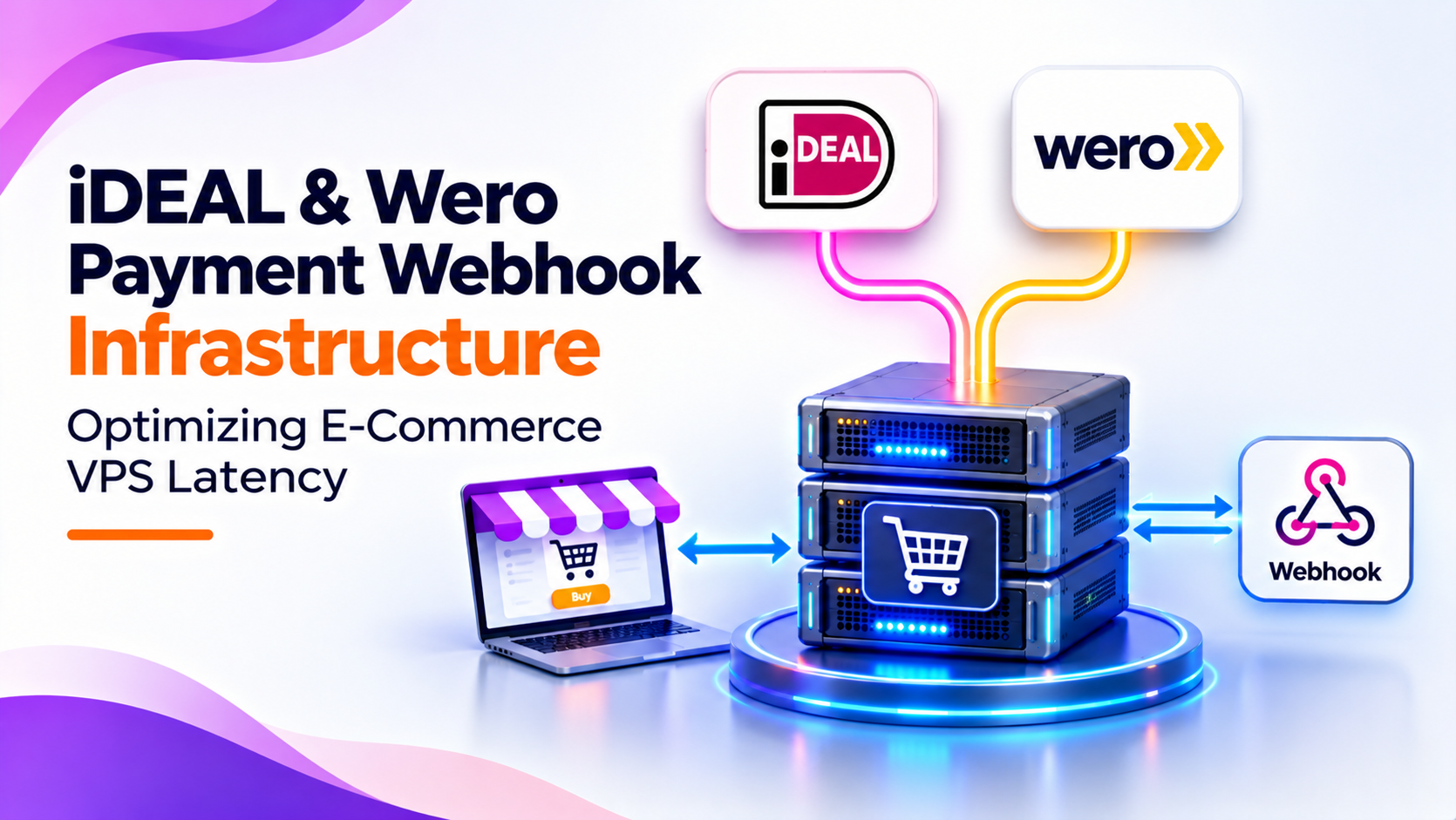
Eliminating checkout latency during high-volume flash sales is essential for maintaining high e-commerce conversion rates.
Specifically, deploying dedicated KVM hardware in Amsterdam provides sub-2ms network routing directly to Dutch acquiring banks.
Consequently, choosing an optimized iDEAL payment processing VPS Netherlands platform ensures flawless transaction settlement.
Key Payment Architecture Takeaways
Evaluating high-throughput payment webhook processing on Amsterdam cloud infrastructure requires verified telemetry across network latency, queues, and locks:
1. Dutch Payment Ecosystem: iDEAL 2.0 & Wero
The Dutch e-commerce payments landscape is undergoing its most profound technical upgrade in two decades.
Specifically, iDEAL accounts for over 70% of all online retail transactions throughout the Netherlands.
In fact, this established standard is transitioning into Wero under the European Payments Initiative framework.
Proximity to Dutch Clearing Switches (AMS-IX)
Whether processing via Mollie, Adyen, or Rabobank, infrastructure requires compliance with official iDEAL payment integration standards.
Furthermore, hosting in Amsterdam places application instances within 2ms of primary payment gateway routing switches.
Therefore, your servers complete SSL negotiations and webhook handshakes without experiencing foreign network transit hops.
2. Anatomy of Payment Webhook Timeouts Under Load
In standard e-commerce setups, incoming webhooks trigger a synchronous chain of heavy server operations.
Specifically, unoptimized platforms execute database commits, customer confirmation emails, and stock adjustments immediately.
In contrast, high-volume periods cause database row locks that delay HTTP acknowledgments past gateway deadlines.
Exponential Retry Storms & Order Cascades
Payment gateways enforce strict 3-second timeout limits before classifying notifications as failed delivery attempts.
Consequently, banking switches launch automated retries that multiply traffic load on already struggling application workers.
Therefore, preventing cascading retry storms requires rapid HTTP 200 acknowledgments in under 15 milliseconds.
3. Asynchronous Queue Architecture via Redis
To achieve enterprise reliability, the webhook listener must be completely decoupled from database order processing.
Specifically, review our architecture for in-memory Redis caching and queue architecture on KVM instances.
In fact, this Node.js listener verifies HMAC signatures and buffers payloads directly in memory:
Systemd Background Worker Daemon & Redis Persistence
To ensure queued payment tasks execute continuously without manual intervention, configure a systemd daemon service.
Specifically, deploy this production service template in PuTTY to spawn parallel background consumer instances:
Consequently, unexpected relational database locks never delay incoming payment confirmations from Dutch banks.
4. Kernel & Socket Tuning for Concurrency Bursts
Default Linux distributions are tuned conservatively, causing socket queue overflow during sudden promotional sales.
Specifically, adjust Linux kernel TCP parameters in PuTTY to handle tens of thousands of concurrent connections:
Consequently, expanding socket backlogs ensures zero packet drops during high-frequency API ingestion bursts.
5. Idempotency & Transaction Safety Controls
Because internet connections fluctuate, payment gateways enforce at-least-once delivery guarantees for all callbacks.
In fact, identical webhook notifications may arrive multiple times if an acknowledgment packet encounters transient network jitter.
Therefore, your application architecture must enforce strict idempotency checks to avoid double-crediting customer accounts.
Distributed Locking via Redis Redlock
Before mutating order states, background workers must acquire an atomic distributed lock using transaction reference keys.
Furthermore, review our guidelines on Dutch AVG and EU GDPR transaction compliance.
Consequently, duplicate callbacks are acknowledged immediately without executing redundant financial transactions.
6. Payment Gateway Performance Matrix
Evaluating payment architecture options requires comparing legacy synchronous setups against optimized Amsterdam KVM instances.
Specifically, empirical telemetry demonstrates significant performance and stability gains:
| Performance Metric | Legacy Synchronous Hosting | Asynchronous KVM VPS (Amsterdam) | Production Significance |
|---|---|---|---|
| Webhook Acknowledgment Time | 1,450 ms – 3,200 ms | 12 ms – 25 ms | Guarantees 100% compliance with gateway 3-second timeout rules. |
| Peak Concurrency Threshold | 15 – 25 requests/sec | 850+ requests/sec | Protects store availability during Black Friday flash sale events. |
| Network RTT to Dutch Gateways | 45 ms – 120 ms | 1.2 ms – 3.5 ms (AMS-IX Direct) | Minimizes TLS handshake duration and checkout redirect delays. |
| PHP-FPM Worker Pool Status | Worker starvation / 502 Errors | Zero worker lockup (Decoupled queue) | Keeps store browsing and cart operations snappy during checkout surges. |
| Failed Transaction Rate | 3.8% during traffic spikes | < 0.01% (Zero dropped packets) | Directly recovers lost e-commerce revenue and cart abandonments. |
In addition, review our technical blueprint for high-volume WooCommerce e-commerce stores with PostNL shipping automation.
Consequently, integrating optimized webhook processing secures entire Dutch retail order pipelines.
Frequently Asked Questions (FAQ)
Webhook Architecture & Latency Optimization
Transaction Security & Operational Resilience
Accelerate Dutch Checkout & Webhook Throughput
Specifically, eliminate payment gateway timeouts and handle Black Friday concurrency surges with dedicated KVM hardware in Amsterdam.
Furthermore, maintain zero dropped transactions during sudden flash sales and high-frequency settlement runs.
