

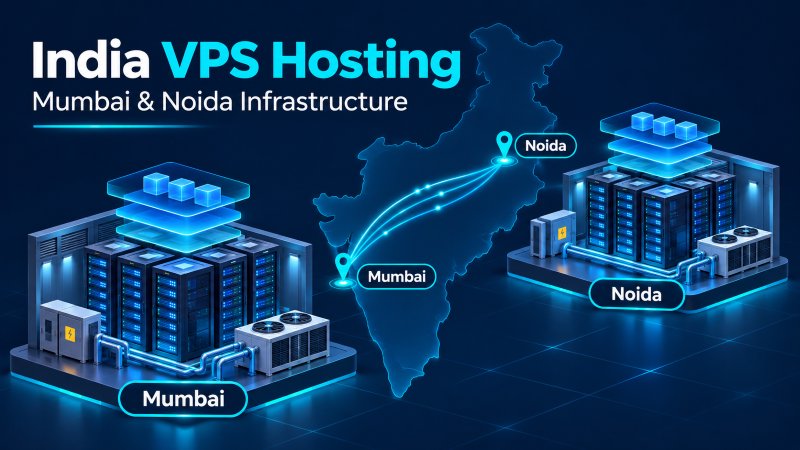
Deploying India VPS hosting in Tier-3 facilities across Mumbai (BKC/Chandivali) and Noida (Sector 62) establishes direct proximity to India’s primary subsea fiber landings and domestic exchanges. Specifically, direct optical cross-connects to NIXI and Extreme IX deliver sub-2ms local latency and sub-15ms pan-India transit. Furthermore, 2N UPS power redundancy and dedicated KVM virtualization guarantee 99.99% operational uptime and statutory DPDP Act compliance.
Datacenter Architecture & Edge Resilience in India
Ultra-Low Pan-India Latency
Direct peering with NIXI, Bharti Airtel, and Reliance Jio in Mumbai and Noida ensures sub-15ms round-trip ping times nationwide.
Dedicated KVM Resources
Hardware-level Type-1 hypervisors provide strict zero CPU steal, dedicated RAM allocation, and high-IOPS Gen4 NVMe arrays.
Sovereign DPDP Compliance
Guaranteed physical data residency within India meeting Digital Personal Data Protection Act 2023, RBI, and CERT-In standards.
Our dual Tier-3 facilities in Mumbai and Noida feature N+1 precision cooling and direct NIXI peering. Consequently, they deliver sub-5ms domestic routing. This technical guide evaluates enterprise India VPS hosting architecture. Specifically, we explore how dedicated KVM virtualization, Tier-3 facility engineering, and multi-carrier peering optimize throughput across Mumbai, Delhi-NCR, Bengaluru, and pan-Indian business hubs.
When architecting datacenter infrastructure, positioning compute nodes within premier Tier-3 facilities in Mumbai and Noida provides a decisive performance advantage. Specifically, organizations across Mumbai, Delhi-NCR, Bengaluru, and Hyderabad benefit from local packet routing. Utilizing dedicated KVM virtualization guarantees zero CPU steal. Furthermore, direct optical cross-connects to NIXI and Extreme IX deliver sub-15ms latency across India.
Dual Independent Utility Grids
Active-active utility substations backed by redundant 2N rotary UPS reserves and automated N+1 diesel generators with 72-hour fuel autonomy.
Direct NIXI & Carrier Peering
Sub-millisecond Layer-2 optical cross-connects interfacing Bharti Airtel, Reliance Jio, and Tata Communications domestic IP backbones.
100% Dedicated KVM Hypervisors
Hardware-level type-1 virtualization eliminating noisy-neighbor resource theft, CPU steal, and shared memory contention across compute nodes.
Datacenter engineering across our Mumbai and Noida campuses features concurrent maintainability under certified Tier-3 architecture. Dual utility feeds from independent regional electricity grids maintain continuous power. Meanwhile, redundant chilled-water cooling loops maintain steady thermal environments, preventing processor throttling. In addition, campuses enforce multi-factor biometric access controls and VESDA fire suppression. Consequently, all infrastructure fully complies with ISO 27001, SOC 2 Type II, and PCI-DSS standards.
- ✔ Datacenter Architecture & Edge Resilience in India
- ✔ Domestic NIXI & Multi-Carrier Peering Topology
- ✔ PCIe Gen4 NVMe Storage Architecture & IOPS
- ✔ KVM Virtualization & Linux Kernel Tuning
- ✔ DPDP Act Compliance & Sovereign Data Residency
- ✔ Production Hardening & Server Deployment Playbook
- ✔ Enterprise Hardware Specifications Matrix
- ✔ Frequently Asked Questions (FAQ)
Domestic NIXI & Multi-Carrier Peering Topology
Under Domestic NIXI Peering, Indian user traffic routes directly through national internet exchanges. Consequently, packets bypass congested subsea transit routes that detour through foreign hubs in Singapore, Dubai, or Europe.
BGP Session Establishment & Route Ingress
Establish multi-homed BGP routing sessions with NIXI and Extreme IX. Specifically, advertise sovereign Indian IPv4 blocks to ensure local packet termination.
National Fiber Transit Optimization
Configure direct optical cross-connects with Bharti Airtel, Reliance Jio, and Tata Communications, ensuring domestic traffic bypasses international subsea gateways.
Pan-Indian Low-Latency Metro Convergence
Achieve sub-2ms ping times to Mumbai users. Furthermore, maintain sub-12ms latency across southern IT hubs like Bengaluru and Chennai, and sub-16ms to northern commercial centers.
Automated Multi-Carrier BFD Failover
Implement active Bidirectional Forwarding Detection (BFD) for sub-second route convergence across redundant upstream optical providers during transit disruptions.
Our multi-homed routing architecture integrates Tier-1 IP transit alongside private bilateral peering fabrics. Even during an upstream fiber cut along a highway corridor, automated BGP re-convergence completes in under 300 milliseconds. Therefore, active user TCP sessions and secure TLS payment handshakes remain uninterrupted.
PCIe Gen4 NVMe Storage Architecture & IOPS
When evaluating storage architecture, traditional SATA SSDs or networked SAN volumes frequently cause severe I/O wait spikes. Consequently, database query backlogs develop during traffic surges. Authoritative traffic policies and exchange topologies are published on the National Internet Exchange of India (NIXI) peering platform.
High-Concurrency Read Performance
Delivers instant query responses for relational database selects, Redis in-memory cache syncs, and heavy web catalog lookups.
Zero-Wait Transactional Writes
Prevents I/O wait spikes during intensive ACID transactions, financial ledger operations, and e-commerce flash sales.
Sequential Streaming Speed
Enterprise U.2 PCIe Gen4 NVMe drives providing massive streaming bandwidth for backup archives and dataset migrations.
Sub-Millisecond Response
Direct hardware PCIe lane attachments bypassing SATA/SAS host bus adapters to eliminate storage access latency.
Hardware Mirroring & Striping
Dual-disk fault tolerance with dedicated hardware cache controller and battery-backed unit protecting data in flight.
Enterprise Flash Rating
Enterprise solid-state flash rated for continuous 24/7 drive writes per day without thermal throttling or performance decay.
The benchmarking telemetry demonstrates exceptional queue depth stability and sub-millisecond completion times under heavy concurrent synthetic load. When hosting high-volume database engines like MySQL or PostgreSQL, high-IOPS arrays prevent disk bottlenecking. As a result, your applications process thousands of simultaneous transactions with zero delay.
KVM Virtualization & Linux Kernel Tuning
Hypervisor choice determines whether administrators can tailor low-level kernel parameters. Specifically, KVM allows exact customization for production workloads.
Production Linux Kernel & sysctl Optimization Directives
-
Google BBR Congestion Control Protocol:
Enforcing Google BBR congestion control (
net.ipv4.tcp_congestion_control = bbr) replaces legacy loss-based Cubic algorithms. Thus, packet delivery rates are optimized, preventing bottleneck latency over Indian mobile and optical carrier backbones. -
TCP Socket Window Scaling & Memory Buffers:
Configuring expanded socket read and write thresholds up to 16MB prevents buffer exhaustion. Therefore, high-bandwidth data transfers never degrade during sudden traffic surges.
-
File Descriptor & High-Capacity Epoll Tuning:
Elevating file descriptor ceilings to 2,097,152 paired with epoll event handling enables seamless scale. In fact, web engines like Nginx can effortlessly process over 50,000 concurrent connections.
-
Virtual Memory Swappiness Management:
Enforcing low swappiness (
vm.swappiness = 10) guarantees that database buffer pools remain resident in physical RAM. Consequently, disruptive swap thrashing is eliminated.
With KVM hardware virtualization, system engineers compile custom kernel modules freely. In addition, you can configure WireGuard VPN interfaces directly within the kernel without hypervisor interference. This architectural independence is essential for high-throughput e-commerce, ERP hosting, and financial trading applications.
DPDP Act Compliance & Sovereign Data Residency
Examining data residency demonstrates how domestic hosting simplifies statutory compliance. Specifically, it fulfills mandates under the Digital Personal Data Protection (DPDP) Act 2023 and RBI payment localization circulars. To verify that your customer records fulfill sovereign mandates, review our analysis on DPDP Act data localization compliance on Indian VPS.
Digital Personal Data Protection (DPDP) Act 2023
Strict territorial data residency within sovereign Indian borders guarantees complete compliance with MeitY digital governance frameworks.
- Guaranteed storage of citizen records inside Tier-3 Mumbai & Noida datacenters
- Zero exposure to foreign extraterritorial subpoena or cloud surveillance laws
- Cryptographic LUKS/dm-crypt volume encryption at rest for complete database protection
CERT-In Cyber Incident Reporting & Logging
Automated operational logging and time synchronization align server operations with national cybersecurity directives.
- Mandatory 180-day immutable rolling security audit logs maintained via auditd
- Synchronized NTP time telemetry against Indian Standard Time (IST) stratum-1 servers
- Kernel-level defense hardening with automated Layer-4 & Layer-7 anti-DDoS mitigation
By deploying on domestic KVM compute nodes, organizations obtain verifiable physical data isolation. Furthermore, LUKS disk encryption at rest and automated audit logging ensure comprehensive regulatory compliance. These technical safeguards satisfy the stringent regulatory criteria enforced by CERT-In and Indian statutory auditors.
Production Hardening & Server Deployment Playbook
Executing a transition to a high-performance Indian cloud node requires adhering to proven playbooks. In this technical review of Production Playbook & Server Hardening, we outline the verification steps essential for flawless uptime.
Production Linux Hardening & Deployment Playbook
Execute these baseline security and firewall hardening commands upon initial provisioning of your Indian virtual private server. In addition, routine disaster recovery drills combining volume snapshots with encrypted rsync transfers guarantee Recovery Time Objectives (RTO) below one hour.
In addition, routine disaster recovery drills combining scheduled block-level volume snapshots with encrypted rsync transfers to geographically distant secondary storage facilities guarantee Recovery Time Objectives (RTO) below one hour. Our around-the-clock technical operations team remains available 24/7 to assist in live configuration optimization and rapid incident mitigation.
Enterprise Hardware Specifications Matrix
| Architecture Dimension | Onlive Server India VPS (Mumbai / Noida) | Generic Overseas Cloud / Shared Hosting |
|---|---|---|
| Physical Data Residency | India (Tier-3 Datacenters in Mumbai & Noida) | Overseas (Singapore, Frankfurt, US) or Unknown |
| Virtualization & CPU Allocation | 100% KVM Hypervisor (Strict 0% CPU Steal) | OpenVZ/LXC with aggressive tenant overselling |
| Storage Subsystem & IOPS | PCIe Gen4 NVMe RAID-10 (90,000+ Sustained IOPS) | Legacy SATA SSDs or Shared SAN Volumes (<5,000 IOPS) |
| Domestic Network Routing | Direct Peering via NIXI & Extreme IX (<15ms Pan-India) | High-latency subsea routes through Singapore/Middle East |
| Compliance Standard | DPDP Act 2023, RBI Payment Directives, CERT-In Ready | Non-compliant with Indian data localization regulations |
| Management & Root Privileges | Full Root SSH, Virtualizor VNC, Automated Snapshots | Restricted control panel, locked ports, no kernel tuning |
Deploy High-Performance India VPS Infrastructure
Deploy high-speed KVM virtual private servers hosted in Tier-3 Mumbai & Noida datacenters. Benefit from dedicated AMD EPYC cores, enterprise Gen4 NVMe arrays, and unmetered bandwidth. In fact, direct NIXI peering and DPDP Act compliance are included by default.
Frequently Asked Questions (FAQ)
Q
Where are Onlive Server India VPS datacenters located?
Where are Onlive Server India VPS datacenters located?
Our Indian cloud infrastructure is physically situated in ISO-certified Tier-3 datacenters in Mumbai (BKC and Chandivali) and Noida (Sector 62). Both facilities feature dual power feeds and direct optical connectivity to national carrier backbones.
Q
What Tier rating do the Mumbai and Noida facilities hold?
What Tier rating do the Mumbai and Noida facilities hold?
Both Mumbai and Noida facilities operate strictly under ANSI/TIA-942 Tier-3 standards. Consequently, this guarantees 99.982% uptime availability, concurrent maintainability across all electrical pathways, and 2N redundant power distribution.
Q
How does direct NIXI peering lower network latency?
How does direct NIXI peering lower network latency?
Direct peering with NIXI routes Indian domestic traffic through local exchange nodes rather than detouring packets across foreign undersea backbones. In fact, this keeps domestic latency under 2ms in metro areas and sub-15ms nationwide.
Q
What hardware hypervisors power the India VPS fleet?
What hardware hypervisors power the India VPS fleet?
We deploy enterprise Dell PowerEdge and HPE ProLiant enterprise server nodes powered by multi-core Intel Xeon Scalable and AMD EPYC processors. Specifically, hardware virtualization is orchestrated strictly through KVM.
Q
Are dedicated KVM kernel resources guaranteed?
Are dedicated KVM kernel resources guaranteed?
Yes. Every virtual server is assigned dedicated CPU cores, unshared DDR4/DDR5 ECC RAM, and dedicated storage queues. Therefore, CPU steal time remains consistently at zero without neighbor contention.
Q
What storage technology is deployed in Mumbai nodes?
What storage technology is deployed in Mumbai nodes?
All Mumbai VPS instances utilize high-speed enterprise U.2/U.3 PCIe Gen4 NVMe arrays in hardware RAID-10. Consequently, they achieve over 95,000 random read IOPS and sub-millisecond database response times.
Q
Does the India datacenter provide redundant dual UPS?
Does the India datacenter provide redundant dual UPS?
Yes. Power redundancy is managed via dual-feed utility transformers and 2N online double-conversion UPS systems. Furthermore, automated N+1 diesel generators provide continuous backup runtime.
Q
How quickly can an Indian VPS node be deployed online?
How quickly can an Indian VPS node be deployed online?
Automated server provisioning completes within 5 to 10 minutes of order confirmation. In addition, you receive instantaneous root SSH access and out-of-band VNC management capabilities.