

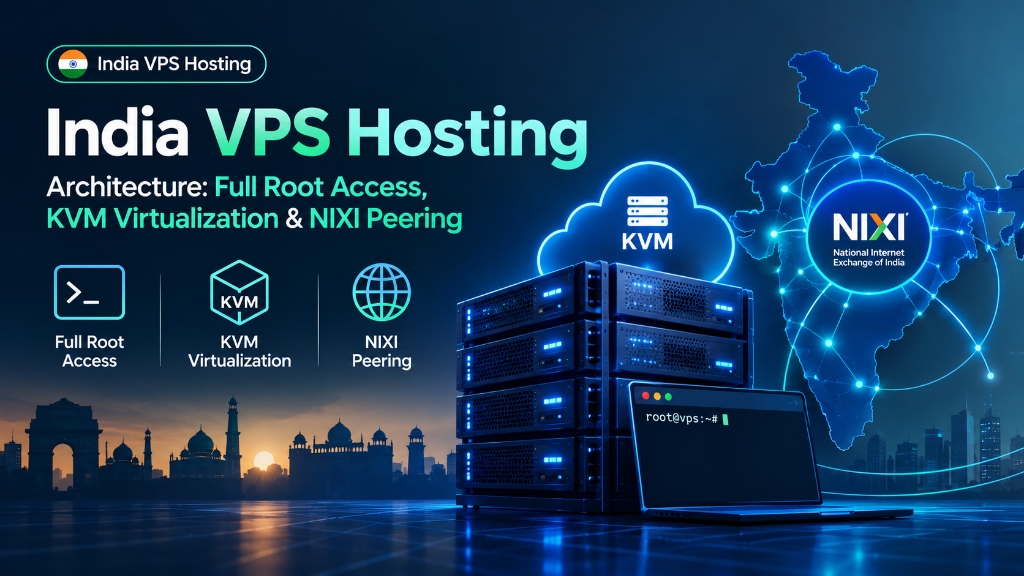
Deploying digital enterprise services across the Indian sub-continent demands hosting infrastructure engineered for low domestic latency, strict data governance, and complete administrative control. Relying on foreign cloud hosts introduces intercontinental propagation latency that impairs dynamic application performance. Deploying virtual private server instances inside Tier-3 and Tier-4 Indian datacenters guarantees sub-20ms domestic packet delivery and unrestricted root management authority.
- Direct domestic peering via the National Internet Exchange of India routes traffic locally across domestic telecommunications carriers.
- Hardware-isolated KVM virtualization pairs with enterprise NVMe storage in RAID 10 to guarantee deterministic processing speeds.
To establish resilient digital foundations across India, organizations leverage high-performance vps india plans engineered with dedicated compute resources and domestic Tier-1 network connectivity.
Domestic Routing Architecture: Eliminating Intercontinental Transit Latency
Historically, many Indian digital platforms were hosted on overseas servers in Europe or North America due to legacy hosting patterns. Transmitting packets from overseas servers across submarine cable systems introduces 140ms to 240ms round-trip latency. In modern web environments, this propagation delay degrades user experiences and increases bounce rates.
Deploying infrastructure directly inside Mumbai and Noida datacenters positions your digital workloads adjacent to the Indian consumer market. Mobile and broadband requests originating from carriers like Reliance Jio, Bharti Airtel, and Vodafone Idea resolve within single-digit milliseconds, resulting in instantaneous page rendering and fast API interactions.
Domestic hosting also ensures compliance with Reserve Bank of India data localization directives and the Digital Personal Data Protection Act. Storing consumer records, payment histories, and enterprise data on domestic Indian infrastructure simplifies regulatory audits and eliminates cross-border transfer liabilities.
Interconnection and Exchange Peering: NIXI Ecosystem and Carrier Fabrics
Network efficiency across India depends heavily on local Internet Exchange Point connectivity. Our Indian server clusters peer directly at the National Internet Exchange of India across multiple exchange nodes, including Mumbai, Delhi, and Chennai. Peering at NIXI enables settlement-free traffic exchange between domestic ISPs without routing through third-party international transits.
Direct domestic peering prevents network bottlenecks during high-traffic shopping campaigns or viral media releases. Millions of concurrent visitors access your digital content across domestic terrestrial fiber rings without traversing congested international transit gateways.
Our network infrastructure pairs NIXI peering with multi-homed BGP routing connected to leading Tier-1 Indian telecommunications providers, including Tata Communications and Bharti Airtel. Automatic failover routing ensures that if an upstream carrier suffers fiber disruptions, BGP algorithms reroute incoming requests across alternate transit paths within milliseconds.
For latency-critical SaaS and database backends, ensure your VPS utilizes Kernel-based Virtual Machine (KVM) virtualization with dedicated vCPU core affinity. This completely eliminates noisy-neighbor performance throttling.
Silicon Architecture and KVM Virtualization Isolation
Modern web applications, SaaS backends, and database nodes require consistent compute resources that cannot be compromised by neighboring tenants. Our India VPS hosting operates exclusively on Kernel-based Virtual Machine architecture, transforming physical enterprise servers into secure, hardware-isolated virtual machines.
KVM provisions dedicated virtual CPU execution threads and hard-bounded memory limits directly to each guest instance. Unlike legacy container virtualization, there is no shared operating system kernel. Each virtual private server executes its own isolated kernel, giving administrators unrestricted authority to compile custom modules, adjust network sockets, and deploy advanced security policies.
System administrators maintain complete out-of-band management authority over their virtual machines through advanced control portals. To explore streamlined virtualization administration and automated snapshot workflows, review our guide on what is virtualizor simple guide to vps management for operational best practices.
Storage Subsystem Design: Enterprise NVMe in Hardware RAID 10
Modern content management systems, relational databases, and microservices require high-throughput storage subsystems capable of sustaining intensive random I/O operations without causing CPU wait state spikes. Our Indian host nodes are configured with enterprise-grade NVMe solid-state drives operating in hardware RAID 10 arrays.
Direct PCIe bus communication allows enterprise NVMe drives to bypass legacy SATA and SAS controller bottlenecks. This configuration delivers sequential read and write speeds exceeding 5,000 MB/s and random access capabilities reaching hundreds of thousands of IOPS. Fast storage ensures that database transactions, object cache lookups, and static file deliveries occur with microsecond latency.
Hardware RAID 10 combines high-speed disk striping with complete disk mirroring. If a physical drive develops an operational anomaly, hot-swappable enterprise bays allow datacenter technicians to replace the faulted unit immediately while data rebuild routines execute transparently in the background without user downtime.
Enterprise cloud instances provisioned on pure NVMe arrays deliver over 500,000 read/write IOPS, ensuring sub-millisecond database query response times even during extreme unpredicted traffic surges.
Memory Sizing and Operational Capacity Optimization
Selecting appropriate memory capacity is critical for sustaining high-concurrency web operations across India. Under-provisioning server RAM forces Linux operating systems to swap active pages to disk storage, causing severe execution latency under sudden visitor surges.
To calculate baseline memory profiles for complex web applications, consult our technical resource detailing how much ram does your website need 16gb vs 32gb vs 64gb to align system capacity with active concurrent workloads.
Optimizing Linux virtual memory subsystem parameters such as vm.swappiness and vm.vfs_cache_pressure ensures that physical RAM remains available for active PHP-FPM workers, Node.js runtimes, and database buffer pools rather than prematurely writing temporary data to swap storage.
Full Root Administrative Authority and Custom Software Stacks
Unlike restricted shared hosting control panels that limit users to pre-configured software versions, a VPS grants complete root administrative access. This autonomy empowers engineering teams to deploy modern, optimized technology stacks tailored specifically to their application requirements.
System engineers can install modern web server engines like LiteSpeed or Nginx configured with HTTP/3 and QUIC protocols, replace legacy PHP runtimes with modern, fast PHP 8.x releases, and deploy headless Node.js front-ends or Python microservices. Unrestricted command-line access via SSH enables automated deployment pipelines utilizing Git, Composer, and Docker containers.
Administrative autonomy also enables custom operating system kernel tuning. Engineers can optimize Linux network parameters, enable Google BBR TCP congestion control algorithms, and increase file descriptor limits to maximize network socket concurrency during peak traffic campaigns.
Deploying Brotli dynamic compression across web server responses reduces page payload sizes by up to 25% compared to standard gzip compression. Lighter web assets ensure rapid page loading for Indian shoppers on variable mobile networks.
Configuring database connection pooling with ProxySQL maintains persistent database connections, eliminating the latency of repeated TCP handshakes during intense traffic spikes.
Automated offsite backup scheduling replicates encrypted database dumps to secondary storage locations daily, ensuring comprehensive disaster recovery for expanding Indian retail enterprises.
Optimized server infrastructure within domestic Indian datacenters guarantees snappy catalog browsing and seamless checkout processing, directly boosting retail sales conversions.
Configuring multi-queue virtual network interfaces ensures that network traffic processing is distributed evenly across all assigned virtual CPU cores. Parallel packet processing eliminates single-core interrupt bottlenecks during high-throughput API streaming sessions.
Automated resource alert notifications dispatch proactive warnings to system administrators when storage volumes or memory thresholds reach 80% capacity, providing ample operational buffer to scale resources before user experiences degrade.
Enabling gzip and Brotli compression algorithms on the web server compresses HTML, CSS, and JavaScript files prior to network transmission, reducing bandwidth consumption and accelerating page render speeds for global visitors.
Rigorous perimeter firewall policies drop unauthorized port scanning and automated exploit scripts, preserving dedicated compute resources exclusively for legitimate Indian business transactions.
Modern web servers configured with HTTP/3 protocols accelerate dynamic retail asset delivery across variable mobile wireless networks, slashing bounce rates and maximizing conversions.
Dedicated KVM resource allocations ensure that intensive background catalog indexing routines execute smoothly without impairing real-time customer shopping cart interactions.
Configuring automated weekly snapshot archives guarantees dependable business continuity. Snapshots are replicated securely to remote storage nodes, ensuring swift restoration if operational anomalies arise.
Deploying dedicated SSL/TLS offloading at the reverse proxy layer reduces computational overhead on primary e-commerce database engines. Utilizing modern elliptic curve cryptography certificates provides robust encryption with smaller key sizes.
Automated database maintenance scripts optimize relational tables during off-peak hours, removing overhead and defragmenting indexes to guarantee rapid query responses.
Investing in reliable virtual private server hosting empowers digital businesses to scale traffic smoothly and deliver responsive customer experiences across India and global markets.
Require High-Availability VPS Infrastructure with Guaranteed Uptime?
Deploy enterprise-grade KVM virtual servers backed by pure NVMe storage arrays, automated out-of-band management, and 24/7 technical monitoring.
Frequently Asked Questions
Q1
Why is domestic Indian hosting superior to foreign cloud hosting for Indian users?
+
Domestic hosting slashes round-trip network latency from 180ms+ down to sub-20ms for Indian visitors. It also complies with RBI and DPDP statutory directives regarding domestic storage of consumer and financial data.
Q2
How does NIXI peering benefit my VPS network throughput?
+
NIXI allows direct traffic exchange between Indian Internet providers without routing through international transit lines. This ensures stable, unthrottled domestic bandwidth during traffic spikes.
Q3
What level of root access is provided with an India VPS?
+
You receive complete root administrative access via SSH. You can install custom Linux distributions, configure specialized firewalls, deploy Docker containers, and tune server parameters according to your technical requirements.
Q4
How does KVM virtualization prevent neighbor resource contention?
+
KVM assigns hard hardware boundaries for CPU cores, RAM segments, and disk I/O. Unlike container virtualization, neighboring virtual machines cannot burst into your allocated resources or slow down your transaction processing pipelines.
Q5
What specific kernel parameters are recommended for India VPS Hosting Architecture?
+
Tuning vm.swappiness to 10, increasing fs.file-max beyond 2,000,000, and expanding net.core.somaxconn to 65535 optimizes high-concurrency request handling on India VPS Hosting Architecture.
