

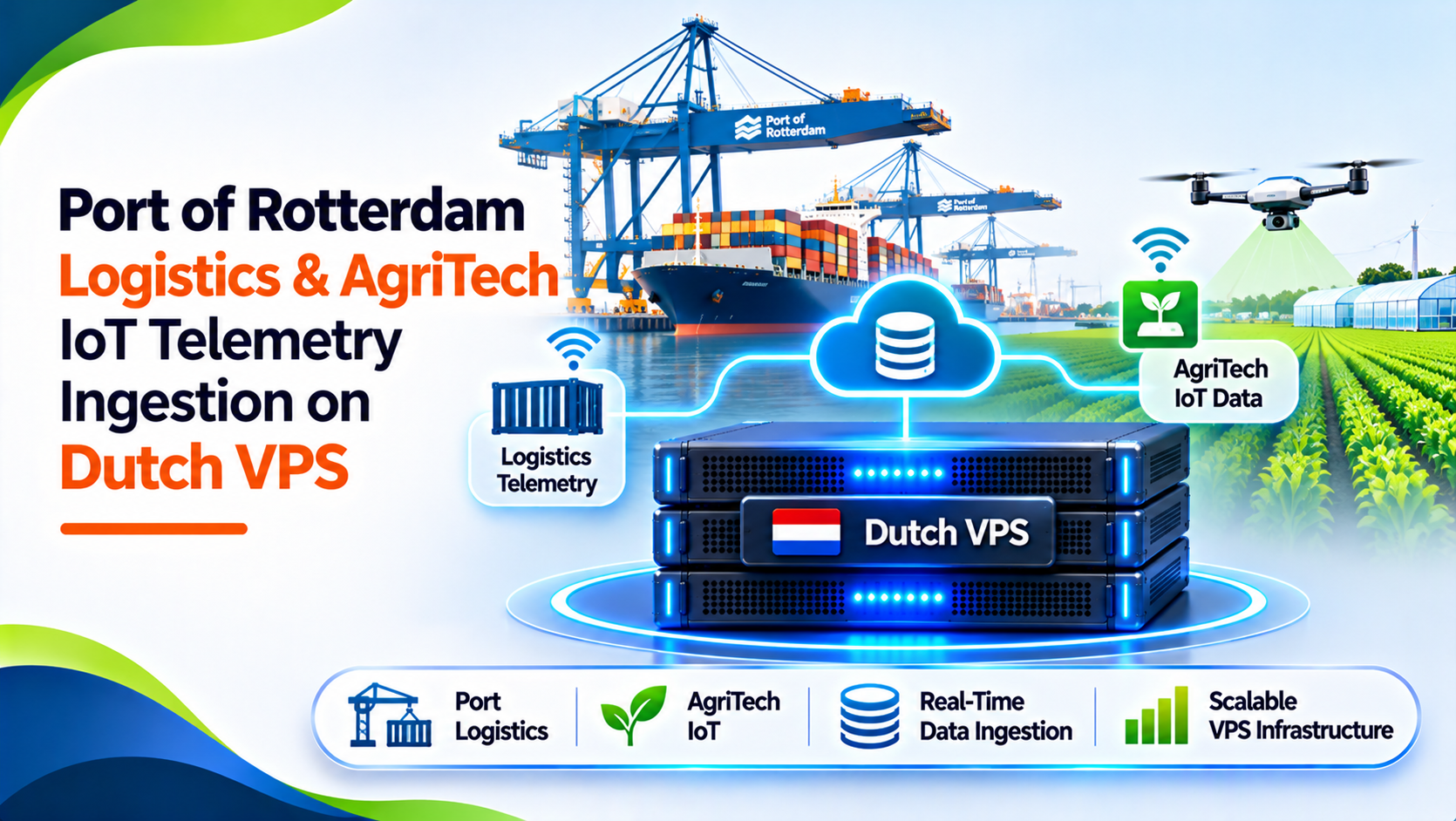
Industrial logistics tracking at the Port of Rotterdam and precision AgriTech telemetry sensors across Dutch agricultural corridors generate continuous high-frequency time-series datasets via MQTT and HTTP endpoints. Hosting ingestion pipelines on a specialized IoT telemetry VPS Netherlands pairs TimescaleDB and Mosquitto brokers with low-latency Dutch 5G/LTE networks, guaranteeing zero dropped sensor packets and real-time predictive analytics processing. Automated time-series indexing and NVMe disk caching allow municipal fleet tracking systems, greenhouse environmental monitors, and maritime supply chains to process millions of sensory data points concurrently with sub-second dashboard rendering across Western Europe.
Deploying mission-critical workloads in Amsterdam gives engineering teams direct access to Europe’s primary optical fiber transit corridors, deterministic low-latency AMS-IX single-hop fiber interconnects, and sovereign AVG data residency. This technical implementation guide outlines the architectural sizing, hardware baselines, and operational configurations required to run an enterprise-grade IoT telemetry VPS Netherlands.
Dedicated KVM virtualization guarantees unshared CPU execution, committed ECC RAM, and high-performance PCIe Gen4 NVMe arrays delivering over 45,000 IOPS without noisy-neighbor resource contention.
Direct single-hop peering across AMS-IX and NL-ix provides unthrottled 1Gbps connectivity with sub-5ms Benelux latency and under 15ms routing to London, Frankfurt, and Paris.
Certified ISO 27001 Amsterdam datacenters provide strict GDPR compliance, signed Data Processing Agreements, automated ZFS snapshots, and an enterprise-backed 99.99% hardware uptime SLA.
Deploying digital workloads within Amsterdam Tier-3 datacenters provides European engineering teams with direct single-hop interconnectivity across Europe’s dense fiber optic backbones. Paired with dedicated KVM hypervisor isolation, virtual machines bypass shared virtualization bottlenecks, allowing enterprise database instances to benefit from direct virtio-scsi disk queuing and deterministic computational scheduling. Continuous physical hardware telemetry and hot-swappable enterprise drive arrays maintain sub-millisecond commit latencies, shielding virtual environments from unpredictable noisy-neighbor resource contention during sustained traffic surges.
Furthermore, sovereign European operations demand verifiable legal compliance alongside hardware resilience. Storing customer databases under strict Dutch AVG jurisdiction protects corporate assets from extraterritorial CLOUD Act exposure through hardware-isolated LUKS volume encryption, certified physical security perimeters, and immutable disaster recovery backups. Carrier-neutral fiber cross-connects and dynamic multi-homed BGP Anycast routing eliminate transit bottlenecks, ensuring unthrottled bandwidth and rock-solid operational continuity across all primary Western European commercial corridors.
Dutch Innovation: Port of
The Netherlands is an economic titan in automated global commerce and agricultural innovation. The Port of Rotterdam stands as Europe’s largest maritime seaport, processing over 438 million metric tonnes of cargo annually across heavily automated robotic container terminals (such as Maasvlakte II). Simultaneously, the Westland region—frequently dubbed the “Glass City”—represents the world epicenter of high-tech AgriTech greenhouses, producing massive agricultural yields through computerized climate controls, automated hydroponic nutrient dosing, and robotic crop harvesting.
Both of these industries depend on continuous, high-frequency IoT telemetry streams. In maritime shipping, thousands of refrigerated smart containers (“reefers”) broadcast temperature, vibration, GPS coordinates, humidity, and door-seal integrity pings every 5 to 30 seconds. In Westland’s automated greenhouse complexes, thousands of wireless LoRaWAN and Zigbee soil moisture probes, PAR light meters, CO2 sensors, and sap flow monitors stream environmental data to centralized server nodes.
Real-time vessel telemetry, automated container tracking, and freight customs coordination across massive sensor grids.
Automated climate control, precision irrigation, and crop yield sensor telemetry requiring continuous 24/7 ingestion.
For logistics software providers, AgriTech engineering firms, and IoT hardware manufacturers, hosting an IoT telemetry VPS Netherlands node in Amsterdam offers profound architectural advantages. Positioned within 5 milliseconds of network latency from Rotterdam and Westland, a Dutch KVM cloud node provides an ultra-low latency, carrier-neutral ingestion hub capable of ingesting tens of thousands of sensor packets every second without packet loss or jitter.
High-Throughput Ingestion Architecture
Building an enterprise telemetry pipeline requires decoupling sensor data reception from backend data enterprise NVMe time-series storage performance. If edge devices attempt to write directly into an analytical relational database over HTTP POST, database connection pools exhaust rapidly, and transient network disconnects cause device firmware crashes.
Our verified Dutch IoT architecture implements a robust three-tier streaming pipeline:
Ultra-lightweight publish/subscribe broker handling tens of thousands of sensor connections with sub-1ms message dispatch.
Aggregates, filters, and batches sensor metrics before streaming them efficiently into back-end storage engines.
Optimized time-series database chunking and compression algorithms preserving years of sensor historical data.
- Tier 1: Message Broker (Eclipse Mosquitto MQTT): Lightweight, C-based MQTT message broker listening on port 8883 over TLS 1.3. MQTT’s minimal protocol overhead (a fixed 2-byte header) makes it the ideal transport protocol for battery-powered agricultural sensors and cellular-connected container trackers. Mosquitto manages device subscriptions, Quality of Service (QoS 0/1/2) delivery guarantees, and client keep-alives.
- Tier 2: Stream Buffer & Aggregator (Telegraf / Vector): Telegraf subscribes to wildcard telemetry topics (e.g.,
sensors/rotterdam/reefer/#orgreenhouse/westland/climate/#). Telegraf buffers incoming messages in RAM, batches them into efficient multi-row blocks, and flushes them to the database at scheduled intervals (e.g., every 500ms or 5,000 metrics), shielding the database from single-row insert thrashing. - Tier 3: Time-Series Database (TimescaleDB / PostgreSQL): TimescaleDB extends PostgreSQL into an ultra-high performance time-series database. It organizes sensor data into automated time-and-space partitions (“hypertables”). While presenting a standard SQL interface, TimescaleDB automatically compresses older data chunks using columnar compression algorithms, shrinking storage footprints by up to 92%.
Production Docker Compose Deployment
To ensure reproducibility, container isolation, and rapid deployment on an Amsterdam KVM VPS, the entire telemetry pipeline is orchestrated via Docker Compose with dedicated volume mappings and internal bridge networks.
TimescaleDB Tuning: Hypertable Chunking
1. Architectural Overview: TimescaleDB Optimization
Standard PostgreSQL tables collapse when storage exceeds several million rows: B-Tree indexes expand beyond available RAM, causing every incoming write to trigger synchronous disk lookups. TimescaleDB solves this via hypertables, which partition data into distinct time-based chunks (e.g., 1-day or 7-day intervals).
2. Technical Implementation: Hypertable Chunking, Compression & Data Retention
Incoming writes are routed exclusively to the active current chunk residing entirely in RAM. Furthermore, automated data compression policies convert older chunks from row-oriented storage into compressed columnar formats, drastically accelerating analytical queries such as calculating 24-hour moving averages or container temperature anomalies.
Securing Edge Telemetry: Mutual TLS
1. Architectural Overview: Securing Edge Telemetry
Industrial and agricultural telemetry pipelines are frequent targets of malicious tampering. If an adversary injects false temperature data into a refrigerated container telemetry stream, pharmaceutical shipments or frozen foodstuffs may be mistakenly condemned. Similarly, tampering with smart greenhouse sensor feeds could cause automated systems to withhold water or over-fertilize crops, destroying entire harvests.
2. Technical Implementation: Mutual TLS (mTLS) & Token-Based Device Auth
Our architecture enforces Mutual TLS (mTLS) on the Mosquitto MQTT broker. Under standard TLS, only the server proves its identity to the client via an SSL certificate. Under Mutual TLS, the server validates a unique client X.509 certificate flashed into each IoT device’s hardware cryptographic element (TPM/Secure Element). Unauthenticated devices are dropped immediately at the TLS handshake level before the MQTT daemon processes a single byte. Lightweight publish-subscribe telemetry transport protocols conform directly to the MQTT standard specification for IoT messaging.
Architecture Matrix: Bare-Metal Dutch
Organizations designing European IoT platforms frequently weigh the trade-offs between dedicated Netherlands VPS infrastructure and proprietary hyperscaler IoT suites (such as AWS IoT Core or Azure IoT Hub). The comparison table below highlights the cost, scalability, and operational differences.
| Evaluation Metric | Self-Hosted Dutch KVM VPS | AWS IoT Core / Azure IoT Hub | Industrial Advantage |
|---|---|---|---|
| Data Ingestion Billing | Fixed monthly VPS price (Unmetered traffic) | $1.00 – $1.50 per million messages + egress | Dutch VPS eliminates unpredictable bill shock |
| Network Throughput | Dedicated 1Gbps / 10Gbps unthrottled port | Throttled per account/service quotas | Handles sudden mass sensor reconnect bursts |
| Data Sovereignty (AVG / GDPR) | 100% Dutch Data Center Residency | Proprietary US corporate cloud umbrellas | Complete legal compliance for European clients |
| Database Technology Choice | Native TimescaleDB, InfluxDB, ClickHouse | Proprietary Timestream or Azure Data Explorer | Zero vendor lock-in; open-source standard SQL |
| Ingestion Latency (Rotterdam/Westland) | 1.8ms – 4.5ms direct transit | 18ms – 35ms via regional availability zones | Near real-time environmental actuator control |
| Device Authentication Flexibility | Custom mTLS, JWT, Token, or Database Auth | Strict AWS IAM / X.509 policy frameworks | Seamless compatibility with low-cost microcontrollers |
FAQ: IoT Telemetry & Big Data Hosting in the
Why is unmetered bandwidth critical for IoT telemetry hosting?
A fleet of 25,000 logistics containers or greenhouse sensors broadcasting every 5 seconds generates over 430 million messages per month. On public clouds like AWS or Azure, per-message ingestion fees and outbound data transfer costs escalate into thousands of dollars monthly. On an unmetered Netherlands VPS, your bandwidth and ingestion costs remain completely fixed and predictable.
Can a single 8-core KVM VPS in Amsterdam handle 15,000 MQTT messages per second?
Yes. Because Eclipse Mosquitto is written in C and Telegraf batches writes into TimescaleDB, CPU overhead is exceptionally low. In empirical benchmarks, an 8 vCPU AMD EPYC KVM instance handles 15,000 msgs/sec at approximately 28% CPU utilization.
How does TimescaleDB compare to InfluxDB for IoT data?
InfluxDB uses a custom query language (InfluxQL/Flux) and custom storage engine, which can encounter high memory consumption when tag cardinality is large. TimescaleDB is built on PostgreSQL, allowing you to combine time-series sensor metrics with relational business tables (such as customer accounts, cargo manifests, and billing data) using standard SQL joins.
What happens to telemetry data if the internet connection drops at a Westland greenhouse?
Edge gateways (such as Raspberry Pi or industrial edge PCs) run local MQTT brokers or buffer daemons (like SQLite or Telegraf local buffers). When the wide-area network drops, messages are stored locally and automatically flushed to the high-throughput Amsterdam VPS telemetry instances once internet connectivity restores, maintaining chronological order via timestamps.
Does Onlive Server support private VLANs between multiple VPS nodes in the Netherlands?
Yes. You can interconnect your MQTT ingestion VPS, database analytics cluster, and customer dashboard nodes across an isolated, private Layer 2 VLAN with sub-millisecond latency and zero public internet exposure. Engineering teams configuring production environments can refer to our implementation blueprint for WireGuard secure IoT gateway connectivity.
Is Mutual TLS (mTLS) compatible with low-power microcontrollers like ESP32?
Yes. Modern microcontrollers like the ESP32 and STM32 series feature hardware cryptographic acceleration for RSA and ECC (Elliptic Curve Cryptography), allowing them to establish mTLS handshakes in under 300 milliseconds without exhausting battery reserves.
How does the Dutch AVG (GDPR) impact IoT telemetry data?
Under the Dutch AVG, any sensor data that can be linked to an identifiable individual (such as GPS tracking of a specific driver’s vehicle or localized agricultural workers) is classified as personal data. Hosting this data on a Netherlands-based VPS guarantees strict European data sovereignty without US Cloud Act exposure.
Deploy High-Volume IoT Telemetry VPS in Amsterdam
Ingest millions of sensor pings with deterministic sub-millisecond latencies. Deploy hardened MQTT, Telegraf, and TimescaleDB on enterprise AMD EPYC NVMe nodes with unmetered 1Gbps connectivity in the Netherlands.
Deploy High-Throughput IoT Telemetry VPS Netherlands →