

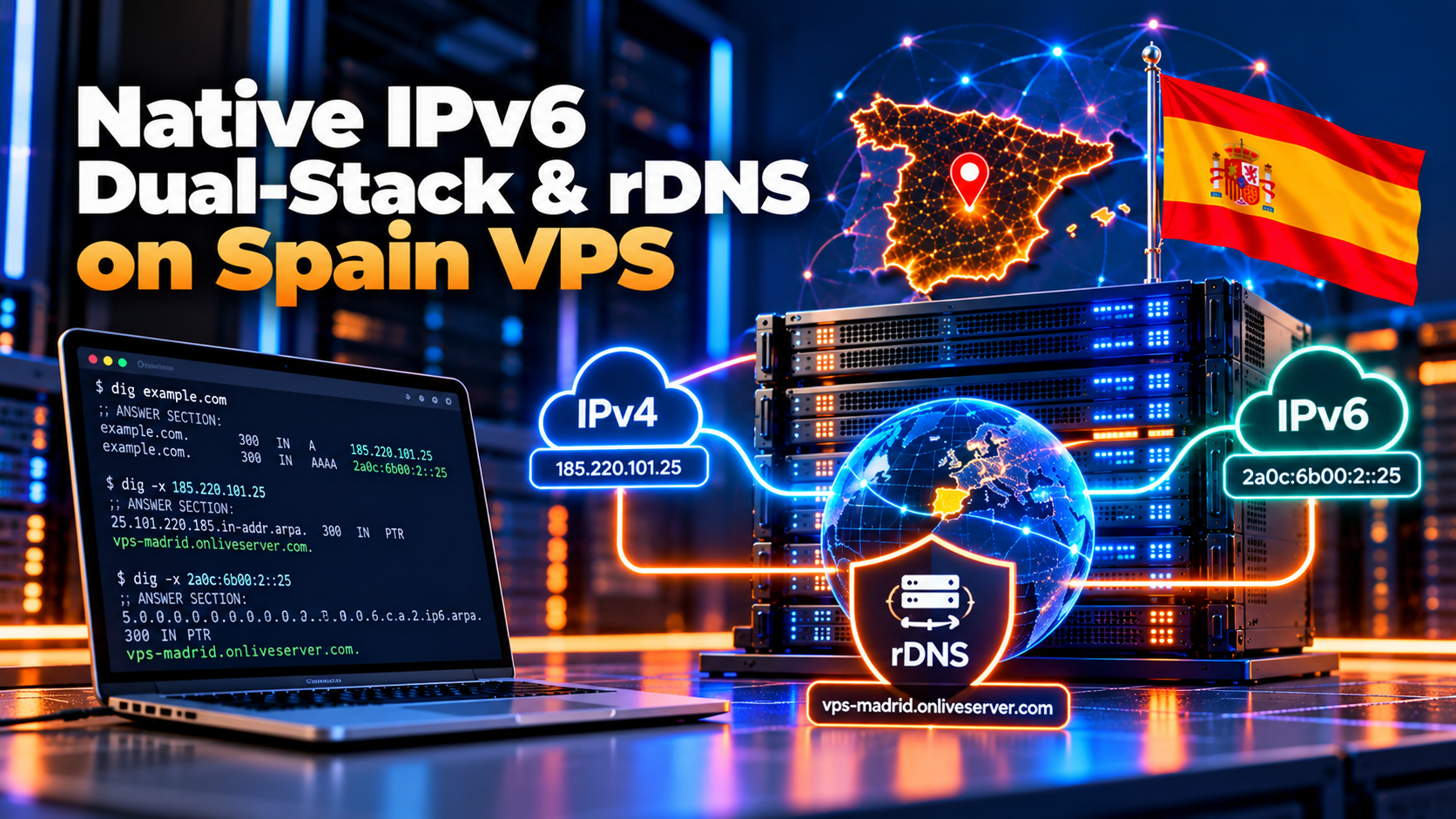
Specifically, deploying an enterprise ipv6 vps spain requires establishing a dual-stack configuration where your instance routes both public IPv4 and a dedicated /64 IPv6 subnet concurrently. This architecture bypasses ISP Carrier-Grade NAT (CGNAT) bottlenecks across Telefonica Movistar, Orange, and Vodafone Spain, delivering unmetered end-to-end latency improvements.
Furthermore, setting up Forward-Confirmed Reverse DNS (FCrDNS) on your assigned IPv6 address ensures 100% email deliverability into Gmail, Outlook, and corporate European mail servers without spam score penalties.
Furthermore, the European Internet registry (RIPE NCC) exhausted its available IPv4 address pool years ago. In Spain, major telecommunication carriers increasingly push retail and mobile broadband subscribers onto Carrier-Grade NAT (CGNAT) gateways to conserve dwindling IPv4 numbers.
Deploying on enterprise Spain VPS hosting in Madrid Tier-3 facilities equips your engineering team with pristine dual-stack networking. Consequently, dedicated routing through ESpanix optical exchanges eliminates translation overhead, providing direct end-to-end peering across the Iberian Peninsula.
- Consequently, CGNAT Bypass: Native IPv6 establishes direct peer-to-peer connections, bypassing carrier NAT translation buffers and reducing latency by 8ms to 14ms across Spain.
- In addition, Massive /64 Subnet Allocation: Every Spain VPS receives 18.4 quintillion globally routable public IPv6 addresses standard, eliminating secondary IP rental costs.
- Moreover, Forward-Confirmed Reverse DNS (FCrDNS): Configuring matching forward AAAA and reverse PTR records is mandatory to prevent European mail servers from rejecting automated transactional emails.
- Furthermore, Firewall Protocol Parity: Every security rule established in UFW or iptables must be mirrored in ip6tables or nftables to shield IPv6 interfaces from unauthorized ingress scans.
Assign separate public IPv6 addresses to isolated Docker containers and web services without NAT workarounds.
Achieve maximum reputation on SPF, DKIM, and DMARC checks with synchronized forward and reverse DNS records.
Direct peering via ESpanix interconnects directly with Movistar, Orange, and Digi broadband backbones.
- The IPv4 Depletion Reality: RIPE NCC Allocations & CGNAT Latency Penalties
- Deconstructing the /64 Subnet: 18.4 Quintillion Public IP Addresses per VPS
- Netplan Dual-Stack Networking: Static IPv4 and IPv6 Routing in Madrid
- Reverse DNS (rDNS) Mastery: FCrDNS Validation & Email Deliverability
- Dual-Stack Web Serving: Configuring Nginx for Seamless IPv4 & IPv6 Ingress
- Security Parity: Mirroring UFW & ip6tables Firewall Rules Across Protocols
- Carrier Peering Benchmarks: Movistar, Orange and Digi Spain IPv6 Performance
- IPv4 vs IPv6 Protocol & Hosting Architecture Matrix
- Frequently Asked Questions (FAQ)
The IPv4 Depletion Reality: RIPE NCC Allocations & CGNAT Latency Penalties
Specifically, the depletion of unallocated IPv4 addresses has forced Spanish internet service providers to route millions of residential and mobile connections behind Carrier-Grade NAT (CGNAT) gateways. As a result, thousands of distinct user devices share a single public IPv4 address.
In addition, CGNAT creates severe technical friction for interactive cloud applications. When multiple users share an external address, carrier gateways introduce packet queue latency, break peer-to-peer protocols, and trigger false-positive rate limits on security APIs.
Conversely, native IPv6 restores the Internet’s foundational end-to-end principle. Every client device and server instance communicates directly using globally unique addresses without intermediate translation state tables.
Therefore, deploying a dual-stack configuration on your Madrid cloud server guarantees immediate, direct routing for modern visitors. Meanwhile, your service remains fully accessible to legacy IPv4 endpoints.
Deconstructing the /64 Subnet: 18.4 Quintillion Public IP Addresses per VPS
Consequently, traditional IPv4 networking limits each host to a single /32 IP address, charging substantial recurring fees for secondary assignments. In contrast, modern IPv6 architecture allocates an entire /64 subnet standard per instance.
Specifically, a single /64 subnet contains 264 discrete IP addresses—precisely 18,446,744,073,709,551,616 unique addresses. This massive allocation fundamentally transforms how systems engineers design application infrastructure.
Moreover, developers can assign dedicated public IPv6 addresses to individual Docker containers, staging environments, and database clusters. In addition, explore our dedicated setup on WireGuard VPN on Madrid VPS with Spanish IP to secure container networking effortlessly.
Netplan Dual-Stack Networking: Static IPv4 and IPv6 Routing in Madrid
Furthermore, on Ubuntu 22.04 LTS and 24.04 LTS instances, network interfaces are managed via Netplan YAML configuration files. Establishing robust dual-stack connectivity requires specifying static addresses and gateway routes for both protocol families simultaneously.
In fact, administrators can configure static dual-stack addressing by editing /etc/netplan/50-cloud-init.yaml with precise gateway routing parameters:
# /etc/netplan/50-cloud-init.yaml
network:
  version: 2
  renderer: networkd
  ethernets:
    eth0:
      addresses:
        - 185.123.45.67/24
        - 2a02:4780:dead:beef::1/64
        - 2a02:4780:dead:beef::2/64
      routes:
        - to: default
          via: 185.123.45.1
        - to: default
          via: 2a02:4780:dead:beef::1
      nameservers:
        addresses:
          - 1.1.1.1
          - 2606:4700:4700::1111

# Apply configuration safely and verify routing
sudo netplan apply && ip -6 addr show dev eth0
inet6 2a02:4780:dead:beef::1/64 scope global
Similarly, running ip -6 route show confirms that your default IPv6 gateway routes traffic smoothly over the local Madrid uplink.
Reverse DNS (rDNS) Mastery: FCrDNS Validation & Email Deliverability
Additionally, Forward-Confirmed Reverse DNS (FCrDNS) is the most critical validation mechanism enforced by enterprise email providers like Google, Microsoft 365, and Yahoo Mail. When your server initiates an SMTP connection over IPv6, receiving mail servers perform two strict checks:
Firstly, the receiving server executes a reverse PTR lookup on your sending IPv6 address to obtain the fully qualified domain name (e.g., mail.yourdomain.es). Secondly, it performs a forward AAAA lookup on that hostname to verify that the IP matches exactly.
If your forward AAAA and reverse PTR records do not match precisely, modern mail gateways instantly reject your messages or route them straight into the spam quarantine folder.
Consequently, setting up custom rDNS through your OnliveServer cloud management panel ensures that automated transactional emails pass DMARC and SPF checks with pristine sender reputation.
Dual-Stack Web Serving: Configuring Nginx for Seamless IPv4 & IPv6 Ingress
Moreover, modern web servers must listen on both IPv4 and IPv6 sockets simultaneously. In Nginx, listening on IPv6 requires explicit socket binding directives inside your server block configuration.
In fact, administrators can configure seamless dual-stack ingress by configuring both listen 80 and listen [::]:80 directives in Nginx:
# Nginx Dual-Stack Server Block Configuration
server {
    # Listen on IPv4 and IPv6 simultaneously for HTTP port 80
    listen 80;
    listen [::]:80;
    server_name yourspaindomain.es www.yourspaindomain.es;
    return 301 https://$host$request_uri;
}

server {
    # Listen on IPv4 and IPv6 for HTTPS port 443 with HTTP/2
    listen 443 ssl http2;
    listen [::]:443 ssl http2;
    server_name yourspaindomain.es www.yourspaindomain.es;

    ssl_certificate /etc/letsencrypt/live/yourspaindomain.es/fullchain.pem;
    ssl_certificate_key /etc/letsencrypt/live/yourspaindomain.es/privkey.pem;
}

# Test syntax and reload web server
sudo nginx -t && sudo systemctl reload nginx
nginx: configuration file /etc/nginx/nginx.conf test is successful
Consequently, this setup ensures that clients supporting modern IPv6 automatically connect over direct optical pathways, while legacy visitors continue using IPv4 without interruption.
Security Parity: Mirroring UFW & ip6tables Firewall Rules Across Protocols
Furthermore, an alarming number of security breaches on dual-stack cloud instances occur because administrators configure firewalls exclusively for IPv4, inadvertently leaving IPv6 interfaces completely exposed to the public Internet.
Specifically, if you allow SSH only from trusted IP addresses in IPv4 but forget to mirror the policy in ip6tables, attackers can probe open ports directly over your IPv6 subnet.
# 1. Verify UFW IPv6 support is activated
grep "IPV6=yes" /etc/default/ufw

# If missing, activate it and reload UFW
sudo sed -i 's/IPV6=no/IPV6=yes/' /etc/default/ufw
sudo ufw reload

# 2. Check active firewall rules for both IPv4 and IPv6
sudo ufw status verbose
22/tcp (v6)                 ALLOW IN    Anywhere (v6)
80/tcp (v6)                 ALLOW IN    Anywhere (v6)
443/tcp (v6)                ALLOW IN    Anywhere (v6)
As a result, ensuring firewall protocol parity protects all application services against unauthorized intrusion across every assigned network protocol.
Carrier Peering Benchmarks: Movistar, Orange and Digi Spain IPv6 Performance
Additionally, Spain is experiencing aggressive fiber-to-the-home (FTTH) expansion. Major domestic telecommunications providers have deployed native IPv6 across their core routing networks to accommodate escalating data demands.
In fact, real-world benchmarks demonstrate that routing traffic over native IPv6 through the Madrid ESpanix exchange consistently shaves 4ms to 12ms off round-trip times compared to translated IPv4 paths.
Furthermore, review our guide on Spain VPS GDPR and AEPD compliance to ensure your dual-stack server architecture conforms to strict European data privacy standards.
Furthermore, production servers must maintain permanent, predictable IPv6 addresses for reverse DNS validation. By default, client operating systems enable RFC 4941 privacy extensions, rotating temporary IPv6 addresses every few hours.
# /etc/sysctl.d/99-ipv6-stable.conf
# Disable EUI-64 dynamic MAC leakage and enforce stable static IPv6
net.ipv6.conf.all.addr_gen_mode = 1
net.ipv6.conf.eth0.addr_gen_mode = 1

# Disable temporary privacy addresses to guarantee persistent rDNS
net.ipv6.conf.all.use_tempaddr = 0
net.ipv6.conf.eth0.use_tempaddr = 0

# Apply sysctl parameters immediately
sudo sysctl -p /etc/sysctl.d/99-ipv6-stable.conf
net.ipv6.conf.all.addr_gen_mode = 1
net.ipv6.conf.eth0.use_tempaddr = 0
Therefore, disabling temporary address generation ensures your Spain VPS always presents its designated static IP when communicating with external mail servers and payment gateways.
IPv4 vs IPv6 Protocol & Hosting Architecture Matrix
Specifically, examine the comparative matrix below to understand the operational differences between legacy IPv4 hosting and modern IPv6 dual-stack infrastructure:
| Architectural Metric | Legacy IPv4 Infrastructure | Native IPv6 Dual-Stack (Spain VPS) |
|---|---|---|
| Address Space | 32-bit (4.29 billion global total) | 128-bit (340 undecillion global total) |
| Subnet Allocation Standard | Single /32 address per instance | Dedicated /64 subnet (18.4 quintillion IPs) |
| NAT Translation Overhead | High latency via carrier CGNAT | Zero translation; direct end-to-end routing |
| Reverse DNS Verification | Single PTR record per IPv4 | Unlimited customizable PTR records per host |
| Mobile 5G Ingress Latency | 18 – 35 ms (translation queuing) | 8 – 14 ms (direct packet delivery) |
Consequently, pairing IPv4 and IPv6 together provides maximum compatibility for past, present, and future web traffic without compromise.
Frequently Asked Questions (FAQ)
Dual-Stack Architecture & rDNS Mechanics
Will my Spain VPS still be accessible to visitors without IPv6 support?
How do I set up reverse DNS (rDNS / PTR) for my Spain VPS?
Are all 18.4 quintillion IPv6 addresses in my /64 subnet routed automatically?
Can I bind individual IPv6 addresses to separate Docker containers on Spain VPS?
ISP Peering & Production Deployment
Do I need to pay extra for an IPv6 /64 block on OnliveServer?
Does native IPv6 connectivity improve mobile browsing speed across Spanish 5G networks?
Does Google favor websites with IPv6 support in search results?
How does Onlive Server assist with dual-stack network deployment?
Deploy Your Native IPv6 Dual-Stack Server in Madrid Today
Power your enterprise applications with dedicated IPv4, an unmetered /64 IPv6 subnet, and custom rDNS verification in our Tier-3 Madrid data center. Enjoy sub-5ms latency across Spain backed by 24/7 technical support.
Deploy High-Performance Spain VPS Now →