

Quick Architecture Overview
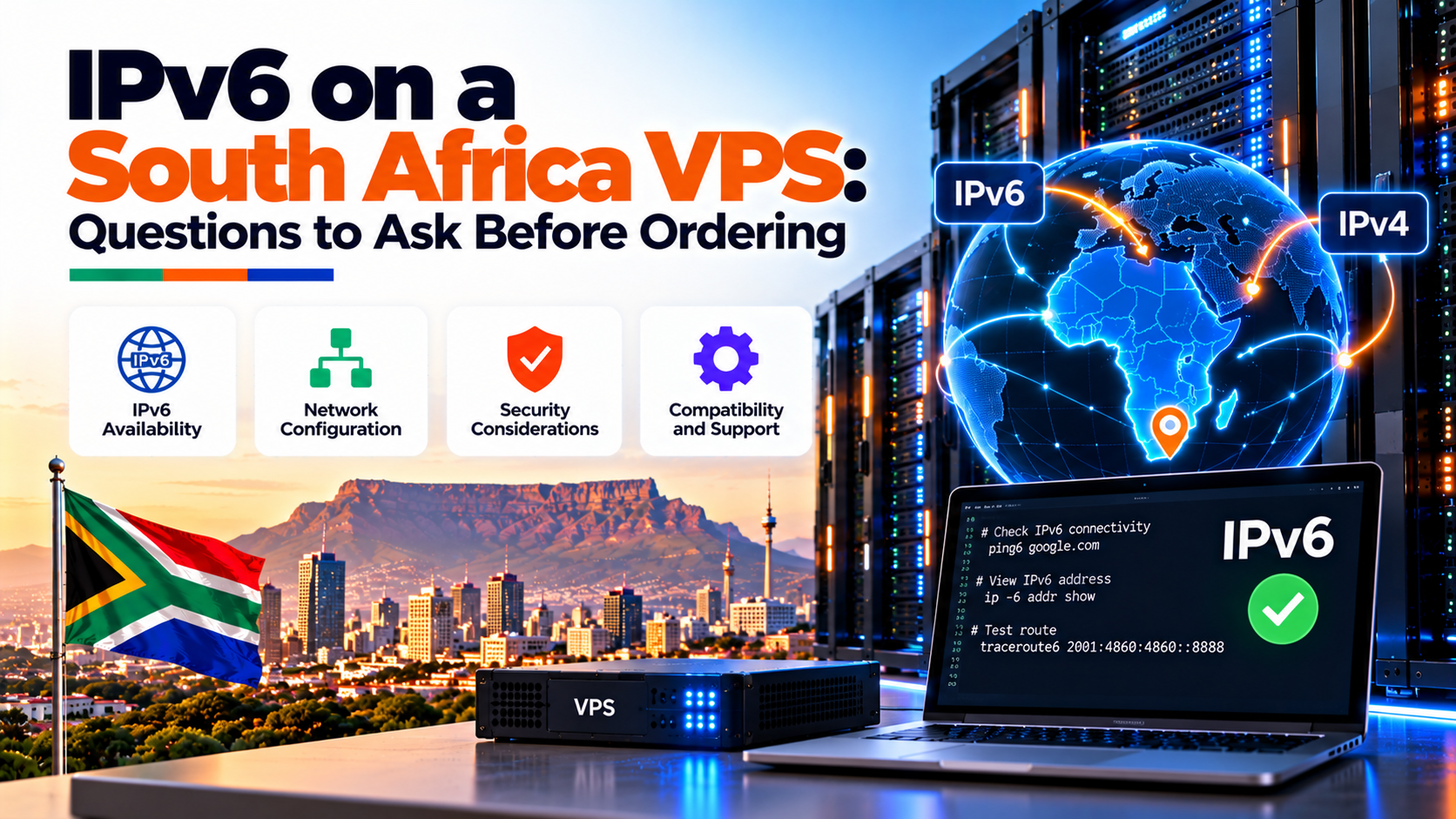
Deploying an ipv6 vps south africa instance ensures optimal network routing across southern Africa. Vodacom and MTN route mobile subscribers natively over IPv6 to avoid congested carrier NAT gateways.
Additionally, provisioning a routed /64 IPv6 subnet alongside dedicated IPv4 unicast delivers complete dual-stack connectivity. Johannesburg data centers guarantee sub-5ms national latency.
⚡ Routed /64 Subnets
Receive 18.4 quintillion globally unique IPv6 addresses to allocate isolated IPs to microservices and containers.
🔄 Native Dual-Stack
Maintain dedicated IPv4 backward compatibility while routing modern cellular subscribers directly over native IPv6 backbones.
🛡️ CGNAT Elimination
Bypass cellular carrier NAT bottlenecks to eliminate TCP handshake delays and avoid shared IP blocklisting.
🌐 NAPAfrica Peering
Direct peering at Teraco JB1 keeps South African web traffic local, avoiding high-latency European transit hops.
📌 IPv6 Architecture Navigation
- 1. AFRINIC IPv4 Depletion & Economic Drivers
- 2. Eliminating CGNAT Bottlenecks on Mobile Networks
- 3. Dual-Stack Architecture: Sizing Your VPS
- 4. Subnet Allocation: Single /128 vs Routed /64
- 5. Netplan & UFW Firewall Configuration Runbook
- 6. Critical Questions Before Ordering South Africa VPS
- 7. Strategic IPv6 Readiness Checklist
- 8. Frequently Asked Questions (FAQ)
1. AFRINIC IPv4 Depletion: The Economic Case for IPv6 VPS South Africa
The global migration to IPv6 is fundamentally driven by finite address space. The African Network Information Centre (AFRINIC) has entered the final phase of IPv4 exhaustion.
Consequently, obtaining clean, contiguous blocks of IPv4 addresses has become exceptionally difficult and expensive. On global address broker markets, a single IPv4 address trades for substantial premiums.
Therefore, cloud hosting providers pass these escalating capital expenditures directly onto enterprise consumers. Adding extra IPv4 addresses to a virtual server now incurs recurring monthly surcharges.
In contrast, our high-performance vps south africa infrastructure includes generous IPv6 allocations by default. Adopting native IPv6 allows organizations to expand networked services without escalating IP leasing expenses.
2. Eliminating CGNAT Bottlenecks: Mobile Performance on an IPv6 VPS
South Africa represents an overwhelmingly mobile-first digital economy. Millions of domestic consumers access online services exclusively through 4G and 5G cellular subscriptions.
Because mobile carriers exhausted public IPv4 pools years ago, they route subscribers through Carrier-Grade NAT (CGNAT) gateways. Thousands of individual cellular subscribers share a tiny pool of public IPv4 addresses.
Consequently, CGNAT introduces severe connection bottlenecks. Carrier NAT gateways must maintain stateful translation tables for millions of concurrent TCP streams, adding measurable latency.
Furthermore, bad actors sharing your CGNAT pool can trigger automated rate-limiting across security firewalls. Deploying native IPv6 eliminates this problem by providing end-to-end direct addressing for mobile visitors.
3. Dual-Stack Architecture: Sizing an IPv6 VPS South Africa Deployment
While IPv6 traffic expands rapidly, running an IPv6-only server remains impractical for general public websites. Legacy corporate networks and older home routers still rely exclusively on legacy IPv4 connectivity.
Therefore, enterprise cloud deployments require a robust dual-stack network architecture. The virtual machine binds both a static IPv4 unicast address and a routed IPv6 subnet.
Specifically, client operating systems use Happy Eyeballs algorithms defined in RFC 8200. Dual-stack systems query both A and AAAA DNS records concurrently to establish the fastest route.
Additionally, if you require predictable cloud budgets while sizing compute resources, explore our budget-friendly cheap vps hosting plans. You can maintain reliable performance across both protocols without overspending.
4. Subnet Allocation Standards: Single /128 vs Routed /64 Blocks
When evaluating cloud hosting providers, network engineers must examine exact IPv6 subnet allocation policies. Budget hosting vendors often provide only a single /128 IPv6 address.
However, enterprise cloud standards require a routed /64 subnet. A single /128 address prevents you from assigning dedicated IPs to containers, SSL certificates, or virtual hosts.
In contrast, a standard /64 subnet contains 18.4 quintillion globally unique addresses. Consequently, you can assign discrete IPv6 addresses to Docker containers, mail daemons, and microservice endpoints.
Furthermore, review our comprehensive johannesburg vps latency network route testing report. Evaluating local peering fabrics confirms that subnets route cleanly across domestic carriers.
5. Technical Runbook: Netplan and UFW Firewall Configuration
Configuring dual-stack networking on modern Ubuntu Linux instances requires updates to Netplan. Specifically, the configuration file defines static addresses and gateways for both protocol families:
After applying network settings, you must verify that your Linux firewall filters IPv6 traffic correctly. Specifically, inspect /etc/default/ufw and confirm that IPV6=yes is active:
Consequently, when you open port 443 in UFW, the firewall creates matching filter rules in both iptables and ip6tables.
6. Critical Questions to Ask Before Ordering an IPv6 VPS in South Africa
Before ordering a South Africa VPS, network architects should pose five critical technical questions to prospective hosting providers:
| Technical Inquiry | Ideal Enterprise Answer | Architectural Risk if Absent |
|---|---|---|
| Subnet Sizing | Dedicated routed /64 subnet included | Restricted to single IP; container isolation fails |
| Routing Architecture | Native dual-stack BGP multi-homed transit | Latency spikes from tunneling or transit proxies |
| Peering Exchange | Direct peering at NAPAfrica (Teraco JB1) | Domestic traffic routes overseas to Europe and back |
| Reverse DNS (rDNS) | Self-service PTR record delegation | Outgoing mail servers blocked by spam filters |
| DDoS Mitigation | Equal scrubbing capacity on IPv4 and IPv6 | Vulnerability to IPv6 amplified attack vectors |
Moreover, comparing network routing topologies helps identify high-throughput infrastructure. Learn more by reviewing our detailed south africa vs europe vps routing latency cost analysis.
7. Strategic IPv6 Readiness Checklist for South African IT Teams
Executing a seamless protocol migration requires methodical verification across your software stack. Specifically, use the checklist below before routing live customer traffic:
DNS AAAA Records: Publish matching AAAA records alongside standard A records in authoritative DNS zones.
Web Server Directives: Configure Nginx or Apache to bind explicitly to
[::]:80 and [::]:443 sockets.
Database Access Lists: Ensure MySQL or PostgreSQL allowlists include IPv6 CIDR blocks for remote application servers.
Log Analytics Format: Verify that SIEM tools and analytics parsers accommodate 128-bit hexadecimal IP strings.
