

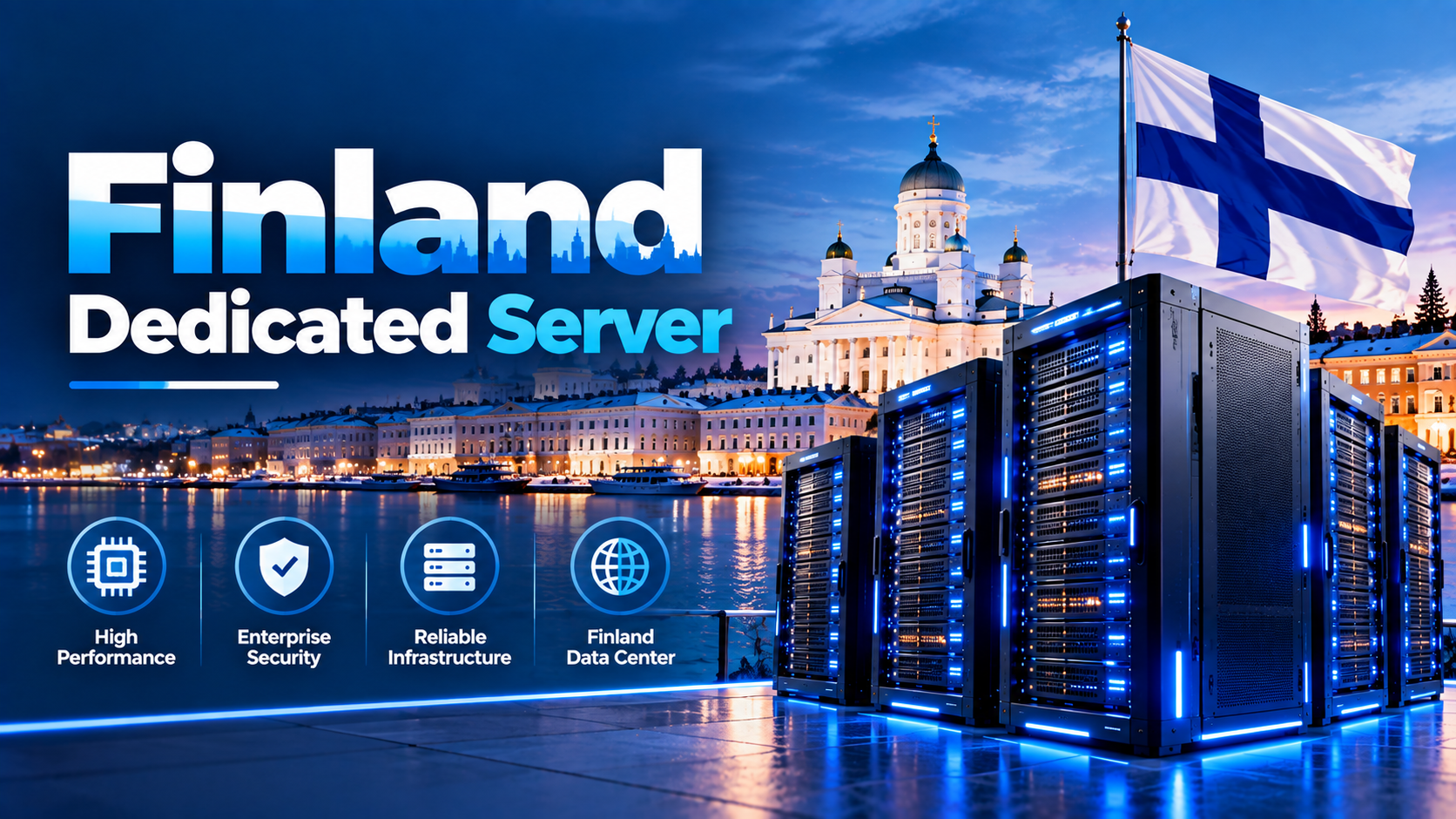
Finland Dedicated Server Hosting Architecture delivers isolated compute resources, enterprise NVMe storage arrays, and low-latency Tier-3 network transit designed for demanding enterprise workloads. By eliminating multi-tenant hypervisor contention and noisy-neighbor slowdowns, it provides deterministic execution speeds, robust cybersecurity hardening, and full administrative autonomy. This architecture is essential for system administrators, developers, and growing organizations requiring dependable uptime, predictable latency, and granular control over their hosting environment.
Introduction: The Operational Demands of Modern Infrastructure
Modern web applications, database clusters, and distributed microservices require predictable compute performance and rock-solid network availability. On multi-tenant shared platforms, unexpected resource contention and hypervisor throttling frequently degrade database responsiveness, leading to elevated bounce rates and lost transactional revenue. Maintaining competitive digital services requires hosting infrastructure built on dedicated hardware resources and carrier-grade routing.
Deploying optimized server architecture guarantees that processing cycles, memory channels, and disk input/output pathways remain reserved exclusively for your production workloads. Whether deploying containerized microservices, high-traffic ecommerce portals, or real-time clinical communications, dedicated compute isolation eliminates latency jitter and provides total environment configurability.
For mission-critical production environments, partnering with high-performance Finland dedicated hosting plans ensures reliable hardware provisioning, enterprise SLA guarantees, and 24/7 technical governance.
What Is Finland Dedicated Server Hosting Architecture?
At its technical foundation, Finland Dedicated Server Hosting Architecture represents an enterprise hosting solution provisioned to provide dedicated physical or virtual computing power, isolated operating environments, and high-throughput network access. Unlike entry-level shared servers where hundreds of users compete for system resources, this architecture establishes strict performance boundaries.
Dedicated Compute Allocation
High-frequency processors (Intel Xeon or AMD EPYC) deliver sustained base and boost clock cycles without artificial CPU credit caps or hypervisor throttling.
Enterprise Memory Architecture
Error-Correcting Code (ECC) DDR4/DDR5 RAM operates with dedicated channels, protecting in-memory caches and transactional databases from memory corruption.
Sub-Millisecond NVMe Storage
Enterprise NVMe solid-state arrays configured in RAID arrays deliver ultra-low read/write latencies and high IOPS throughput for intensive database operations.
Carrier-Grade Network Fabric
Multi-homed BGP routing connects to Tier-1 carriers and regional Internet Exchange Points (IXPs) for deterministic low-latency transit.
Hardware DDoS Mitigation
Automated Layer 3/4 filtering centers inspect incoming packets in real time to neutralize volumetric and reflection attacks before reaching your operating system.
Full Root & Kernel Sovereignty
Complete administrative autonomy allows engineers to deploy customized operating systems, compile custom kernel flags, and optimize network socket buffers.
Why Does It Matter for Enterprise Scalability?
Selecting appropriate hosting architecture directly affects business revenue, SEO rankings, and operational stability:
- Eliminating Resource Contention and Latency Jitter: On multi-tenant platforms, traffic spikes on adjacent accounts can exhaust shared hypervisor memory and stall database connections. Finland Dedicated Server Hosting Architecture guarantees complete hardware and resource isolation.
- Ensuring Regulatory Compliance and Data Sovereignty: Data privacy frameworks—including GDPR, PIPEDA, and CCPA—require transparent data residency and strict physical boundary control. Deploying within certified Tier-3 facilities enables organizations to satisfy regulatory compliance.
- Engineering Agility and DevOps Automation: Development teams require administrative autonomy to configure CI/CD pipelines, container runtimes (Docker, Kubernetes), and custom network rules. Sysadmins can integrate Nordic and European multi-datacenter connectivity directly into provisioning routines to maintain consistent security postures.
Architectural Comparison: Nordic Datacenter Hosting vs. Continental European Hosting
| Evaluation Metric / Feature | Finland Datacenter (Helsinki) | Traditional Western European Facilities |
|---|---|---|
| Datacenter PUE Rating | Ultra-low (1.10–1.20) via natural Nordic ambient cooling | Higher (1.40–1.65) requiring intensive refrigeration |
| Energy Cost Stability | Backed by 100% renewable hydro/wind energy | Susceptible to continental peak power grid pricing volatility |
| Baltic & Nordic Latency | Sub-10ms across Finland, Sweden, and Estonia | 40ms–70ms round-trip latency to Nordic users |
| Environmental Compliance | Net-zero carbon footprint supports ESG reporting | Higher carbon offset requirement for enterprise sustainability |
Security Hardening and Linux Kernel Performance Engineering
Maintaining operational excellence requires structured security and kernel tuning protocols. In /etc/sysctl.conf, configure socket buffers to optimize throughput and network resilience:
net.core.rmem_max = 16777216
net.core.wmem_max = 16777216
net.ipv4.tcp_congestion_control = bbr
vm.swappiness = 10
Additionally, capture point-in-time disk states for immediate rollback capabilities and establish proactive server hardening and security checklists across isolated storage pools to guarantee business continuity.
Technical Selection Matrix: Choosing Your Configuration
- Evaluate Compute Load and Concurrency: Compute-bound tasks (API parsing, transcoding, microservices) require high single-thread clock speeds and multiple dedicated CPU cores, while caching workloads benefit most from generous RAM capacity.
- Determine Storage IOPS and Throughput Needs: High-transaction databases require enterprise NVMe SSDs in RAID 10 arrays to balance maximum random read/write throughput with hardware fault tolerance.
- Analyze Network Transit and Latency Boundaries: Match datacenter geography directly to your primary visitor concentration to ensure sub-30ms round-trip latency and eliminate transatlantic packet hops.
- Select Administrative Management Level: Choose unmanaged root access for experienced Linux sysadmins, or fully managed hosting for 24/7 proactive security monitoring, automated patching, and infrastructure troubleshooting.
- Plan for Horizontal and Vertical Capacity Headroom: Ensure your hosting tier supports dynamic resource additions without requiring complex database migrations or prolonged service downtime.
📌 Frequently Asked Questions (FAQ)
.ols-faq-accordion-box { margin-top: 24px; margin-bottom: 35px; } .ols-faq-item { background: #ffffff; border: 1px solid #e2e8f0; border-left: 4px solid #2563eb; border-radius: 12px; margin-bottom: 14px; overflow: hidden; box-shadow: 0 2px 6px rgba(15, 23, 42, 0.02); transition: all 0.2s ease; } .ols-faq-item:hover { border-color: #cbd5e1; border-left-color: #1d4ed8; box-shadow: 0 4px 12px rgba(37, 99, 235, 0.06); } .ols-faq-item[open] { border-color: #bfdbfe; border-left-color: #2563eb; box-shadow: 0 4px 16px rgba(37, 99, 235, 0.08); } .ols-faq-summary, .ols-faq-item .ols-faq-summary, .ols-faq-item[open] .ols-faq-summary, details.ols-faq-item > summary.ols-faq-summary, details.ols-faq-item[open] > summary.ols-faq-summary { border: none !important; border-left: none !important; border-top: none !important; border-right: none !important; } .ols-faq-summary { display: flex !important; align-items: center !important; justify-content: space-between !important; padding: 16px 20px !important; cursor: pointer !important; list-style: none !important; user-select: none !important; background: #ffffff !important; border: none !important; border-left: none !important; transition: background 0.2s ease !important; margin: 0 !important; outline: none !important; } .ols-faq-summary::-webkit-details-marker, .ols-faq-summary::marker { display: none !important; } .ols-faq-summary br, .ols-faq-summary p { display: none !important; } .ols-faq-summary:hover { background: #f8fafc !important; border-left: none !important; } .ols-faq-item[open] .ols-faq-summary { background: #ffffff !important; border: none !important; border-left: none !important; border-bottom: 1px solid #f1f5f9 !important; } .ols-faq-qwrap { display: flex !important; align-items: center !important; gap: 12px !important; flex: 1 !important; text-align: left !important; } .ols-faq-badge { display: inline-flex !important; align-items: center !important; justify-content: center !important; background: #eff6ff !important; color: #2563eb !important; font-weight: 800 !important; font-size: 12px !important; letter-spacing: 0.5px !important; padding: 4px 9px !important; border-radius: 6px !important; line-height: 1 !important; flex-shrink: 0 !important; } .ols-faq-title { color: #0f172a !important; font-weight: 700 !important; font-size: 15.5px !important; line-height: 1.4 !important; } .ols-faq-summary::after { content: ‘+’ !important; font-size: 20px !important; color: #2563eb !important; margin-left: auto !important; font-weight: 700 !important; line-height: 1 !important; width: 28px !important; height: 28px !important; border-radius: 50% !important; background: #ffffff !important; border: 1px solid #cbd5e1 !important; display: flex !important; align-items: center !important; justify-content: center !important; transition: all 0.2s ease !important; flex-shrink: 0 !important; } .ols-faq-item[open] .ols-faq-summary::after { content: ‘−’ !important; background: #2563eb !important; color: #ffffff !important; border-color: #2563eb !important; transform: rotate(180deg) !important; } .ols-faq-answer { padding: 16px 20px 18px 20px !important; color: #334155 !important; font-size: 15px !important; line-height: 1.75 !important; background: #ffffff !important; } .ols-faq-answer p { margin: 0 !important; color: #334155 !important; font-size: 15px !important; line-height: 1.75 !important; }Q1Why is Finland considered ideal for green computing?
Finland’s cold sub-arctic climate allows datacenters to utilize year-round free-air cooling instead of power-hungry chillers, resulting in exceptionally low Power Usage Effectiveness (PUE < 1.15) powered entirely by clean renewable hydro and wind energy.
Q2How is latency from Finland to neighboring European countries?
Finland is directly connected via subsea fiber (C-Lion1) to Germany and Scandinavia. Ping times to Stockholm and Tallinn are sub-5ms, and to Frankfurt and Amsterdam under 18ms.
Q3What processors are available on Finland dedicated servers?
We provide high-performance Intel Xeon Scalable and AMD EPYC (7003/9004 series) processors supporting up to 128 physical cores and 512GB ECC DDR5 RAM per server.
Q4Is bandwidth unmetered on our Finland dedicated servers?
Yes. All configurations feature high-speed unmetered 1Gbps or 10Gbps optical uplinks connected directly to FICIX and Tier-1 transit backbones with zero overage billing.
Q5How quickly can hardware components be replaced during a failure?
Our on-site datacenter technicians in Helsinki maintain redundant spare drives, power supplies, and RAM modules, providing a guaranteed 2-hour hardware replacement SLA.
Conclusion: Strategic Architecture & Performance Summary
Implementing these technical optimizations for is dedicated server finland the right choice? ensures robust throughput, predictable latency, and maximum system reliability across production environments. Rigorous benchmarking and proactive parameter tuning eliminate latent resource bottlenecks before they impact end users.
Pairing disciplined operating system administration with reliable compute foundations is essential for mission-critical operations. Deploying workloads on enterprise dedicated server hosting provides the dedicated resources, network resilience, and hardware acceleration necessary to sustain high availability under heavy production load.