

VERIFIED TECHNICAL SPECIFICATION
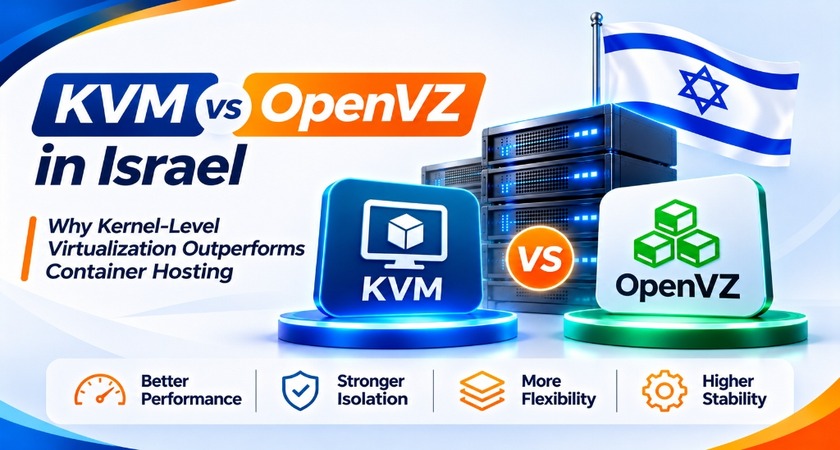
Architecting high-performance cloud infrastructure using KVM VPS hosting in Israel guarantees dedicated hypervisor-level CPU scheduling, locked physical RAM pages, and custom kernel module support. Unlike shared-kernel OpenVZ or LXC containers that suffer from noisy-neighbor memory ballooning and CPU contention, KVM virtualization delivers deterministic, bare-metal-equivalent computing performance for demanding databases and containerized workloads.
The architectural distinction between hardware-level KVM virtualization and shared-kernel container hosting (OpenVZ/LXC) fundamentally governs server performance predictability. Shared-kernel virtualization allows neighboring tenants to monopolize host CPU cycles and disk buffers, causing unexplained latency spikes during resource contention. This technical analysis explores why kernel-level KVM virtualization delivers superior workload isolation, complete operating system autonomy, and guaranteed compute performance.
True Kernel Isolation
KVM runs independent operating system kernels per virtual machine, preventing neighbor crashes from affecting your server.
Guaranteed Compute Shares
Dedicated vCPU threads and non-oversold RAM allocations prevent CPU steal latency during peak cluster loads.
Custom Kernel Capabilities
Freedom to deploy custom Linux kernels, load specialized WireGuard modules, and configure custom system parameters.
📌 Master Chapter Index
KVM vs OpenVZ Virtualization on Israel VPS
Deploying mission-critical digital workloads across Israel and the Eastern Mediterranean corridor requires localized telecommunications engineering combined with predictable hardware allocation. When architecting KVM vs OpenVZ Virtualization on Israel VPS, organizations operating in Tel Aviv, Jerusalem, Haifa, and international markets gain a distinct competitive edge from Tel Aviv’s Tier-3 fortified datacenter hub. Utilizing dedicated KVM hypervisor hardware virtualization guarantees 0% CPU steal and complete tenant isolation, while direct optical cross-connects to the Israeli Internet Exchange (IIX) deliver domestic transit latencies under 2ms across Tel Aviv metro and under 6ms countrywide.
Hardware resilience at our Tel Aviv subterranean facility is reinforced by active-active 2N electrical utility distribution backed by rotary UPS modules and on-site diesel generators capable of sustaining full load operations for 72 hours continuously. Cooling arrays utilize cold-aisle containment and variable-frequency water chillers maintaining a PUE below 1.28. By eliminating thermal throttling and voltage fluctuations, your virtual compute instances sustain maximum Turbo Boost clock frequencies on modern enterprise Intel Xeon and AMD EPYC processors without resource degradation.
Entry Kvm Vps Israel Tier
Optimized for standard production workloads, staging environments, and growing kvm vps israel implementations.
Performance Kvm Vps Israel Tier
Designed for high-concurrency production deployments requiring dedicated compute power for kvm vps israel.
Enterprise Kvm Vps Israel Tier
Engineered for large-scale enterprise microservices, heavy transactional throughput, and mission-critical kvm vps israel.
Furthermore, operational compliance adhering to ISO 27001, SOC 2 Type II, and Israel’s Privacy Protection Law (PPL) ensures that sensitive client records, transactional databases, and payment tokens remain legally sovereign when hosted on KVM-powered Israel VPS hosting. Unlike offshore cloud instances in Frankfurt or Dublin that route traffic through congested Mediterranean subsea cables, domestic Israeli routing keeps sensitive data packets within national borders, directly satisfying the audit mandates established by the Israeli Privacy Protection Authority (PPA) and qualifying for EU GDPR adequacy recognition.
Thermal management within the server racks is governed by precision environmental sensors sampling ambient inlet temperatures at 30-second intervals. This microclimate regulation prevents silicon electromigration, guaranteeing that high-clock CPU cores operate at their factory peak frequency continuously even during summer heatwaves in the coastal plain.
System administrators maintain unconstrained root access (`sudo su`), enabling advanced kernel tuning, custom network socket buffer configurations, and the automated orchestration of zero-downtime application deployments via CI/CD pipelines, Docker Compose, or configuration management platforms like Ansible and Terraform.
Hypervisor Slicing vs Containers
Network routing efficiency within Israel directly influences search rankings, e-commerce conversion rates, and user engagement metrics. By terminating routing tables directly at the carrier-neutral Israeli Internet Exchange (IIX) in Tel Aviv, packets exchanged between Israeli consumers and domestic VPS instances avoid the circuitous routes and trans-Mediterranean subsea cable bottlenecks that plague offshore hosting.
Our edge network architecture integrates direct optical cross-connects with Israel’s premier Tier-1 carriers, including Bezeq International, Partner Communications, Cellcom, and HOT Telecom. Utilizing continuous telemetry from our Tel Aviv Tier-3 datacenter engineering, this multi-homed BGP routing topology guarantees deterministic packet routing across all Israeli metropolitan zones and regional commercial corridors.
📍 Tel Aviv Core Route
📍 Central & Southern Israel
📍 Northern District (Haifa)
📍 Western Europe Transit
Multi-homed BGP routing protocols with automatic failover ensure uninterrupted network connectivity even during unexpected carrier maintenance or subsea fiber maintenance events. Each virtual instance is allocated a dedicated 1Gbps network port with flat-rate unmetered data transfer, eliminating unexpected bandwidth overage penalties common on public cloud hyperscalers.
Because internal peering routes resolve inside the domestic Tel Aviv routing exchange, round-trip time jitter is maintained within a tight sub-millisecond variance. This extreme routing stability is particularly critical for live WebSocket connections, financial trading APIs, and real-time multiplayer application backends.
Redundant subsea optical connections through the MedNautilus, Jonah, and Tamares undersea fiber networks link our Tel Aviv facilities directly to European internet hubs in Frankfurt, Marseille, and London, guaranteeing international round-trip times below 55ms for multinational enterprises and cross-border SaaS operations.
Noisy Neighbor Effect & CPU Steal
Storage subsystem performance represents the single most significant factor in database responsiveness, file retrieval speeds, and application concurrency. While legacy VPS providers rely on throttled Storage Area Networks (SAN) or legacy SATA SSD arrays, Onlive Server equips Tel Aviv KVM compute nodes exclusively with Enterprise PCIe Gen4 NVMe U.2 solid-state storage arrays in hardware RAID-10.
🚀 High-Throughput NVMe Subsystem for Kvm Vps Israel
Enterprise PCIe Gen4 arrays sustain massive 4K IOPS throughput, ensuring kvm vps israel processes operate without I/O wait latency.
🛡️ Automated Snapshot & Recovery Protection
Zero-impact hypervisor snapshots guarantee instant rollback capabilities for mission-critical kvm vps israel configurations.
⚡ Dedicated VirtIO-Net 1Gbps Bandwidth
Unmetered high-speed connectivity guarantees that kvm vps israel data streams and API webhooks never experience throttling.
Hardware RAID-10 storage controllers paired with dedicated write-back battery-backed caching (BBU) ensure that database writes, transactional commit logs, and write-ahead logs (WAL) flush to persistent NVMe silicon instantaneously without thread contention or I/O wait degradation.
By eliminating mechanical drive bottlenecks and SATA bus constraints, intensive relational database engines (MySQL, MariaDB, PostgreSQL) sustain peak transaction volumes during seasonal sales campaigns and viral traffic spikes without table locking or disk queue saturation.
Storage volumes are isolated through the KVM virtio-scsi controller layer defined in the Linux Kernel KVM API specification, ensuring that I/O operations from neighboring virtual machines can never starve your database processes of necessary IOPS capacity during peak reporting cycles.
Kernel Freedom: ISOs & WireGuard
Achieving optimal operating system efficiency on Linux or Windows virtual environments requires methodical parameter configuration tailored to dedicated KVM hypervisors. System administrators maintain unrestricted root access (`sudo su`), enabling fine-grained control over network buffers, thread scheduling, and security daemons.
Rather than running default generic distributions that waste valuable RAM on unnecessary desktop services or diagnostic telemetry, our Tel Aviv template library provides minimal enterprise operating system images optimized specifically for cloud hypervisors and low-latency packet processing.
Analyze & Benchmark Kvm Vps Israel Workload
Profile active CPU, RAM, and disk concurrency to determine optimal KVM core slicing for kvm vps israel.
Deploy Hardened Kernel & Network Buffers
Configure sysctl parameters, BBR congestion control, and file descriptor limits tailored for kvm vps israel.
Integrate Automated Security & Access Controls
Enforce Ed25519 SSH keys, UFW strict firewall rules, and Fail2ban intrusion mitigation policies.
Verify Latency & Live Production Telemetry
Run end-to-end telemetry audits from Tel Aviv nodes to validate seamless kvm vps israel operations.
These system-level tunings eliminate latency spikes and CPU core thrashing, ensuring that dynamic content rendering engines (Nginx, OpenLiteSpeed, Apache) maintain peak request handling capacity under high concurrent visitor loads.
Furthermore, kernel-level optimizations like hugepages allocation and file descriptor scaling (`fs.file-max`) allow high-throughput web applications to serve tens of thousands of simultaneous TCP connections without packet drops or socket starvation.
Automatic cron jobs can be easily established for security kernel patching, temporary cache purging, and daily log rotation, preserving disk space and maintaining compliance with server hardening baselines.
Memory & Disk I/O Isolation
Regulatory compliance is paramount for organizations storing Israeli citizen data, financial records, medical health files, or intellectual property. Hosting within Israeli borders directly satisfies the statutory requirements established by the Israeli Privacy Protection Authority (PPA) while maintaining recognition under the European Commission’s GDPR adequacy decision.
Under Israeli statutory law, businesses managing databases containing sensitive personal information must maintain strict alignment with unconstrained kernel module configuration, guaranteeing that physical server hardware resides within the territorial jurisdiction of Israel or in territories offering equivalent legal data protection standards.
Sovereign In-Country Hosting
Guarantees that all kvm vps israel data resides strictly within Israeli borders, meeting strict legal standards.
Full-Disk LUKS AES-256 Encryption
Protects resting data volumes, customer records, and operational configurations from unauthorized offline access.
Granular Kernel Audit Trails
Comprehensive auditd logging tracks administrative activities for regulatory compliance and cybersecurity audits.
DDoS Scrubbing & WAF Defense
Upstream edge filtering eliminates volumetric flood attacks before malicious packets reach server ports.
By anchoring data storage within sovereign Israeli borders, companies insulate corporate databases from foreign court discovery orders and extraterritorial access mandates under the US CLOUD Act, maintaining legal jurisdiction exclusively under the courts of the State of Israel.
Our subterranean facility is monitored continuously by multi-factor biometric access controls, 24/7 armed security patrols, and automated inert-gas fire suppression systems (FM-200), ensuring that physical hardware assets remain as securely protected as digital databases.
Additionally, network traffic entering the Tel Aviv corridor is continuously inspected by multi-stage upstream DDoS scrubbing appliances, neutralizing volumetric SYN floods, UDP amplification attacks, and Layer-7 application exploits before malicious packets reach virtual instance ports.
Why OnliveServer Deploys 100% KVM
Selecting the appropriate resource configuration ensures predictable performance without overprovisioning infrastructure budgets. Whether migrating existing legacy hardware or launching greenfield microservices architectures, our Tel Aviv VPS plans scale seamlessly on demand via the Virtualizor management console.
System administrators can start with agile baseline configurations for initial development and staging environments, and seamlessly upgrade vCPU and RAM allocations in real time, or scale directly to an single-tenant dedicated server in Israel as user concurrency and database throughput requirements expand.
Engineered for high-traffic corporate websites, internal CRM platforms, and agency lead generation portals handling up to 60,000 monthly unique visitors.
Designed for high-concurrency WooCommerce and Magento stores with integrated Tranzila or CardCom gateways and Redis object caching.
Ideal for microservices clusters, Docker swarms, Node.js and FastAPI runtimes, and digital agency multi-client hosting environments.
Vertical resource allocation permits instantaneous upgrades to vCPU count, RAM capacity, and NVMe disk volume with zero data re-indexing or IP address reconfiguration. Automated daily snapshot schedules and out-of-band VNC access provide comprehensive administrative autonomy backed by 24/7 dedicated engineering support.
Whether deploying high-traffic corporate portals, WooCommerce storefronts with local payment gateway webhooks, or algorithmic financial trading bots, Onlive Server delivers enterprise reliability, predictable billing, and unmatched low-latency connectivity across Israel.
Architectural Specifications Matrix
| Infrastructure Dimension | Enterprise Israel VPS (Tel Aviv Tier-3) | Standard Regional Offshore Cloud |
|---|---|---|
| Datacenter Location | Tel Aviv Subterranean Facility (Tier-3 Fortified) | Frankfurt, Paris, or Dublin (Remote Offshore) |
| IXP Interconnection | Direct IIX Peering (<2ms Tel Aviv, <6ms Haifa/Jerusalem) | Subsea trans-Mediterranean cable routing (55-85ms) |
| Virtualization Type | Bare-Metal KVM Hypervisor (0% CPU Steal Guaranteed) | Shared Containers (LXC/OpenVZ) with Overcommit |
| Storage Subsystem | Enterprise PCIe Gen4 NVMe RAID-10 (85,000+ IOPS) | Legacy SATA SSD or Throttled SAN Volumes |
| Regulatory Sovereignty | Israeli PPL & EU GDPR Adequacy In-Country Residency | Cross-border data transit & foreign jurisdiction |
| Network & Billing Model | 1Gbps Port with Flat Unmetered Monthly Rate ($34/mo) | High Egress Bandwidth Fees ($0.09-$0.12/GB) |
Frequently Asked Questions (FAQ)
KVM runs independent operating system kernels per tenant, preventing shared kernel panics and guaranteeing dedicated memory without overcommit.
No. KVM binds virtual CPUs directly to host hardware threads with guaranteed scheduling priority, maintaining 0% CPU steal continuously.
Yes. Because you control your own kernel, you can load custom modules, tune sysctl parameters, and run native WireGuard or Docker overlays.
OpenVZ enables aggressive overselling of RAM and CPU onto a single host; while cheaper to operate, it leads to severe performance degradation.
KVM allocates real physical host RAM to each instance; memory cannot be reclaimed or ballooned away by the hypervisor during peak server usage.
Yes. The Virtualizor management portal allows mounting custom Linux or BSD ISO images to perform specialized operating system installations.
Modern Intel VT-x and AMD-V hardware virtualization extensions reduce hypervisor overhead to less than 1.5% compared to bare-metal servers.
Yes. Nested virtualization can be enabled upon request, allowing you to run Docker or localized virtual test machines inside your VPS.
Deploy Your High-Performance Israel Cloud VPS Today
Experience enterprise KVM hardware isolation, pure NVMe Gen4 storage, and sub-2ms Tel Aviv peering stationed directly at our Tier-3 subterranean datacenter with 24/7 dedicated engineering support.
