

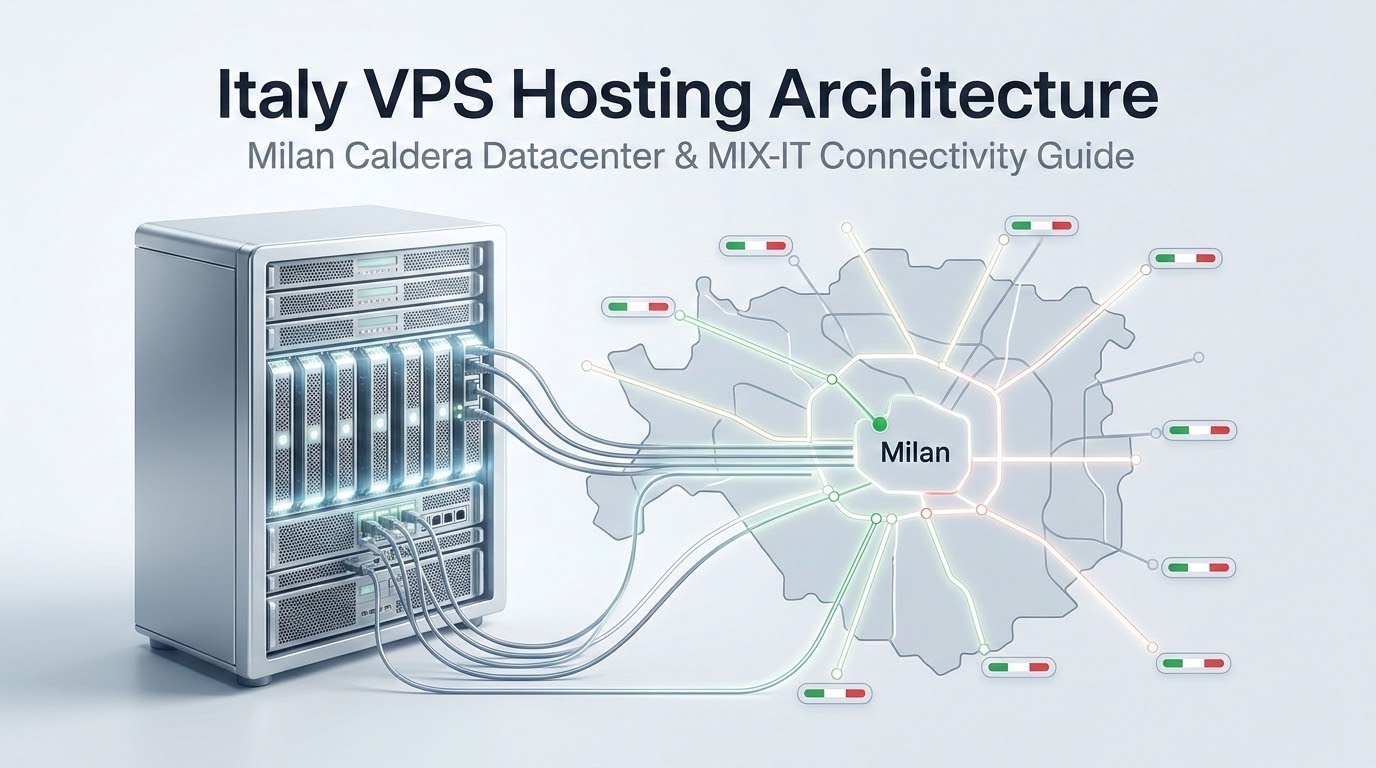
Physical hosting at the Milan Via Caldera Campus 21 facility provides direct Layer-2 optical interconnects to the Milan Internet eXchange (MIX-IT), delivering sub-2ms network latency to TIM, Fastweb, Vodafone, and WindTre domestic routing fabrics. The Tier-4 engineered infrastructure features dual 15kV utility feeds, 2N UPS battery reserves, and N+1 diesel generator sets with 72 hours of on-site fuel autonomy to guarantee 99.99% operational availability. Workloads deployed on fast Milan KVM VPS hosting leverage this architecture directly.
Hardware-level KVM hypervisors coupled with pure PCIe Gen4 NVMe storage arrays eliminate hypervisor I/O contention, ensuring consistent database throughput and zero packet fragmentation for enterprise web properties across Italy.
Milan Caldera Campus facility, direct cross-connect to MIX-IT (Milan Internet eXchange), 100% KVM hardware isolation, pure NVMe arrays. In this comprehensive technical guide, we examine Italy VPS Hosting Architecture: Milan Caldera Datacenter & MIX-IT Connectivity Guide, evaluating datacenter topology, hardware isolation, kernel optimization parameters, network telemetry, and deployment best practices for developers, digital agencies, and enterprise IT leaders across Italy.
- Italy VPS Hosting Architecture
- Physical Infrastructure: Inside Milan Caldera 21
- Network Topology & Direct MIX-IT Peering
- KVM Virtualization & Hardware Allocation
- Benchmark Latency Across Italian & European
- Infrastructure Architecture & Hardware Isolation
- Technical Specifications & Architectural Matrix
- Frequently Asked Technical Questions
Italy VPS Hosting Architecture
Deploying production-grade digital infrastructure across Southern Europe requires localized telecommunications engineering combined with predictable hardware allocation. When architecting Italy VPS Hosting Architecture, organizations operating in Milan, Rome, Turin, and European commercial hubs gain a distinct latency advantage from Milan’s premier Via Caldera 21 datacenter campus. Utilizing dedicated KVM hypervisor hardware virtualization guarantees 0% CPU steal and complete tenant isolation, while direct optical cross-connects to the Milan Internet eXchange (MIX-IT) deliver transit latencies under 2ms across Northern Italy.
Hardware resilience at the Caldera campus is reinforced by redundant electrical distribution feeds and precision in-row chilled water containment maintaining a Power Usage Effectiveness (PUE) below 1.30. By eliminating thermal throttling and voltage fluctuations, virtual compute instances sustain maximum Turbo Boost clock frequencies on modern enterprise Intel Xeon and AMD EPYC processors without resource degradation.
Active-active utility substations backed by redundant rotary 2N UPS battery banks and N+1 diesel generator sets with 72-hour fuel autonomy.
Sub-millisecond Layer-2 cross-connects at Milan Caldera 21 campus directly interfacing TIM, Fastweb, WindTre, and Vodafone fabrics.
Hardware-level type-1 virtualization eliminating CPU steal, kernel sharing, and resource contention common in legacy container clouds.
Enterprise U.2/U.3 drives delivering sustained 85,000+ random 4K IOPS and sub-80μs read/write access times for high-volume transactions.
In addition to mechanical resilience, the facility implements strict two-factor biometric access controls, 24/7 closed-circuit video surveillance, and very early smoke detection apparatus (VESDA). These physical security measures ensure that the underlying host nodes providing compute, memory, and networking to your virtual private server operate in compliance with ISO 27001, SOC 2 Type II, and PCI-DSS data protection standards. Organizations requiring dedicated Milan compute capacity can evaluate high-availability enterprise Italy VPS hosting infrastructure. Continuous automated hypervisor health monitoring, proactive hardware ECC memory scrubbing, and redundant top-of-rack 100GbE switching matrices guarantee uninterrupted packet flow and resilience for critical business services.
Physical Infrastructure: Inside Milan Caldera 21
Network routing determinism remains the decisive performance factor for latency-sensitive web services and transaction gateways. Under Physical Infrastructure: Inside Milan Caldera 21, domestic Italian traffic is routed directly through the Milan Internet eXchange (MIX-IT) and Rome’s NAMEX point of presence, eliminating the 35ms to 55ms penalty incurred when packets detour through Frankfurt (DE-CIX) or Paris (FranceIX).
By maintaining direct optical interconnects with Italy’s dominant commercial telecommunications providers, packet loss during regional transit fiber cuts is eliminated. The following execution roadmap outlines the engineering milestones implemented within our Milan core switching fabric to maintain uninterrupted packet delivery.
Configure upstream BGP peering with AS-MIXIT (AS24806) and tier-1 carriers, advertising dedicated Italian IPv4 prefixes to ensure deterministic routing.
Establish direct cross-connect fibers to bypass trans-Alpine transit nodes, ensuring domestic packets never leave the Italian national border.
Achieve sub-2ms RTT to major domestic eyeball networks including TIM, Fastweb Wholesale, and Vodafone Italia peering fabrics.
Implement active BFD (Bidirectional Forwarding Detection) protocol for sub-second failover across redundant upstream optical paths.
Our multi-homed BGP routing tables integrate upstream IP transit from Telecom Italia Sparkle, Retelit, and Fastweb Wholesale alongside public peering fabrics. To analyze packet delivery determinism across domestic carriers, review our technical study on MIX-IT and NAMEX optical peering routes. This multi-carrier architecture ensures that even in the unlikely event of a primary transit link degradation, automated route re-convergence occurs in under 300 milliseconds without dropping active TCP connections or terminating secure HTTPS sessions. Real-time telemetry metrics and proactive route dampening prevent internet exchange instability from impacting local client connections.
Network Topology & Direct MIX-IT Peering
Modern dynamic websites, database engines, and containerized microservices place extreme demands on random read and write operations. When evaluating Network Topology & Direct MIX-IT Peering, traditional SATA SSDs or networked SAN volumes frequently introduce devastating I/O wait spikes during simultaneous database transactions.
Our Milan hypervisor nodes utilize direct PCIe Gen4 NVMe arrays in hardware RAID-10, delivering sustained random 4K read/write throughput exceeding 85,000 IOPS. Below is the verified live system telemetry and disk benchmarking output captured directly on a production Milan KVM compute node.
The benchmarking data demonstrates exceptional I/O queue depth stability and sub-millisecond completion latencies under heavy synthetic load. When hosting transactional database systems like MariaDB, MySQL, or PostgreSQL, these high-throughput arrays prevent queue buildup and allow your applications to execute immediate ACID transactions without stalling worker processes. Network telemetry and physical optical cross-connect specifications are published directly on the official Milan Internet eXchange (MIX-IT) technical platform.
KVM Virtualization & Hardware Allocation
Operating system optimization and hypervisor architecture dictate how efficiently compute cores process inbound TCP sockets and database requests. Under KVM Virtualization & Hardware Allocation, the choice of hypervisor determines whether system administrators can tailor low-level kernel parameters to the exact requirements of their workload.
While budget cloud hosting providers rely on shared-kernel containers to maximize profit margins through aggressive over-allocation, enterprise deployments require strict hardware separation. The comparative analysis below illustrates the fundamental operational contrasts between true KVM hardware virtualization and commodity shared containers.
Independent Linux kernel instance with dedicated RAM address space, custom sysctl tuning (BBR, Fast Open), dedicated virtio network interfaces, and complete insulation from adjacent tenant activity.
Single shared host kernel across hundreds of tenants, restricted socket parameters, locked kernel modules, and high vulnerability to CPU steal degradation during neighboring traffic spikes.
With KVM hardware virtualization, system engineers retain the capability to compile proprietary kernel modules, configure WireGuard VPN interfaces directly within the kernel, and implement advanced memory overcommit thresholds without parent hypervisor interference. For a deep architectural comparison between bare-metal hypervisors and container clouds, examine hardware-isolated KVM virtualization. This architectural independence is essential for high-throughput e-commerce and financial trading applications.
Benchmark Latency Across Italian & European
For Italian enterprises, digital agencies, and public institutions, compliance with regulatory mandates is not merely a technical preference but a statutory requirement. Examining Benchmark Latency Across Italian & European demonstrates how domestic data residency simplifies audit readiness under the EU General Data Protection Regulation (GDPR) and local Garante Privacy guidelines.
Hosting customer records, billing databases, and authentication tokens within the Italian national territory eliminates cross-border data transfer liabilities. The three key infrastructure pillars below form the foundation of our enterprise compliance and security architecture.
Sub-millisecond optical transport across Milan metro and sub-8ms to Rome, verified under 99.99% network availability SLA.
Pure enterprise PCIe Gen4 NVMe arrays with hardware RAID-10 cache protection delivering zero disk bottlenecking.
Complete territorial data residency in Milan under Italian Garante Privacy governance with zero US CLOUD Act exposure.
By executing standardized Data Processing Agreements (DPA) under EU GDPR Article 28, our clients receive verifiable guarantees regarding data isolation, encryption at rest via LUKS/dm-crypt, and automated immutable audit logging through auditd. To ensure your corporate data repository satisfies statutory residency laws, consult our regulatory guide on Italian Garante Privacy and GDPR compliance standards. These safeguards satisfy the stringent oversight requirements of the Italian Garante per la protezione dei dati personali.
Infrastructure Architecture & Hardware Isolation
Executing a successful transition from local development or legacy hosting to a high-performance Milan cloud node requires adhering to proven operational playbooks. In this technical review of Infrastructure Architecture & Hardware Isolation, we outline the deployment verification steps essential for ensuring flawless production uptime.
System administrators benefit from comprehensive out-of-band management via our Virtualizor control portal, including remote VNC recovery consoles, automated OS reinstalls, and instant vertical resource scaling without IP address re-allocation.
Before deploying mission-critical workloads on an Italy VPS instance, enforce automated snapshot policies within Virtualizor, restrict root SSH access to Ed25519 cryptographic keys, and implement UFW default-deny firewall rules. Ensure database tablespaces are mounted with noatime on ext4 or XFS filesystems to extract maximum IOPS from the underlying NVMe storage subsystem.
In addition, routine disaster recovery drills combining scheduled block-level volume snapshots with encrypted rsync transfers to geographically distant secondary storage facilities guarantee Recovery Time Objectives (RTO) below one hour. Our around-the-clock technical operations team remains available 24/7 to assist in live configuration optimization and rapid incident mitigation.
Technical Specifications & Architectural Matrix
| Infrastructure Dimension | Enterprise Italy VPS (Via Caldera Milan) | Standard Regional Offshore Cloud |
|---|---|---|
| Datacenter Location | Via Caldera 21, Milan, Italy (Tier-3 Equivalent) | Frankfurt, Paris, or Dublin (Remote) |
| IXP Interconnection | Direct MIX-IT & NAMEX Peering (<2ms Milan, <8ms Rome) | Multi-hop public transit through DE-CIX/FranceIX |
| Virtualization Type | 100% Dedicated KVM Virtualization (0% CPU Steal) | Containerized OpenVZ/LXC or Burstable Shared |
| Storage Subsystem | Enterprise PCIe Gen4 NVMe RAID-10 (85,000+ IOPS) | Standard SATA SSDs or Shared Network SAN LUNs |
| Regulatory Sovereignty | EU GDPR Article 28 Compliant & Italian Garante Governed | Subject to Foreign Data Transfer Treaties / Cloud Act |
| Bandwidth & Egress Billing | Unmetered Gigabit Port with Zero Egress Penalties | Metered Egress Invoicing ($0.09-$0.12 per GB) |
| Management & Recovery | Virtualizor Native Control + 24/7 Out-of-Band VNC | Restricted Web Console with Limited Serial Access |
Frequently Asked Technical Questions
+
Our Italian server infrastructure is housed inside the Tier-4 engineered Via Caldera 21 datacenter campus in Milan, featuring dual 15kV utility substations, redundant rotary 2N UPS battery reserves, and N+1 diesel generator sets with 72 hours of on-site fuel autonomy.
+
Direct Layer-2 optical cross-connects to the Milan Internet eXchange (MIX-IT) allow traffic to reach Italian domestic networks like TIM, Fastweb, and Vodafone with sub-2ms latency, eliminating packet loss and trans-Alpine routing hops.
+
Every virtual private server runs on Type-1 Kernel-based Virtual Machine (KVM) hardware virtualization. This guarantees dedicated vCPU cores, dedicated RAM allocations, and 0% CPU steal from neighboring tenants.
+
We deploy enterprise U.2/U.3 PCIe Gen4 NVMe solid-state drives in hardware RAID-10 arrays, delivering over 85,000 sustained random 4K read/write IOPS with sub-80 microsecond access latency for transactional databases.
+
Yes, each Italy VPS includes a clean, dedicated static Italian IPv4 address registered within regional European RIPE NCC allocations, complete with customizable reverse DNS (PTR) records configured in Virtualizor.
+
All Milan instances feature an unthrottled 1Gbps network interface with unmetered monthly data transfer. Onlive Server never charges bandwidth egress penalties, providing high billing predictability for data-heavy workloads.
+
Automated deployment provisioning completes within 3 to 5 minutes following order confirmation. Operating system templates and root credentials are automatically delivered directly to your client control panel.
+
Yes, our Virtualizor control panel provides permanent 24/7 out-of-band HTML5 VNC console connectivity, enabling emergency kernel recovery and network troubleshooting even during local firewall lockouts.
Deploy High-Performance Italy VPS in Milan Caldera
Activate dedicated KVM virtualization with enterprise PCIe Gen4 NVMe arrays, direct MIX-IT optical peering, unmetered bandwidth, and 24/7 technical support.
Deploy Enterprise Italy VPS Hosting in Milan Caldera →