

What Technical Measures Are Required for KVKK Law No. 6698 Compliance on Turkey VPS?
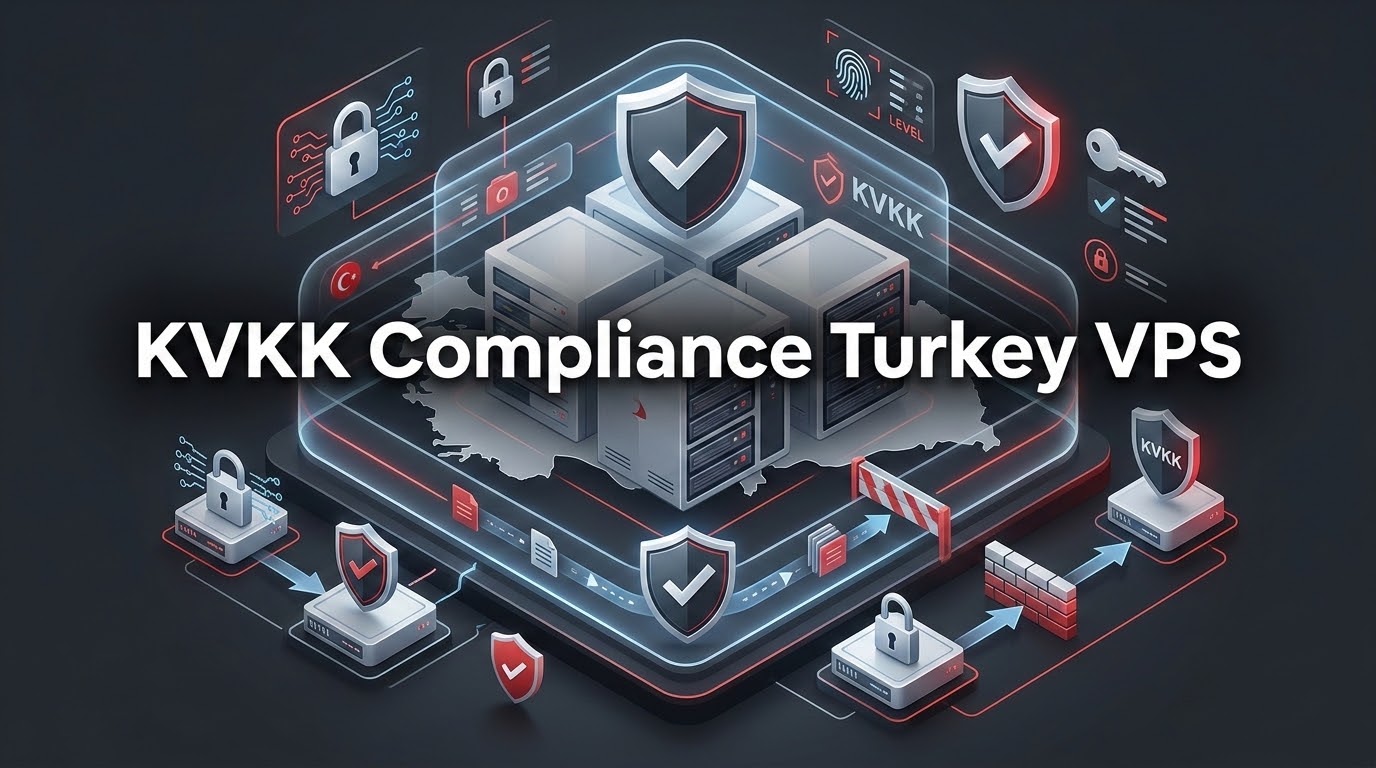
Deploying an Istanbul cloud server fulfills KVKK compliance Turkey VPS standards under Law No. 6698. In fact, it keeps customer databases within sovereign national boundaries.
Consequently, local hosting eliminates complex cross-border transfer liabilities under Article 9. Therefore, this protects organizations against severe Personal Data Protection Authority (KVKK) fines.
Mandatory technical safeguards include LUKS disk encryption, firewall isolation, and immutable audit logs. In addition, role-based database access prevents unauthorized exposure.
Data privacy compliance is an imperative legal mandate in Türkiye. The Personal Data Protection Authority (KVKK) strictly enforces compliance across all digital businesses.
Furthermore, storing Turkish citizen records on foreign hyperscale clouds triggers regulatory scrutiny. Specifically, Article 9 restricts cross-border transfers of financial and personal data.
Consequently, deploying a certified Turkey VPS hosting solution in Istanbul ensures legal compliance. In addition, domestic infrastructure guarantees complete data residency and audit readiness.
✔ Key Architectural Takeaways
- Consequently, Article 9 Cross-Border Restriction: Transferring Turkish citizens’ personal data to servers located outside Türkiye requires explicit consent (açık rıza) or bilateral binding corporate commitments approved by the KVKK Board.
- In addition, 100% Onshore Data Sovereignty: Hosting on Istanbul cloud VPS keeps primary databases, backups, and transaction logs physically within Turkish borders, completely bypassing cross-border transfer legal liabilities.
- In particular, KVKK Technical Measures Guide (Veri Güvenliği Rehberi): Compliance requires implementing technical safeguards: LUKS encryption at rest, TLS 1.3 in transit, strict role-based access control (RBAC), and centralized audit logging.
- Therefore, VERBİS Registration Alignment: Data controllers registered in the Data Controllers’ Registry (VERBİS) must accurately declare server geolocation and technical data security measures during regulatory audits.
- Moreover, Immutable Access Auditing: Administrative SSH logins, database query accesses, and privileged root commands must be logged and archived to prevent unauthorized data tampering or leaks.
Table of Contents
- Demystifying KVKK Law No. 6698: The Legal Framework for Turkish Cloud Data
- Data Sovereignty vs. Cross-Border Transfers: Deciphering Article 9 Liabilities
- The KVKK Technical Measures Guide: Mapping Legal Mandates to Sysadmin Actions
- Cryptographic Hardening: Full-Disk LUKS Encryption & Enforced TLS 1.3 Ciphers
- As a result, Access Governance: Least Privilege, Multi-Factor Authentication & Audit Logging
- Specifically, VERBİS Registration & Board Audits: Documenting Infrastructure Safeguards
- KVKK Compliance Checklist Matrix: Legal Requirement vs. Technical Control
- Production Administrator Runbook: Hardening an Ubuntu Turkey VPS for KVKK
- In addition, Frequently Asked Questions (FAQ)
Demystifying KVKK Law No. 6698: The Legal Framework for Turkish Cloud Data
Enacted in April 2016, Turkish Personal Data Protection Law No. 6698 governs personal data handling. Specifically, the statute closely mirrors the European Union’s GDPR.
In addition, any organization processing citizen data is classified as a Data Controller. This includes e-commerce shops, SaaS startups, private hospitals, and accounting practices.
Therefore, violations carry severe consequences. The KVKK Board routinely levies administrative fines reaching millions of Turkish Liras for non-compliance.
Furthermore, the Turkish Penal Code imposes prison terms for unlawful data recording. As a result, corporate officers bear direct legal responsibility for data security failures.
Data Sovereignty vs. Cross-Border Transfers: Deciphering Article 9 Liabilities
Article 9 of Law No. 6698 governs cross-border personal data transfers. In fact, it represents the primary compliance hurdle for online services in Türkiye.
Under Article 9, citizen records cannot leave Türkiye without strict legal mechanisms. For example, companies must obtain explicit consent or Board-approved transfer agreements.
Meanwhile, hosting applications in Frankfurt, Paris, or Dublin constitutes an international transfer. Every checkout or user registration triggers regulatory liabilities.
In contrast, an Istanbul cloud VPS keeps all processing strictly within Turkish borders. Consequently, this eliminates Article 9 transfer risks and compliance penalties entirely.
The KVKK Technical Measures Guide: Mapping Legal Mandates to Sysadmin Actions
Complying with KVKK requires more than publishing an online privacy policy. In fact, the Board published an explicit Technical Measures Guide for production hosting environments.
Specifically, data controllers must implement robust cybersecurity safeguards. These include network firewalls, access controls, encrypted disks, and immutable logging.
Failing to establish these controls is treated as negligence during audit investigations. As a result, non-compliant firms face maximum statutory enforcement penalties.
Enterprises must enforce statutory data security measures. Therefore, these requirements are codified in the official Law No. 6698 text on Mevzuat.gov.tr.
Cryptographic Hardening: Full-Disk LUKS Encryption & Enforced TLS 1.3 Ciphers
The Technical Measures Guide requires data encryption both in transit and at rest. Therefore, administrators must secure network streams and physical storage arrays.
Encryption in Transit: Web applications must enforce modern TLS 1.3 or TLS 1.2 protocols. In addition, legacy protocols like SSLv3 and weak ciphers must be disabled.
Encryption at Rest: Database tables containing sensitive citizen data require AES-256 cryptographic algorithms. In fact, this prevents unauthorized reading of stored records.
On Linux instances, administrators utilize LUKS block device encryption. Consequently, raw disk data remains unreadable without the proper decryption key.
Access Governance: Least Privilege, Multi-Factor Authentication & Audit Logging
Section 2.3 of the Technical Measures Guide mandates strict access governance. Specifically, systems administrators must enforce the Principle of Least Privilege across all instances.
- Consequently, Eliminating Shared Root Accounts: System administrators must never share generic root login credentials. Each systems engineer must have an individual named user account with personal SSH cryptographic key pairs.
- In addition, Multi-Factor Authentication (MFA): Administrative access to cloud management panels, control panels, and SSH bastions must require time-based one-time password (TOTP) verification.
- In particular, Comprehensive Audit Trails (Linux Auditd): All administrative privilege escalations (
sudocommands), sensitive directory modifications (/var/lib/mysql/,/etc/passwd), and failed authentication attempts must be recorded via the Linux Audit daemon and forwarded to an append-only remote log server to prevent tamper erasure.
VERBİS Registration & Board Audits: Documenting Infrastructure Safeguards
Qualifying businesses must register with the Data Controllers’ Registry Information System (VERBİS). In fact, registration requires disclosing technical safeguards and data locations.
Specifically, companies must state whether personal data resides domestically or abroad. Hosting in Istanbul ensures positive answers on regulatory audit questionnaires.
Furthermore, ISO 27001 certified physical security and automated backup recovery provide evidentiary proof. As a result, this satisfies regulatory Board inspections completely.
KVKK Compliance Checklist Matrix: Legal Requirement vs. Technical Control
Additionally, this matrix shows how KVKK Technical Measures map to concrete server configurations on a Turkey Cloud VPS:
| KVKK Technical Requirement | Legal Mandate (Veri Güvenliği Rehberi) | Production Linux Server Implementation |
|---|---|---|
| Ağ Güvenliği (Network Security) | Prevent unauthorized external network access | UFW/nftables default drop, Fail2ban brute-force jails |
| Veri Aktarımı Güvenliği (Transit Security) | Protect data from interception on public networks | Enforce TLS 1.3 / TLS 1.2 with ECDHE PFS ciphers + HSTS |
| Şifreleme (Encryption at Rest) | Safeguard physical data files from unauthorized extraction | LUKS AES-256 partition encryption, MariaDB data-at-rest encryption |
| Kullanıcı Yetkilendirme (Access Governance) | Restrict administrative privileges to authorized staff | SSH Ed25519 public key auth only, root login disabled, sudo RBAC |
| Güvenlik Olayı Yönetimi (Security Auditing) | Capture immutable logs of system and data access | Linux auditd rules on database files, centralized remote rsyslog |
| Yedeklilik ve Dayanıklılık (Disaster Recovery) | Ensure continuous data availability and backup recovery | Automated encrypted offsite snapshots, tested restore runbooks |
Production Administrator Runbook: Hardening an Ubuntu Turkey VPS for KVKK
Execute this administrative bash runbook to enforce baseline technical measures on an Istanbul cloud VPS:
Executing these commands establishes an audit-ready technical foundation. In fact, it satisfies KVKK guidelines and protects your organization from penalties.
Frequently Asked Questions (FAQ)
Legal Framework & Data Residency FAQ
Technical Security & Operational Inquiries
Guarantee Full KVKK Law No. 6698 Compliance in Istanbul
Safeguard customer data within sovereign Turkish borders on ISO 27001 certified hardware. Eliminate cross-border transfer risks and fulfill VERBİS technical measures today.
