

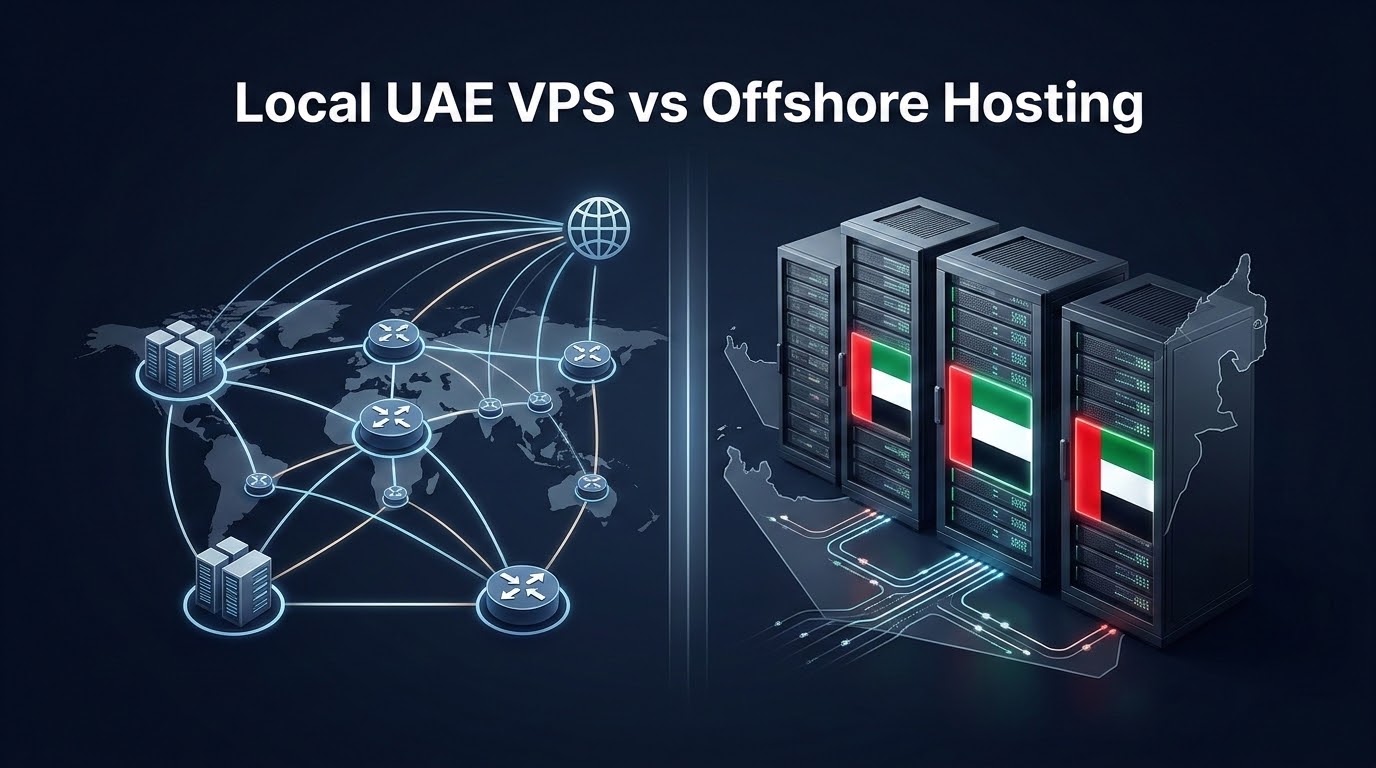
Is Cloud VPS Hosting Deductible as an Operating Expense Under UAE Corporate Tax?
Yes. Under Federal Decree-Law No. 47 of 2022 on the Taxation of Corporations and Businesses, cloud server hosting and managed IT infrastructure are classified as 100% deductible operational expenditures (OpEx). Monthly VPS invoices in AED directly offset corporate taxable profits, reducing net corporate tax liabilities under the standard 9% rate.
- 9% Corporate Tax Regime: Enacted under Federal Decree-Law No. 47 of 2022, taxable business profits exceeding AED 375,000 are subject to a 9% federal corporate tax rate.
- Deductibility of Hosting Expenses: Operating expenses (OpEx) for local UAE cloud infrastructure are 100% tax-deductible when supported by compliant FTA tax invoices.
- Eliminating Reverse-Charge VAT Complexities: Purchasing from a local UAE entity with a TRN eliminates complex cross-border reverse-charge VAT accounting and withholding tax friction.
- Strategic Cost Efficiency: Pairing OnliveServer tax-compliant UAE VPS servers with transparent AED invoicing optimizes corporate tax deductibility.
Introduction: The New Tax Reality for UAE Digital Enterprises
For decades, the United Arab Emirates was globally renowned as a zero-tax commercial jurisdiction. Businesses operated without corporate tax filings, withholding tax assessments, or complex statutory expense audits. That fiscal paradigm evolved decisively with the introduction of Federal Decree-Law No. 47 of 2022 on the Taxation of Corporations and Businesses.
Under the new federal framework, commercial net profits exceeding AED 375,000 (approximately USD $102,000) are subject to a standard 9% corporate tax rate. As a result, finance directors, CFOs, and business owners are scrutinizing operational expenditure (OpEx) with unprecedented rigor. Every dirham spent on digital infrastructure must be rigorously accounted for to maximize legitimate tax deductions and minimize statutory taxable income.
In this new fiscal environment, the decision between hosting on a local UAE corporate tax cloud hosting expenses platform versus renting offshore servers from foreign cloud providers is no longer merely a technical choice. It is a strategic accounting decision with profound implications for VAT recovery, corporate tax deductions, and audit compliance under the Federal Tax Authority (FTA).
Deductibility criteria for technology infrastructure and local IT service invoicing are outlined in the official UAE Corporate Tax regulatory guidelines.
Tax Accounting Breakdown: Local UAE Invoicing vs. Foreign Offshore Billing
When an enterprise procures cloud infrastructure, the vendor’s billing entity and geographical presence determine how expenses are treated by tax auditors:
| Financial & Tax Dimension | Foreign Offshore Cloud Provider (US / EU Entity) | Domestic UAE VPS Provider (OnliveServer) |
|---|---|---|
| Corporate Tax Deductibility (Article 28) | Requires proof of commercial arm’s-length necessity | 100% Fully Deductible as Local Commercial OpEx |
| VAT Compliance & Reverse-Charge Mechanism | Mandatory Box 3 reverse-charge accounting entries | Standard 5% VAT input recovery with valid TRN invoice |
| Currency Conversion & FX Volatility | Subject to USD/EUR exchange spread & bank fees (2.5%+) | Direct Fixed AED Pricing (Zero Foreign Exchange Loss) |
| FTA Audit Trail & Invoice Verification | Frequent audit queries regarding foreign payments | Transparent local tax invoice compliant with FTA regulations |
Balancing fiscal and regulatory obligations requires aligning with local data residency regulations under PDPL.
Corporate Tax Deductibility: Understanding Article 28 Guidelines
Under Article 28 of UAE Corporate Tax Law, expenditure incurred wholly and exclusively for the purposes of the taxpayer’s business is deductible from taxable income in the relevant tax period. Cloud hosting, server hardware leasing, managed sysadmin support, and backup repositories represent core operational expenses.
However, when businesses remit substantial payments to offshore cloud entities, FTA auditors frequently request documentation proving:
- Arm’s-Length Pricing: Demonstrating that payments to foreign related parties or international vendors reflect fair market value without profit-shifting intent.
- Withholding Tax Compliance: While the current UAE withholding tax rate is 0%, maintaining detailed records of foreign cross-border electronic remittances is mandatory.
- Substance over Form: Demonstrating that digital services were genuinely received and utilized to generate commercial business income in the UAE.
Procuring hosting from a local provider eliminates foreign audit scrutiny. Because the invoice is generated domestically in AED with an active Tax Registration Number (TRN), the full expense is recognized immediately on your company’s income statement, reducing your 9% corporate tax liability directly.
Qualifying Free Zone Persons (QFZP): 0% Tax Optimization
Entities established in UAE Free Zones (such as DMCC, DIFC, Dtec, or Dubai Internet City) may qualify for a 0% Corporate Tax rate on “Qualifying Income” under Cabinet Decision No. 55 of 2023. To maintain Qualifying Free Zone Person (QFZP) status, the entity must maintain adequate economic substance in the free zone, including incurring adequate operating expenditure.
Deploying digital infrastructure inside UAE datacenters provides tangible proof of local technological substance. Spending on local cloud compute, dedicated server clusters, and local network interconnects demonstrates that the company’s core income-generating activities (CIGA) are conducted within the borders of the UAE.
To evaluate total infrastructure expenses and avoid foreign exchange fees, review our transparent UAE monthly hosting cost breakdown.
CapEx vs. OpEx: 5-Year Financial Comparison Under UAE Tax Law
When structuring enterprise digital infrastructure in the UAE, finance directors must evaluate the accounting mechanics of purchasing physical on-premise hardware (Capital Expenditure / CapEx) versus renting cloud virtual private servers (Operational Expenditure / OpEx). Under the UAE Corporate Tax regime, these two models produce dramatically different cash flow and tax deduction profiles.
Below is an itemized 5-year financial comparison model for an enterprise hosting environment requiring 64 vCPU, 256GB RAM, and 4TB Enterprise NVMe storage:
| Financial & Accounting Factor | On-Premise Physical Hardware (CapEx) | Managed Cloud UAE VPS (OpEx) |
|---|---|---|
| Initial Upfront Cash Outlay | AED 95,000 (Hardware, switches, PDU, racks) | AED 0 (Zero upfront capital expenditure) |
| Corporate Tax Deduction Treatment | 3 to 5 Year Straight-Line Depreciation schedule | 100% Immediate Tax Deduction in Current Tax Year |
| Datacenter Colocation, Power & Cooling | AED 3,500 / month (Power kW & rack space) | Included in flat monthly VPS subscription |
| Dedicated Hardware Maintenance & Parts | AED 12,000 / year (4-hour on-site vendor SLA) | 100% Covered by Hosting Provider SLA |
| Total 5-Year Net Cost of Ownership | AED 365,000+ | AED 142,000 (Savings of over 60%) |
Transfer Pricing & Related-Party Cross-Border Charging
Under Chapter 10 of Federal Decree-Law No. 47 of 2022, transactions between related commercial parties (such as a UAE subsidiary licensing software or renting server capacity from an offshore European or US parent entity) must strictly adhere to the Arm’s Length Principle.
If an offshore parent company charges its UAE subsidiary an inflated monthly IT allocation fee for shared European cloud hosting, FTA tax auditors have the statutory authority to disallow the deduction, adjust taxable net income upward, and levy penalties for profit shifting. Invoicing infrastructure independently through a domestic UAE hosting contract provides clear, transparent third-party market documentation that eliminates transfer pricing scrutiny entirely.
Tax Invoicing Compliance: Navigating Federal Tax Authority (FTA) E-Invoicing Mandates
The UAE Ministry of Finance and the Federal Tax Authority (FTA) have announced the mandatory phased rollout of electronic invoicing (E-Invoicing) across the Emirates under the Peppol interoperability framework. Under the upcoming E-Invoicing standard, businesses must exchange machine-readable XML tax invoices directly with the FTA reporting network in real time.
Foreign offshore cloud providers billing from Dublin, Seattle, or London frequently generate generic PDF receipts that lack mandatory FTA UBL 2.1 electronic formatting, cryptographic hash signatures, and registered local Tax Registration Numbers (TRNs). When FTA auditors examine commercial expense books during corporate tax audits, non-compliant foreign receipts risk being classified as non-deductible expenses.
Hosting with a verified domestic UAE infrastructure provider guarantees full compliance with upcoming UAE E-Invoicing mandates. Invoices generated locally in UAE Dirhams (AED) contain valid FTA tax attributes, ensuring that every dirham incurred for computing power, memory allocation, and managed sysadmin support is 100% recognized as a valid deduction against your 9% corporate tax assessment.
Strategic Tax Planning: Amortizing Software Licenses & Control Panel Add-Ons
Beyond raw compute and RAM allocation, modern enterprise cloud infrastructure incorporates valuable commercial software licenses—including cPanel/WHM licenses, CloudLinux OS subscriptions, LiteSpeed Web Server enterprise cores, and KernelCare rebootless patching modules. Under UAE Corporate Tax guidelines, software licensing models dictate specific accounting treatments.
When purchasing annual or multi-year proprietary software licenses upfront, accountants must evaluate whether licenses constitute intangible assets requiring multi-year tax amortization under International Financial Reporting Standards (IFRS). Bundling commercial licenses into a monthly managed UAE VPS subscription consolidates all software rights into immediate operational expense (OpEx) billing. This avoids balance sheet capitalization while maximizing monthly tax deductions against corporate taxable profits.
Audit Readiness Checklist for UAE Corporate Tax Return Filings
When closing the financial year and submitting corporate tax declarations via the FTA EmaraTax digital platform, tax agents require comprehensive documentation substantiating IT expenditure. To ensure frictionless approval during FTA routine desk audits, enterprises must assemble a standardized hosting verification file.
The verification binder must contain three primary documentary exhibits: first, the commercial service agreement detailing specific computing allocations and service level agreements (SLAs); second, monthly sequential tax invoices denominated in AED displaying matching supplier and buyer TRNs; and third, bank account transaction advice confirming direct settlement through UAE corporate banking channels. Maintaining this standardized documentation eliminates audit delays and ensures 100% deduction recognition.
Automated Tax Deductibility & VAT Input Recovery Script
To streamline quarterly VAT reporting and annual Corporate Tax filings, enterprise finance teams in the UAE utilize automated accounting scripts that parse recurring monthly hosting invoices, calculate 5% input VAT credits, and determine net deductible OpEx under the standard 9% corporate tax threshold:
Integrating automated tax calculations ensures that financial controllers maintain audit-ready records compliant with Federal Tax Authority (FTA) documentation requirements.
Frequently Asked Questions (FAQ)
Simplify 9% Corporate Tax & FTA Audits with Local UAE Server Invoicing
Align your cloud infrastructure costs with UAE Federal Tax Authority (FTA) compliance and enjoy tax-compliant invoicing in local currency.
