

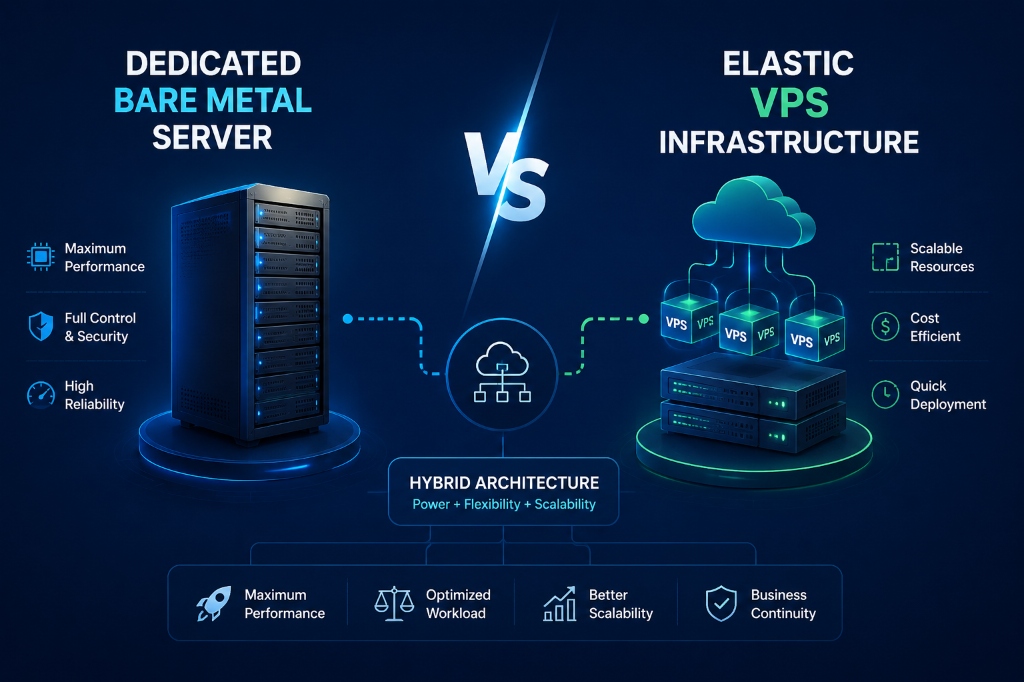
A hybrid hosting architecture combines the raw hardware power, high IOPS, and dedicated security of bare-metal dedicated servers for relational databases with the flexibility and elasticity of KVM virtual servers for front-end web and caching tiers. Connecting the two tiers over a private LAN or encrypted WireGuard tunnel minimizes latency and infrastructure costs.
Introduction: Bridging Bare-Metal Raw Power with Cloud Elasticity
Enterprise IT architectures increasingly face an economic and technical dilemma: public cloud providers charge steep premiums for raw compute and memory, while traditional dedicated servers lack rapid elasticity. A hybrid infrastructure solves this dilemma by marrying the best of both worlds.
Strategic Considerations & Architecture Drivers
Evaluating production infrastructure requirements highlights three critical operational factors:
- Public Cloud Hypervisor Markups: Giant cloud VMs carrying 128GB+ RAM incur massive monthly costs and suffer from unpredictable noisy neighbor I/O.
- The Dedicated Database Core: Bare-metal hardware provides 100% dedicated hardware cores and unshared NVMe arrays for database performance.
- Elastic VPS Edge Scaling: Cost-effective KVM VPS nodes act as dynamic web frontends, scaling capacity up or down to meet seasonal demand.
By interconnecting both tiers over private, non-routable 10Gbps Virtual Local Area Networks (VLANs), data packets travel between web workers and database backends in under 0.3 milliseconds without ever traversing the public internet. This delivers the bulletproof security and raw compute power of bare metal alongside the agility of elastic cloud VPS hosting.
To optimize costs across hybrid deployments, discover how scaling web traffic with VPS and dedicated servers maximizes ROI using high-performance dedicated servers.
Architectural Blueprint: The Multi-Tier Hybrid Topology
A hybrid server architecture links physical and virtual computing tiers over private data center networking:
A. Bare-Metal Database Foundation
Runs high-volume MySQL, PostgreSQL, or Cassandra clusters directly on physical silicon with zero hypervisor overhead.
B. Elastic KVM Edge Frontend Tier
Provisions lightweight virtual nodes in Kyiv that terminate TLS, cache static media, and route application logic.
C. Isolated Private VLAN Fabric
Connects dedicated servers and virtual machines over local data center backplanes with sub-millisecond latency and zero transit costs.
To review cryptographic handshake benchmarks and private VPN tunneling specifications, consult the official WireGuard technical whitepaper.
| Infrastructure Tier | Hardware Deployment Type | Network Interface | Key Operational Benefit |
|---|---|---|---|
| Edge Proxy / Web Ingress | Elastic KVM VPS (Kyiv) | Public 1Gbps + Private 10Gbps | Instant horizontal elasticity & DDoS shielding |
| Application Logic Workers | Clustered KVM VPS Nodes | Private 10Gbps VLAN only | Isolated stateless execution for PHP/Node/Python |
| Primary Relational Database | Dedicated Bare-Metal Server | Dual 10Gbps Private Bonding | Zero hypervisor overhead, 500K+ IOPS, dedicated RAM |
| Secondary Backup Storage | Storage VPS with ZFS Pool | Encrypted Private Tunnel | Automated non-blocking offsite snapshot sync |
Step-by-Step Implementation: Private VLAN & Database Security Runbook
Implement this configuration runbook to establish an isolated private network between your Ukrainian VPS frontend and dedicated database server:
Step 1: Configuring Private Static IP via Netplan on Ubuntu
Step 2: Securing PostgreSQL on the Bare-Metal Host
Step 3: Verifying Sub-Millisecond Private Latency
Enterprise Industry Use Cases for Hybrid Infrastructure
Hybrid bare-metal and cloud VPS architecture represents the optimal blueprint across data-heavy industries:
- Fintech & Banking Core Platforms: Processing millions of micro-transactions on dedicated bare metal while hosting public customer portals on scalable VPS frontends.
- Enterprise E-Commerce Marketplaces: Maintaining massive multi-million product relational catalogs on bare metal while autoscaling frontend web nodes during Black Friday sales.
- Big Data & Telemetry Analytics: Running ClickHouse or Elasticsearch clusters on bare-metal NVMe arrays while ingesting telemetry from distributed edge VPS nodes.
- SaaS Platforms with Strict Compliance: Ensuring multi-tenant customer databases reside on physically isolated hardware to satisfy enterprise compliance audits.
Operational Advantages and Strategic Trade-Offs
Architectural Considerations
- Network Topography Management: Requires proficient network engineering to configure VLANs and internal routing tables.
- Colocation / DC Proximity: The VPS and dedicated server must reside within the same data center facility to guarantee sub-millisecond interconnect latency.
Automated Failover & Database Replication Topologies
In high-availability enterprise environments, relying on a single bare-metal server introduces a single point of failure (SPOF). To eliminate downtime risks, hybrid architectures deploy asynchronous or semi-synchronous database replication across an active-passive bare-metal pair or to high-spec standby KVM VPS nodes.
Using tools like Patroni with Etcd for PostgreSQL or Orchestrator with ProxySQL for MySQL, the cluster continuously monitors master database health. If the primary bare-metal host suffers a hardware disruption, automated consensus algorithms elect a standby node and re-route frontend VPS traffic in less than 5 seconds with zero data loss.
Furthermore, read-heavy analytical queries can be directed to dedicated replica VPS nodes over the private VLAN, freeing the bare-metal master node to process write transactions at peak IOPS.
Hardware vs. Virtualization Economic TCO Comparison
When analyzing the Total Cost of Ownership (TCO) over a three-year operational cycle, the hybrid model demonstrates profound financial superiority over running 100% hyperscale cloud infrastructure. Provisioning an equivalent 128GB RAM, 16-core database instance on public cloud providers costs upwards of $1,200 to $1,800 per month, plus exorbitant variable egress fees for data transfer between availability zones.
In contrast, hosting a dedicated bare-metal database server paired with elastic VPS nodes in Kyiv operates at a fixed, predictable monthly expense that is typically 65% to 75% lower, while delivering superior sustained IOPS and latency metrics.
This financial efficiency allows growing enterprises to reallocate critical IT capital into software innovation, marketing acquisition, and business expansion.
Consequently, deploying hybrid infrastructure represents the gold standard for high-performance software engineering, ensuring unbreakable reliability, peak computing efficiency, and flawless user satisfaction across all digital touchpoints.
HAProxy High-Availability Load Balancing Runbook
In a multi-tier hybrid architecture, distributing incoming client traffic seamlessly across frontend KVM VPS instances is essential to prevent single-node bottlenecks. HAProxy (High Availability Proxy) delivers industry-leading layer-4 and layer-7 load balancing, connection pooling, and health-check failover.
By deploying two entry VPS instances configured with Keepalived Virtual Router Redundancy Protocol (VRRP) and floating virtual IPs (VIP), the load balancer tier guarantees continuous uptime. If the primary HAProxy node becomes unresponsive, the secondary standby node claims the virtual IP within 500 milliseconds, routing web traffic without dropped TCP connections:
WireGuard Point-to-Point Mesh Encryption Runbook
While hosting within the same physical data center provides isolated layer-2 VLAN options, organizations operating distributed hybrid architectures (e.g., dedicated database in Kyiv paired with edge caching VPS nodes across Warsaw and Frankfurt) must encrypt traffic across public transit links. WireGuard offers high-performance kernel-space cryptographic encapsulation using state-of-the-art Noise protocol, ChaCha20-Poly1305 encryption, and Curve25519 key exchange.
Unlike legacy OpenVPN or IPSec architectures which introduce high CPU overhead and connection negotiation lag, WireGuard creates a persistent, peer-to-peer virtual tunnel interface with minimal latency overhead (under 0.1ms processing delay per packet):
Activating the tunnel via sudo wg-quick up wg0 establishes an unbreakable encrypted link between the virtual frontend cluster and physical database server.
Production Observability: Unified Metrics with Prometheus & Node Exporter
Managing a distributed hybrid architecture requires centralized, real-time observability across both bare-metal and virtualized infrastructure tiers. Relying on fragmented monitoring dashboards prevents systems engineers from correlating latency spikes or identifying cascading performance degradations.
By deploying Prometheus Node Exporter across all frontend VPS instances and the bare-metal database server, telemetry metrics—including CPU core utilization, memory page swapping, disk iowait percentages, network interface saturation, and PostgreSQL transaction query latencies—are collected and visualized inside a unified Grafana dashboard. Automated alert rules configured via Alertmanager dispatch instant notifications to Slack, PagerDuty, or Telegram whenever database connection pools exceed 85% capacity or frontend error rates surge.
This unified visibility ensures that IT operations teams can proactively resolve resource bottlenecks before customer-facing transactions are impacted, maintaining flawless application uptime across Central and Eastern Europe.
Database Connection Pooling with PgBouncer
When multiple elastic VPS frontends scale dynamically to handle incoming user traffic, opening dozens of direct database connections per virtual worker can overwhelm the dedicated PostgreSQL server. Each direct PostgreSQL backend connection allocates dedicated RAM buffers and fork overhead, rapidly exhausting database resources.
Deploying PgBouncer as a lightweight connection pooler between the frontend VPS nodes and the bare-metal database server solves this challenge. Operating in transaction pooling mode, PgBouncer maintains a small, fixed pool of active server connections (such as 50 to 100 connections) while multiplexing thousands of incoming client requests. This architectural buffer prevents database connection spikes and reduces CPU context-switching overhead, ensuring smooth, uninterrupted transactional throughput.
This complete architectural synergy delivers rock-solid reliability, predictable operational expenditures, and unmatched transactional responsiveness across all enterprise workloads.
Frequently Asked Questions (FAQ)
Explore essential questions and architectural best practices for this deployment on Ukraine VPS:
Executive Summary: Hybrid Bare-Metal & Cloud VPS Architecture
