

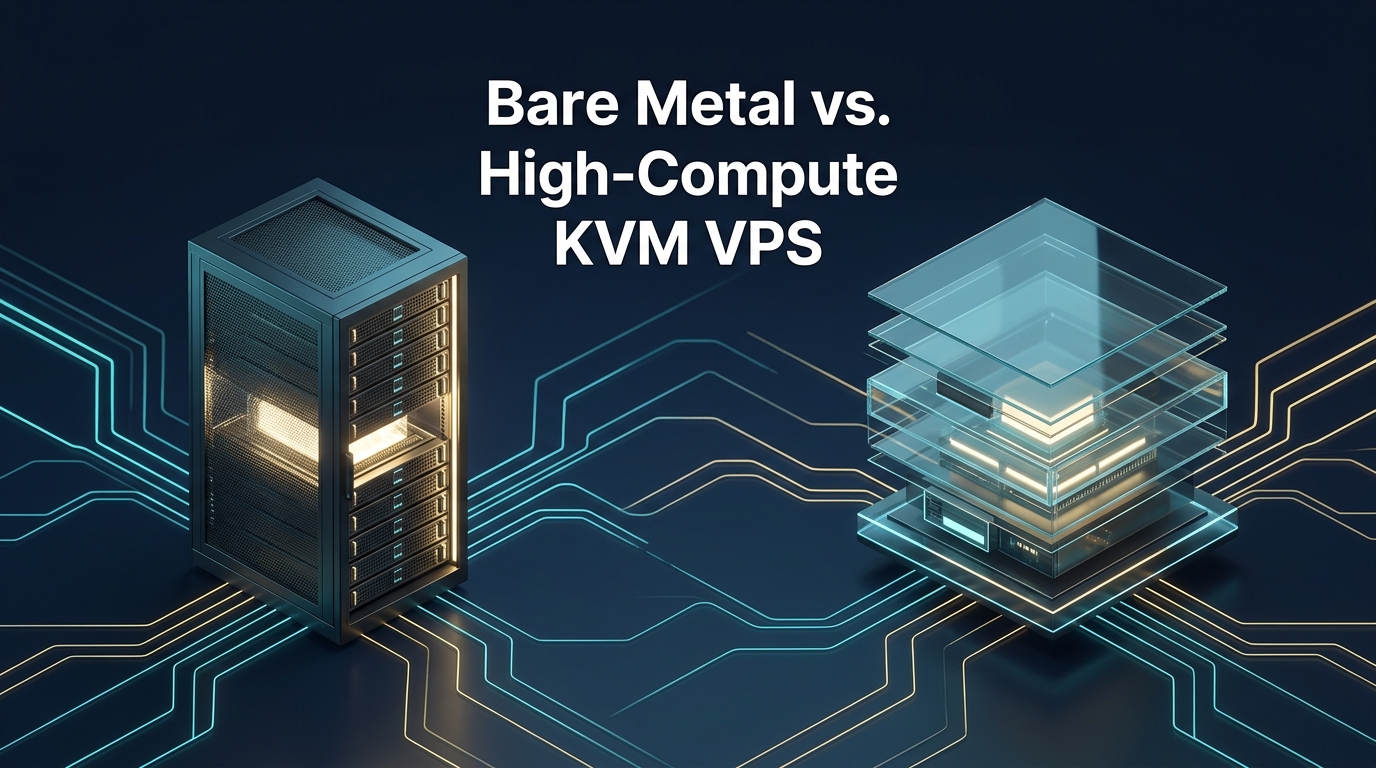
Specifically, when planning an enterprise deployment for dedicated server vs KVM VPS, choose a KVM VPS when workloads require elastic resource scaling (2–16 vCPUs, up to 32GB RAM), low entry costs, and automated hypervisor snapshots. Upgrade to a Bare-Metal Dedicated Server when applications require raw multi-threaded CPU saturation, 64GB+ dedicated ECC memory, zero hypervisor virtualization overhead, or customized BIOS/kernel configurations that cannot be shared.
dedicated server vs KVM VPS: Introduction: The Strategic Infrastructure Procurement Dilemma
Consequently, aligning these configurations with your dedicated server vs KVM VPS environment ensures optimal uptime and throughput. When architecting infrastructure for high-compute workloads, engineering leads must evaluate whether to provision physical bare-metal hardware or high-compute KVM virtual instances. Understanding the operational trade-offs, total cost of ownership (TCO), and performance metrics is essential for long-term scalability.
Strategic Considerations & Architecture Drivers
Furthermore, evaluating production infrastructure requirements highlights three critical operational factors:
- The Hypervisor Trade-Off: KVM virtualization offers instant provisioning and flexibility, while bare metal provides 100% raw hardware utilization.
- Consequently, I/O Virtualization Parity: Modern VirtIO-SCSI multi-queue paravirtualization brings KVM storage performance to within 95% of native hardware speed.
- In addition, Economic Sizing Thresholds: VPS remains more cost-effective for moderate workloads, but bare metal delivers lower cost-per-core for high-memory systems.
Consequently, aligning these configurations with your dedicated server vs KVM VPS environment ensures optimal uptime and throughput. This comprehensive guide provides an exhaustive, engineering-driven comparison between bare-metal dedicated servers and high-compute KVM VPS hosting in Eastern Europe, analyzing architectural trade-offs, raw CPU and disk I/O benchmarks, three-year Total Cost of Ownership (TCO) financial modeling, and strategic workload placement.
In particular, for workloads requiring dedicated compute hardware, explore our reliable dedicated servers and fully managed dedicated server hosting environments.
dedicated server vs KVM VPS: Architectural Breakdown: Dedicated Hardware vs. Hypervisor Virtualization
Therefore, analyzing total cost of ownership and architectural efficiency reveals distinct workload sweet spots:
A. Pure Hardware Silicon Access
Moreover, bare metal eliminates the virtualization abstraction layer, offering unrestricted access to hardware performance counters.
B. High-Compute KVM Elasticity
In fact, virtual private servers enable instant CPU core and RAM resizing without requiring physical hardware migrations.
C. Multi-Queue Storage Controllers
Similarly, paravirtualized VirtIO drivers parallelize I/O queues across hypervisor CPU cores to maximize NVMe utilization.
Meanwhile, for low-level hypervisor virtualization drivers and host kernel tuning, review the official Linux KVM documentation.
| Infrastructure Metric | High-Compute KVM VPS (Ukraine) | Enterprise Bare-Metal Server (Kyiv DC) |
|---|---|---|
| Tenancy & Isolation | Multi-tenant with hardware-level KVM isolation | 100% Single-tenant; physical air-gapped isolation |
| Provisioning & Spin-up Time | Instant (30 to 90 seconds via Cloud-Init) | 1 to 4 hours (Hardware racking & PXE deployment) |
| CPU Steal Risk (%st) | Near-zero on premium KVM; potential on budget hosts | Mathematically 0.00% (Zero hypervisor contention) |
| Disk I/O Throughput | 50,000 – 150,000 IOPS (VirtIO SCSI queue) | 500,000 – 1,500,000+ IOPS (Direct PCIe NVMe bus) |
| Vertical Elasticity | Seamless dynamic upgrade via management portal | Requires scheduled physical maintenance or migration |
Three-Year Total Cost of Ownership (TCO) Financial Modeling
Additionally, calculating infrastructure ROI requires modeling hardware costs, operational management overhead, electricity efficiency, and scaling flexibility across multi-year operational cycles.
Scenario A: The Small-to-Medium Workload (4 vCPU, 16GB RAM)
Consequently, aligning these configurations with your dedicated server vs KVM VPS environment ensures optimal uptime and throughput. For standard web applications, corporate blogs, and microservice APIs requiring 4 vCPUs and 16GB of RAM, provisioning a dedicated bare-metal server is financially unjustifiable. A high-compute KVM VPS in Kyiv costs approximately $25 to $40 per month ($900 to $1,440 over 3 years). An entry-level dedicated server costs at least $90 per month ($3,240 over 3 years), leaving 75% of the physical hardware capacity idle.
Verdict: KVM VPS delivers 60% to 70% cost savings with zero operational waste.
Scenario B: The Enterprise High-Compute Workload (32 Cores, 128GB RAM, 4TB NVMe)
When scaling an enterprise database cluster, big-data analytics pipeline, or multi-tenant SaaS application requiring 32 dedicated cores and 128GB of RAM, the financial math flips dramatically. Provisioning equivalent virtualized compute instances across hyperscale clouds costs between $750 and $1,200 per month (plus variable bandwidth egress fees). Even on budget virtual clouds, multiple large VPS slices carry heavy multi-tenant virtualization markups.
In contrast, a physical dedicated bare-metal server equipped with an AMD EPYC 16-core/32-thread CPU, 128GB DDR5 ECC RAM, and enterprise NVMe drives in a Kyiv data center costs approximately $180 to $260 per month ($6,480 to $9,360 over 3 years). On a per-vCPU and per-gigabyte basis, bare metal delivers 50% to 65% lower Total Cost of Ownership while eliminating noisy-neighbor jitter.
Performance Auditing Runbook: Detecting CPU Steal & Storage Latency
To verify whether your existing virtualized environment is suffering from hypervisor contention or storage queuing, execute these diagnostic terminal commands:
Step 1: Monitoring CPU Steal Percentage (%st)
Step 2: Auditing Random 4K Disk Latency via FIO
Strategic Workload Decision Matrix: When to Choose VPS vs. Bare Metal
Use this architectural decision matrix to determine the optimal hosting tier for specific enterprise workloads:
Deploy on Dedicated Bare-Metal Servers When:
- High-Throughput Relational Databases: PostgreSQL, MySQL/Percona clusters handling >5,000 queries/second.
- Private Hypervisor Clouds: Running Proxmox VE or OpenStack to provision your own internal VM fleet.
- Big Data & Machine Learning Ingestion: ClickHouse, Apache Kafka, Cassandra, real-time analytics.
- High-Bitrate Media Transcoding: FFmpeg live HLS video encoding clusters running 24/7 at 100% CPU saturation.
Data Sovereignty, Security Compliance & Physical Perimeter Defense
Beyond compute metrics and financial calculations, enterprise compliance regulations frequently mandate specific hosting topologies. Organizations operating under strict data protection frameworks (such as GDPR, ISO/IEC 27001, or financial banking standards) must provide verifiable proof that sensitive customer records are shielded against unauthorized access.
In a multi-tenant virtualized cloud, hypervisor vulnerabilities (such as Spectre, Meltdown, and L1 Terminal Fault) theoretically create microscopic risks of cross-tenant side-channel memory leaks. While modern KVM hypervisors implement strict kernel page table isolation, regulated financial institutions and healthcare providers often require dedicated bare-metal servers to ensure single-tenant physical isolation. Bare-metal hardware guarantees that no other entity’s code ever executes on the same physical CPU or memory bus, streamlining security audits and satisfying compliance officers.
Conversely, for standard commercial web applications, high-compute KVM VPS hosting backed by automated kernel patching and enterprise firewalls provides robust security that easily satisfies international compliance standards while minimizing operational overhead.
Network Throughput & Unmetered Bandwidth Economics
A critical differentiator between public hyperscale clouds and Eastern European hosting providers is network bandwidth billing. Hyperscale cloud providers operate on complex variable egress models, charging anywhere from $0.05 to $0.09 per gigabyte of outbound traffic. For video streaming services, game server distributors, or high-traffic download mirrors transferring 50TB to 100TB per month, bandwidth bills frequently exceed the cost of the underlying compute hardware.
Dedicated servers and premium KVM virtual private servers hosted in Kyiv feature generous unmetered 1Gbps or 10Gbps port allocations connected directly to major internet exchange points (UA-IX, DTEL-IX, Giganet). This predictable, unmetered network model eliminates budget surprises and enables digital publishers to distribute high-definition media assets at maximum line-rate speeds.
Consequently, conducting thorough capacity planning and continuous performance auditing empowers engineering teams to extract maximum computational efficiency from every dollar invested in their hosting architecture.
Hardware Lifecycle & Storage RAID Resilience: Hardware vs. Software ZFS
When operating physical dedicated servers, storage reliability directly dictates enterprise business continuity. In virtualized KVM VPS instances, underlying storage resilience is managed entirely by the hosting provider’s SAN or Ceph cluster. On bare metal, however, systems engineers must architect their own storage redundancy strategy.
Historically, enterprise dedicated servers relied on hardware RAID controllers (such as MegaRAID or Broadcom SAS adapters) equipped with battery-backed write caches (BBU). While hardware RAID offloads parity calculations from the host CPU, it introduces proprietary controller lock-in: if the physical RAID card fails, drive arrays cannot be read by standard Linux kernels without an identical replacement card.
Modern high-performance bare-metal deployments overwhelmingly adopt OpenZFS software RAID (RAID-Z or mirrored pools) executing on direct Host Bus Adapters (HBA). ZFS integrates continuous cryptographic data scrubbing, protecting enterprise databases against silent data corruption (bit rot) while delivering unthrottled NVMe read and write IOPS directly across PCIe buses.
Microarchitecture Performance: L3 Cache Sizing & Memory Bandwidth
A frequently overlooked factor in the bare-metal vs. VPS debate is CPU cache hierarchy and memory bus saturation. Modern server processors (such as AMD EPYC Genoa and Milan) feature massive unified L3 caches (up to 256MB to 768MB with 3D V-Cache). High-intensity workloads—such as in-memory Redis caches, algorithmic trading models, and large database join indexes—gain enormous speedups when working sets fit directly inside ultra-fast CPU L3 cache.
On multi-tenant virtual machines, cache thrashing occurs when multiple competing virtual machine threads evict each other’s data from shared L3 cache lines, causing CPU cache misses that force execution pipelines to wait on slower main system RAM. On dedicated bare-metal servers, your applications enjoy 100% exclusive access to the CPU cache hierarchy, delivering deterministic, sub-microsecond instruction processing times.
Automated Lifecycle Management & Migration Strategies
Transitioning between virtualized and dedicated environments should never represent an operational cliff. By adopting containerization (Docker, Podman) and infrastructure-as-code configuration scripts (Ansible playbooks), engineering teams decouple application code from underlying hardware boundaries. This portability allows organizations to launch on agile KVM virtual machines in Kyiv and migrate effortlessly to physical bare-metal hardware as transaction volume scales, preserving software consistency and developer productivity.
This ensures complete business agility and guarantees that your enterprise infrastructure continuously supports sustainable commercial growth.
Frequently Asked Questions (FAQ)
Core Technical Specifications
Explore essential questions and architectural best practices for this deployment on Ukraine VPS:
Technical Architecture & Execution Analysis
Executive Summary: Bare Metal vs. KVM VPS Infrastructure Economics
%st) during noisy-neighbor spikes.
