

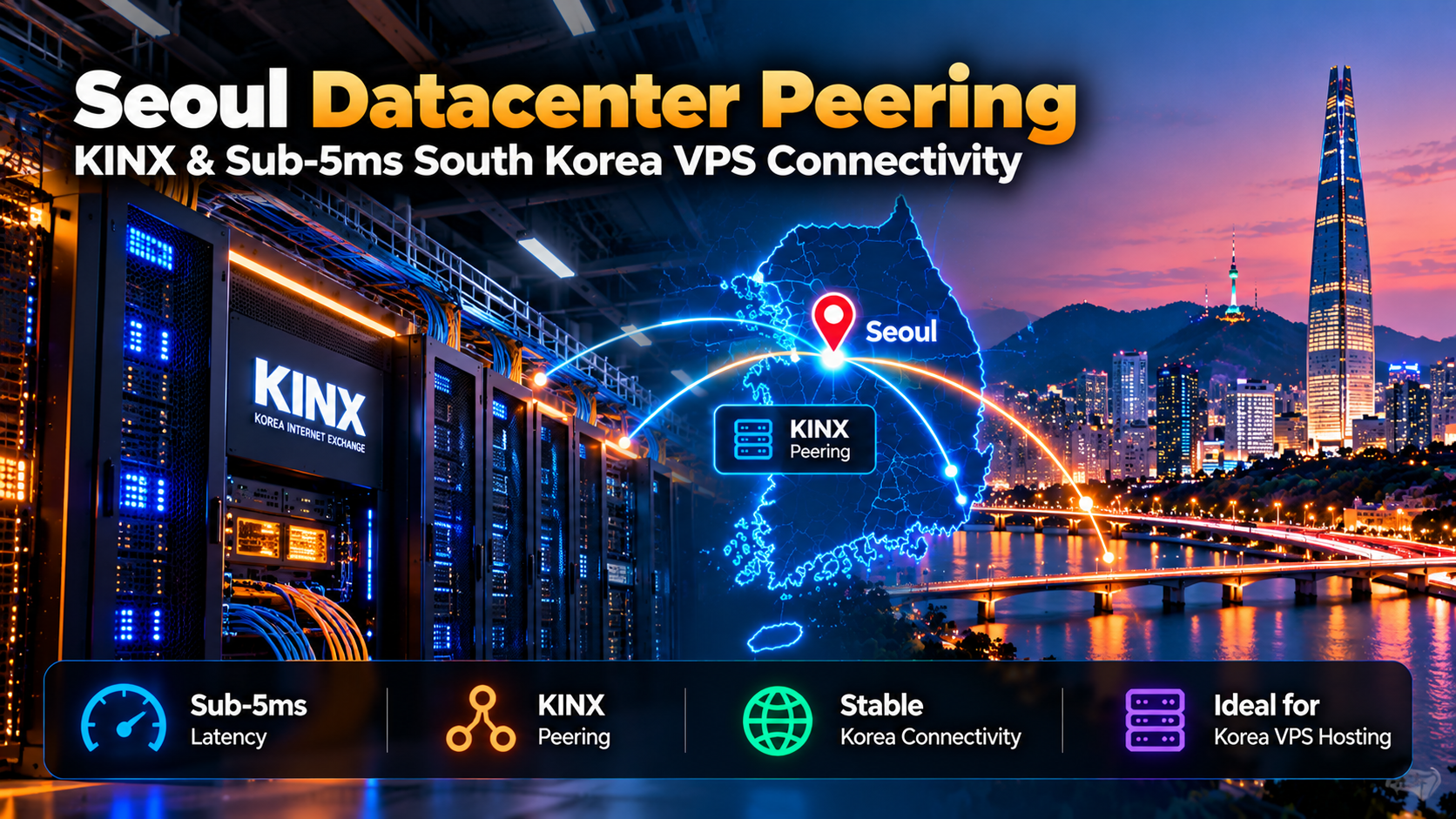
When evaluating an enterprise Seoul datacenter peering, local peering via KINX (Korea Internet Neutral Exchange) is essential because it allows traffic between domestic Korean ISPs (KT, SK Broadband, and LG Uplus) to exchange data directly within Seoul without incurring costly transit fees or routing through overseas hubs. Without domestic KINX peering, budget hosts route local traffic through Tokyo or Hong Kong, spiking latency from sub-5ms to over 70ms. OnliveServer peers directly at KINX with unmetered 1Gbps uplinks.
Specifically, network latency dictates the commercial viability of modern digital platforms. In South Korea, internet users enjoy ubiquitous gigabit fiber and rapid mobile 5G connectivity. However, high-speed access networks do not automatically ensure rapid server response times. The physical path packets travel between consumer devices and server racks determines transactional throughput. Therefore, systems architects must evaluate datacenter interconnection topologies before deploying regional infrastructure.
Furthermore, seoul represents the undisputed digital nucleus of South Korea. The metropolitan area concentrates financial exchanges, enterprise headquarters, and gaming servers. Yet, server connectivity within Seoul varies drastically based on peering relationships. Low-cost providers often lack direct connections to domestic Internet Exchange Points (IXPs). As a result, domestic traffic frequently suffers from unnecessary routing hops. This guide examines the engineering mechanics of Seoul datacenter peering, focusing on KINX architecture and BGP optimization.
Operational Infrastructure Takeaway
Consequently, Operational Takeaway: Achieving sub-5ms round-trip latency across metropolitan Seoul requires strategic Seoul datacenter peering through KINX (Korea Internet Neutral Exchange). Because South Korea operates a regulated settlement model, direct interconnection across Korea Telecom (KT), SK Broadband, and LG Uplus is vital. Deploying virtual private servers in Tier III Seoul datacenters with multi-homed BGP routing bypasses expensive international transit loops. Consequently, your applications maintain uninterrupted, single-digit millisecond response times for domestic users.
Seoul datacenter peering: The Mechanics of KINX Peering in Seoul
In addition, the Korea Internet Neutral Exchange (KINX) was established in 2000 as South Korea’s only carrier-neutral internet exchange. In traditional carrier-controlled environments, internet service providers impose restrictive settlement fees on cross-network traffic. KINX resolved this inefficiency by providing a neutral switching fabric where member networks exchange domestic traffic directly. To verify intermediate transit hops and detect packet loss across Korean fiber backbones, examine our guide to empirical Seoul network latency and MTR telemetry.
In particular, when your virtual private server resides in a datacenter with direct KINX connectivity, domestic packets bypass upstream transit providers entirely. For instance, a request originating from an LG Uplus subscriber reaches a server hosted on a separate network across high-speed optical cross-connects. In contrast, servers lacking KINX peering must send traffic across commercial IP transit links. This alternative path adds multiple routing hops and exposes traffic to network congestion.
Furthermore, KINX operates distributed nodes across major Seoul facilities, including Dogok, Gasan, and Sangam. This physical distribution enables redundant physical fiber paths. Therefore, hardware maintenance or fiber cuts on one link do not interrupt active TCP sessions.
Seoul datacenter peering: The South Korean Big Three Telecom Ecosystem
While KINX provides neutral switching, complete domestic coverage requires direct integration with the three primary telecommunications providers in South Korea. These carriers are Korea Telecom (KT), SK Broadband, and LG Uplus. Together, they control over 95% of domestic residential broadband and mobile subscriber lines. For comparative round-trip time measurements between Seoul facilities and East Asian regional hubs, review our cross-border Seoul vs Tokyo latency benchmarks. For technical specifications on autonomous system interconnects and low-latency peering topology design, review IETF RFC 7938 BGP routing architecture standards.
Therefore, each carrier operates its own autonomous system (AS). This streamlined approach ensures minimal network overhead and reliable throughput across domestic backbones.
KT (Korea Telecom)
Moreover, the historic national carrier operating the widest domestic fiber backhaul and extensive international trans-Pacific subsea links, ensuring flawless connectivity for enterprise clients.
SK Broadband
In fact, dominates urban Sudogwon metropolitan gigabit residential fiber and mobile data networks, delivering ultra-low packet jitter for domestic media streaming and consumer mobile apps.
LG Uplus (LGU+)
Similarly, features high-density metropolitan routing, major commercial enterprise business lines, and extensive direct private peering interconnects across modern corporate technology parks.
| Carrier Network | Autonomous System (ASN) | Direct Peering Latency (Seoul) | Indirect Transit Latency |
|---|---|---|---|
| Korea Telecom (KT) | AS4766 | 1.8ms – 3.2ms | 24ms – 42ms |
| SK Broadband | AS9318 | 2.1ms – 3.8ms | 28ms – 45ms |
| LG Uplus | AS3786 | 2.0ms – 3.5ms | 26ms – 40ms |
| KINX Neutral Fabric | AS9970 | 1.2ms – 2.5ms | N/A (Direct Local Fabric) |
Meanwhile, when selecting infrastructure, always verify that your provider advertises BGP routes directly into these autonomous systems. Selecting reliable South Korea VPS hosting in Seoul guarantees optimized routes to every domestic carrier.
Avoiding International Routing Tromboning
Additionally, one of the most damaging routing anomalies in East Asian hosting is known as “traffic tromboning.” Tromboning occurs when two communicating systems reside within South Korea, yet network packets travel overseas before returning to the country. This issue stems directly from South Korea’s “Sending Party Pays” peering rules.
As a result, under this regulation, domestic ISPs charge each other mutual data settlement fees. To avoid these fees, unprincipled budget hosting companies export domestic traffic through international transit providers. Consequently, a request sent from Incheon to Seoul might route through an exchange point in Tokyo or Hong Kong. This unnecessary detour inflates latency from 3ms to over 60ms.
Moreover, international routing hops introduce packet jitter and packet loss during peak evening hours. During undersea fiber maintenance in the Luzon Strait or East China Sea, international hops face severe congestion. Therefore, enterprise architects must audit traceroute paths to verify that all hops remain inside South Korean borders.
Regional Subsea Cable Architecture and International Reach
While domestic latency within South Korea is exceptional, cross-border connectivity relies upon an intricate network of submarine fiber systems. South Korea connects to global backbones through landing stations located in Busan, Geoje, and Taean. Principal submarine cable systems include the Asia Pacific Gateway (APG), Trans-Pacific Express (TPE), and South-East Asia Japan Cable (SJC). To shield high-throughput network interfaces from volumetric UDP floods without adding transit delay, explore our multi-terabit inline anti-DDoS scrubbing fabric.
Specifically, enterprise applications serving users across East Asia must evaluate both domestic peering and international transit performance. The table below outlines standard round-trip transit times from a multi-homed Seoul datacenter to key regional and global endpoints:
| Destination City | Primary Subsea Routing | Optimal Round-Trip Time | Degraded / Unpeered Path |
|---|---|---|---|
| Tokyo, Japan | Busan → Shima (APG / KJCN) | 28ms – 34ms | 65ms – 95ms |
| Osaka, Japan | Busan → Kita-Kyushu / Osaka | 22ms – 28ms | 55ms – 80ms |
| Hong Kong | Busan → Tseung Kwan O (APG) | 42ms – 50ms | 95ms – 140ms |
| Singapore | Busan → Tuas (SJC / APG) | 68ms – 78ms | 120ms – 180ms |
| Los Angeles, USA | Geoje → Nedonna Beach (TPE) | 125ms – 138ms | 190ms – 250ms |
| Frankfurt, Germany | Terrestrial Eurasian Transit | 180ms – 210ms | 270ms – 340ms |
Furthermore, these latency baselines highlight why server placement matters. Applications demanding responsive regional interactions must anchor their primary database and compute instances within Seoul while utilizing multi-homed BGP routing to ensure direct subsea transit.
Tier III Seoul Datacenter Physical Standards
Consequently, low-latency peering requires robust physical datacenter infrastructure to prevent downtime. Tier III datacenter standards establish concurrent maintainability across all electrical and mechanical systems. In Seoul, primary enterprise facilities concentrate in districts like Mokdong, Sangam, and Pangyo Techno Valley.
In addition, tier III facilities incorporate N+1 redundancy across chillers, backup diesel generators, and uninterruptible power supply (UPS) batteries. Furthermore, network entry points must utilize diverse underground conduit entries. Dual fiber pathways ensure that accidental street excavations do not sever server connectivity.
- Verify dual-fed power distribution through independent utility substations.
- Confirm on-site fuel reserves supporting at least 48 hours of autonomous generator operation.
- Audit physical security measures, including biometric mantraps and round-the-clock CCTV surveillance.
- Ensure carrier-neutral meet-me rooms with diverse fiber risers connected to KINX nodes.
Measuring Latency with MTR and Looking Glasses
In particular, standard ICMP ping commands provide an incomplete picture of network health. Ping reveals only round-trip time without identifying intermediate router bottlenecks. Instead, network engineers rely on Matt’s Traceroute (MTR) to evaluate packet loss and jitter across every intermediate hop.
Therefore, execute an automated 100-packet MTR trace against domestic Korean endpoints to evaluate routing consistency:
Examine the resulting output for intermediate packet loss or unexpected geographic latency jumps. In a healthy Seoul peering environment, average latency remains below 3ms across the entire trace. If an intermediate hop suddenly jumps to 35ms, traffic is routing through an offshore exchange point.
Kernel Tuning for High-Speed Gigabit Uplinks
In fact, default Linux network parameters are engineered for conservative bandwidth environments. When operating virtual servers connected to dedicated 1Gbps ports in Seoul, the Linux kernel requires tuning to maximize window scaling and socket buffer allocation.
Similarly, add the following high-performance network parameters to /etc/sysctl.d/99-network-peering.conf:
Apply these settings immediately using sudo sysctl --system. This configuration eliminates socket buffer exhaustion during high-concurrency traffic spikes.
BGP Community Tagging & Dynamic Traffic Engineering
Border Gateway Protocol (BGP) governs autonomous routing decisions across global networks. However, standard BGP path selection prioritizes the shortest AS-path rather than the lowest physical latency. In complex regional routing environments like East Asia, an AS-path with two hops can experience higher latency than an optimized path with three hops.
To address this limitation, high-performance hosting providers deploy performance-based BGP optimization appliances. These systems actively probe destination networks, monitoring real-time packet loss, jitter, and latency. When an upstream carrier experiences latency degradation, the BGP engine dynamically steers outgoing traffic to alternative peering partners.
Furthermore, network administrators can utilize BGP community strings to influence outbound path selection. For example, assigning localized community tags instructs upstream transit providers to prioritize direct peering links over expensive transit channels. The diagrammatic workflow below illustrates how dynamic BGP path selection maintains sub-5ms latency:
| < 2.5ms Round-Trip
v
[Seoul Datacenter Edge Router]
| Dynamic BGP Path Engine
+—> [Direct KINX Fabric (AS9970)] → Fast Domestic Switch (1.2ms)
+—> [Direct KT BGP (AS4766)] → 45% Domestic Subscribers (2.1ms)
+—> [Direct SK Broadband (AS9318)] → 30% Domestic Subscribers (2.3ms)
+—> [Direct LG Uplus (AS3786)] → 25% Domestic Subscribers (2.0ms)
+—> [Tier-1 Global Transit] → Subsea Cables (Tokyo 30ms / HK 45ms)
Consequently, dynamic BGP routing protects your applications against upstream carrier degradation. Your systems maintain consistent throughput even during major regional subsea cable maintenance.
Network Jitter and Packet Loss Mitigation
While total round-trip time is a critical metric, packet delay variation—commonly known as jitter—is equally damaging for interactive workloads. Real-time gaming servers, VoIP communications, WebRTC streaming, and high-frequency trading platforms experience severe performance degradation when packet arrivals fluctuate unpredictably.
In unpeered hosting environments, jitter occurs when intermediate upstream transit switches experience buffer bloat. Under heavy load, standard network queues fill completely before dropping packets, introducing latency spikes of 50ms to 120ms. In contrast, datacenters with direct KINX switching maintain dedicated port capacity with Active Queue Management (AQM).
To mitigate buffer bloat on your virtual instance, configure Fair Queueing (FQ) scheduler modules in combination with BBR congestion control. This ensures that individual TCP streams receive equitable bandwidth allocations without overwhelming network interface buffers.
Comprehensive Peering Audit & Verification Playbook
Before signing long-term infrastructure commitments, engineering teams must conduct an empirical network verification audit. Follow this pre-flight verification routine during prospective vendor trials:
Query Autonomous System Details
Inspect BGP announcements to confirm upstream peering directly with AS9970 (KINX) or Tier 1 domestic carriers rather than offshore intermediaries.
Test Looking Glass Nodes
Use public looking glasses across KT and SK networks to execute MTR traces toward your instance IP, verifying hop counts under 5 inside Seoul.
Audit Sustained Throughput
Run iperf3 multi-stream TCP tests during Korean peak evening hours (20:00–23:00 KST) to detect bandwidth throttling or carrier link congestion.
Evaluate Redundant Fiber Paths
Inquire directly with your provider regarding physical fiber conduits entering the datacenter facility to ensure diverse dual-path routing.
Applying this verification framework eliminates infrastructure guesswork. Your team can confidently deploy high-performance applications backed by true carrier-grade Seoul peering.
Frequently Asked Questions
Core Technical Specifications
What is the typical latency between Seoul and Busan on a peered VPS?
On a multi-homed Seoul VPS with direct KT or SK Broadband peering, round-trip latency to Busan consistently measures between 8ms and 12ms across domestic optical fiber routes.
Why does carrier neutrality matter when choosing a Seoul datacenter?
Carrier-neutral datacenters allow hosting providers to interconnect simultaneously with KT, SK Broadband, LG Uplus, and KINX. This multi-carrier architecture prevents vendor lock-in and guarantees redundant failover routing.
How do I check if my provider is tromboning traffic through Japan?
Run an MTR trace from your server to domestic Korean IPs like 168.126.63.1. If intermediate hops show hostnames containing “tyo”, “nrt”, or latency exceeding 25ms, your traffic is routing through Tokyo.
Does KINX peering eliminate the need for upstream transit?
No. KINX facilitates domestic interconnection among member networks. However, global upstream transit is still required to route packets to international users across Asia, North America, and Europe.
Deployment & Operational Inquiries
Can TCP BBR improve transfer speeds on high-latency international routes?
Yes. Google’s BBR congestion control models packet delivery rates rather than relying on packet loss. Therefore, BBR maintains high throughput even across lossy international connections.
What physical security certifications should I expect from a Seoul Tier III facility?
Reputable Seoul Tier III facilities maintain ISO/IEC 27001 security standards, ISMS-P certification overseen by KISA, and multi-factor biometric access controls.
How many major telecom carriers peer directly through the KINX exchange in Seoul?
Over 40 domestic network operators, including KT, SK Broadband, LG Uplus, and regional cable MSOs, interconnect at the KINX exchange. This comprehensive fabric allows servers peered at KINX to route domestic Korean traffic without exiting national border gateways.
What round-trip time (RTT) should I expect between a Seoul VPS and users in Incheon or Daegu?
Round-trip latency to Incheon consistently measures below 2ms, while latency to Daegu averages between 6ms and 9ms over domestic Tier-1 fiber backbones. These sub-10ms times ensure seamless performance for domestic SaaS and real-time streaming.
Power Your Applications with Sub-5ms Seoul Connectivity
Eliminate transit latency with direct KINX exchange peering and multi-homed BGP uplinks into KT, SK Broadband, and LG Uplus. Backed by dedicated KVM hypervisors and 1Gbps ports.
