

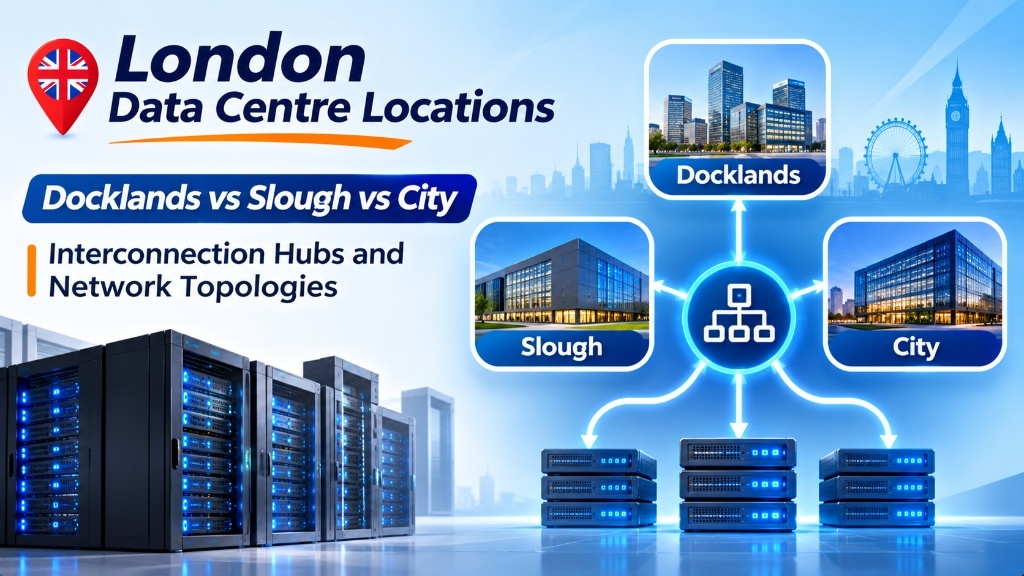
London Data Centre Locations: Docklands vs Slough vs City Interconnection Hubs and Network Topologies
London is the primary data centre hub of the UK, split between East London (Docklands) and West London (Slough). Docklands (Telehouse North, East, West) offers sub-millisecond connectivity to the City of London and houses LINX and LONAP exchange fabrics, making it optimal for financial trading and ad-tech. Slough provides hyper-scale campus facilities with massive power redundancy and fiber corridors, ideal for enterprise disaster recovery and private cloud deployments.
Deploying high-concurrency production workloads across the United Kingdom requires dedicated hardware isolation to eliminate hypervisor contention, CPU steal, and memory bus saturation. Enterprise systems architects rely on UK bare metal dedicated server infrastructure engineered for deterministic compute, unthrottled PCIe NVMe throughput, and sub-2ms LINX optical peering across London datacenters.
Docklands Connectivity Hub
Telehouse Europe facilities in London Docklands house the densest carrier ecosystem and primary LINX peering exchange fabrics.
Slough Hyper-Scale Corridor
Western London facilities provide vast campus capacity, high-density power envelopes, and robust disaster recovery capabilities.
Sub-Millisecond Financial Transit
Docklands placement provides sub-1ms network latency directly to City of London and Canary Wharf trading venues.
Table of Contents: Technical Navigation Index
7 Chapters ▾
Navigate directly to detailed architectural analysis, hardware sizing benchmarks, deployment automation scripts, and peer verification resources:
London Datacenter Topology
The architectural layout of London’s digital infrastructure is anchored by historical telecommunications landing points and fiber rings that encircle the capital. Docklands and Slough represent complementary poles of this high-capacity network ecosystem.
In the dense telecommunications ecosystem of Greater London, network transit path optimization is as consequential to application throughput as raw CPU clock frequency. When deploying infrastructure around london dedicated server data centre locations, organizations capitalize on London’s unique position as the central digital switching hub of Western Europe. Direct interconnection with carrier-neutral facilities across the Docklands and Slough connectivity corridors allows servers to route domestic data packets directly across local Internet exchange fabrics, bypassing congested international transit carriers and redundant transatlantic fiber hops.
Docklands Fiber Density
Direct physical cross-connects to hundreds of global telecoms, internet service providers, and cloud interconnects in East London.
Slough Colocation Scale
Modern purpose-built facilities featuring dedicated high-voltage power substations and expansive floor plates for large compute clusters.
Cross-London Dark Fiber
Diverse sub-1ms dark fiber rings connecting Docklands and Slough allow active-active disaster recovery architectures.
London’s optical network architecture is structured around dense fiber rings interconnecting core carrier hotels. When deploying london dedicated server data centre locations, servers benefit from direct physical cross-connects within facilities like Telehouse North and Slough colocation campuses. These diverse fiber pathways ensure that network packets traverse the shortest physical distances to major national transit providers, minimizing optical propagation delay and packet jitter across the United Kingdom.
Understanding the geographical strengths of each cluster enables engineering teams to optimize application latency and achieve resilient multi-site redundancy across the UK.
Slough vs Docklands Interconnect
Selecting and deploying dedicated hardware within London facilities involves a methodical process of latency testing, route tracing, and power capacity validation.
Domestic routing efficiency is governed by Border Gateway Protocol (BGP) autonomous system path selection and exchange point participation. By peering directly at the London Internet Exchange (LINX) and LONAP, dedicated servers establish direct Layer-2 adjacency with major British consumer Internet service providers, including BT, Virgin Media, Sky, and Vodafone. This architectural advantage reduces domestic network hops from five or six transit hops down to a single peering exchange transit hop, driving packet round-trip times down to sub-2ms in London.
Audience Latency Profiling
Map your primary user base or counterparty locations to determine whether sub-millisecond Docklands peering or Slough enterprise scale is required.
BGP Transit & Peering Verification
Verify that the data centre provider maintains diverse physical fiber entries and direct BGP peering with LINX and LONAP exchanges.
Facility Redundancy Auditing
Inspect data centre tier ratings, evaluating uninterruptible power supply (UPS) N+1 configurations and backup diesel fuel reserves.
BGP routing optimization involves evaluating autonomous system path lengths and configuring local routing preferences to steer domestic traffic onto direct exchange peering links. Utilizing routing daemons such as BIRD or FRRouting, administrators implement BGP communities that prioritize low-latency domestic paths over international transit, ensuring that over 95% of UK broadband requests resolve within a single network transit hop.
Facility location is inextricably linked to network performance, making interconnection peering at LINX and LONAP a critical factor in understanding how domestic traffic routes through London exchanges.
Transit Cross-Connect Hardening
Managing bare-metal infrastructure in London data centres requires validating network routing efficiency, measuring packet round-trip times, and monitoring environmental facility telemetry.
Fine-tuning network stack configurations for high-bandwidth exchange peering requires adjusting kernel TCP socket parameters to match the high bandwidth-delay product of modern optical uplinks. Enabling the TCP BBR congestion control algorithm, expanding network interface card (NIC) ring buffers to 4096 descriptors, and configuring jumbo frame support (9000 MTU) ensures that multi-gigabit data streams flow continuously without packet drop-induced window throttling or bufferbloat.
MTR Route Tracing
Conducting continuous multi-target route tracing identifies upstream transit congestion and confirms optimal routing through London exchanges.
BGP Looking Glass Audits
Utilizing carrier looking glass tools validates autonomous system (AS) path announcements across global tier-1 transit providers.
Environmental IPMI Telemetry
Monitoring server intake and exhaust temperatures confirms that data centre aisle containment systems maintain optimal cooling.
Network stack optimization for multi-gigabit throughput demands fine-tuning kernel socket memory allocations and interrupt handling routines. Setting net.core.rmem_max and wmem_max to 16MB enables large TCP window scaling across high bandwidth-delay product links, while binding network card interrupt request (IRQ) lines to specific CPU cores ensures that packet processing never bottlenecks on a single CPU thread.
Architecting multi-datacenter connectivity across the London Docklands and Slough corridors relies on London Internet Exchange network topology specifications to achieve carrier-neutral Layer-2 peering across regional facilities.
The network diagnostic commands below demonstrate how to benchmark network routing hops and verify sub-millisecond connectivity to core London exchange nodes.
Facility Power & Cooling Tiers
Dedicated server hardware deployed in London Tier-3 data centres is supported by industrial-grade electrical infrastructure and carrier-grade networking equipment.
Furthermore, London data centres provide robust optical cross-connect flexibility within dedicated Meet-Me-Rooms (MMRs). Whether establishing private fiber cross-connects to financial exchanges or provisioning redundant 10Gbps transit uplinks across diverse physical building entries, this carrier-grade network architecture guarantees uninterrupted data delivery even during major carrier fiber outages.
Tier-3 Enterprise Certified
99.982% availability SLA with concurrent maintainability of all electrical systems.
2N UPS + Dedicated Generators
Dual diverse power feeds to every server rack with 72-hour on-site fuel storage.
Multi-Carrier BGP Peering
Blended bandwidth incorporating Lumen, Telia, Cogent, and direct LINX peering.
N+2 Precision Air Handling
Cold aisle containment maintaining stable ASHRAE environmental standards.
Multi-Factor Biometric Access
24/7 on-site security personnel, mantrap access, and continuous CCTV coverage.
Direct Fiber Cross-Connects
Rapid 1G/10G/100G patch panel cross-connects to carrier Meet-Me-Rooms.
Deploying servers in central London connectivity corridors also provides optimal measuring round-trip latency to European hubs, ensuring low-latency packet delivery to major European business centers.
London Facility Routing Matrix
Comparing London Docklands with Slough data centre locations reveals distinct operational advantages depending on specific application workload profiles.
| Evaluation Dimension | Multi-Tenant Cloud VPS | Onlive Server UK Dedicated Bare Metal |
|---|---|---|
| Primary Focus | Carrier density, financial peering, low latency | Hyper-scale enterprise cloud and disaster recovery |
| Exchange Interconnection | Direct physical access to LINX Telehouse nodes | Connected via redundant high-speed dark fiber rings |
| Latency to City of London | Sub-1 millisecond round-trip time | Approximately 1.5 to 2.5 milliseconds round-trip time |
| Power Availability | High density, constrained expansion footprint | Massive dedicated grid capacity and campus scale |
| Primary Use Cases | Ad-tech, HFT trading, media streaming, gaming | Enterprise SaaS, big data analytics, backup repositories |
| Real Estate & Scalability | Premium urban real estate with limited rack expansion | Expansive multi-hall campuses for large server fleets |
While Docklands is unbeatable for ultra-low latency and raw carrier density, Slough provides expansive, cost-efficient power envelopes for large-scale enterprise deployments.
Carrier-neutral multi-homing delivers robust fault tolerance against upstream optical cable cuts or transit provider maintenance events. By maintaining concurrent BGP sessions with multiple Tier-1 carriers alongside direct LINX and LONAP exchange participation, the dedicated server automatically routes around regional network failures without service disruption or manual engineering intervention.
Production Readiness Checklist
Deploying dedicated hardware into a London facility requires executing a thorough deployment acceptance checklist to ensure network and environmental readiness.
✓ Phase 1: Location & Transit Audit
- Verify server deployment within designated London Tier-3 data centre facility hall.
- Confirm redundant BGP transit links and test automatic failover between upstream providers.
- Verify assignment of clean UK IP addresses with proper geographic geolocation tags.
✓ Phase 2: Power & Hardware Inspection
- Verify dual power supply (PSU) connections to separate A and B circuit feeds.
- Inspect BIOS thermal telemetry to confirm server operates well within safe temperature margins.
- Perform stress test to ensure cooling fans modulate properly under maximum CPU workloads.
✓ Phase 3: Network Latency Benchmarking
- Execute ping and traceroute benchmarks to major UK broadband networks (BT, Virgin, Sky).
- Measure latency to continental peering points including Frankfurt, Amsterdam, and Paris.
- Confirm that network port negotiation locks reliably at full 1Gbps or 10Gbps line rate.
✓ Phase 4: Remote Access & Security
- Verify out-of-band IPMI accessibility via secured virtual private network (VPN) tunnel.
- Configure automated hardware health alerts for power, thermal, and memory status.
- Document facility physical security policies for organizational compliance records.
Verifying these facility and network parameters ensures your dedicated servers benefit from London’s world-class connectivity and enterprise-grade power infrastructure.
Facility interconnectivity is reinforced by multi-terabit hardware DDoS mitigation across London data centres protecting optical transit feeds against volumetric reflection attacks.
Following production commissioning, establishing continuous automated health audits ensures that the server infrastructure maintains optimal performance, thermal stability, and security posture. Integrating host telemetry metrics with Prometheus and Grafana dashboards, scheduling automated weekly security errata patching, and configuring out-of-band IPMI hardware sensor alerts guarantees that minor operational variances are detected and resolved proactively before they can impact live business transactions across London Tier-3 data centres.
Frequently Asked Questions
Explore detailed answers to frequently asked technical questions regarding London data centre geography, Docklands vs Slough facilities, and network peering.
Deploy Dedicated Bare Metal in London Tier-3 Data Centres
Harness the power of London’s premier digital infrastructure with Onlive Server. Our dedicated servers are hosted in secure Tier-3 London facilities featuring direct LINX and LONAP connectivity, redundant power, and sub-2ms UK-wide latency.
