

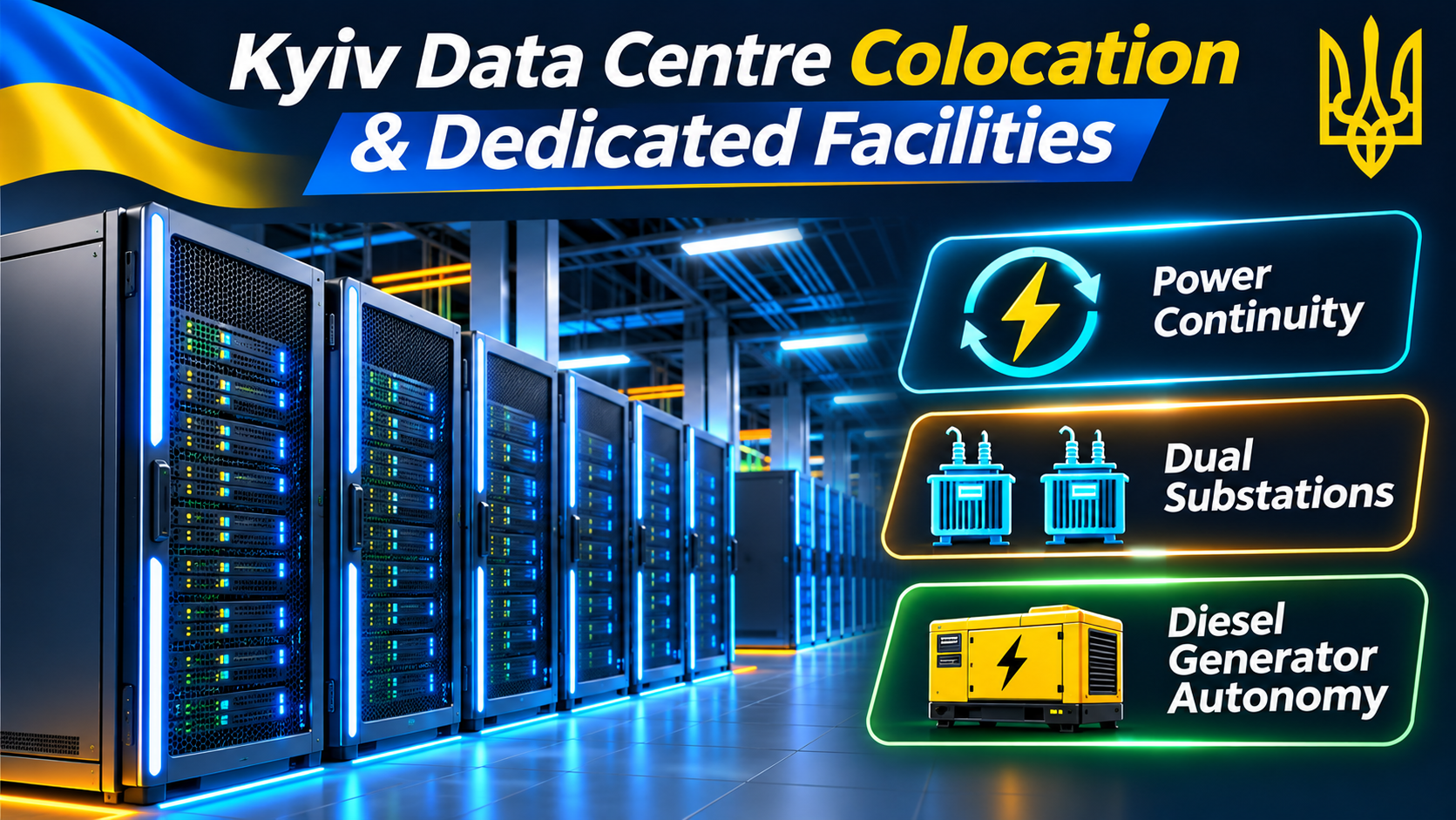
Kyiv data centre facilities housing Onlive Server dedicated hardware maintain continuous electrical autonomy through a multi-tier defense architecture engineered for municipal electrical disruptions. Facilities connect to dual independent 10kV high-voltage utility feeds from geographically separated city substations. In the event of municipal grid collapse, industrial 2N online double-conversion UPS battery systems absorb the transition with zero milliseconds (0ms) phase drop, while automated industrial diesel generators ignite within 10 to 12 seconds, supported by on-site fuel reserves guaranteeing 72+ hours of autonomous operation.
Evaluating enterprise hosting infrastructure in Ukraine requires an objective architectural comparison between raw bare-metal execution and multi-tenant virtualization. Deploying on Ukraine bare metal dedicated server infrastructure guarantees 0% CPU steal, unmetered UA-IX optical connectivity, and deterministic PCIe NVMe throughput for high-concurrency workloads across Kyiv and regional commercial hubs.
Direct Compute
Unvirtualized physical CPU cores ensure 0% CPU steal and deterministic processing cycles under peak load.
Hardware Isolation
Dedicated memory bus channels and independent PCIe storage lanes eliminate noisy neighbor interference.
Optical UA-IX Peering
Direct unshared 1Gbps uplinks to UA-IX and GigaNet deliver sub-2ms round-trip latency across Kyiv.
Table of Contents: Technical Navigation Index 8 Chapters ▾
Navigate directly to detailed architectural analysis, hardware sizing benchmarks, deployment automation scripts, and peer verification resources:
Table of Contents
- Electrical Resilience Imperative in Kyiv
- Multi-Stage Electrical Topology in Kyiv Data Centres
- Static UPS Double-Conversion & ATS Mechanics
- Diesel Generator Autonomy & Fuel Logistics in Kyiv
- Data Centre Resilience Audit Runbook (Tier-III)
- Precision HVAC & Thermal Inertia in Kyiv Facilities
- Strategic Infrastructure Deployment with Onlive Server
- Frequently Asked Questions
Electrical Resilience Imperative in Kyiv
The operational landscape for IT infrastructure in Ukraine has transformed over recent years. Enterprises, financial institutions, media broadcasting networks, and e-commerce platforms can no longer treat commercial electricity as a guaranteed constant. Municipal power grids across major urban centers face unprecedented operational stress, requiring data centre facilities to act as fully autonomous power plants when necessary.
When evaluating hosting infrastructure, deploying Kyiv Ukraine dedicated server facilities with autonomous power backup ensures that your digital services remain completely unaffected by municipal blackouts or rolling grid curtailments. A modern Tier-III compliant data centre in Kyiv is engineered with concurrent maintainability: every power transformer, breaker panel, UPS module, and generator line can be serviced or taken offline without causing a single microsecond of downtime to running customer servers.
Data Centre Survivability Principle: Computing infrastructure availability in Ukraine is defined at the physical substation boundary. Software-defined failovers cannot compensate for data centre utility collapse; enterprise servers must reside in Tier-III facilities engineered for concurrent maintainability.
For technical directors and systems architects, conducting due diligence on a data centre’s physical electrical topology is just as vital as evaluating processor clock speeds or network peering ports.
Multi-Stage Electrical Topology in Kyiv Data Centres
To understand how an enterprise facility maintains uninterrupted compute availability, we must trace the path of electricity from the municipal utility down to the server power supply unit (PSU).
Dual 10kV Municipal Substation Entrances
Tier-III facilities in Kyiv do not rely on a single utility line. Instead, the facility connects to two physically independent 10kV medium-voltage substations operated by the regional energy utility (DTEK Kyiv Grids). These feeds enter the property through diverse underground conduits separated by hundreds of meters to eliminate common-trench excavation accidents.
Inside the facility’s electrical intake room, automated switchgear monitors line voltage, phase balance, and frequency. If Substation A experiences a voltage drop, phase loss, or total interruption, high-speed motorized breakers automatically transfer the electrical load to Substation B in less than 200 milliseconds.
Geographically Separated Utility Source: Physically independent substation located miles away from Substation A.
- Zero common-trench excavation risk
- Feeds independent transformer bank B & PDU B
- Seamless sub-200ms motorized breaker transfer
- Guarantees 100% compute during local grid repairs
Transformer Downscaling and Redundant Busways
Dry-type cast-resin transformers step down the 10kV utility feed to 400V 3-phase commercial building power. Electricity is then routed through dual independent busway runs (Bus A and Bus B). Every enterprise server rack is wired with two separate Power Distribution Units (PDUs), allowing dual-corded servers equipped with redundant power supplies to draw balanced current simultaneously from both electrical paths.
Static UPS Double-Conversion & ATS Mechanics
The most vulnerable period during a grid disruption is the initial 10 to 15 seconds required for industrial diesel generators to crank, reach operating RPM, and stabilize voltage. Bridging this critical window requires industrial uninterruptible power supply (UPS) systems.
Online Double-Conversion Battery Topology
Enterprise Kyiv data centres deploy online double-conversion UPS architectures arranged in N+1 or 2N redundant topologies. In double-conversion mode, utility AC power is continuously rectified into DC power, which charges massive valve-regulated lead-acid (VRLA) or lithium iron phosphate (LiFePO4) battery banks. Concurrently, an inverter transforms the DC power back into clean, synthesized AC power for server racks. Autonomous power topologies and concurrently maintainable electrical circuits fulfill Uptime Institute Tier III datacenter availability standards.
Because servers are perpetually fed from the inverter rather than directly from the raw utility grid, the transfer time during a sudden municipal power blackout is exactly zero milliseconds (0ms). Furthermore, double conversion completely isolates sensitive server hardware from grid voltage sags, power surges, harmonic distortion, and electrical noise.
Automatic Transfer Switch (ATS) Sequencing
Simultaneously, an Automatic Transfer Switch (ATS) orchestrates generator engagement. When sensors detect grid failure across both municipal feeds:
- The ATS controller sends start signals to the diesel generator engines.
- Heavy-duty starters crank industrial diesel engines, achieving nominal 1500 RPM within 8 to 10 seconds.
- Electronic governors stabilize output voltage to 400V ±1% and frequency to 50Hz ±0.2Hz.
- The ATS switches the building electrical intake from the dead grid to the live generator bus, taking over the load while the UPS batteries remain at full charge.
Diesel Generator Autonomy & Fuel Logistics in Kyiv
While UPS systems bridge immediate transitions, sustained operational independence during extended municipal grid failures rests entirely on industrial diesel generators. Furthermore, when evaluating holistic infrastructure agility, analyzing low-latency cross-border optical routes into Poland and Germany provides a decisive competitive advantage.
| Resilience Metric | Standard Commercial Building | Kyiv Tier-III Data Centre Facility | Operational Benefit |
|---|---|---|---|
| Grid Feeds | Single 0.4kV line | Dual independent 10kV substation feeds | Protects against local transformer failures |
| UPS Redundancy | None or desktop line-interactive | 2N Online Double-Conversion (0ms transfer) | Completely isolates hardware from power sags |
| Generator Redundancy | Optional single generator | N+1 Industrial Generators (Cummins/Cat) | Guarantees continuous compute during generator servicing |
| On-Site Fuel Reserve | Under 8 hours runtime | 72+ hours continuous full-load fuel storage | Ensures autonomy during municipal supply shocks |
| Fuel Delivery SLAs | Standard commercial delivery | Priority emergency refilling contracts | Guaranteed tanker dispatch within 4 to 6 hours |
| Automatic Transfer Time | Manual or uncalibrated | Automated ATS engagement (< 12 seconds) | Zero manual technician intervention required |
During grid emergencies, reliable telecommunications and low-latency transit are equally vital. Facilities housing Onlive Server infrastructure maintain direct optical cross-connects to domestic network peering at UA-IX and GigaNet, ensuring that domestic traffic routing remains fully intact even while municipal utility grids undergo repair.
Data Centre Resilience Audit Runbook (Tier-III)
Before committing mission-critical workloads to a Ukrainian facility, technical directors and infrastructure managers should execute a thorough technical audit of the hosting provider’s electrical claims:
Demand single-line electrical schematics proving that dual feeds originate from separate utility substations, not two circuits exiting the same physical utility building.
Review monthly generator testing records. Reputable facilities conduct monthly full-load tests using artificial load banks to prevent diesel wet-stacking and verify ATS sync.
Calculate total on-site diesel volume divided by hourly fuel burn rates at 100% facility load. True enterprise resilience requires a minimum of 48 to 72 continuous hours.
Verify off-site replication capabilities. For maximum enterprise risk mitigation, pair your Kyiv primary nodes with a cross-border disaster recovery pairing with Warsaw.
Precision HVAC & Thermal Inertia in Kyiv Facilities
Power continuity is not solely about keeping servers booted; it is equally about keeping them cool. Modern high-density compute nodes (such as AMD Ryzen 9 3900X and multi-socket Intel Xeon systems) generate substantial thermal dissipation. If precision air handling systems fail during a power transition, data centre ambient temperatures can rise by 1°C per minute, triggering automatic thermal CPU throttling or emergency hardware shutdowns within minutes.
To prevent thermal collapse during grid blackouts:
- UPS-Backed Fan Units: Precision Computer Room Air Handler (CRAH) fan blowers are backed by the primary UPS system, maintaining continuous airflow through hot and cold aisle containment systems during generator crank cycles.
- Dedicated Chiller Generator Feeds: Industrial chillers, pumps, and external condensers are connected to the essential generator power bus, resuming mechanical refrigeration within 30 seconds of grid failure.
- Buffer Tanks & Thermal Mass: Closed-loop chilled water systems integrate insulated thermal storage tanks, providing sufficient cooling reserve to bridge chiller restart cycles without allowing server inlet air temperatures to exceed 24°C.
Strategic Infrastructure Deployment with Onlive Server
Onlive Server operates dedicated bare-metal infrastructure situated exclusively within Tier-III certified Kyiv data centre facilities. Engineered specifically for continuous operations, our hosting environments combine enterprise electrical resilience with uncompromised compute performance.
Every dedicated server includes dual independent power supplies connected to diverse PDU buses, unmetered 1Gbps connectivity to UA-IX and GigaNet exchanges, and dedicated IPMI out-of-band management for remote control.
| Infrastructure Tier | Compute & RAM Specification | Storage & Redundancy | Power & Network Resilience | Monthly Flat Rate |
|---|---|---|---|---|
| Kyiv Resilient Entry | Intel Xeon E3-1281 v3 (4C / 8T @ 3.70 GHz), 32GB RAM | 480GB Enterprise SSD | Dual PDU, 2N UPS, 1Gbps UA-IX | $69.00 / month |
| Kyiv Business Resilient | Intel Xeon E3-1270 v5 (4C / 8T @ 3.60 GHz), 32GB DDR4 ECC | 960GB Enterprise SSD | Dual PDU, 2N UPS, 1Gbps UA-IX | $89.00 / month |
| Kyiv High-Compute Resilient | AMD Ryzen 9 3900X (12C / 24T @ 3.80 GHz), 64GB DDR4 | 2x 960GB NVMe RAID-1 | Dual PDU, 2N UPS, 1Gbps UA-IX | $146.00 / month |
| Kyiv Enterprise Dual-Node | Dual Intel Xeon E5-2680 v4 (28C / 56T), 128GB DDR4 ECC | 2x 1.92TB NVMe RAID-1 | Dual PDU, 2N UPS, 1Gbps UA-IX | $249.00 / month |
Frequently Asked Questions
How do Kyiv data centres maintain server uptime during municipal power outages?
How long can a Kyiv data centre run exclusively on diesel generator power?
What happens to server hardware during the transfer from grid power to generator power?
Are cooling systems also powered by diesel generators during a blackout?
Does a power outage in Kyiv affect internet connectivity and peering through UA-IX?
Can I order dedicated servers with redundant dual power supply units (2x PSU) from Onlive Server?
What tests do Kyiv data centres conduct to verify automatic transfer switch (ATS) reliability?
How do data centres prevent diesel fuel gelling during cold Ukrainian winter months?
Deploy Autonomous Resilient Dedicated Hosting in Kyiv
Shield your mission-critical applications against municipal grid blackouts. Benefit from dual 10kV substation feeds, 2N UPS battery protection, 72+ hours of autonomous generator fuel reserves, and unmetered 1Gbps peering in Kyiv starting at $69.00/month.
