

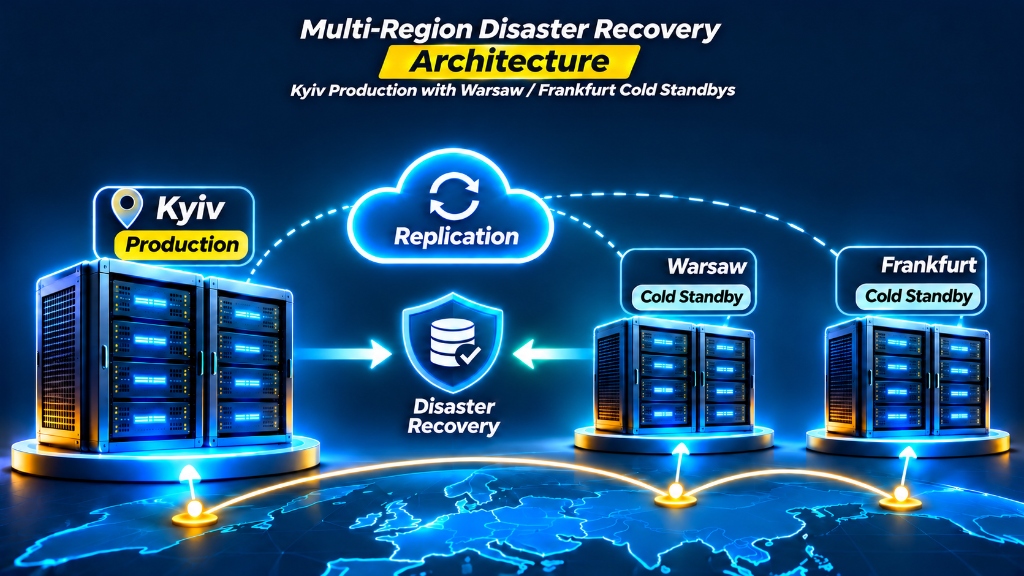
This technical evaluation establishes the production blueprint for running high-availability bare metal dedicated servers in Kyiv, Ukraine, paired with automated cross-border standbys in Warsaw, Poland, or Frankfurt, Germany. By combining ultra-low domestic UA-IX transit latency with asynchronous storage replication (DRBD 9 / ZFS send) across encrypted WireGuard tunnels and automated DNS/BGP Anycast failover, enterprise systems engineers achieve Recovery Point Objectives (RPO) under 5 minutes and Recovery Time Objectives (RTO) under 15 minutes—safeguarding mission-critical workloads against electrical grid anomalies, fiber cuts, and regional infrastructure disruptions.
To architect cross-border disaster recovery for Kyiv dedicated servers, host primary production workloads on bare-metal servers in Kyiv for sub-3ms domestic latency, and synchronize them with cold or warm standbys in Warsaw (12ms) or Frankfurt (24ms). Connect sites via encrypted WireGuard tunnels, execute asynchronous storage replication via ZFS snapshots or DRBD 9, and automate traffic failover using health-checked DNS policies. This guarantees an RPO under 5 minutes and RTO under 15 minutes during local infrastructure failures.
Cross-Border Continuity: Balancing Ukrainian Domestic Latency with European Resilience
Deploying mission-critical IT infrastructure in Eastern Europe requires balancing ultra-low domestic latency with robust electrical and network survivability. Operating sovereign infrastructure within certified Kyiv data centers eliminates cross-border network transit penalties, ensuring Ukrainian users experience sub-3ms latency for real-time transactions, database queries, and media streaming. However, relying exclusively on a single geographic location creates catastrophic vulnerabilities to regional power grid stress, unexpected municipal transit disruptions, or localized physical infrastructure failures.
To achieve enterprise survivability without compromising domestic speed, high-availability architects deploy a cross-border disaster recovery topology. By partnering with enterprise Ukraine bare metal dedicated server infrastructure in Kyiv and establishing an asynchronous replication bridge to cold or warm standby nodes in Warsaw (12-14ms) or Frankfurt (24-28ms), engineering teams secure complete business continuity across geopolitical boundaries.
Under high-load production operations, multi-tenant cloud instances suffer from variable CPU steal time (often exceeding 8-15% during peak hours) and shared virtual disk I/O bottlenecks. Bare-metal dedicated servers eliminate hypervisor scheduling latency, ensuring 100% of physical CPU cycles, dedicated memory channels, and Gen4 NVMe disk bandwidth remain reserved exclusively for high-throughput database transactions and real-time offsite replication.
Table of Contents: Technical Navigation Index 7 Chapters ▾
Navigate directly to detailed architectural analysis, cross-border replication protocols, failover automation, and disaster recovery runbooks:
Multi-Region Disaster Recovery Principles
Architecting multi-region disaster recovery for enterprise infrastructure requires defining two core operational metrics: Recovery Point Objective (RPO) and Recovery Time Objective (RTO). RPO represents the maximum acceptable age of data lost when an unplanned outage strikes, while RTO dictates the maximum permissible elapsed duration between primary facility failure and standby workload restoration. For high-throughput Ukrainian databases, fintech transaction ledgers, and e-commerce platforms, operational targets demand an RPO under 5 minutes and an RTO under 15 minutes.
While multi-region active-active architectures provide sub-second cutover, they introduce severe distributed consensus locking latency across international borders. For cross-border links between Kyiv and Central Europe, an Active-Passive (Warm Standby) topology delivers the optimal balance of data consistency, architectural simplicity, and cost efficiency. The primary bare metal server in Kyiv actively handles 100% of read/write production traffic, while the secondary node in Warsaw or Frankfurt maintains continuous asynchronous storage and database replication in a read-only standby state.
Operating on dedicated physical servers rather than virtualized cloud instances ensures that asynchronous snapshot streaming and encryption daemons never contend with neighboring virtual machines for memory bus bandwidth or CPU cycles. To evaluate compute isolation trade-offs in depth, consult our technical analysis on bare metal vs cloud VPS in Ukraine.
Network Latency Topology: Kyiv, Warsaw & Frankfurt
Cross-border disaster recovery depends on deterministic round-trip time (RTT) and low packet jitter. Modern optical DWDM backbones running through Lviv and Krakow connect Kyiv to Warsaw with an average round-trip latency of just 12ms to 14ms. For organizations requiring deeper geographical separation into Western Europe, dedicated transit from Kyiv to Frankfurt (connecting to DE-CIX) clocks in at 24ms to 28ms. Both paths easily accommodate asynchronous block and transaction log replication without stalling local application commits.
Standard Linux TCP stacks utilize legacy loss-based congestion algorithms (such as Cubic) that misinterpret cross-border packet timing variations as network congestion, prematurely slashing transmission windows. Systems administrators must calibrate the Linux kernel to utilize Google’s **BBR (Bottleneck Bandwidth and RTT)** congestion control alongside enlarged socket buffers, sustaining full 1Gbps unmetered throughput across international links.
# Kernel Network Tuning for High-Throughput Cross-Border Replication
net.core.default_qdisc = fq
net.ipv4.tcp_congestion_control = bbr

# Socket Read/Write Buffer Allocations for 1Gbps / 10Gbps WAN Links
net.core.rmem_max = 67108864
net.core.wmem_max = 67108864
net.ipv4.tcp_rmem = 4096 87380 33554432
net.ipv4.tcp_wmem = 4096 65536 33554432

# Window Scaling & Fast Open
net.ipv4.tcp_window_scaling = 1
net.ipv4.tcp_fastopen = 3
net.ipv4.tcp_mtu_probing = 1When throughput spikes or dataset volumes grow beyond virtual server capacities, dedicated hardware guarantees dedicated network controllers (NICs) with hardware checksum offloading. For capacity planning benchmarks, review our guide on when to transition from Ukrainian VPS to a dedicated server.
Data Replication Protocols: ZFS Send & DRBD 9
Maintaining disaster recovery fidelity requires decoupling application data into distinct synchronization layers. Replicating multi-terabyte filesystems wholesale over WAN links causes synchronization lag. Professional systems engineers segment storage into block-level volumes, transactional databases, and unstructured media assets, applying specialized replication protocols to each layer.
| Replication Layer | Primary Technology | Cross-Border Protocol | RPO SLA Target | Local Performance Overhead |
|---|---|---|---|---|
| Block-Level Storage | DRBD 9 / OpenZFS | Protocol A (Asynchronous) over WireGuard | < 2 Minutes | Zero local write penalty; asynchronous memory queuing. |
| Relational Database | MariaDB / PostgreSQL | GTID-Based Asynchronous Replication / WAL-G | < 30 Seconds | Minimal transaction log streaming overhead. |
| Static Media & Uploads | Lsyncd / Incremental Rsync | Inotify file-event triggered SSH streaming | < 5 Minutes | Negligible CPU consumption on dedicated cores. |
| Cold Backup Archives | Encrypted Borg / Restic | Authenticated SFTP to European storage repository | Daily / Hourly | Scheduled during off-peak maintenance windows. |
For raw block-level replication, DRBD 9 configured with Protocol A writes data to local Kyiv NVMe storage and simultaneously places disk writes into a local TCP transmit buffer before acknowledging the write to the application. This ensures that cross-border latency to Warsaw never introduces disk wait latency to Kyiv users. For additional reference, review the official DRBD distributed storage documentation and our operational framework on automated offsite backup architecture.
Automated Traffic Failover: BGP Anycast & DNS
An automated disaster recovery plan is only as reliable as its failover detection system. The failover orchestrator must distinguish between transient network packet drops and genuine data center power outages to avoid destructive false-positive cutovers (split-brain scenarios). Synthetic health monitors execute multi-vantage HTTP, TCP, and ICMP probes against the primary Kyiv dedicated server from independent nodes in Frankfurt, Warsaw, and Amsterdam.
#!/usr/bin/env bash
PRIMARY_KYIV_IP="194.28.172.10"
STANDBY_WARSAW_IP="185.190.140.25"
MAX_FAILURES=3
FAILURE_COUNT=0

while true; do
  # Synthetic probe: Check HTTP status 200 on local health endpoint
  HTTP_STATUS=$(curl -s -o /dev/null -w "%{http_code}" --connect-timeout 2 "http://${PRIMARY_KYIV_IP}/health.php")

  if [ "$HTTP_STATUS" != "200" ]; then
    FAILURE_COUNT=$((FAILURE_COUNT + 1))
    echo "[WARNING] Kyiv primary probe failed (${FAILURE_COUNT}/${MAX_FAILURES})"
  else
    FAILURE_COUNT=0
  fi

  if [ $FAILURE_COUNT -ge $MAX_FAILURES ]; then
    echo "[CRITICAL] Primary Kyiv node down. Initiating automated cutover to Warsaw..."
    # 1. Promote Warsaw standby database to read-write mode
    ssh -i /root/.ssh/dr_key root@${STANDBY_WARSAW_IP} "systemctl start postgresql && sed -i 's/read_only = on/read_only = off/' /etc/postgresql/postgresql.conf"
    # 2. Update DNS A-record to Warsaw standby node via API
    curl -X PATCH -H "Authorization: Bearer $API_TOKEN" -d "{\"content\":\"${STANDBY_WARSAW_IP}\"}" https://api.dns-provider.com/v1/zones/example.com/records/app
    break
  fi
  sleep 10
doneTo execute traffic redirection smoothly, production DNS records must be configured with a 60-second Time to Live (TTL). When the primary node fails 3 consecutive health checks, the orchestrator triggers an API call that switches the DNS A-record to the Warsaw standby server. For large enterprises with autonomous system numbers (ASNs), BGP Anycast announcements can withdraw the Kyiv route and advertise the Warsaw route across European transit providers in under 10 seconds.
Data Center Autonomy & Physical Hardening
Hardware resilience in Ukraine begins at the electrical sub-tier. Onlive Server’s Tier-3 partner data centers in Kyiv are engineered to withstand municipal grid instability through autonomous power infrastructure: dual independent 10kV utility substations feeds, 2N online double-conversion UPS battery banks, and on-site industrial diesel generators with contracted continuous fuel replenishment pipelines. This guarantees uninterrupted server uptime even during multi-day national grid disruptions.
Operating bare metal servers during remote incidents requires robust out-of-band management. Every Kyiv dedicated server is provisioned with hardware-level IPMI 2.0, Dell iDRAC Enterprise, or HP iLO controllers assigned to an isolated management VLAN. Systems administrators can power-cycle unresponsive nodes, mount remote ISO recovery images, and rebuild storage arrays without physical data center access.
Disaster recovery endpoints are frequent targets for opportunistic DDoS floods during operational transitions. Both Kyiv and Warsaw locations feature carrier-grade hardware traffic scrubbing that filters volumetric reflection attacks, SYN floods, and UDP amplifications at line speed before traffic reaches physical server network cards. For comprehensive defense architecture, explore our guide on hardware DDoS protection for dedicated servers.
Production Diagnostic & Telemetry Runbook
Frequently Asked Questions
? Why is pairing a Kyiv dedicated server with a Warsaw replica ideal for disaster recovery?
Kyiv and Warsaw share direct low-latency optical interconnects (under 14ms RTT). Pairing servers across this corridor gives organizations the best of both worlds: sub-3ms domestic Ukrainian response times during normal operations, combined with complete geographic and legal survivability inside the European Union if regional events disrupt local Ukrainian infrastructure.
? What is the difference between Recovery Point Objective (RPO) and Recovery Time Objective (RTO)?
RPO defines the maximum acceptable data loss measured in time (e.g., losing under 5 minutes of data), dictating how frequently storage and database replication must occur. RTO defines the maximum acceptable downtime before workloads must be online and servicing traffic at the standby facility. Our Kyiv-Warsaw architecture targets RPO under 5 minutes and RTO under 15 minutes.
? How is database replication maintained between Kyiv and Warsaw with minimal latency lag?
Using asynchronous or semi-synchronous replication over sub-14ms optical channels ensures that database transactions commit immediately on the primary Kyiv node without waiting for cross-border confirmation. Transaction write-ahead logs (WAL) or binary logs stream continuously to Warsaw in background threads, keeping replica lag typically under 1 second.
? What role does GeoDNS or Anycast routing play in automated cross-border failover?
GeoDNS health monitoring services continuously check the primary Kyiv endpoint; if health probes fail 3 consecutive times, DNS records update automatically to point to the Warsaw IP. For organizations operating their own BGP autonomous systems, Anycast routes withdraw the Kyiv announcement, allowing global Internet routers to converge traffic onto Warsaw within seconds.
? Can a Warsaw replica server also handle read-only database queries during normal operations?
Yes. In an active-passive warm architecture, the Warsaw dedicated server can service reporting, analytical queries, and European visitor read requests during routine operations, maximizing hardware ROI while standing ready to assume primary write operations during cutover.
? How is file storage synchronized across the Ukrainian border securely?
File synchronization utilizes encrypted rsync or Lsyncd over WireGuard or IPsec VPN tunnels, streaming modified blocks with ChaCha20-Poly1305 or AES-256-GCM hardware encryption. This ensures data in transit remains completely secure from interception or surveillance across international backbones.
? Can dedicated servers in Kyiv continue operating during national electrical grid blackouts?
Yes. Onlive Server’s Tier-3 Kyiv data center facilities maintain on-site industrial diesel generator systems with dedicated fuel reserves supporting 72+ hours of autonomous operation, backed by priority replenishment agreements with fuel suppliers to guarantee continuous power during extended municipal grid failures.
? How does Onlive Server support cross-border dedicated server disaster recovery deployments?
Onlive Server provisions matching bare-metal server infrastructure in both Kyiv and Warsaw/Frankfurt, configuring dedicated private interconnects, WireGuard site-to-site encryption, and 24/7 proactive hardware monitoring to deliver seamless, managed disaster recovery for enterprise clients.
Deploy Resilient Ukraine Dedicated Servers with European Continuity
Experience unthrottled AMD EPYC and Intel Xeon bare-metal performance in Kyiv paired with automated cross-border replication to Warsaw and Frankfurt, backed by 24/7 senior systems engineers.
Deploy Dedicated Server