

Cyberjaya Tier-3 Telemetry
PDPA Compliance & Malaysian Data Sovereignty
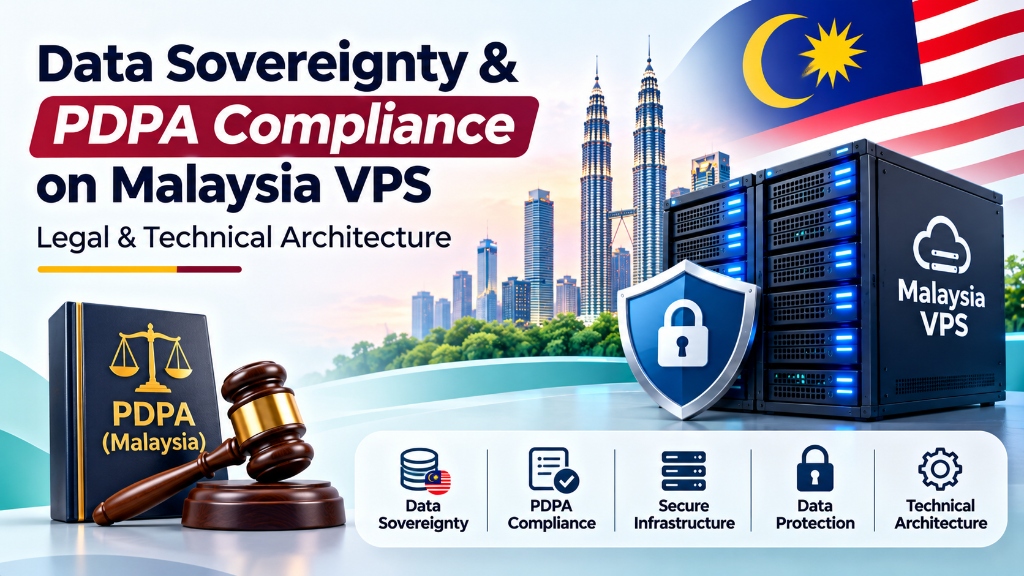
Operating a certified pdpa compliant vps malaysia instance guarantees adherence to statutory data sovereignty laws under the Personal Data Protection Act. Specifically, hosting in Cyberjaya Tier-3 facilities satisfies Section 129 cross-border transfer requirements by keeping data domestic. Furthermore, dedicated KVM hypervisor isolation paired with LUKS AES-256 encryption secures data at rest. In addition, immutable Linux auditd logging provides tamper-proof audit trails for regulatory compliance. Consequently, Malaysian commercial enterprises maintain continuous legal standing without cross-border legal liabilities.
📌 Table of Contents
- 1. Statutory Framework: PDPA 2010 on PDPA Compliant VPS Malaysia
- 2. Section 129: Cross-Border Data Transfers vs Cyberjaya Residency
- 3. Seven PDPA Principles & Technical Engineering Controls
- 4. Data Security Architecture: LUKS AES-256 on PDPA Compliant VPS Malaysia
- 5. Immutable Audit Trails & System Access Governance with auditd
- 6. Data Breach Notification & Mandatory 72-Hour Response Playbook
- 7. Architectural Specifications & Compliance Matrix: Cyberjaya Nodes
- 8. Frequently Asked Questions: PDPA Compliant VPS Malaysia
Malaysian Regulatory Landscape: Personal Data Protection Standards
Specifically, Malaysian commercial enterprises must align their digital storage platforms with national privacy legislation. The Department of Personal Data Protection enforces strict administrative and technological standards. Furthermore, storing domestic customer records on foreign public clouds exposes organizations to Section 129 transfer sanctions. Deploying sovereign Malaysia VPS hosting inside Cyberjaya Tier-3 datacenters provides direct regulatory compliance.
In addition, enterprise retail networks can scale across our regional Linux VPS infrastructure. Financial institutions needing total hardware isolation can provision an enterprise dedicated server.
Consequently, in-country cloud hosting prevents severe statutory penalties and reinforces consumer trust.
1. Statutory Framework: PDPA 2010 on PDPA Compliant VPS Malaysia
Notably, Malaysia’s Personal Data Protection Act 2010 governs the processing of personal data in commercial transactions. According to guidelines from the Department of Personal Data Protection (JPDP), data users must ensure practical security safeguards. The 2024 PDPA amendments substantially raised financial penalties for non-compliance up to RM 1 million.
Furthermore, the legislation establishes direct officer liability for corporate directors and executive management. Specifically, organizations must prove that technical controls prevent unauthorized disclosures and malicious alterations.
Therefore, hosting on a certified pdpa compliant vps malaysia instance mitigates regulatory exposure and safeguards digital assets.
2. Section 129: Cross-Border Data Transfers vs Cyberjaya Residency
Specifically, Section 129 of the PDPA restricts the transfer of personal data outside Malaysia unless explicitly exempted. Transferring records to jurisdictions lacking equivalent privacy protections requires onerous individual consent workflows. In contrast, maintaining database residency inside Cyberjaya eliminates cross-border legal exposure entirely.
In addition, direct peering via the Malaysia Internet Exchange (MyIX) delivers sub-5ms round-trip latency across the Klang Valley. International routing introduces unpredictable 50ms to 120ms network hops that hinder transactional databases.
Consequently, domestic datacenter hosting guarantees both full statutory compliance and superior application latency.
3. Seven PDPA Principles & Technical Engineering Controls
Moreover, Malaysian privacy legislation is anchored by seven core principles governing the full data lifecycle. The Security Principle explicitly commands operators to implement robust technical measures protecting personal records.
For instance, the Retention Principle requires automated destruction protocols once processing objectives are satisfied. Compliance with Bank Negara Malaysia (BNM RMIT) guidelines reinforces cryptographic storage separation.
As a result, rigorous operational controls fulfill statutory audit inspections conducted by national authorities.
4. Data Security Architecture: LUKS AES-256 on PDPA Compliant VPS Malaysia
Notably, physical and logical data protection requires strong sector-level cryptographic encryption. Linux Unified Key Setup (LUKS2) enforces transparent AES-256 block encryption across NVMe virtual disks.
Furthermore, utilizing the Argon2id key derivation function protects encryption keys against advanced brute-force attacks. System administrators map encrypted volumes during startup, preventing offline access if underlying storage media is seized.
Below is our hardened LUKS volume formatting and initialization procedure designed for Malaysian cloud infrastructure:
5. Immutable Audit Trails & System Access Governance with auditd
Specifically, statutory audit inspections require comprehensive accounting of all administrative interactions. The Linux audit framework logs identity adjustments, privilege elevations, and unauthorized access events.
In addition, streaming audit records to an immutable offsite log aggregator prevents local log tampering. Internal administrative accounts cannot modify audit histories without triggering immediate automated alerts.
The hardened auditd ruleset below monitors sensitive identity and database directories:
6. Data Breach Notification & Mandatory 72-Hour Response Playbook
Furthermore, the 2024 PDPA amendments mandate statutory notification of data breaches to the JPDP commissioner within 72 hours. Organizations must maintain documented incident containment and forensic protocols.
In addition, automated server snapshot capabilities allow immediate forensic image capture without destroying evidence. System logs preserve an unalterable chronological record of anomalous traffic patterns.
Therefore, systematic incident response playbooks protect enterprises from severe regulatory enforcement penalties.
7. Architectural Specifications & Compliance Matrix: Cyberjaya Nodes
Specifically, deploying an enterprise compliant platform requires certified infrastructure specifications. The matrix below outlines our compliant deployment tiers across business scales:
| Security Profile | Compute & RAM | Disk Encryption | Audit Telemetry | Target Regulatory Tier |
|---|---|---|---|---|
| Standard Compliance | 2 vCPU • 4GB ECC RAM | LUKS2 AES-256 | Local auditd logs | Standard Corporate Websites |
| Advanced Protection | 4 vCPU • 8GB ECC RAM | Hardware + LUKS2 | Encrypted Syslog Stream | E-Commerce & User Portals |
| Enterprise Sovereign | 8 vCPU • 16GB ECC RAM | Full Disk NVMe RAID-10 | Immutable WORM Storage | Financial & Healthcare Apps |
| Mission-Critical BCP | 16 vCPU • 32GB ECC RAM | Multi-Zone Encrypted Array | Real-Time SIEM Integration | National Enterprise Platforms |
8. Frequently Asked Questions: PDPA Compliant VPS Malaysia
Regulatory Oversight & Data Residency
Does hosting in Cyberjaya guarantee full PDPA compliance?+
Specifically, hosting in Cyberjaya satisfies Section 129 data residency requirements. Consequently, organizations must also maintain proper administrative policies and application-level access controls.
What are the penalties under the 2024 PDPA Amendments?+
Specifically, the 2024 amendments increased maximum fines to RM 1 million for data breaches. Therefore, company directors may also face imprisonment for severe willful non-compliance.
Can foreign law enforcement subpoena data on a Malaysian VPS?+
Specifically, foreign extraterritorial warrants like the US CLOUD Act do not apply to domestic Malaysian infrastructure. Consequently, data stored in Cyberjaya remains under Malaysian sovereign jurisdiction.
What is the mandatory timeline for reporting data breaches?+
Specifically, data users must notify the JPDP commissioner within 72 hours of confirming a security breach. Therefore, rapid incident containment protocols are essential for statutory compliance.
Encryption, Auditing & Infrastructure
How does LUKS disk encryption protect against physical drive theft?+
Specifically, LUKS provides transparent block-level AES-256 encryption across storage volumes. Consequently, stored customer records remain protected against unauthorized physical extraction and off-line analysis.
Can auditd system logs be forwarded to an offsite SIEM?+
Specifically, system administrators can stream auditd records over TLS to remote logging repositories. Therefore, this prevents internal administrators from modifying logs to conceal unauthorized access events.
Are automated encrypted backup snapshots included in Cyberjaya?+
Yes, our cloud dashboard supports automated daily block-level snapshots and offsite archival. Furthermore, all snapshot backups are encrypted at rest to preserve data integrity and PDPA compliance.
Deploy PDPA Compliant VPS Infrastructure in Cyberjaya
Specifically, maintain strict Malaysian data sovereignty with Tier-3 Cyberjaya cloud hosting. Enjoy pure PCIe Gen4 NVMe speeds, full LUKS disk encryption, MyIX peering, and automated daily backups.
