

Executive Summary (AEO Technical Benchmark)
Operating mission-critical applications in Switzerland requires balancing technical autonomy against administrative maintenance overhead. Evaluating managed versus unmanaged virtual servers demonstrates substantial total cost of ownership reductions. Specifically, automated patching and certified Zurich engineering support streamline operations.
Quick Answer
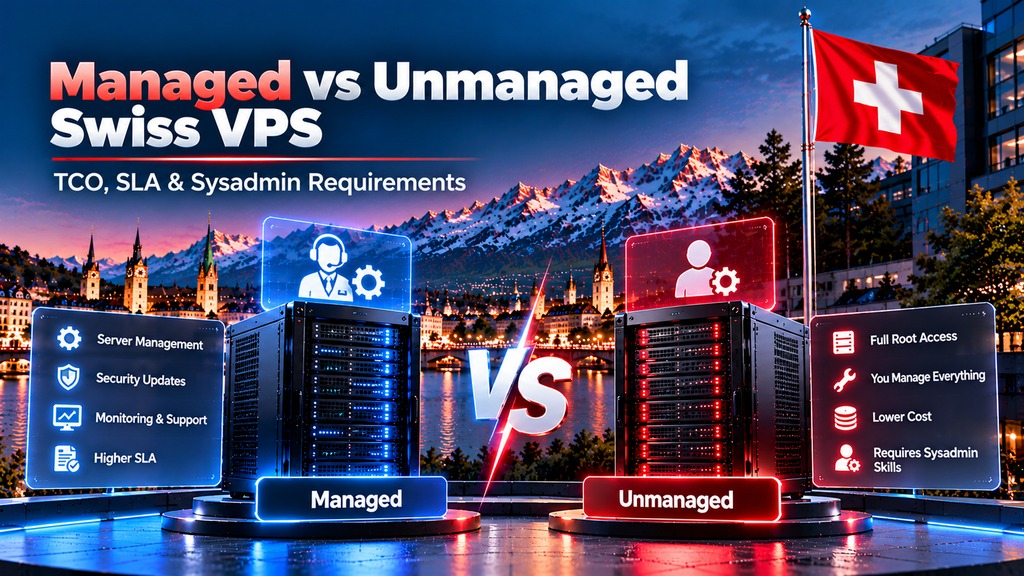
Selecting managed swiss vps hosting provides 24/7 proactive monitoring, automated kernel patching, firewall hardening, and tier-3 sysadmin resolution. Conversely, unmanaged hosting provides bare compute where internal teams manage all system updates, security patches, and disaster recovery. Consequently, managed hosting eliminates internal staffing expenses exceeding CHF 2,000 monthly.
Deploying mission-critical enterprise systems on managed swiss vps hosting guarantees hardware-level performance and proactive infrastructure administration. Specifically, software teams must evaluate whether in-house developers should spend valuable hours patching Linux kernels and configuring firewalls.
For example, neglecting routine vulnerability scans exposes unmanaged servers to catastrophic zero-day compromises. Conversely, enterprise Switzerland VPS hosting combines strict Swiss revDSG data privacy with 24/7 professional datacenter monitoring.
Specifically, this engineering guide evaluates operational demarcations, security workflows, and SLA guarantees. Furthermore, it details total cost of ownership models in Swiss Francs (CHF). Therefore, technology executives can select the optimal infrastructure tier for their platforms.
24/7 Proactive SLA
Certified Linux administrators monitor service uptime, apply CVE patches, and mitigate server incidents under 15 minutes.
Swiss revDSG Privacy
Physical data residency inside subterranean Zurich bunkers fulfills rigorous Swiss data protection and banking confidentiality laws.
Zero CPU Steal KVM
Hardware-isolated hypervisor virtualization delivers pinned AMD EPYC cores, DDR5 ECC memory, and Gen4 NVMe arrays.
Navigation Directory
- Core Architecture: Managed Swiss VPS Hosting vs Unmanaged Servers
- The Sysadmin Maintenance Burden: Quantifying Engineering Hours
- Security Patching & Vulnerability Management on Managed Swiss VPS Hosting
- 24/7 Proactive Monitoring & Rapid Incident Response SLAs
- Financial Modeling & TCO Analysis for Managed Swiss VPS Hosting
- Managed vs Unmanaged Feature & Responsibility Matrix
- Performance Benchmarking Audits & Proactive Optimization Cycles
- Frequently Asked Questions
Core Architecture: Managed Swiss VPS Hosting vs Unmanaged Servers
Specifically, the architectural boundary between managed and unmanaged hosting centers around operational administrative responsibility. Deploying infrastructure on managed Swiss virtual servers provides a turn-key platform where provider engineers oversee the entire operating system stack. Furthermore, provider teams handle continuous kernel updates, web server configuration, and baseline firewall enforcement.
Conversely, unmanaged Swiss VPS instances provide pure Infrastructure-as-a-Service (IaaS). For official hypervisor architectural documentation, engineers can consult the KVM Hypervisor Documentation.
Unmanaged Root Autonomy
Developers maintain 100% administrative discretion to compile custom kernels, build experimental networking drivers, and install uncommon Linux packages.
Managed Operational Protection
Datacenter engineers handle automated snapshot rotations, proactive service healing, and database vacuuming around the clock.
SwissIX Peering Core
Both hosting tiers route traffic directly through the Swiss Internet Exchange (SwissIX) in Zurich for sub-1ms transit.
Therefore, organizations must decide whether their development team has the technical bandwidth to manage low-level Linux administrative chores. In addition, organizations managing sensitive consumer databases often prefer dedicated platform management to prevent misconfigurations.
The Sysadmin Maintenance Burden: Quantifying Engineering Hours
In fact, maintaining an unmanaged production Linux server requires substantial recurring technical effort each week. System engineers must rotate system logs, test database integrity, verify external backup archives, and patch critical packages. Specifically, routine operational duties consume between fifteen and twenty-five engineering hours per month for a single virtual machine.
Furthermore, unexpected kernel panics or filesystem corruptions can occur overnight. Consequently, internal engineers must abandon product development to troubleshoot urgent issues. In addition, high-concurrency web optimization requires tuning Nginx worker processes, PHP-FPM pools, and MySQL buffer pools.
Consequently, delegating system management to datacenter specialists frees internal engineers to build customer-facing application features.
Security Patching & Vulnerability Management on Managed Swiss VPS Hosting
Vulnerability mitigation velocity directly determines an organization’s susceptibility to catastrophic ransomware infections. Selecting managed Swiss server infrastructure guarantees rapid deployment of critical Common Vulnerabilities and Exposures (CVE) patches. Specifically, datacenter sysadmins apply kernel updates within hours of release without requiring service disruption or uncoordinated reboots.
Conversely, unmanaged servers often suffer from a dangerous vulnerability gap lasting several weeks while busy teams delay routine maintenance. Furthermore, managed servers utilize automated intrusion detection, automated brute-force IP blocking, and strict kernel-level auditing.
Consequently, below is the production automated security daemon verification script executed on managed Swiss nodes:
24/7 Proactive Monitoring & Rapid Incident Response SLAs
Specifically, the difference between proactive monitoring and reactive triage determines whether customers notice an outage before you do. On unmanaged virtual servers, monitoring is strictly reactive; providers only guarantee that the underlying physical host is powered on. If an Nginx daemon segfaults or a MySQL table crashes, the virtual machine remains silent until users complain.
Conversely, managed virtual instances incorporate synthetic monitoring probes that test HTTP/2 endpoints, disk saturation, and memory leaks every sixty seconds. Furthermore, when synthetic checks fail, automated paging systems alert on-duty Zurich engineers within ninety seconds.
Therefore, system anomalies are resolved and validated before they escalate into catastrophic corporate revenue loss. In addition, guaranteed fifteen-minute initial response Service Level Agreements (SLAs) ensure enterprise peace of mind.
Financial Modeling & TCO Analysis for Managed Swiss VPS Hosting
Evaluating hosting expenditure purely based on invoice line-item pricing is a frequent financial miscalculation for growing businesses. A rigorous Total Cost of Ownership (TCO) model must incorporate the high value of technical human capital. For example, selecting managed Swiss cloud platforms introduces a modest management fee while eliminating internal technical labor.
Specifically, senior Linux systems administrators in Zurich command high compensation. Average annual base salaries range between CHF 115,000 and CHF 140,000. Allocating merely fifteen percent of an engineer’s time to server maintenance represents an internal monthly cost exceeding CHF 1,800.
Consequently, subscribing to a comprehensive managed plan delivers over CHF 20,000 in net annual organizational savings.
Managed vs Unmanaged Feature & Responsibility Matrix
For example, understanding operational delineations prevents costly confusion between datacenter personnel and internal development staff. Consequently, the empirical comparison matrix below outlines specific administrative responsibilities across both Swiss VPS deployment models:
Performance Benchmarking Audits & Proactive Optimization Cycles
In addition, high-traffic web applications experience performance degradation as databases grow and memory pools fragment over time. Managed services include scheduled quarterly profiling audits to inspect slow database queries and optimize indexes. Specifically, database optimization prevents transaction queue buildups during intense ecommerce sales campaigns.
Furthermore, engineers inspect caching hit ratios across Redis instances and optimize OPcache memory boundaries. In addition, applying Google BBR congestion control over high-bandwidth SwissIX links accelerates dynamic page generation.
Therefore, applications hosted on managed nodes sustain low latency across Switzerland and the broader European market.
Frequently Asked Questions
Explore clear technical answers regarding managed support scope, root privileges, and Zurich datacenter operations:
Zurich Tier-III Interxion Hub
Deploy Your Enterprise Swiss VPS in Zurich Today
Deploy high-performance KVM virtual instances in certified Zurich facilities. Choose unmanaged hosting for full root autonomy, or managed hosting for 24/7 proactive sysadmin maintenance and revDSG compliance.
PCIe Gen4 NVMe RAID-10
Swiss revDSG Compliance
SwissIX 1Gbps Peering
