

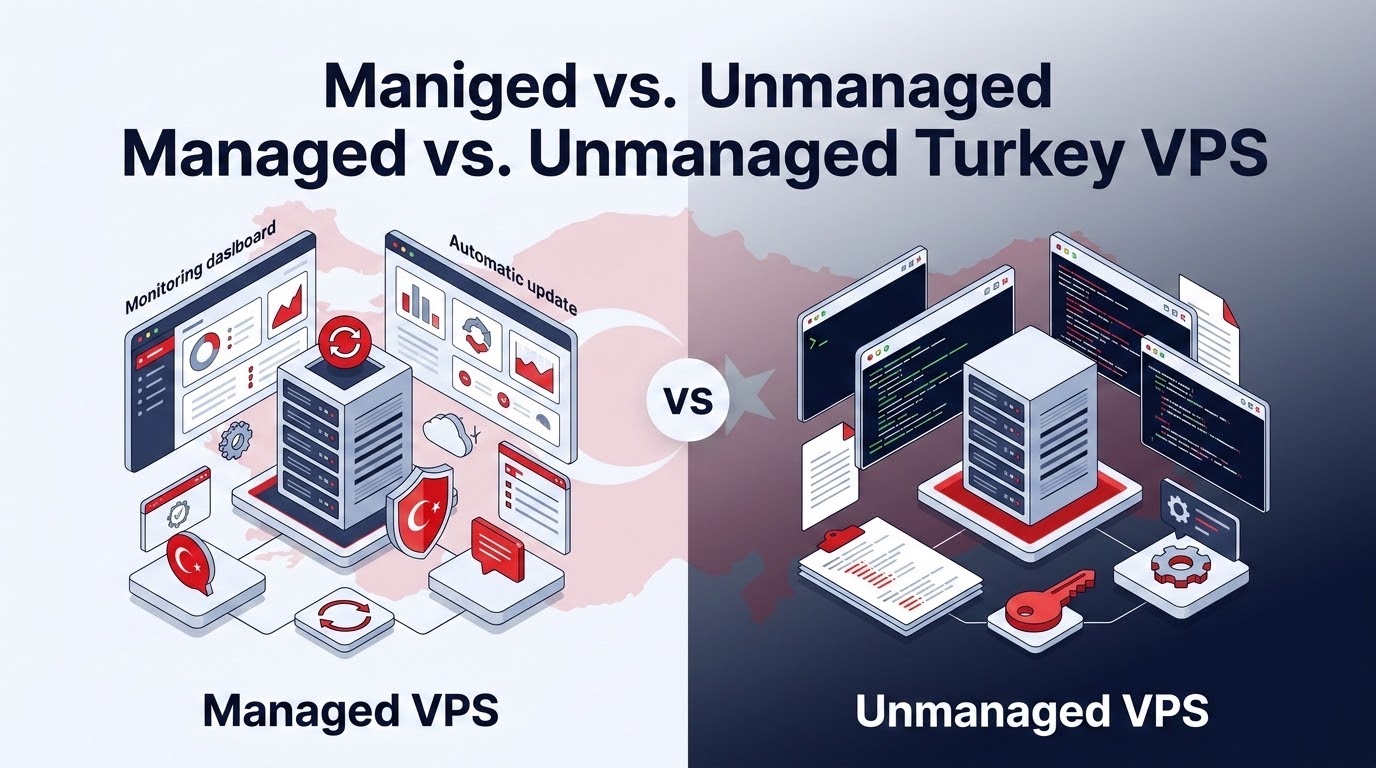
What Is the Difference Between Managed and Unmanaged Turkey VPS Hosting?
An unmanaged Turkey VPS provides full root access where your internal team is solely responsible for OS installation, security patches, firewall hardening, and crash recovery. A managed Turkey VPS includes 24/7 proactive infrastructure monitoring, zero-day CVE patching, automated snapshot backups, and guaranteed 15-minute response SLAs handled by senior hosting engineers. For growing businesses without dedicated Linux sysadmins, managed services reduce operational payroll overhead by up to 80% compared to hiring full-time in-house engineering staff in Türkiye.
When planning cloud infrastructure deployment in Istanbul, technical executives and business founders face a strategic operational decision: should you manage your own virtual servers from the raw Linux command prompt or partner with a fully managed cloud operations team? While unmanaged virtual servers offer the lowest entry price, the true cost of server management is measured in engineering labor, on-call alert fatigue, and revenue lost during catastrophic midnight outages. Deploying on fully managed Turkey VPS hosting stationed in Istanbul frees your internal engineering talent to focus exclusively on product development and business revenue while dedicated hosting engineers safeguard infrastructure reliability 24/7.
✔ Key Architectural Takeaways
- The In-House Cost Reality: Hiring a qualified mid-level Linux systems administrator in Istanbul or Ankara commands an average gross monthly salary exceeding 75,000 TRY, whereas managed server tiers add only a modest monthly service premium.
- Guaranteed Incident Response: Managed server contracts enforce strict 15-minute response time service level agreements (SLAs) for critical server emergencies 24/7/365.
- Proactive Security & Patching: Managed services handle routine glibc, OpenSSL, and kernel security updates automatically, eliminating zero-day vulnerability windows.
- Database & Stack Tuning: Managed teams actively optimize Nginx buffers, PHP-FPM pools, and MySQL InnoDB parameters to maximize local Core Web Vitals.
- Full Root Flexibility Maintained: OnliveServer managed cloud instances grant full administrative root access while maintaining back-line tier-3 engineering support.
Table of Contents
- Defining the Operational Boundary: What is Managed vs. Unmanaged?
- The Economic Realities of In-House IT Staffing in Türkiye
- Incident Response & Proactive Telemetry: 15-Minute SLAs vs. 3:00 AM Panics
- Security Maintenance: Kernel Hardening, Zero-Day CVEs & KVKK Audits
- Performance Optimization: Web Server Tuning & Database Maintenance
- Comprehensive Operational Matrix: Managed vs. Unmanaged Turkey VPS
- Responsibility Division Runbook: Mapping Sysadmin Duties on Cloud VPS
- Frequently Asked Questions (FAQ)
Defining the Operational Boundary: What is Managed vs. Unmanaged?
When you purchase an unmanaged cloud server in Istanbul, the hosting provider’s contractual responsibility ends at the physical hypervisor layer. The host guarantees that the physical server chassis receives electrical power, the KVM virtualization hypervisor remains active, and the network interface card exchanges packets with the data center switch. Everything inside the virtual machine—the operating system kernel, user permissions, firewall rules, web server software, database engine, and application runtime—is solely your responsibility.
Consequently, if a faulty WordPress update crashes your MySQL database at 2:00 AM on a Sunday, or if an aggressive volumetric brute-force attack overwhelms your SSH daemon, an unmanaged host will not intervene. Your internal team must log in via SSH or the emergency VNC console, diagnose core dumps, review system logs, and execute remediation steps.
In contrast, a managed cloud server transfers operational administration of the underlying operating system and software stack to the provider’s dedicated team of Linux systems engineers. The hosting provider assumes continuous responsibility for monitoring service uptime, deploying operating system security patches, optimizing database configuration files, managing automated daily snapshots, and responding immediately to application errors.
The Economic Realities of In-House IT Staffing in Türkiye
For growing Turkish businesses, digital marketing agencies, and mid-sized e-commerce portals, hiring an in-house systems administration and DevOps team represents a substantial recurring financial commitment. According to regional IT compensation surveys across Istanbul, Ankara, and Izmir, compensation figures illustrate a stark operational reality:
- Junior Linux Administrator: Average net monthly salary of 38,000 TRY to 50,000 TRY (Gross employer cost: ~65,000 TRY / month).
- Mid-Level DevOps / Sysadmin Engineer: Average net monthly salary of 60,000 TRY to 85,000 TRY (Gross employer cost: ~110,000 TRY / month).
- Senior Infrastructure Architect: Gross employer costs regularly exceed 160,000 TRY per month.
Furthermore, true 24/7/365 operational coverage cannot be maintained by a single engineer. Providing uninterrupted night, weekend, and holiday coverage requires a minimum team of three rotating engineers to prevent burnout and labor regulation violations. For most digital agencies and medium enterprises, allocating hundreds of thousands of Turkish Liras annually to infrastructure maintenance is economically unfeasible.
Therefore, by opting for a managed Turkey VPS tier—which typically adds a predictable service management fee of $30 to $80 (roughly 1,000 to 2,800 TRY) per month—businesses gain round-the-clock access to an entire team of senior Linux architects for a fraction of the cost of a single part-time employee.
Incident Response & Proactive Telemetry: 15-Minute SLAs vs. 3:00 AM Panics
Moreover, the true value of managed hosting is realized during critical production emergencies. In an unmanaged hosting setup, downtime is almost always discovered by an angry customer, a failed payment gateway alert, or the business owner noticing an inaccessible storefront. By the time internal personnel are awakened, locate their laptops, and establish SSH access, tens of thousands of liras in revenue and search engine crawl budget have been lost.
OnliveServer managed cloud infrastructure employs enterprise telemetry suites (including Prometheus, Grafana, and Netdata) monitoring dozens of server health metrics in real time. Automating process recovery and daemon health checks on Linux virtual servers relies on unit supervisory controls documented in the systemctl service manager manual on Linux man-pages.
- HTTP/HTTPS endpoint availability and TLS certificate expiration.
- Per-core CPU utilization and CPU steal time spikes.
- RAM saturation and swap space utilization thresholds.
- MySQL/MariaDB active thread counts and slow query deadlocks.
- Disk space capacity and NVMe random write latency.
When telemetry detects an anomaly—such as Nginx returning 502 Bad Gateway responses or memory usage climbing toward an OOM threshold—automated alerting dispatches an alert to our on-duty Istanbul engineering desk. Under our 15-minute response SLA, a qualified systems administrator investigates the issue, restarts stalled daemons, clears deadlocks, and restores service, often before the business owner even realizes an incident occurred.
Security Maintenance: Kernel Hardening, Zero-Day CVEs & KVKK Audits
Unmanaged servers exposed to public IP addresses face hundreds of malicious port scans, dictionary attacks, and exploit probes every hour. Securing a Linux production server requires ongoing, disciplined maintenance:
- SSH Daemon Hardening: Disabling root password authentication, enforcing public key cryptographic handshakes, and changing standard port 22.
- Web Application Firewall (WAF) Integration: Configuring ModSecurity with OWASP Core Rule Sets to filter SQL injection, cross-site scripting (XSS), and remote code execution attempts.
- Automated CVE Patching: Applying kernel security live-patches (via Canonical Livepatch or KernelCare) and updating core packages (OpenSSL, glibc, curl) without requiring disruptive server reboots.
- Fail2ban & Brute-Force Jails: Dynamically banning abusive IP addresses attempting unauthorized login attempts against WordPress admin, cPanel, or mail daemons.
- KVKK Log Compliance: Ensuring system access logs, authentication attempts, and network connections are captured and stored in accordance with Turkish Law No. 6698 privacy mandates.
On a managed VPS, these comprehensive security protocols are established at deployment and audited continuously by our security engineering staff.
Performance Optimization: Web Server Tuning & Database Maintenance
A default installation of Ubuntu or AlmaLinux is configured for generic server tasks, not for high-concurrency web hosting. Extracting peak performance requires deep stack optimization.
Our managed hosting engineers audit and tune every layer of your software stack. In PHP-FPM, we configure dynamic process manager workers to eliminate request queuing. In MySQL, we calculate precise InnoDB buffer pool allocations, adjust query cache settings, and tune log file write operations. In Nginx, we enable HTTP/2 and HTTP/3 QUIC protocols, configure Brotli compression, and optimize client header buffers. This proactive tuning directly improves Time to First Byte (TTFB), greenlights Core Web Vitals scores, and elevates organic rankings on Google.com.tr.
Comprehensive Operational Matrix: Managed vs. Unmanaged Turkey VPS
The comparative matrix below details the division of technical responsibilities between managed and unmanaged hosting tiers:
| Operational Responsibility | Managed Turkey VPS | Unmanaged Turkey VPS | Business Impact |
|---|---|---|---|
| 24/7 Service Uptime Monitoring | Included (Proactive Alerts) | Customer Responsibility | Zero midnight customer panics |
| OS Security & Kernel Patching | Automated & Verified by Host | Customer Responsibility | Zero-day vulnerability protection |
| Automated Snapshot Backups | Nightly Offsite Snapshots | Manual Scripting Required | Instant one-click disaster recovery |
| Web Server & DB Optimization | Custom Tuning Included | Default Stock Configs | Greener Core Web Vitals |
| Emergency Incident SLA | 15-Minute Guaranteed Response | Best Effort Hardware Only | Minimal revenue loss during outages |
Responsibility Division Runbook: Mapping Sysadmin Duties on Cloud VPS
To determine whether your team is equipped to manage an unmanaged server or requires managed operational support, review this administrative competency checklist:
SERVER MANAGEMENT CAPABILITY CHECKLIST
- Can your team compile and tune Nginx with Brotli and HTTP/3 QUIC?
- Do you have automated scripts verifying nightly MySQL dump integrity?
- Can an engineer wake up at 3:00 AM and fix an OOM crash within 15 minutes?
- Are you actively auditing Linux CVE announcements (e.g., glibc/OpenSSL)?
- Do you maintain off-site encrypted backup replication outside the host DC?
🚨 If you answered NO to any of these questions, a Managed VPS Tier is an essential operational investment to protect your revenue.
❓ Frequently Asked Questions
Click any question to expand the answer.
Focus on Business Growth While We Manage Your Istanbul VPS
Eliminate on-call alert fatigue and protect your revenue with 24/7 proactive monitoring, automated patching, and guaranteed 15-minute emergency SLAs. Deploy on enterprise Istanbul hardware today.
Written by Naveen Rajput
CEO & Director, Onlive Server Private Limited
Naveen Rajput is the CEO and Director of Onlive Server Private Limited, bringing 16+ years of expertise in web hosting, cloud infrastructure, and international server operations. Since 2009, he has guided thousands of enterprise businesses toward reliable, secure, and scalable hosting architectures worldwide.