

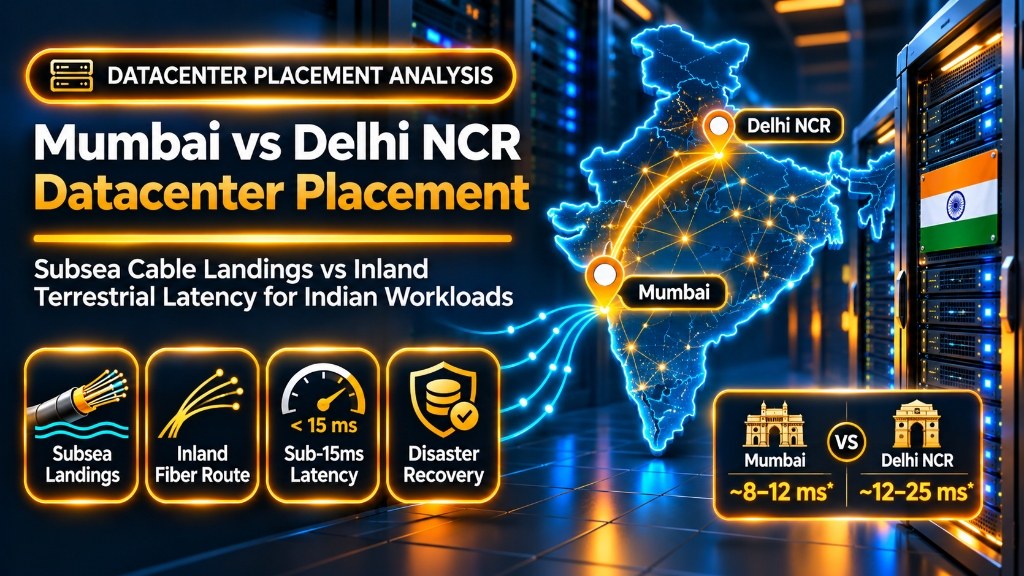
Direct Answer: Evaluating mumbai vs delhi datacenter latency reveals that Mumbai delivers 15ms to 28ms lower international latency due to direct subsea cable landings, while achieving an optimal pan-India average round-trip time of 22ms. Delhi NCR provides sub-5ms latency for North Indian government and enterprise corridors but adds 24ms of terrestrial transit to international gateways.
- Choose Mumbai Bare Metal: Recommended for e-commerce, banking, fintech, SaaS platforms, and global gaming requiring direct subsea fiber landings and balanced, low-latency reach across both North and South India.
- Choose Delhi NCR (Noida / Gurugram) Bare Metal: Ideal for public sector undertakings (PSUs), government procurement portals (GeM), defense subcontractors, and enterprises whose end-user base resides predominantly in Northern India (Punjab, Haryana, UP, Rajasthan).
- Deploy Mumbai Primary + Delhi NCR Disaster Recovery (DR): The gold-standard enterprise architecture, establishing 1,400km geographic separation across independent seismic zones with sub-25ms synchronous or asynchronous database replication.
- Leverage Direct NIXI Interconnects: Guarantees domestic traffic routes locally within India, bypassing costly international transit routes.
When planning dedicated server infrastructure in India, one of the most consequential architectural decisions infrastructure architects face is geographical datacenter placement. India is a vast subcontinent spanning over 3,200 kilometers from north to south and nearly 3,000 kilometers from east to west. In a nation with over 900 million active internet users connected across mobile 4G/5G and fiber broadband networks, physical server placement dictates network round-trip time (RTT), user experience, application conversion rates, and disaster recovery resilience.
The two dominant enterprise datacenter markets in India are the Mumbai Metropolitan Region (including Navi Mumbai and Chandivali) and the National Capital Region (Delhi NCR, encompassing Noida and Gurugram). While both regions offer enterprise facilities, their underlying fiber topology, subsea connectivity, and regional transit profiles differ substantially. Selecting the right location—or architecting a resilient multi-region deployment on an Onlive Server mumbai vs delhi datacenter latency framework—ensures your dedicated infrastructure delivers optimal performance across the subcontinent.
Mumbai terminates international subsea cables directly, whereas Delhi NCR relies on 1,400km of terrestrial optical fiber to reach coastal gateways.
Mumbai’s central-west coastal placement balances latency across South India (18ms) and North India (24ms) with consistent uniformity.
Clustering Mumbai and Delhi NCR fulfills RBI and regulatory disaster recovery mandates requiring diverse seismic and weather zones.
Dual-region NIXI and Extreme IX peering enables dynamic BGP Anycast routing for high-availability DNS and API gateways.
- 1. The Geography of Indian Fiber: Coastal Landing Hubs vs Inland Terrestrial Corridors
- 2. Terrestrial Fiber Routes: Mumbai-to-Delhi Backhaul & DWDM Regeneration
- 3. Empirical Latency Benchmarks: Round-Trip Times (RTT) Across 10 Indian Metros
- 4. International Egress Economics: Transmitting to Europe, Middle East & Singapore
- 5. Enterprise Multi-Region Topologies: Mumbai Primary with Delhi NCR Disaster Recovery
- 6. Comparative Technical Matrix: Mumbai Bare Metal vs Delhi NCR (Noida/Gurugram)
- 7. Step-by-Step Production Runbook: Cross-Region MTR Profiling & BGP Route Tuning
- 8. Industry & Regulatory Drivers: BFSI/Fintech (Mumbai) vs PSU/Government (Delhi)
- 9. Frequently Asked Questions (Technical FAQs)
1. The Geography of Indian Fiber: Coastal Landing Hubs vs Inland Terrestrial Corridors
Understanding latency dynamics in India requires examining the physical routing of optical fiber cables across the subcontinent:
- The Coastal Advantage of Mumbai: Mumbai sits directly on the Arabian Sea coast, acting as the primary terminus for more than a dozen major international subsea cable consortia. Packets arriving from Europe, North America, and the Middle East land directly in Mumbai and are routed into local datacenters within single-digit microseconds over metro dark fiber rings.
- The Inland Reality of Delhi NCR: Delhi NCR (encompassing New Delhi, Noida, and Gurugram) is situated 1,400 kilometers inland in Northern India. All international data arriving at or departing from Delhi datacenters must traverse terrestrial backhaul optical routes across multiple states (Haryana, Rajasthan, Gujarat, and Maharashtra) before reaching ocean cable landing stations in Mumbai or Gujarat.
- Terrestrial Fiber Degradation Risks: Terrestrial fiber routes are inherently exposed to higher physical failure rates than subsea conduits due to ongoing highway construction, railway expansion, and municipal utility digging. Every 100 kilometers of terrestrial fiber introduces approximately 0.5ms of round-trip optical propagation delay plus optical amplifier latency.
2. Terrestrial Fiber Routes: Mumbai-to-Delhi Backhaul & DWDM Regeneration
The telecommunications corridor between Mumbai and Delhi is the most heavily trafficked data trunk in India. Dense Wavelength Division Multiplexing (DWDM) optical networks operate along two primary physical rights-of-way:
- Western Highway Route (NH48 / National Expressway): Follows Mumbai → Surat → Vadodara → Ahmedabad → Jaipur → Delhi NCR. This is the lowest-latency commercial terrestrial route, delivering approximately 22ms to 24ms one-way round-trip latency over modern coherent optical transport networks.
- Central Railway Route (RailTel Optical Fiber): Deployed along the Indian Railways right-of-way via Madhya Pradesh (Mumbai → Bhusawal → Bhopal → Agra → Delhi). Serves as a vital geographically diverse backup route to protect against highway optical cuts.
- Optical Regeneration Hops: Because optical signals degrade over long distances, terrestrial signals pass through optical amplification stations (EDFA) every 80 to 100km and optical regeneration nodes every 800km. High-grade carrier routes utilize Raman amplification to minimize digital jitter and maintain optical signal-to-noise ratios (OSNR).
3. Empirical Latency Benchmarks: Round-Trip Times (RTT) Across 10 Indian Metros
To provide infrastructure architects with objective performance data, Onlive Server network engineers conducted comprehensive ICMP ping and HTTP TTFB benchmarks from dedicated bare-metal nodes in Mumbai and Noida (Delhi NCR) across 10 major Indian metropolitan areas:
| Target Metro City | Geographic Zone | Latency from Mumbai Server (RTT) | Latency from Delhi NCR Server (RTT) | Performance Winner |
|---|---|---|---|---|
| Mumbai (MMR) | West India | 1.2ms – 3.5ms | 23.5ms – 26.2ms | Mumbai (8x Faster) |
| Delhi NCR (Noida/Gurugram) | North India | 22.8ms – 25.1ms | 1.5ms – 4.1ms | Delhi NCR (7x Faster) |
| Bangalore (Bengaluru) | South India | 16.4ms – 19.2ms | 36.5ms – 42.1ms | Mumbai (2.2x Faster) |
| Hyderabad | South-Central | 14.8ms – 17.5ms | 29.2ms – 34.0ms | Mumbai (2x Faster) |
| Chennai | South-East | 21.2ms – 24.0ms | 38.4ms – 44.2ms | Mumbai (1.8x Faster) |
| Pune | West India | 3.5ms – 5.2ms | 26.8ms – 29.5ms | Mumbai (6x Faster) |
| Kolkata | East India | 31.5ms – 35.2ms | 32.0ms – 36.4ms | Tie (Virtually Identical) |
| Ahmedabad | West India | 11.5ms – 13.8ms | 18.2ms – 21.0ms | Mumbai (1.6x Faster) |
| Chandigarh / Punjab | North India | 28.5ms – 32.1ms | 5.8ms – 8.2ms | Delhi NCR (4x Faster) |
| Jaipur | North India | 19.4ms – 22.0ms | 6.2ms – 8.9ms | Delhi NCR (2.8x Faster) |
4. International Egress Economics: Transmitting to Europe, Middle East & Singapore
For organizations serving international audiences or consuming overseas API microservices, Mumbai’s direct subsea cable landings provide decisive latency and financial advantages:
- Latency to Frankfurt (DE-CIX / Interxion): Traffic from Mumbai reaches Frankfurt in 84ms to 88ms over SEA-ME-WE-5. From Delhi NCR, that same traffic takes 108ms to 115ms due to inland terrestrial backhaul.
- Latency to Dubai & Middle East (UAE-IX): Mumbai to Dubai traverses the Arabian Sea in sub-24ms RTT. From Delhi, latency increases to 48ms.
- Latency to Singapore (Equinix SG1): Direct Bay of Bengal Gateway (BBG) routing from Mumbai delivers Singapore packets in 31ms to 35ms. From Delhi, round-trip times span 55ms to 62ms.
- Carrier Terrestrial Backhaul Surcharges: Dedicated bandwidth transiting from inland Delhi NCR to international subsea cable heads incurs additional carrier terrestrial transit fees, making 10Gbps unmetered transit substantially more cost-effective when provisioned natively in Mumbai.
5. Enterprise Multi-Region Topologies: Mumbai Primary with Delhi NCR Disaster Recovery
For mission-critical banking platforms, payment gateways, and Tier-1 e-commerce enterprises, deploying within a single datacenter region—regardless of how resilient—leaves the organization vulnerable to regional catastrophe. Establishing an Active-Passive or Active-Active Disaster Recovery (DR) topology between Mumbai and Delhi NCR represents the industry benchmark:
- Optimal Geographic Separation (1,400km): RBI business continuity directives and international ISO 22301 standards mandate that secondary disaster recovery sites reside in a distinct seismic zone, different power grid jurisdiction, and separate climatic weather corridor. Mumbai (coastal, Arabian Sea, Western power grid) and Delhi NCR (inland, Indo-Gangetic plain, Northern power grid) perfectly satisfy this mandate.
- Sub-25ms Asynchronous Replication: A continuous optical RTT of ~24ms between Mumbai and Delhi enables high-throughput asynchronous database replication (MySQL GTID or PostgreSQL streaming replication) with replication lag consistently below 50 milliseconds.
- BGP Anycast Dynamic Traffic Steering: By announcing identical IP prefixes from both Mumbai and Delhi via NIXI and Extreme IX, North Indian users are automatically routed to the Delhi cluster while West, South, and international users route to Mumbai. If one facility experiences an outage, BGP health checks withdraw the failed prefix, redirecting 100% of national traffic to the surviving site in under 3 seconds.
6. Comparative Technical Matrix: Mumbai Bare Metal vs Delhi NCR (Noida/Gurugram)
The following engineering comparison summarizes the core operational differences between hosting dedicated bare-metal infrastructure in Mumbai versus Delhi NCR:
| Operational Dimension | Mumbai Dedicated Bare Metal (Onlive Server) | Delhi NCR Dedicated Bare Metal (Noida/Gurugram) |
|---|---|---|
| Primary Industry Alignment | BFSI, Fintech, E-Commerce, Media & SaaS | Government (MeitY), PSUs, Defense, Northern Retail |
| Subsea Cable Landings | 12+ Direct International Landings (Versova/Prabhadevi) | 0 (Inland; requires 1,400km terrestrial backhaul) |
| Pan-India Latency Average | 21.5ms (Balanced reach across North & South) | 29.8ms (Superior in North, degraded in South) |
| Power Utility Infrastructure | MSEDCL & Tata Power (Highly resilient coastal grid) | UPPCL (Noida) / DHBVN (Gurugram) (Requires robust 2N diesel) |
| Internet Exchange Fabric | Extreme IX Mumbai, NIXI, DE-CIX, AMS-IX | Extreme IX Delhi, NIXI Noida |
7. Step-by-Step Production Runbook: Cross-Region MTR Profiling & BGP Route Tuning
Execute this production runbook to audit optical packet routing, identify terrestrial fiber hops, and tune BGP path selection between Mumbai and Delhi NCR dedicated servers.
Step 1: Execute High-Resolution MTR Route and Jitter Audit:
Step 2: Profile TCP Bandwidth-Delay Product (BDP) Across Inter-City Link:
Step 3: Configure BGP Local Preference to Steer North Indian Traffic via Delhi:
8. Industry & Regulatory Drivers: BFSI/Fintech (Mumbai) vs PSU/Government (Delhi)
Datacenter selection in India is frequently governed by sector-specific regulatory frameworks:
- Banking, Financial Services & Insurance (BFSI): The Reserve Bank of India (RBI) and Securities and Exchange Board of India (SEBI) mandate ultra-low latency to stock exchange matching engines (BSE in Fort, NSE in BKC). Operating dedicated metal in Navi Mumbai or Chandivali ensures sub-millisecond execution times for colocation and trading APIs.
- Government & Public Sector (PSUs): Ministry of Electronics and Information Technology (MeitY) empanelled applications, Government e-Marketplace (GeM), and defense contractors frequently mandate primary hosting within Delhi NCR to ensure direct optical connectivity to the National Informatics Centre (NIC) and National Knowledge Network (NKN) backbones.
9. Frequently Asked Questions (Technical FAQs)
Below are authoritative answers to common technical inquiries regarding Mumbai vs Delhi datacenter placement:
Coastal Mumbai facilities sit closest to international subsea landings, whereas Noida and Gurugram hubs shave milliseconds off northern Indian terrestrial routes. Many teams pair a Mumbai primary node with Delhi NCR failover to balance global egress and domestic reach. Compare Indian server locations and specs.
Mumbai and Indian server locations