

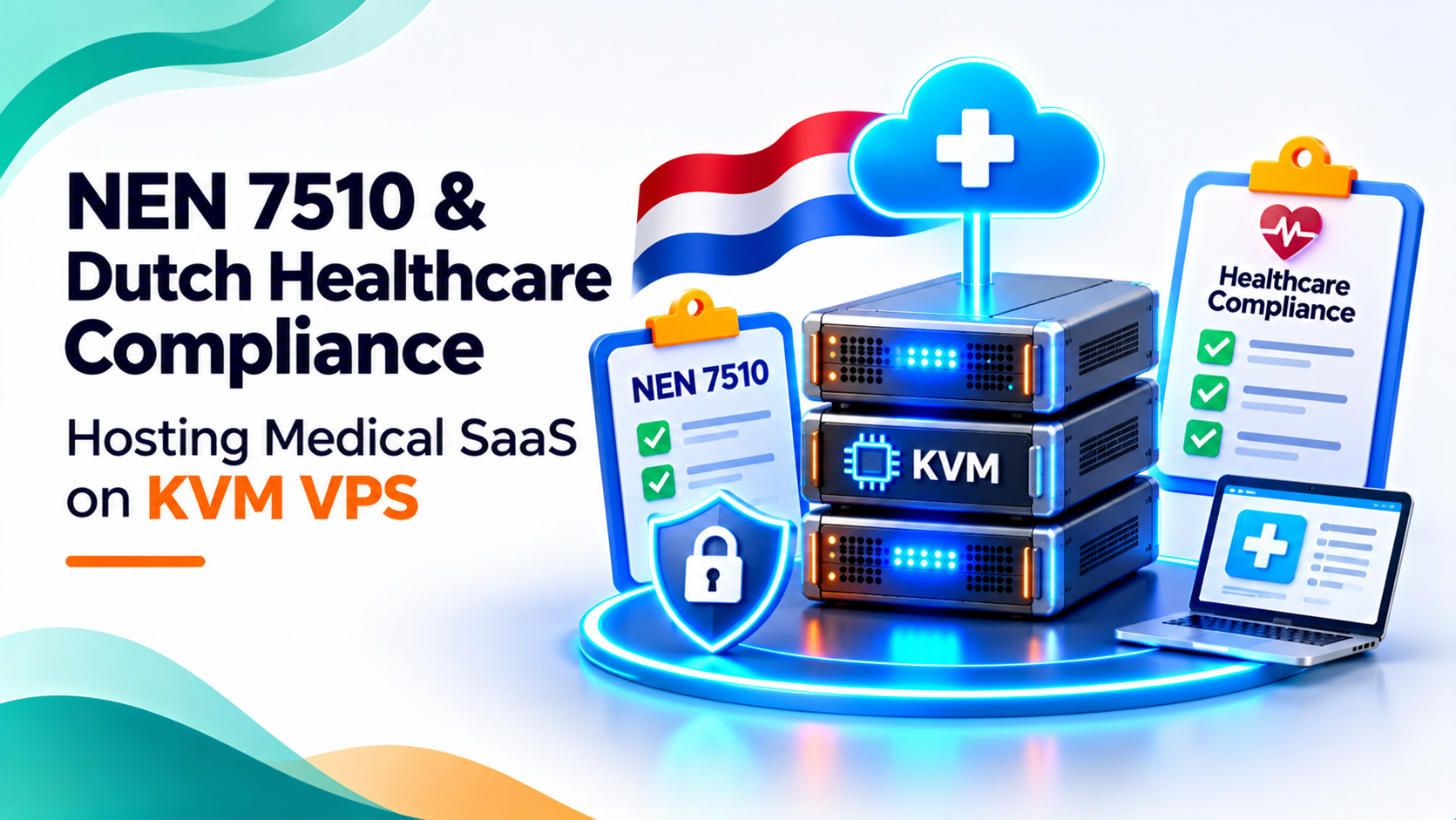
This executive technical checklist defines the data residency, compliance standards, and architectural criteria for deploying Dutch medical SaaS and EPD workloads in accordance with NEN 7510 and ISO 27001:
Hosting Dutch medical SaaS applications, electronic patient dossiers (EPD), and pharmacy integration portals requires strict adherence to NEN 7510 and ISO 27001 healthcare data governance standards. Operating on a certified NEN 7510 hosting Netherlands environment provides AES-256 encrypted block storage, isolated non-routable private VLANs for patient databases, multi-factor PAM administrative authentication, and immutable audit logging meeting Dutch Ministry of Health regulatory standards.
Deploying mission-critical digital healthcare workloads and electronic patient dossiers (EPD) in Amsterdam gives engineering teams direct access to Europe’s primary optical fiber transit corridors, deterministic low-latency peering, and sovereign AVG data residency. This compliance architecture manual explains how deploying workloads on an Amsterdam-based KVM VPS ensures physical data sovereignty, avoids unauthorized cross-border data transfers, and satisfies Dutch Ministry of Health and NEN 7510 audit standards.
Strict Dutch AVG Sovereignty
Full adherence to the Dutch AVG and GDPR shields enterprise records from foreign CLOUD Act overreach, ensuring complete territorial data sovereignty in the Netherlands.
LUKS Encrypted Block Storage
Hardware-accelerated AES-256 LUKS volume encryption safeguards confidential customer databases and system files against unauthorized physical extraction.
Audit-Ready ISO 27001 Facilities
Biometrically secured Tier-3 datacenters in Amsterdam comply with NEN 7510 and ISO 27001 standards, providing signed Data Processing Agreements.
NEN 7510 Healthcare Mandate & Compliance Scope
NEN 7510 is the national standard for information security within the Dutch healthcare sector. It applies to all healthcare institutions (care providers, hospitals, general practitioners, mental health clinics) and, crucially, to all commercial IT suppliers and SaaS vendors acting as data processors under the Medical Treatment Contracts Act (Wet op de geneeskundige behandelingsovereenkomst – Wgbo).
The standard is divided into two primary sections: NEN 7510-1 defines the Information Security Management System (ISMS) framework based on ISO/IEC 27001, while NEN 7510-2 details 114 specific technical and organizational security controls based on ISO/IEC 27002, expanded with Dutch healthcare-specific mandates (such as strict logging of who accessed which patient file and when). Organizations seeking committed compute resources can evaluate enterprise secure Dutch healthcare hosting.
Mandatory Dutch information security norm for Electronic Patient Dossiers (EPD) and medical SaaS application hosts.
International security baseline establishing audited risk assessments, access control matrices, and physical facility safeguards.
The IGJ enforces NEN 7510 across the Dutch healthcare domain. Under the Healthcare Quality, Complaints and Disputes Act (Wkkgz), healthcare organizations that contract third-party cloud software must ensure that their vendors operate on infrastructure verified against NEN 7510 baselines. If a clinical SaaS platform suffers unauthorized access due to weak multi-tenancy or lack of encryption, the IGJ can mandate immediate operational shutdown and impose administrative fines.
KVM Isolation vs Multi-Tenancy in Healthcare
In medical cloud hosting, the choice of virtualization hypervisor is a primary audit checkpoint. In shared container hosting (such as OpenVZ, LXC, or generic shared Kubernetes clusters), all tenant workloads execute against a single, shared Linux host kernel. A vulnerability in the host kernel (such as a local privilege escalation or dirty COW exploit) allows a malicious tenant in an adjacent container to escape boundaries and read physical memory belonging to your medical application.
Kernel-based Virtual Machine (KVM) technology provides hardware-assisted isolation. Under KVM, each virtual server runs as an independent operating system instance with its own virtualized kernel, memory paging tables, and dedicated virtual CPUs managed directly by hardware extensions (Intel VT-x and AMD-V). Even in the extreme theoretical event of a guest kernel compromise, the hypervisor enforces strict hardware boundary isolation, preventing cross-tenant data leakage and fulfilling NEN 7510 Section 14.1 (Isolation of sensitive systems).
Dedicated KVM architecture guarantees patient electronic health records (EHR) cannot be inspected across virtual machine boundaries.
Enterprise NVMe storage volumes are cryptographically sealed at rest with AES-256 keys managed exclusively by your security team.
Legally binding Data Processing Agreements (DPA) ensure healthcare databases remain under sovereign Dutch jurisdiction.
Cryptographic Safeguards: LUKS2 & TLS 1.3 for EPD
NEN 7510 Section 10 mandates that personal health data must be cryptographically protected at rest and in transit. For medical databases storing Electronic Patient Dossiers (EPD), this requires combining full-disk block encryption with strict TLS 1.3 cipher suites.
Because Onlive Server operates on a pure KVM model, encryption passphrases and cryptographic master keys reside exclusively within your guest operating system memory. Hosting provider engineers possess zero access to encryption keys, guaranteeing zero-knowledge physical storage meeting NIS2 critical infrastructure security directives.
Audit Logging & Syslog-ng Remote Vaults
Under NEN 7510 and NEN 7513 (the Dutch standard for logging access to electronic patient dossiers), healthcare systems must maintain detailed logs of every viewing, modification, or export of patient records. Crucially, these logs must be protected against tampering by internal system administrators. For statutory audit frameworks and cryptographic verification, review our guide on European GDPR and Dutch AVG compliance standards. To satisfy this requirement, system logs must be forwarded in real time over an encrypted TLS channel to an external, write-once log vault using syslog-ng:
Even if an attacker or rogue administrator obtains root access on the application VPS, previous access logs cannot be edited or deleted because they have already been shipped to the remote append-only log vault, satisfying NEN 7513 forensic audit standards.
1. NEN 7513 Clinical Audit Record Schema & Emergency Break-Glass Logging
To satisfy Dutch standard NEN 7513 (Information Security in Healthcare – Logging Access to Electronic Patient Records), every software interaction with patient data must generate a structured, machine-parsable audit record. Crucially, the log entry must capture whether the access occurred during routine clinical care or via an emergency “Break-Glass” override:
In the event of an emergency life-threatening clinical situation where a doctor accesses records without an existing formal treatment relationship, setting “emergency_override”: true immediately triggers an automated notification to the healthcare institution’s Data Protection Officer (Functionaris voor Gegevensbescherming – FG), fulfilling NEN 7513 oversight mandates.
2. Column-Level Encryption for Dutch Burgerservicenummer (BSN)
Under the Dutch Wet gebruik burgerservicenummer in de zorg (Wbsn-z), the Burgerservicenummer is a highly protected national identifier. Storing plain BSN values inside database columns violates NEN 7510 controls. On our Amsterdam KVM nodes, relational databases must employ deterministic or authenticated column encryption (AES-256-GCM) paired with blinded index hashes for exact-match lookups. This ensures that even during SQL injection attacks or unprivileged database backups, sensitive Dutch national identifiers remain entirely unreadable without access to the isolated hardware encryption key. Clinical data processing baselines and healthcare audit mandates are formally codified under the NEN 7510 healthcare information security standards.
High Availability & RPO/RTO Clinical Mandates
In clinical environments, downtime is not just an economic inconvenience; it directly imperils patient care. NEN 7510 mandates that healthcare organizations establish strict Recovery Point Objectives (RPO) and Recovery Time Objectives (RTO). Onlive Server’s Amsterdam KVM infrastructure natively supports enterprise clinical disaster recovery and RPO/RTO mandates.
Real-time WAL streaming and continuous block replication ensure zero clinical record loss during hardware failures.
Automated hypervisor failover across redundant Amsterdam facilities restores hospital SaaS access in under sixty minutes.
Write-Once-Read-Many cryptographic archives protect patient histories against malicious ransomware deletion.
- Recovery Point Objective (RPO) < 15 Minutes: Continuous asynchronous database replication ensures that in the event of a severe software fault, at most 15 minutes of transactional clinical updates are exposed to recovery verification.
- Recovery Time Objective (RTO) < 1 Hour: Automated snapshot images stored on secondary, physically isolated storage clusters in the Netherlands enable rapid instance restoration in under 60 minutes.
- 99.982% Facility Availability: Tier III datacenter engineering with 2N power and ATES cooling guarantees uninterrupted electrical and thermal stability.
To satisfy NEN 7510 network segmentation requirements, database tiers storing electronic patient dossiers must never reside on a publicly accessible IPv4 address. Instead, our Amsterdam KVM cloud allows administrators to configure private Virtual Local Area Networks (VLANs) backed by IEEE 802.1Q tagging or VXLAN encapsulation.
Under this topology, frontend web servers reside on a public-facing network interface with strict HTTPS reverse-proxying, communicating with the backend healthcare database exclusively over an isolated, non-routable private subnet (such as 10.240.0.0/24). Furthermore, cryptographic salts utilized for hashing patient Burgerservicenummer (BSN) identifiers are maintained in separate key stores with automated annual rotation cycles, guaranteeing that rainbow-table and dictionary-based reverse lookups are mathematically intractable.
NEN 7510 Healthcare Specs Matrix
The following matrix evaluates the NIS2 critical infrastructure security directives parameters of our Amsterdam KVM VPS against Dutch healthcare regulatory baselines:
FAQ: Dutch Healthcare Hosting
Can a virtual private server be used to host patient data under Dutch NEN 7510 regulations?
Yes. NEN 7510 does not prohibit virtualized infrastructure provided that the hypervisor enforces strict multi-tenancy isolation (such as hardware KVM), patient storage volumes are strongly encrypted, access logs are securely archived, and the facility maintains physical Tier III security.
What is the difference between NEN 7510 and ISO 27001?
ISO 27001 is a generic international information security framework. NEN 7510 builds upon ISO 27001 by adding specific Dutch legal requirements, strict guidelines for patient identification (BSN) handling, and mandatory logging rules conforming to NEN 7513.
Does Onlive Server sign healthcare Data Processing Agreements?
Yes. We provide comprehensive Data Processing Agreements (Verwerkersovereenkomst) conforming strictly to Dutch UAVG and NEN 7510 standards, delineating security obligations and audit assistance rights.
Are backup snapshots stored physically within the Netherlands?
Yes. All automated snapshot repositories reside on secondary, physically isolated storage clusters inside certified Dutch datacenters, ensuring patient health data never exits Dutch legal jurisdiction.
How does KVM virtualization satisfy healthcare multi-tenancy audits?
KVM provides separate kernel memory spaces, dedicated CPU core execution contexts, and isolated virtual block devices. Unlike container sharing, KVM satisfies external auditor requirements for boundary isolation under ISO 27001 and NEN 7510 Section 14.
What network safeguards protect healthcare API endpoints from DDoS attacks?
Our Amsterdam network edge deploys multi-tiered automated Anycast DDoS scrubbing pipelines that filter volumetric flood attacks without blocking legitimate clinical traffic or disrupting telemedicine streams.
Host Your Medical SaaS on NEN 7510 Ready Amsterdam KVM VPS
Satisfy IGJ and NEN 7510 mandates with physical Dutch data residency, hardware-isolated KVM virtualization, LUKS2 disk encryption, and immutable audit logging.
