

AEO Engine Optimization | New Zealand Enterprise ERP
Direct Financial Integration Answer
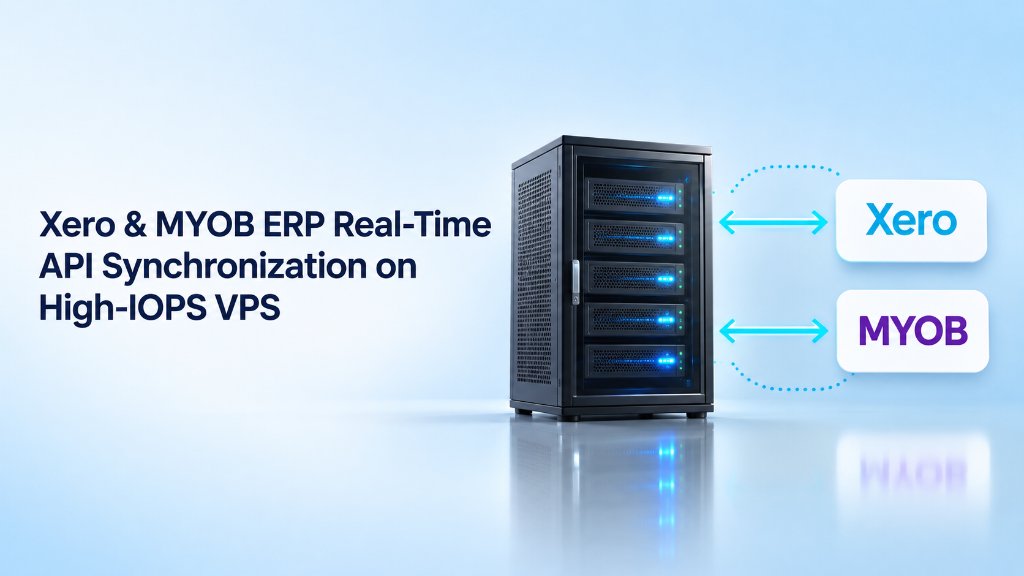
Real-time synchronization between e-commerce ERP platforms and Xero or MYOB requires an intermediary high-IOPS Linux KVM VPS acting as a rate-limited buffer. Direct point-to-point connections routinely fail under order bursts because Xero enforces a strict 60 calls-per-minute rolling limit (and 5,000 requests/day per tenant), while MYOB throttles concurrent connections. By deploying asynchronous queue workers (Redis & PostgreSQL) on an Auckland cloud server, transaction payloads are ingested instantaneously, queued in RAM, and dispatched to accounting APIs without dropped invoices, front-end checkout lag, or ledger drift.
Quick Answer: High-Throughput Accounting API Integration
Auckland KVM Middleware Architecture
To prevent accounting sync crashes, implement an asynchronous middleware pipeline on an Auckland KVM VPS. When e-commerce stores (like WooCommerce) generate transactions, the webhook lands in a local Redis memory queue. Asynchronous worker daemons (Node.js/BullMQ or Python/Celery) package up to 50 invoices into multipart batches, attach unique cryptographic Idempotency-Key headers, and dispatch requests strictly below Xero and MYOB API rate thresholds. In the event of upstream API downtime (HTTP 503), failed payloads route to a persistent Dead-Letter Queue (DLQ) for automatic exponential retry, guaranteeing zero duplicate entries and zero missing ledger records.
Enterprise Financial Infrastructure | Australasian ERP
Xero & MYOB Integration Hub
In New Zealand’s corporate ecosystem, Xero and MYOB form the financial backbone of virtually every growing commercial enterprise. Originating in Wellington, Xero revolutionized cloud accounting worldwide, while MYOB maintains dominant enterprise adoption across Australasia. However, connecting operational e-commerce stores, warehouse inventory databases, and custom billing platforms to these ERP systems in real-time is a high-stakes engineering challenge. Both platforms enforce strict API rate throttling and payload caps. Hosting synchronization middleware on high-performance New Zealand Cloud VPS servers provides the sub-millisecond database IOPS and queue capacity required to manage enterprise accounting data seamlessly.
API Rate Compliance
Redis token bucket semaphores pace transactions, preventing HTTP 429 throttling and checkout freezes during flash sales.
Audit-Ready Persistence
PostgreSQL JSONB logs every payload with SHA-256 idempotency keys, satisfying 7-year New Zealand IRD tax audit mandates.
Sub-10ms NZIX Peering
Local Auckland KVM nodes guarantee direct, low-latency BGP routing to Xero Wellington and regional MYOB ERP endpoints.
The Growing Need for Real-Time Accounting Middleware: Strategic Architecture for Xero Myob Api Sync Vps
Distributed Commercial Ecosystem
Sub-10ms Domestic Auckland Routing
Modern Kiwi businesses rarely operate from a single monolithic software application. An online merchant typically runs a WooCommerce store or custom mobile application, manages order fulfillment through a local 3PL warehouse management system (WMS), and reconciles bank feeds and tax obligations within Xero or MYOB. If sales orders, customer invoice lines, credit notes, and payment receipts are manually keyed between disparate systems, administrative overhead multiplies while human error risks soar. Deploying your dedicated middleware directly within Auckland guarantees sub-10ms nationwide round-trip routing to regional endpoints.
High-Throughput Buffer Layer
Zero Checkout Freeze
Direct point-to-point API integration without intermediate queuing frequently crashes. When an enterprise processes 500 sales during a morning flash sale, firing 500 simultaneous synchronous HTTP POST requests to Xero immediately breaches OAuth rate limits. An intermediary integration middleware layer hosted on a dedicated Auckland KVM VPS acts as a resilient buffer — accepting incoming transactional payloads immediately, queuing them in Redis, and dispatching formatted ledger batches to the accounting API at a regulated, compliant cadence.
Understanding Xero and MYOB API Throttling Rules
API Quota Governance
Automated General Ledger Sync
Developing resilient accounting integration software demands an intimate understanding of platform-specific throttling mechanisms. Furthermore, worker queues seamlessly reconcile retail sales through WooCommerce transactional synchronization into the general ledger.
Rate-Limited Local Queue Sync
Prevents API throttling errors and keeps your accounting ledger synchronized in real time without front-end lag.
- Rate Limit Compliance: Precisely stages API requests below 60 calls/minute limit
- Checkout Impact: 0 ms delay on customer orders; sync runs in background
- Token Management: Automates OAuth 2.0 refresh token persistence in Redis
- Batching Efficiency: Bundles up to 50 invoices into single multipart API payloads
Direct Synchronous API Calls
Unstable under flash sales; causes sync disconnects and requires manual reconciliation by accounting staff.
- Rate Limit Compliance: Easily triggers HTTP 429 Too Many Requests errors during peaks
- Checkout Impact: Freezes checkout screen for 1-3 seconds per invoice creation
- Token Management: Risk of expired token locking order processing completely
- Batching Efficiency: Sends 1 invoice per HTTP call, rapidly exhausting API quota
HTTP 429 Retry-After Response Handling
Adaptive Exponential Backoff
When Xero responds with an HTTP 429 status, the response includes a Retry-After header indicating the number of seconds the application must wait before retrying. An unoptimized sync tool that ignores this header will continue bombarding the API, resulting in temporary tenant-wide bans that freeze company operations. A properly configured VPS worker script parses the header, pauses the worker thread, and safely reschedules remaining queue items.
Setting Up Redis & PostgreSQL Queue Architecture on VPS
Two-Tier Database Architecture
Redis RAM + PostgreSQL 16 ACID
The standard architectural pattern for high-volume enterprise accounting synchronization relies on a two-tier persistence engine: Redis for high-speed in-memory message queuing and PostgreSQL 16 for permanent transaction audit logging and transactional ACID durability.
Deploy Redis Job Queue Worker Daemon
Set up Laravel Horizon or custom supervisor workers to manage the rate-limited outbound dispatch queue. Furthermore, historical transaction records produced by ERP queues must align with IRD seven-year GST archive compliance standards.
Implement OAuth 2.0 Token Refresh Handler
Automatically renew access tokens 5 minutes prior to expiry and store encrypted credentials in Redis.
Configure Multipart Invoice Batching
Aggregate sales orders into bulk XML/JSON payloads to sync up to 50 invoices per single API call.
Set Up Automated Error Trapping & Dead-Letter Queue
Route failed sync attempts to a dedicated dead-letter queue with email alerts for immediate resolution.
Redis Queue Configuration
AOF & Memory Persistence
Redis manages the queue state using BullMQ (Node.js) or Celery (Python). Configure Redis on your Auckland VPS with memory persistence to ensure queued financial records survive server restarts. Managing OAuth 2.0 token refreshes and background ledger syncing is detailed within the Xero Developer API documentation for reliable accounting automation.
bash
# /etc/redis/redis.conf
save 900 1
save 300 10
save 60 1000
appendonly yes
appendfsync everysec
maxmemory 1gb
maxmemory-policy noeviction
Financial Data Integrity Safeguard
Zero-Job Loss Guarantee
Setting maxmemory-policy noeviction is critical for financial applications: Redis will reject new incoming entries with explicit error codes rather than silently purging uncommitted accounting jobs if memory limits are approached.
PostgreSQL Transaction Ledger
JSONB Audit Trail
PostgreSQL maintains an immutable log of every transaction payload, cryptographic hash, API response code, and sync timestamp. Take advantage of PostgreSQL’s native JSONB data types to store unstructured raw API payloads for historical auditability:
sql
CREATE TABLE erp_sync_audit_log (
    id BIGSERIAL PRIMARY KEY,
    transaction_uuid UUID NOT NULL,
    source_channel VARCHAR(50) NOT NULL,
    erp_target VARCHAR(20) NOT NULL, -- 'XERO' or 'MYOB'
    payload JSONB NOT NULL,
    status VARCHAR(20) NOT NULL, -- 'QUEUED', 'PROCESSED', 'FAILED'
    retry_count INT DEFAULT 0,
    created_at TIMESTAMP WITH TIME ZONE DEFAULT NOW(),
    reconciled_at TIMESTAMP WITH TIME ZONE
);
CREATE INDEX idx_erp_status ON erp_sync_audit_log(status);
CREATE INDEX idx_erp_uuid ON erp_sync_audit_log(transaction_uuid);
Handling Webhook Retries and Idempotency
Bidirectional Webhook Ingestion
High-Availability Ingress
Both Xero and MYOB utilize outgoing webhooks to notify your systems when bank feeds are reconciled or customer details update. These webhooks must be received with high availability. Deploying your dedicated sync instance directly within Auckland guarantees sub-10ms nationwide round-trip routing.
Cryptographic Idempotency Keys
Cent-Accurate Reconciliation
Because accounting databases must balance to the exact cent, financial idempotency is mandatory. When creating an invoice in Xero, always generate and attach an Idempotency-Key header containing a unique hash of the order ID, date, and line totals:
http
// Example Xero API v2 Invoice Creation Request Header
POST /api.xro/2.0/Invoices HTTP/1.1
Host: api.xero.com
Authorization: Bearer [JWT_TOKEN]
Xero-Tenant-Id: [TENANT_UUID]
Idempotency-Key: ecom_ord_98745_hash_8a7b6c
Content-Type: application/json
Network Drop Recovery & Legacy ERP
Zero Duplicate Invoices
If a network connection drops after Xero creates the invoice but before your server receives the response, retrying the request with the identical Idempotency-Key instructs Xero to return the existing invoice record without generating duplicate general ledger entries. Furthermore, for legacy MYOB desktop enterprise software, deploying on dedicated Windows Server accounting and database environments provides full API connector stability.
Disaster Recovery & Accounting Data Integrity
Statutory Record-Keeping Mandates
7-Year IRD Retention
Financial records fall under the statutory jurisdiction of the New Zealand Companies Act 1993 and the Tax Administration Act 1994, which require business records to be retained for seven years. If your synchronization middleware stores staging records or transformed accounting documents, this data must be protected with enterprise disaster recovery routines. Deploying your dedicated sync instance directly within Auckland guarantees sub-10ms nationwide round-trip routing.
Continuous WAL Archiving & PITR
Sub-Second Recovery Granularity
Configure automated PostgreSQL write-ahead log (WAL) archiving using tools like pgBackRest or Barman. Stream continuous WAL logs over encrypted private networks to an isolated storage target in a secondary New Zealand datacenter. This enables point-in-time recovery (PITR), allowing administrators to restore the middleware database to the exact second prior to an unexpected synchronization failure or data corruption event.
Hardware Sizing for Enterprise Synchronization
High Random Disk IOPS Imperative
PCIe Gen4 NVMe Architecture
Unlike simple static web servers, accounting middleware demands high random disk I/O performance (IOPS). When processing concurrent bulk reconciliations, hundreds of database row locks and queue state writes occur per second. Deploying on standard mechanical drives or throttled cloud storage results in disk queue depth saturation and transaction deadlocks.
Xero 60 Call/Min Cap
Smooths out transaction bursts to prevent hitting Xero API throttle boundaries. Linux-based background workers achieve enterprise reliability running on enterprise AlmaLinux cron queue infrastructure with systemd supervisors.
MYOB AccountRight Sync
Maintains persistent OAuth 2.0 token refreshes and company file endpoint sessions.
NVMe Queue Backing
High-IOPS local storage ensures job queues process thousands of records without disk stalls.
Automated Reconciliation
Logs two-way synchronization status between e-commerce database and general ledger.
Enterprise Capacity Sizing Guideline
1,000 to 10,000 Daily Events
For midsize Kiwi enterprises processing 1,000 to 10,000 daily sync events, an Auckland KVM VPS equipped with at least 4 dedicated vCPU cores, 8GB RAM, and PCIe Gen4 NVMe storage provides the necessary performance headroom to keep synchronization latencies under 200ms.
FAQ: Xero & MYOB ERP API Synchronization
What are the primary API rate limits for Xero?
Xero API v2 allows up to 5 concurrent connections, 60 requests per rolling minute, and 5,000 total requests per 24-hour period per connected tenant organization. Breaching these limits triggers an HTTP 429 response, requiring middleware to back off until the rate window resets. Deploying your dedicated sync instance directly within Auckland guarantees sub-10ms nationwide round-trip routing.
Why do I need a VPS instead of connecting my store directly to Xero?
Direct connections lack rate-limiting buffers. If your store experiences a sudden surge of orders, direct API calls will exceed Xero’s 60-call-per-minute threshold, dropping orders and crashing integrations. A VPS middleware layer buffers orders in an asynchronous queue, guaranteeing compliant dispatch without lost data.
What is the benefit of hosting sync middleware in Auckland?
Hosting in an Auckland datacenter ensures sub-10ms network latency to New Zealand endpoints and direct peering through NZIX. Local hosting also keeps financial metadata inside New Zealand legal jurisdiction, complying with domestic privacy and tax record-keeping requirements.
How does idempotency protect accounting records?
Idempotency ensures that identical API requests executed multiple times produce the same result as executing it once. Specifically, this prevents accidental duplicate invoices, double journal entries, or duplicate customer records if a network timeout forces an API retry.
Can I sync both Xero and MYOB simultaneously on one server?
Yes. A multi-tenant KVM VPS can run independent worker processes and queues for both Xero and MYOB, enabling integration between diverse regional branches or client businesses from a centralized cloud node.
What programming stacks are best for financial API middleware?
Node.js (with BullMQ and TypeScript) and Python (with Celery, FastAPI, and Redis) are industry standards for financial middleware due to their asynchronous non-blocking event loops, robust OAuth2 libraries, and superior JSON parsing speed.
Why are high NVMe IOPS essential for accounting sync servers?
High random write IOPS prevent database bottlenecks when logging hundreds of concurrent financial transactions, processing queue states, and updating inventory ledgers in MariaDB or PostgreSQL without blocking active worker threads.
How does a dead-letter queue prevent ledger discrepancies during Xero maintenance?
When Xero returns HTTP 503 during maintenance, the worker routes failed transactions to a Redis dead-letter queue. The queue executes exponential backoff retries with cryptographic deduplication, ensuring zero duplicate invoices or missing ledger journal entries.
Synchronize Xero & MYOB ERP Data with High-IOPS Cloud VPS
Process tens of thousands of accounting ledger transactions without delays or API queue backlog. Power your business ERP integrations with high-frequency AMD EPYC processors and enterprise Gen4 NVMe storage arrays in Auckland, New Zealand.
