

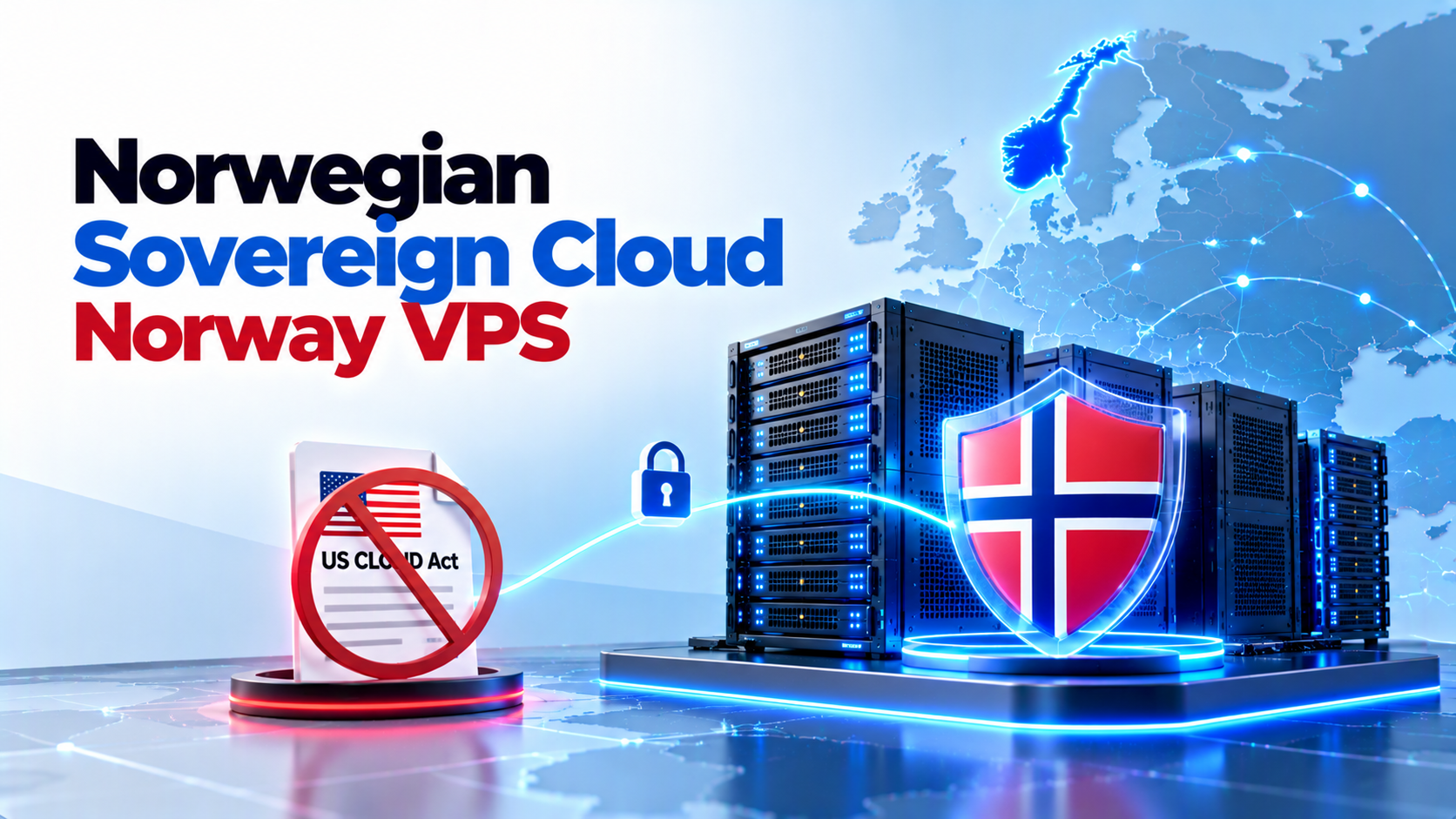
Avoiding US CLOUD Act Exposure on Norwegian Sovereign VPS
A Norwegian sovereign cloud VPS eliminates extraterritorial exposure under the US CLOUD Act (18 U.S.C. § 2713) and FISA Section 702 by guaranteeing 100% European corporate ownership and physical Oslo data residency.
Unlike American hyperscalers operating European regions, OnliveServer maintains zero US corporate nexus. This ensures customer data cannot be subpoenaed without an independent Norwegian court warrant under Straffeprosessloven.
The US CLOUD Act Dilemma
The Clarifying Lawful Overseas Use of Data (CLOUD) Act enables US federal law enforcement to compel technology providers to disclose data regardless of where servers reside.
Under 18 U.S.C. § 2713, the statute applies extraterritorially to all communications or records within the provider’s possession, custody, or control.
This means physical server location alone does not create legal immunity if the operating company is subject to US corporate jurisdiction.
The Corporate Control Test: Why US Parents Expose European Datacenters
In corporate law, an American parent corporation exercises legal control over its wholly owned foreign subsidiaries.
When a US judge serves a warrant on Microsoft, AWS, or Google, the parent entity is legally compelled to direct its European operating arm to produce customer data.
Under international jurisdictional doctrine, corporate officers face severe contempt sanctions in US courts if they fail to produce foreign-stored customer datasets.
Hosting inside a foreign datacenter operated by a US tech company provides zero legal insulation from CLOUD Act warrants. Genuine immunity requires an infrastructure provider with no American corporate ownership or executive ties.
Extraterritorial Warrants vs Norwegian National Sovereignty
From the perspective of Norwegian constitutional law and the Norwegian Penal Code (Straffeloven), unilateral foreign data seizures violate territorial sovereignty.
European enterprises utilizing US-controlled clouds in Oslo remain trapped in a conflict of laws, caught between foreign production mandates and local privacy rules.
Schrems II Precedent and FISA Section 702 Risks
The legal exposure of foreign clouds extends beyond criminal subpoenas into national security surveillance governed by Section 702 of the Foreign Intelligence Surveillance Act (FISA).
In July 2020, the Court of Justice of the European Union (CJEU) delivered its landmark Schrems II ruling (Data Protection Commissioner v. Facebook Ireland & Maximillian Schrems).
The court invalidated the EU-US Privacy Shield, establishing that US mass surveillance regimes lack essential equivalence to European fundamental rights.
Contractual assurances (SCCs) cannot override foreign intelligence mandates. Storing unencrypted or foreign-keyed telemetry on US-controlled platforms exposes organizations to GDPR Article 83 fines up to €20 million or 4% of annual global turnover.
The Legal Invalidity of US Cloud Storage for Sensitive European Telemetry
Under GDPR Article 44, transfers of personal data to a third country may only proceed if essentially equivalent protections are maintained.
Because FISA Section 702 permits warrantless bulk intelligence collection without judicial redress for non-US citizens, US-tied infrastructure presents an unavoidable compliance hazard.
Hyperscalers in Oslo vs Truly Independent Sovereign VPS
In response to European regulatory scrutiny, global cloud giants have launched marketing initiatives promoting “Sovereign Cloud Zones” and “EU Data Boundaries.”
However, objective technical analysis reveals these represent software abstractions rather than genuine jurisdictional separations.
Dissecting the ‘Sovereign Controls’ Marketed by Global Cloud Giants
Commercial hyperscaler sovereign controls typically include local European billing entities, regional data residency filters, and customer-supplied HSM keys.
Crucially, none of these features alter underlying corporate ownership. The hypervisor management plane, identity services, and firmware telemetry remain centrally controlled by American entities.
The Absolute Immunity of Purely Norwegian Corporate Custodians
OnliveServer operates on an entirely independent legal foundation with zero American corporate parentage and no US executive nexus.
To access any server within our Oslo datacenters, foreign authorities must convince an independent Norwegian judge at the Oslo District Court (Oslo tingrett) that the request meets Norwegian statutory requirements.
The Legal Firewall
Operating on independent Norwegian infrastructure establishes an enforceable legal firewall governed by the Mutual Legal Assistance Treaty (MLAT) framework and the Norwegian Constitution.
Sovereign datacenters enforce rigorous Sikkerhetsloven defense perimeter controls to prevent unauthorized data access.
Intergovernmental Mutual Legal Assistance Treaties (MLAT)
Under the bilateral MLAT treaty between the United States and Norway, foreign authorities cannot issue direct discovery orders to local hosting providers.
The US Department of Justice must submit a diplomatic petition to the Norwegian Ministry of Justice, which subjects every request to strict dual criminality analysis.
If a foreign subpoena touches upon trade secrets, peaceful expression, or commercial disputes where Norwegian statutes diverge from foreign laws, the Norwegian Ministry of Justice retains the sovereign authority to deny the petition outright.
Corporate Immunity Against Unilateral Foreign Subpoenas
Because OnliveServer’s operating infrastructure in Oslo is owned and governed by entities incorporated within the EEA, unilateral foreign subpoenas possess zero extraterritorial effect.
In foreign civil litigation—such as patent claims or antitrust disputes—foreign litigants cannot compel discovery, insulating trade secrets and corporate intellectual property.
Architectural Blueprint
Achieving true digital sovereignty requires combining legal safeguards with defensive systems engineering.
OnliveServer provides enterprise KVM virtualization that enforces physical and logical isolation at every layer of the compute stack:
Customer-Managed Key Encryption (BYOK) Across Block Storage
To eliminate insider threat vectors, OnliveServer empowers customers to implement “Bring Your Own Key” (BYOK) architectures.
Configure LUKS2 volumes where decryption key material is derived via Tang/Clevis network-bound disk encryption (NBDE) or entered via SSH consoles during boot:
Datacenter administrators and hypervisors possess zero access to plaintext filesystems. Even under hypothetical hardware seizure, encrypted volumes remain unreadable without customer-held private keys.
Air-Gapped Sovereign Backup Corridors in Norway
A sovereign architecture must prevent backup replication from crossing foreign borders.
Automated snapshots of your Oslo compute nodes route across encrypted private dark fiber directly to secondary Norwegian recovery vaults on immutable WORM storage.
Corporate Procurement Verification Matrix
When submitting RFP responses to Scandinavian banks, maritime operators, or public entities, address these four validation criteria:
| Validation Dimension | Audit Standard & Verification Criterion | Compliance Outcome |
|---|---|---|
| Ultimate Beneficial Ownership (UBO) | Zero non-EEA parent controlling interest (>25%) | 100% Legal CLOUD Act Immunity |
| Physical Datacenter Audit Trail | Tier-3 Oslo facilities (Bulk OS-IX / Green Mountain) | Strict Norwegian Data Residency |
| Hardware Virtualization Isolation | KVM hardware hypervisor with dedicated core pinning | Zero Multi-Tenant Memory Leakage |
| EEA Article 28 DPA | Data Processing Agreement designating Oslo tingrett venue | Full Pan-European GDPR Validity |
Frequently Asked Questions (FAQ)
Q1
Can US law enforcement access customer data stored in an AWS or Microsoft Azure datacenter in Oslo?
Yes. Under the US CLOUD Act (18 U.S.C. § 2713), US-headquartered tech companies are legally obligated to disclose customer data stored on foreign servers upon receiving a US warrant, regardless of whether the datacenter is physically located in Oslo, Ireland, or Germany.
Q2
What makes OnliveServer’s Norway Virtual Dedicated Server (VDS) legally immune to the US CLOUD Act?
OnliveServer operates as an independent infrastructure provider not subject to US parent company control or extraterritorial US legal jurisdiction. All physical server hardware, network transit, and administrative credentials reside exclusively within the European Economic Area under Norwegian legal sovereignty.
Q3
How does the Schrems II court ruling affect commercial European SaaS companies?
The Schrems II European Court of Justice ruling invalidated the EU-US Privacy Shield, determining that US surveillance laws (FISA Section 702) undermine European privacy. European SaaS companies face substantial regulatory fines if customer personal data is exposed to foreign intelligence overreach without supplementary technical safeguards.
Q4
What technical safeguards must accompany Norwegian sovereign cloud hosting?
Sovereign hosting requires physical data residency in Norway, end-to-end client-side encryption where encryption keys never leave Norwegian borders, strict identity verification, independent DNS nameservers, and zero reliance on foreign-hosted telemetry or management planes.
Q5
Can a European enterprise be penalized for hosting on US-owned sovereign clouds?
Yes. European data protection authorities have repeatedly warned that storing sensitive public-sector or healthcare data on US hyperscaler European regions still presents legal compliance risks under Schrems II and FISA 702, recommending migration to independent European sovereign infrastructure providers.
Q6
How does client-side key management protect cloud backups from foreign subpoenas?
By maintaining master encryption keys locally or within an independent Norwegian Hardware Security Module (HSM), data stored in the cloud remains an unreadable ciphertext blob. Even if a datacenter is legally compelled to produce storage disks, the information cannot be decrypted without the private keys.
Q7
Does hosting on an independent Nordic cloud instance protect against US intellectual property seizures?
Yes. Storing source code repositories, proprietary algorithms, and enterprise trade secrets on independent Norwegian virtual compute nodes shields intellectual property from unilateral foreign civil subpoenas, patent seizure orders, and foreign administrative discovery motions.
Q8
How do Norwegian privacy laws compare with Switzerland regarding corporate data secrecy?
Both Norway and Switzerland offer exceptional legal frameworks for corporate data privacy. Norway benefits from full integration with EU GDPR standards through the EEA, granting frictionless pan-European commercial legitimacy while maintaining independent national court sovereignty over physical datacenter assets.
Deploy Norwegian Sovereign Cloud VPS
Eliminate extraterritorial US CLOUD Act exposure with 100% independent European corporate ownership, Tier-3 Oslo data residency, and high-performance KVM NVMe hardware.
