

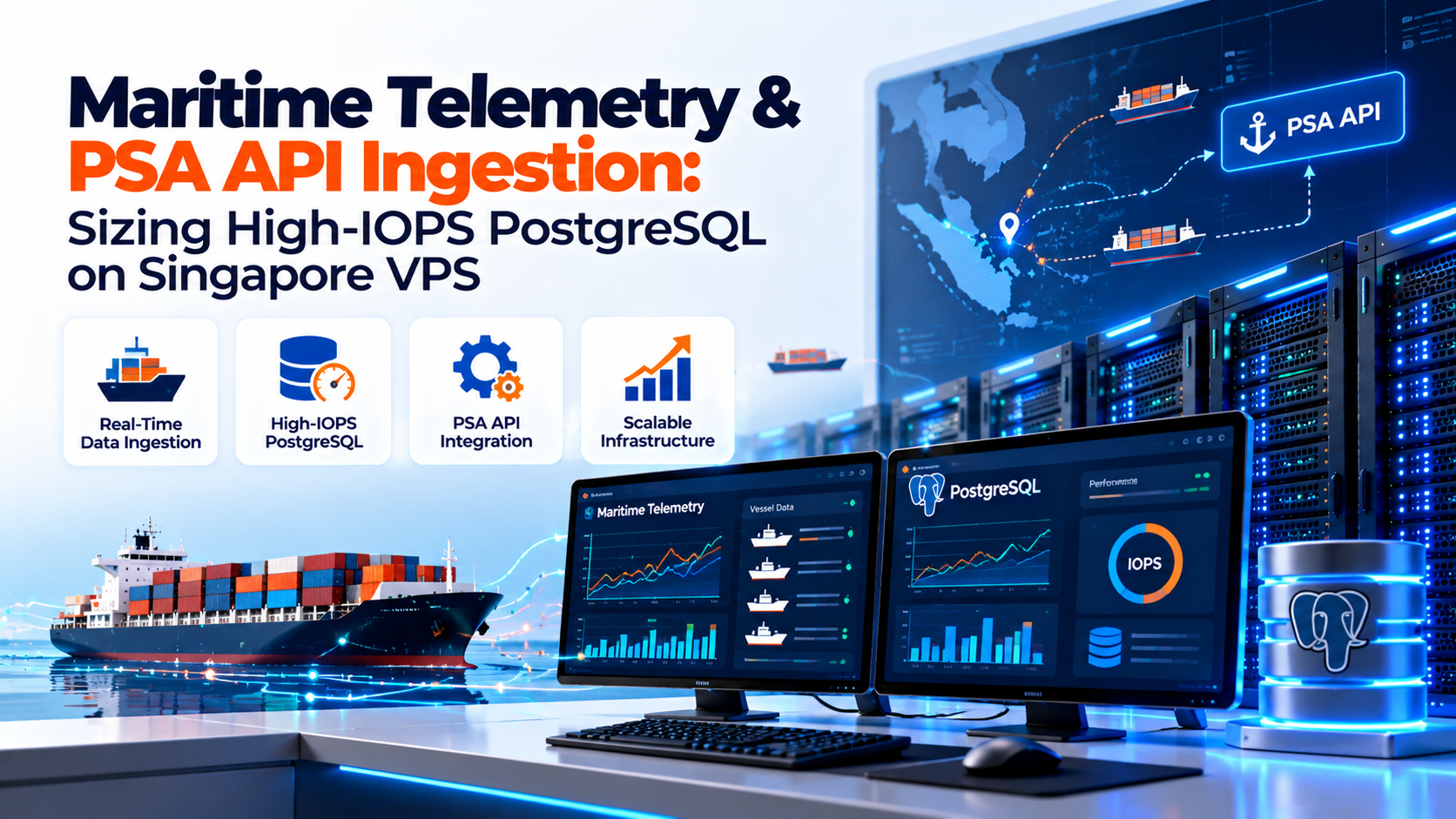
Sizing High-IOPS PostgreSQL on Singapore VPS for Maritime Telemetry
Ingesting real-time AIS vessel telemetry and PSA port API feeds requires a high-IOPS Singapore VPS backed by enterprise PCIe Gen4 NVMe storage.
Configure PostgreSQL 16 with TimescaleDB or native partitioning, allocate 16GB–32GB RAM with shared_buffers = 8GB, tune max_wal_size = 16GB, and implement PgBouncer to sustain write throughput exceeding 15,000 telemetry events/sec at sub-5ms commit latency.
The Port of Singapore is the global crossroad of maritime commerce, managing over 37 million TEUs annually and leading the world in vessel refueling and bunkering.
With the development of Tuas Mega Port—designed to handle 65 million TEUs upon completion—maritime logistics has transformed into a high-concurrency real-time engineering discipline.
Every vessel navigating the Singapore Strait broadcasts Automatic Identification System (AIS) transponder signals every 2 to 10 seconds, paired with continuous PSA CALISTA and MPA digitalPORT@SG webhooks.
Capturing and analyzing this continuous geospatial stream requires a dedicated high-IOPS Singapore VPS hosting platform with dedicated KVM compute, NVMe arrays, and direct SGIX domestic peering.
The Singapore Maritime Telemetry Ecosystem: PSA CALISTA, digitalPORT@SG, and AIS
OceanTech applications in Singapore ingest data across three primary operational streams that drive vessel scheduling, cargo routing, and maritime compliance.
Managing thousands of concurrent vessel signals requires an ingestion architecture tailored for high packet density:
Coastal receiver towers and LEO satellites stream raw NMEA 0183 sentences. The Singapore Strait generates 5,000 to 15,000 packets/sec during peak traffic.
PSA’s global logistics API broadcasts real-time vessel berthing allocations, automated guided vehicle (AGV) dispatches, and container yard stack updates.
The Maritime and Port Authority portal mandates digital reporting for vessel arrivals, pilot boarding orders, and Mass Flow Meter (MFM) bunkering clearances.
Integrating these streams requires predictable low-latency networking so that dispatch engines can react to ETA changes instantly.
Technical Comparison: High-IOPS Singapore VPS vs Generic Cloud Database
Processing high-velocity geospatial telemetry requires architectural guarantees that shared or throttled cloud platforms cannot deliver:
| Infrastructure Dimension | Generic Cloud DB (AWS RDS / GCP Cloud SQL) | Onlive Server Singapore High-IOPS VPS |
|---|---|---|
| Storage Architecture | Network-attached block storage (EBS gp3/io2) with burst throttling | Direct-attached Hardware RAID-10 PCIe Gen4 Enterprise NVMe SSDs |
| Sustained Random Write IOPS | 3,000 baseline (expensive provisioned upgrades required) | 100,000+ sustained write IOPS with zero burst limits |
| PSA & MPA API Latency | 4ms to 12ms (routed through cloud availability zone NAT gateways) | < 1.5ms direct SGIX / Equinix Singapore port exchange peering |
| Data Egress Taxation | $0.08 to $0.12 per GB for outbound telemetry feeds | Unmetered 1Gbps bandwidth with zero per-gigabyte egress fees |
| PostGIS Extension Control | Restricted cloud parameter groups; limited custom extension compiling | Full root SSH access; custom TimescaleDB and PostGIS builds allowed |
Streaming continuous vessel telemetry across multi-cloud dashboards can generate 20TB+ of monthly egress traffic. On standard clouds, this results in thousands of dollars in egress bills, whereas OnliveServer Singapore VPS provides unmetered 1Gbps ports with zero transfer taxes.
Optimizing PostgreSQL and TimescaleDB: Sizing Memory, WAL, and Hypertables
Maritime supply chain software vendors can review system connectivity specs on the secure API gateway integration protocols for telemetry API endpoints.
PostgreSQL is renowned for stability, but default installations are configured for minimal resource consumption. Ingesting continuous maritime time-series telemetry requires tuning memory buffers, checkpoint intervals, and Write-Ahead Logging (WAL).
Deploy the following production configuration parameters inside your server’s postgresql.conf file:
Setting checkpoint_completion_target = 0.9 spreads dirty page writes across the entire 15-minute checkpoint window. This prevents I/O write spikes that can stall real-time AIS transponder ingestion.
Database Configuration and Python High-Speed AIS Parser Script
To achieve sustained ingestion speeds, deploy TimescaleDB temporal hypertables combined with PostGIS spatial geometry indexing.
Execute the SQL schema below to initialize the telemetry database and build compound spatial-temporal indexes:
Next, deploy this asynchronous Python ingestion daemon to decode raw NMEA AIVDM sentences and batch-insert points into PostGIS:
Utilizing ST_MakePoint(lon, lat) with SRID 4326 stores coordinates natively on the WGS 84 ellipsoid. GIST indexing ensures spatial bounding box scans execute in under 5ms across millions of historical rows.
Vessel Trajectory Reconstruction and Spatial Dead Reckoning in PostGIS
In high-density straits, VHF radio congestion and physical signal shadowing from Ultra-Large Container Vessels (ULCVs) can cause temporary AIS blackouts lasting 30 to 120 seconds.
For terminal dispatchers coordinating automated quay cranes at Tuas Mega Port, losing track of vessel approach vectors disrupts berth sequencing.
To bridge data gaps, spatial engineers implement automated trajectory reconstruction and dead reckoning algorithms inside PostgreSQL:
When transponder packets drop, PostGIS projects the vessel’s future position using speed over ground (SOG) vectors and true heading angles along spherical great circles via ST_Project().
Once physical signals resume, new GPS coordinates reconcile against projected vectors, smoothly merging segmented paths via ST_MakeLine() without manual operator intervention.
Port telemetry pipelines maintain sub-5ms round trips to shipping hubs by leveraging direct SGIX exchange connectivity in Singapore.
Automating Singapore Port Limits (SPL) Geofence Alarms and Bunkering Audits
Maritime operations depend on instant automated triggers: alerting ship agents when an inbound container ship crosses into Singapore Port Limits (SPL), tracking anchorage deviations, or verifying bunkering transfers.
By storing port boundary polygons directly inside PostGIS, spatial trigger functions execute ST_Contains() queries on every incoming position update:
When a vessel enters a pilot boarding zone, PostgreSQL emits asynchronous NOTIFY events directly to dispatch backends, orchestrating tugboats before the vessel anchors.
During bunkering, proximity audits pair barge telemetry with Mass Flow Meter (MFM) data, auditing compliance with MPA Singapore digital bunkering regulations in real time.
Executing geofencing directly inside the database on dedicated high-frequency CPU cores avoids application round-trip overhead and guarantees sub-millisecond alert delivery.
Frequently Asked Questions: Singapore Maritime Telemetry & High-IOPS VPS
Q1
Why is local Singapore hosting essential for maritime applications?
Hosting within Singapore provides direct, sub-1.5ms network peering to PSA CALISTA, MPA digitalPORT@SG, and regional coastal AIS telemetry receivers, preventing packet loss and latency spikes during high-frequency tracking.
Q2
How does hardware RAID-10 NVMe storage benefit AIS ingestion?
Enterprise PCIe Gen4 NVMe arrays in RAID-10 deliver sustained write throughput exceeding 100,000 IOPS without the I/O credit depletion or burst throttling common to multi-tenant cloud storage pools.
Q3
What database stack is recommended for maritime tracking platforms?
PostgreSQL 16 combined with PostGIS for spatial geometric calculations and TimescaleDB for temporal chunk partitioning provides the industry gold standard for high-throughput vessel telemetry ingestion.
Q4
Can Onlive Server support streaming vessel data to live client dashboards?
Yes. Unmetered 1Gbps uplink connectivity allows real-time WebSockets, MQTT brokers, and Server-Sent Events (SSE) to broadcast live vessel positions to thousands of concurrent users without bandwidth throttling or egress charges.
Q5
How does dedicated KVM virtualization prevent CPU contention during peak traffic?
KVM virtualization assigns dedicated physical vCPU cores and ECC memory directly to your virtual server, preventing noisy neighbor contention when sudden maritime traffic surges occur in the Singapore Strait.
Q6
How does sub-1.5ms SGIX port peering prevent packet drops during heavy AIS telemetry bursts?
Direct peering via the Singapore Internet Exchange (SGIX) routes incoming UDP telemetry packets directly to your VPS across domestic dark fiber, bypassing international transit loops and eliminating buffer overflows.
Q7
How are Singapore Port Limits (SPL) geofence triggers processed inside PostGIS without external API latency?
By indexing port boundary polygons with PostGIS GIST indexes, native ST_Contains() queries run on every coordinate insert, triggering automated alerting via PostgreSQL LISTEN/NOTIFY in under 2 milliseconds.
Deploy High-IOPS Singapore Maritime VPS
Ingest real-time maritime telemetry with 100,000+ NVMe IOPS, sub-1.5ms SGIX port peering, unmetered 1Gbps bandwidth, and dedicated AMD EPYC compute power in Singapore.