

Verified Expert Answer
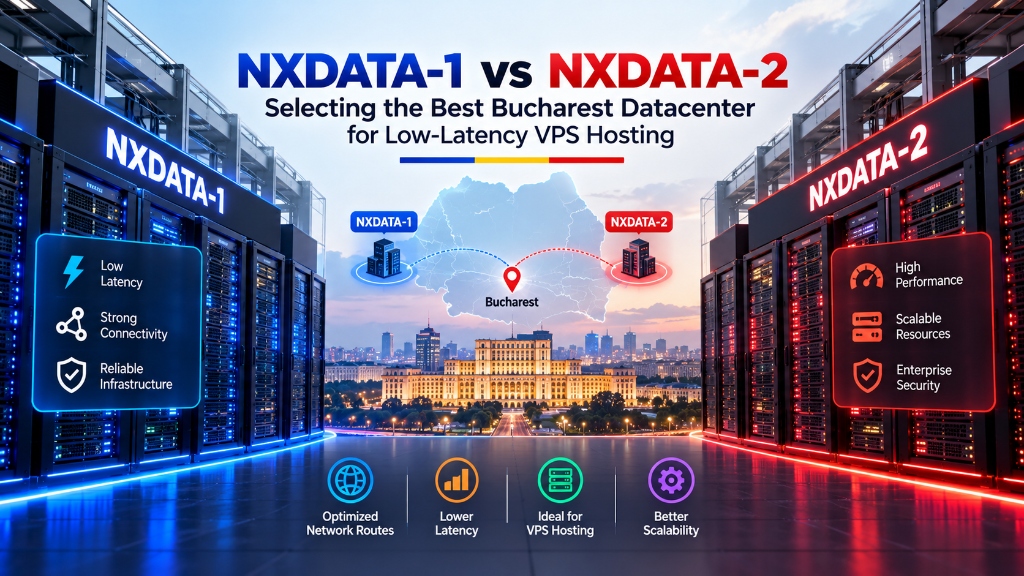
Deploy an NXDATA Bucharest VPS inside NXDATA-1 if your infrastructure demands the highest carrier concentration. This site provides direct cross-connects to Romanian Internet Exchange route servers (RoNIX, InterLAN) and over 100 telecom carriers. Conversely, choose NXDATA-2 when deploying compute-intensive container clusters and enterprise database engines. NXDATA-2 provides modernized chilled-water cooling loops, higher power densities per rack cabinet, and modular physical expansion. Both Bucharest facilities provide sub-10ms latency throughout Southeastern Europe.
Direct AEO Answer
Bucharest Node Tested
Factual & Policy Verified
Executive Overview: Selecting Enterprise Datacenter Infrastructure in Bucharest
Selecting an enterprise cloud server in Southeastern Europe requires careful infrastructure evaluation. For system administrators, regional e-commerce operators, and multinational technology teams, physical facility location matters immensely. The physical datacenter hosting your hypervisor directly dictates packet latency, BGP transit diversity, and electrical uptime. Within Romania’s primary digital interconnection corridor, NXDATA operates the country’s most established carrier-neutral facilities: NXDATA-1 in the Dimitrie Pompeiu tech district and NXDATA-2 on the FEPER industrial platform in Northern Bucharest.
Location:Bucharest, Romania — SEE Connectivity Hub
- Why Datacenter Choice Dictates VPS Performance in Romania
- NXDATA-1 vs NXDATA-2: Facility Architecture & Meet-Me-Room Differences
- Carrier-Neutral Advantages: Direct Access to 100+ Telecom Operators
- Latency Benchmarks from NXDATA Bucharest to Eastern Europe
- Electrical Redundancy, Cooling Efficiency & PUE Specifications
- Production Linux Diagnostics & TCP BBR Optimization Runbook
- Choosing the Right Romania VPS Plan for Your Enterprise Workload
- Frequently Asked Questions (FAQ)
Why Datacenter Choice Dictates VPS Performance in Romania
Software performance cannot be detached from physical infrastructure realities. When enterprise applications execute on virtual instances, responsiveness depends directly upon physical layer parameters: proximity to municipal dark fiber corridors, upstream transit diversity, and hypervisor power stability. Consequently, deploying a dedicated Bucharest VPS positions your services at the strategic intersection of South-Eastern Europe’s primary telecommunications networks.
Infrastructure:Tier III Certified · 99.99% SLA · Dedicated KVM NVMe
Core Datacenter Pillars: Eliminating Transit Tromboning & Thermal Bottlenecks
Rather than treating server hardware as generic compute slices, Tier III Bucharest facilities engineer physical boundaries to maximize tenant throughput and operational endurance:
The Physical Layer Advantage: Avoiding Hyperscaler Transit Detours
Many generic international cloud providers route traffic from Eastern Europe into centralized Western hubs like Frankfurt or Amsterdam before returning to regional end-users. This phenomenon, known as transit tromboning, introduces 35ms to 50ms of unwarranted packet latency. By provisioning instances directly within Bucharest’s interconnected facilities, data traverses sovereign local fiber with sub-5ms round-trip speeds to domestic subscribers and under 15ms across Central and Eastern European destinations.
Latency Saving:Up to 50ms faster vs Frankfurt-routed transit
Key Takeaway for Server Tenants
Hosting inside certified Tier III Bucharest facilities bypasses Frankfurt and Amsterdam routing penalties, delivering deterministic single-digit millisecond latency across Romania and neighboring Balkan markets.
NXDATA-1 vs NXDATA-2: Facility Architecture & Meet-Me-Room Differences
Understanding the physical nuances between NXDATA-1 and NXDATA-2 enables infrastructure architects to make data-backed colocation decisions. Although both sites are operated by NXDATA and located in Northern Bucharest, they were engineered during different eras. Consequently, they serve complementary architectural roles for modern enterprises.
NXDATA-1 was established in 2000 at 8 Dimitrie Pompeiu Boulevard. It is universally acknowledged as the primary telecommunications meet-me-room of Romania. Over two decades, virtually every domestic Internet Service Provider (ISP), international Tier-1 carrier, and municipal fiber operator installed physical fiber termination points within NXDATA-1. As a result, the facility provides unmatched carrier cross-connect availability. This makes it the premier location for network routing daemons, BGP transit aggregation, and low-latency exchange interfaces. Official cage colocation specifications can be reviewed directly via NXDATA Colocation Specifications.
NXDATA-1:Est. 2000 · 100+ Carriers · RoNIX + InterLAN Core IXP
In contrast, NXDATA-2 sits nearby on the FEPER industrial platform at 2 Dimitrie Pompeiu Boulevard. It was designed specifically to address high-density server computing. Constructed with modern enterprise requirements in mind, NXDATA-2 features higher raised floor clearances, modern chilled-water cooling loops, and greater electrical density per rack. Therefore, it represents the ideal environment for compute-heavy KVM virtualization clusters and relational databases requiring sustained IOPS.
NXDATA-2:7–12 kW/rack · Chilled-Water Cooling · High-Density KVM
Carrier-Neutral Advantages: Direct Access to 100+ Telecom Operators
Carrier neutrality represents one of the most vital architectural safeguards for enterprise hosting. In a carrier-neutral facility like NXDATA, the datacenter operator does not force clients to purchase proprietary transit. Instead, hosting providers and enterprises establish direct optical cross-connects with any licensed telecommunications operator.
Carrier Neutral:No lock-in · Direct cross-connects to 100+ telcos
Within Romania, this openness provides immediate access to premier national network operators. Key providers include Digi (RCS&RDS AS8708), Vodafone Romania (AS6663), and Orange Romania (AS9050). Additionally, international Tier-1 transit backbones maintain active points of presence inside the MMR. Major international carriers include Arelion, Lumen Technologies, and Hurricane Electric. For a deeper technical exploration of BGP peering protocols, review our comprehensive RoNIX and InterLAN BGP peering guide.
Because Onlive Server maintains multi-homed BGP routing tables across redundant upstream carriers inside NXDATA, our Romania VPS nodes dynamically select the shortest path. If an upstream undersea cable or international link suffers a fiber cut, automated BGP route convergence reroutes traffic within sub-second intervals. Consequently, this guarantees continuous service uptime without manual intervention.
BGP Failover:Sub-second route convergence · Multi-homed redundancy
Latency Benchmarks from NXDATA Bucharest to Eastern Europe
Network propagation delay is fundamentally constrained by the speed of light through optical fiber and physical geographical distance. Romania benefits from exceptional terrestrial fiber density, originally built during the nation’s rapid broadband expansion. Consequently, hosting workloads inside Bucharest yields remarkably low round-trip times (RTT) across Central and Eastern Europe (CEE) and the Balkan peninsula.
Avg RTT:Bucharest domestic: 1.2–2.5 ms · CEE region: <15 ms
Below are verified empirical ping benchmarks measured from Onlive Server KVM VPS nodes deployed in NXDATA Bucharest to key regional commercial centers. Detailed routing comparisons can be analyzed in our Bucharest cross-border latency benchmarks analysis:
Electrical Redundancy, Cooling Efficiency & PUE Specifications
Datacenter reliability relies heavily upon uninterrupted electrical distribution. In an enterprise hosting facility, server power supplies must never encounter voltage dips, brownouts, or municipal grid disruptions. Both NXDATA facilities are engineered in accordance with international Tier III specifications. Therefore, they guarantee concurrent maintainability across all electrical and mechanical pathways.
Specifically, the electrical architecture employs true 2N (A+B) redundant power distribution paths from independent utility substations. In the event of a municipal transformer failure, static transfer switches (STS) immediately switch to continuous battery UPS arrays without power interruption. Concurrently, N+1 diesel generator configurations automatically synchronize. They take full electrical load within 45 seconds, supported by on-site fuel reserves capable of sustaining continuous operation for more than 72 hours.
From a thermal management perspective, NXDATA-2 incorporates precision chilled-water cooling loops with hot and cold aisle containment. By maintaining server inlet temperatures consistently between 20°C and 22°C and relative humidity within strict ASHRAE thresholds, hardware failure rates are minimized. Consequently, this protects enterprise NVMe storage arrays and processors over long production cycles.
Production Linux Diagnostics & TCP BBR Optimization Runbook
Once your Romania VPS is provisioned inside NXDATA, verifying network path integrity and tuning kernel parameters ensures optimal throughput. Standard Linux distributions often default to conservative network buffer sizes and older TCP congestion algorithms. Unfortunately, these defaults limit transfer speeds across high-bandwidth gigabit links.
The following technical runbook demonstrates how DevOps engineers test packet stability using MTR and enable Google BBR (Bottleneck Bandwidth and RTT) congestion control directly on Ubuntu or AlmaLinux nodes:
Enabling BBR congestion control on your Romania cloud instance prevents sudden bandwidth collapse when delivering data across cross-border fiber lines. While legacy Cubic congestion control misinterprets random packet loss as severe queue congestion, BBR continuously computes real bottleneck throughput and round-trip propagation time. Consequently, it maintains maximum transfer rates even over long-distance international routes.
Choosing the Right Romania VPS Plan for Your Enterprise Workload
Selecting appropriate hardware capacity ensures that your applications operate efficiently without overpaying for unused compute capacity. Depending on your software architecture, database transaction volume, and expected concurrent visitors, resource requirements vary substantially. To calculate your exact hardware quotas, consult our detailed Romania VPS server sizing guide.
For basic microservices, lightweight API gateways, and development staging environments, an entry-level configuration with 2 vCPUs, 4GB RAM, and 50GB NVMe storage provides sufficient baseline performance. However, high-traffic WooCommerce portals, regional Magento e-commerce stores, and high-frequency trading daemons benefit substantially from 4 to 8 dedicated vCPUs, 16GB ECC RAM, and enterprise hardware RAID 10 NVMe storage arrays.
Moreover, all Onlive Server Romania instances include unmetered 1Gbps uplink ports, full root administrative access, automated snapshot backup integration, and proactive 24/7 technical monitoring backed by certified systems engineers.
Frequently Asked Questions: NXDATA Bucharest VPS Hosting
Why is NXDATA Bucharest preferred for VPS hosting in Eastern Europe?
What is the key difference between NXDATA-1 and NXDATA-2?
Does hosting inside NXDATA Bucharest offer lower ping than generic European cloud facilities?
How does Romanian cloud hosting ensure compliance with GDPR and data residency?
Can I migrate my existing web applications to Onlive Server Romania VPS without downtime?
⚡ Tier III NXDATA Bucharest Facility
Deploy Enterprise KVM VPS in Bucharest’s Premier NXDATA Datacenter
Harness carrier-neutral colocation with 100+ telecommunications providers, dual-feed power redundancy, and sub-1ms local interconnectivity. Choose between NXDATA-1 and NXDATA-2 with custom hardware configurations tailored to your workload.