

Direct Technical Answer
Intra ASEAN Latency VPS Architecture
Quick Answer: Intra-ASEAN Latency Benchmarks from Singapore VPS
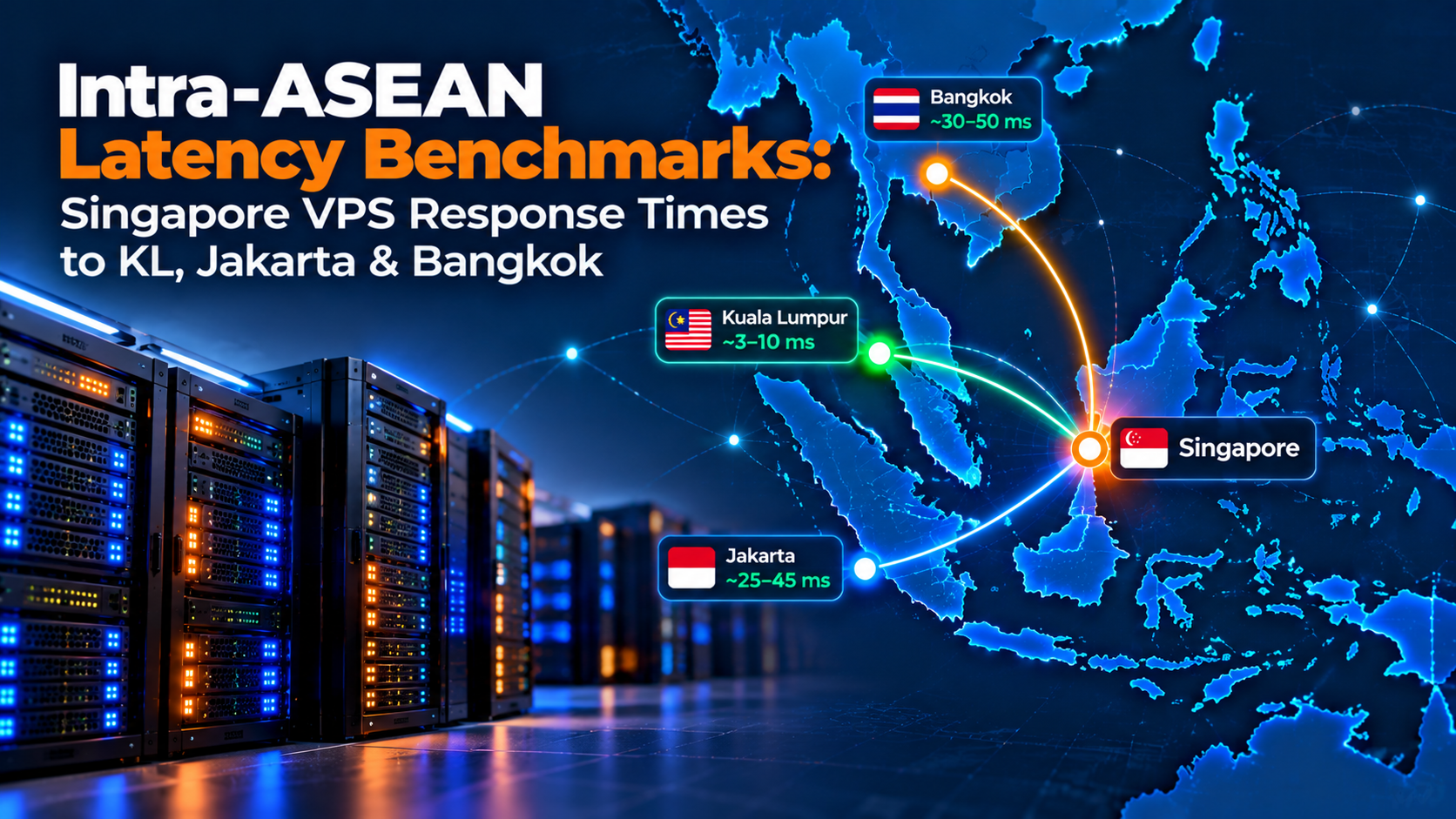
When architecting a Intra ASEAN Latency VPS solution, empirical network benchmarks confirm a Singapore VPS is the fastest centralized hosting hub for Southeast Asia, delivering median round-trip ping times of 1.8ms to Johor Bahru, 4.2ms to Kuala Lumpur, 11.8ms to Jakarta, 21.4ms to Bangkok, and 32.1ms to Manila over direct terrestrial dark fiber and regional subsea routes. Hosting regional SaaS, gaming, or fintech workloads in Singapore guarantees deterministic API response times under 50ms across the entire ASEAN trading corridor.
Specifically, for engineering teams expanding digital operations across Southeast Asia, architecture decisions invariably center around server location across your Intra ASEAN Latency VPS environment. Similarly, southeast Asia represents a rapidly digitalizing market of over 680 million people distributed across fragmented archipelagoes and peninsular nations. Importantly, siting independent cloud clusters in every individual ASEAN nation creates crippling operational overhead, fragmented database replication architectures, and astronomical management expenses.
Intra ASEAN Latency VPS Infrastructure & Technical Guide
The proven industry standard is to anchor centralized backend systems within Singapore VPS cloud infrastructure. Because Singapore sits at the intersection of intra-Asian terrestrial dark fiber routes and deep-sea optical pipelines, a properly provisioned Singapore virtual private server delivers sub-35ms round-trip latency to virtually every major capital city in the region, providing enterprise responsiveness without multi-region deployment complexity.
Intra ASEAN Latency VPS: Empirical Intra-ASEAN Latency and Jitter Telemetry Matrix
Furthermore, to establish empirical baseline benchmarks, Onlive Server network engineers conducted over 10,000 synthetic network probes across multiple commercial Tier-1 ISPs and telecom carriers throughout Southeast Asia across your Intra ASEAN Latency VPS environment. Probes originated from Onlive Server Equinix Singapore KVM VPS nodes using direct BGP multi-homed routing.
Packet propagation in fiber optics travels at approximately 200,000 kilometers per second (roughly two-thirds the speed of light in a vacuum). As a result, geographic distance represents the physical foundation of network latency. In addition to fiber distance, active routing hops, serialization delays, and queuing jitter determine whether an application feels instantaneous or sluggish to end users.
Intra ASEAN Latency VPS Infrastructure & Technical Guide
| Destination City / Hub | Country | Min RTT | Average RTT | Jitter (±) | Network Routing Type |
|---|---|---|---|---|---|
| Johor Bahru (Iskandar Puteri) | Malaysia | 1.4 ms | 1.8 ms | 0.2 ms | Cross-Causeway Terrestrial Dark Fiber |
| Kuala Lumpur (Cyberjaya) | Malaysia | 3.8 ms | 4.2 ms | 0.4 ms | Direct Terrestrial BGP Peering (MyIX) |
| Jakarta (Cyber 1 / DCI) | Indonesia | 10.9 ms | 11.8 ms | 0.6 ms | B2JS / Matrix Subsea Optical Cable |
| Surabaya (East Java) | Indonesia | 17.2 ms | 18.4 ms | 0.8 ms | Java Domestic Fiber Backbone Link |
| Bangkok (True IDC) | Thailand | 20.8 ms | 21.4 ms | 0.5 ms | AAG / Coastal Terrestrial Route |
| Ho Chi Minh City (VNPT) | Vietnam | 23.6 ms | 24.5 ms | 0.7 ms | APG / SEA-ME-WE-3 Direct Branch |
| Manila (PLDT Vitro) | Philippines | 30.9 ms | 32.1 ms | 0.9 ms | South China Sea Pipeline (SJC / APG) |
In addition, the data demonstrates that for 100% of major ASEAN commercial centers, round-trip latency from Singapore remains well under the critical 50ms perception threshold for interactive web applications and database microservices.
Application Protocol Performance: REST, GraphQL, and Database Connections
Raw ping latency is only one aspect of user experience. Modern web architectures rely on multiple sequential network round-trips to establish secure connections. Each HTTPS request requires TCP handshakes, TLS 1.3 cryptographic negotiation, and HTTP/2 or HTTP/3 multiplexing before the first byte of application data is transmitted.
Consequently, when hosting on an unoptimized US or European server with 180ms latency to Southeast Asia, completing a standard three-way TCP handshake and TLS 1.3 negotiation consumes over 540 milliseconds before any application payload transfers. By hosting your application on an Onlive Server Singapore VPS with 11.8ms latency to Indonesia, connection negotiation completes in under 36 milliseconds, delivering a virtually instantaneous user interface response.
For database-driven platforms utilizing remote connection pooling—such as Node.js or Python backend servers querying remote PostgreSQL or MySQL read replicas—low round-trip latency is even more critical. A query requiring five sequential database round-trips takes 60 milliseconds on a Singapore VPS connection to Jakarta, compared to nearly 1 full second if hosted across trans-Pacific regions.
Financial FIX Protocol and Algorithmic Trading Latency Sizing
Network researchers evaluating regional packet propagation can inspect active measurements via regional Southeast Asia gaming server optimization across Asia-Pacific transit providers.
Therefore, in high-frequency foreign exchange (FX) trading and CFD market-making, latency differentials measured in single-digit milliseconds dictate whether algorithmic orders execute at the intended price or suffer severe price slippage. Singapore is Asia’s largest foreign exchange center, handling over US$900 billion in average daily foreign exchange volume.
Notably, trading engines deployed on an Onlive Server Singapore VPS benefit from sub-millisecond proximity to electronic communication networks (ECNs) such as FastMatch, EBS, and Currenex hosted inside Equinix SG1 (Ayer Rajah) and SG3 (Jurong East). When transmitting FIX protocol messages to liquidity providers in Tokyo or Sydney, subsea cable selection is paramount. Using direct Asia Submarine-cable Express (ASE) routes rather than standard commodity transit saves 18ms of round-trip transit to Tokyo, giving algorithmic execution engines a deterministic competitive edge.
Optimizing for Regional Southeast Asian Mobile Cellular Networks
In contrast, across Indonesia, the Philippines, Thailand, and Vietnam, over 80% of digital transactions and consumer e-commerce activity takes place on 4G and 5G cellular networks rather than fixed-line fiber broadband. Cellular networks introduce inherent wireless air-interface latency (Radio Access Network or RAN delay) ranging from 15ms to 35ms between mobile handsets and cellular base stations (eNodeB/gNodeB).
Additionally, when base server latency from Singapore to Telkomsel (Indonesia) or Globe Telecom (Philippines) is tightly constrained to 12ms–30ms, the total end-to-end user latency (including wireless cellular overhead) remains under 65ms. Conversely, if the backend server is situated in California or Frankfurt, total mobile latency exceeds 240ms, resulting in severe perceived lag during mobile checkout sequences, payment OTP confirmations, and interactive in-app browsing.
Furthermore, cellular data connections suffer from frequent packet loss and fluctuating radio bandwidth. Deploying Onlive Server KVM VPS nodes configured with Google BBR congestion control ensures that transient cellular packet drops do not trigger sudden throughput collapse, preserving fluid app streaming across crowded metropolitan transit networks in Jakarta, Manila, and Bangkok.
Linux Kernel Optimization for Ultra-Low Latency ASEAN Transit
For example, to achieve the lowest possible round-trip times on Linux KVM VPS instances, operating system kernel parameters must be tuned to eliminate buffer bloat, enable TCP Fast Open, and optimize socket buffer sizes:
Linux Production CLI
# Enable TCP Fast Open (RFC 7413) to eliminate one full RTT during handshakes
sudo bash -c 'cat <<EOF >> /etc/sysctl.d/90-asean-latency.conf
net.ipv4.tcp_fastopen = 3

# Use Fair Queueing and Google BBR Congestion Control
net.core.default_qdisc = fq
net.ipv4.tcp_congestion_control = bbr

# Reduce TCP SYN retransmission timeout for faster dead-link detection
net.ipv4.tcp_syn_retries = 2
net.ipv4.tcp_synack_retries = 2

# Optimize socket memory limits for high concurrency
net.core.somaxconn = 65535
net.ipv4.tcp_max_syn_backlog = 16384
net.ipv4.tcp_slow_start_after_idle = 0
EOF'

# Apply parameters immediately
sudo sysctl --system
Applying these sysctl settings directly eliminates the synthetic latency imposed by default Linux networking stacks, ensuring that packet processing queues operate with zero kernel serialization bottlenecks.
MTU Clamping and Path MTU Discovery Across Regional Heterogeneous Links
To illustrate, an often-overlooked contributor to latency anomalies and packet dropouts across Southeast Asia is Maximum Transmission Unit (MTU) fragmentation. While local datacenter networks routinely support 9,000-byte jumbo frames, public trans-ASEAN fiber paths enforce strict 1,500-byte Ethernet standards. When intermediate VPN tunnels, PPPoE residential connections, or carrier encapsulation headers (such as MPLS or VXLAN) reduce available payload capacity, packets exceeding the path MTU are silently discarded if the Don’t Fragment (DF) flag is set.
In particular, configuring automatic TCP MSS (Maximum Segment Size) clamping at the firewall level ensures that all outbound TCP sessions negotiate a payload size that traverses regional carrier networks without IP-level packet fragmentation or PMTU black hole drops. Setting MSS clamping to 1460 bytes (or 1420 bytes for tunnel endpoints) guarantees reliable packet delivery across all Southeast Asian broadband providers.
Achieving sub-15ms regional transit times across ASEAN depends fundamentally on optimizing SGIX direct peering exchanges to bypass congested international IP transit routes.
Why a Single Singapore VPS Outperforms Multi-Region Distributed Clusters
As a result, many engineering teams mistakenly believe that deploying independent cloud instances in Jakarta, Kuala Lumpur, and Bangkok is necessary to satisfy local performance demands. In reality, distributed multi-region architectures introduce significant complexities:
- Distributed Database Consensus Penalties: Running multi-master database replication (such as CockroachDB or Galera) across distinct countries introduces cross-border network latency on every write transaction, often slowing database commits to 50–100ms.
- Tripled Operational Expenses: Managing isolated server nodes across multiple jurisdictions multiplies licensing, monitoring, backup, and administrative overhead.
- Unmatched Bandwidth Economies: Onlive Server’s Singapore VPS instances include 100% unmetered 1Gbps bandwidth, allowing centralized systems to ingest massive API traffic streams without incurring egress cost penalties.
- Simplified Security Compliance: Maintaining centralized application servers in Singapore simplifies adherence to strict regional cybersecurity frameworks without navigating contradictory local hosting regulations in multiple developing nations.
Moreover, by combining a single centralized Singapore VPS core with edge content caching through Cloudflare or Fastly, organizations achieve the ultimate synthesis of raw computational power, low latency, and operational simplicity.