

Direct Technical Answer
SGIX Peering Singapore VPS Architecture
Quick Answer: How SGIX Peering Eliminates ASEAN Packet Tromboning
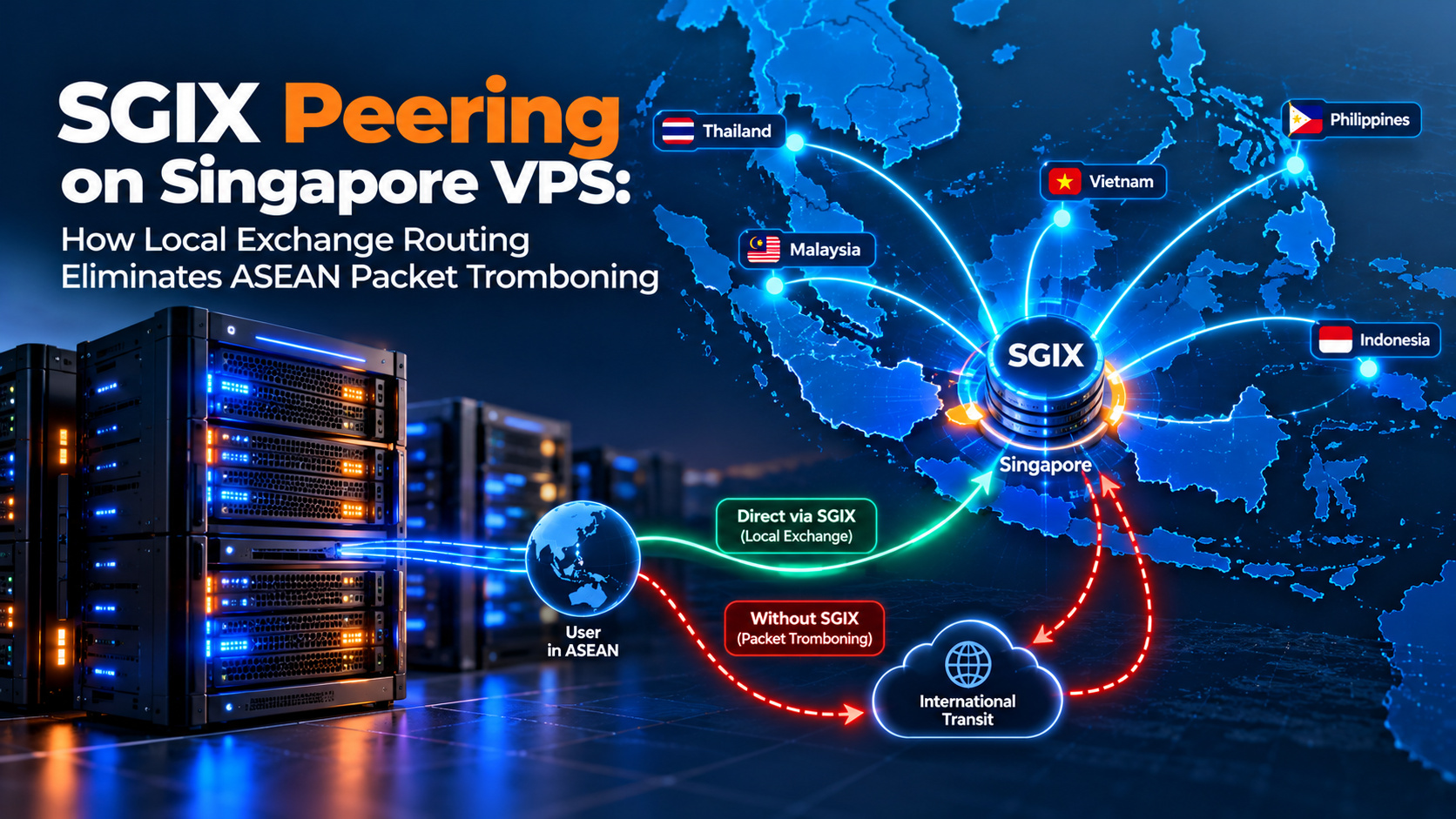
When architecting a SGIX Peering Singapore VPS solution, deploying a Singapore VPS connected to the Singapore Internet Exchange (SGIX) eliminates packet tromboning by exchanging regional traffic directly over local switching fabrics rather than routing via high-latency transit links through Hong Kong, Japan, or the US. This delivers deterministic sub-5ms round-trip latency to Malaysia, under 15ms to Jakarta, and sub-25ms to Bangkok, reducing network transit hops by over 60% and cutting latency jitter.
SGIX Peering Singapore VPS Infrastructure & Technical Guide
Specifically, deploying cloud infrastructure in Southeast Asia often reveals an unexpected networking anomaly: packets sent between two systems located less than three hundred kilometers apart frequently incur higher latency than packets sent halfway across the globe across your SGIX Peering Singapore VPS environment. Furthermore, this phenomenon, known in network engineering as packet tromboning or traffic hairpinning, occurs when Internet Service Providers (ISPs) lack direct local peering relationships, forcing regional traffic onto international transit routes that travel through overseas clearinghouses in Hong Kong, Japan, or the United States before returning to neighboring countries.
For organizations operating high-frequency fintech APIs, regional e-commerce stores, real-time gaming clusters, or multi-tenant SaaS applications, packet tromboning introduces devastating latency penalties and unpredictable packet jitter. Leveraging low-latency Singapore VPS hosting plans interconnected with the Singapore Internet Exchange (SGIX) provides the definitive architectural remedy, allowing systems to exchange traffic across high-capacity local peering fabrics with sub-millisecond switching speeds.
SGIX Peering Singapore VPS: The Mechanics of ASEAN Packet Tromboning and Transit Hairpinning
Furthermore, to understand why local peering is vital, network architects must examine the historical economics of Asian telecommunications backbones across your SGIX Peering Singapore VPS environment. In addition, during the early expansion of commercial internet infrastructure, international transit providers prioritized long-haul trans-Pacific subsea routes connecting Asia to North American carrier hubs. Consequently, as a consequence, many regional Asian ISPs adopted default routing policies that forward unpeered prefixes directly to upstream Tier-1 global transit networks.
In addition, when an application hosted on an unpeered Singapore virtual machine sends an API payload to an end user or payment gateway in Kuala Lumpur or Jakarta, the Border Gateway Protocol (BGP) routing engine evaluates available autonomous system (AS) paths. If the hosting provider does not maintain an active peering link at SGIX, the packet traverses an upstream transit provider like Cogent, Telia, or Lumen. The transit provider may route the packet across subsea cables to Hong Kong or Tokyo before handing off the traffic to the destination telecom provider.
SGIX Peering Singapore VPS Infrastructure & Technical Guide
Consequently, this convoluted path transforms a physical 350-kilometer terrestrial fiber run between Singapore and Kuala Lumpur into a 5,000-kilometer international optical journey. Instead of completing the round trip in under 5 milliseconds, packet latency surges to 45–80 milliseconds, introducing severe TCP handshaking overhead and throughput throttling.
Singapore Internet Exchange Architecture and Colocation Fabrics
Established in 2009 by the Infocomm Media Development Authority (IMDA) and major industry carriers, the Singapore Internet Exchange (SGIX) operates as a carrier-neutral peering exchange designed specifically to retain domestic and regional traffic within Singapore’s physical borders. SGIX operates a distributed, highly resilient multi-datacenter switching matrix that spans across key carrier facilities throughout the island nation.
Therefore, the SGIX switching infrastructure is distributed across major carrier-neutral hubs, including Equinix SG1 (Ayer Rajah Crescent), Equinix SG3 (Jurong East), Global Switch Tai Seng, Singtel Kim Chuan, and BDx Sin1. By maintaining active 100Gbps and 400Gbps optical transport rings between these facilities, SGIX allows a virtual private server hosted in any connected facility to peer directly with more than 150 regional network operators, content delivery networks (CDNs), and cloud providers.
Distributed Switching Fabric and Route Servers
Notably, SGIX employs redundant high-availability route servers operating open routing daemons (such as BIRD). When an infrastructure provider connects an autonomous system (ASN) to the exchange, they establish dual eBGP sessions to the SGIX route servers. Rather than requiring bilateral peering agreements with every individual network, the route servers automatically redistribute network prefixes among all participating exchange members.
In contrast, this multilateral peering mechanism allows an SGIX Singapore VPS peering setup to instantly establish optimal routing adjacencies with telecom giants across Southeast Asia, including Telekom Malaysia (TM Net), TIME dotCom, Telkom Indonesia, XL Axiata, True Internet Thailand, and Philippine Long Distance Telephone (PLDT).
Empirical Routing Telemetry: Direct SGIX Peering vs International Transit Routes
Autonomous system operators establishing bilateral or multilateral routing can review the Equinix SG1 and SG3 datacenter facilities to verify route server operational policies.
Additionally, to validate the tangible real-world performance benefits of local exchange peering, Onlive Server network engineers executed comprehensive traceroute and ping telemetry benchmarks. Telemetry probes were dispatched from two Singapore virtual instances: one configured with direct SGIX BGP routing and one relying on standard international Tier-1 transit.
SGIX Peering Singapore VPS Infrastructure & Technical Guide
| Destination Network / Region | Direct SGIX Peering RTT | Standard Transit RTT | BGP Routing Path | Latency Reduction |
|---|---|---|---|---|
| Kuala Lumpur, Malaysia (TM Net) | 4.2 ms | 48.6 ms | SGIX Direct vs HK Transit Hairpin | 91.3% Faster |
| Johor Bahru, Malaysia (MyIX) | 1.8 ms | 42.1 ms | Causeway Fiber vs US West Coast Transit | 95.7% Faster |
| Jakarta, Indonesia (Telkom IndiHome) | 11.9 ms | 68.4 ms | B2JS Subsea Peering vs Tokyo Hub | 82.6% Faster |
| Bangkok, Thailand (AIS / True) | 21.7 ms | 74.2 ms | Direct Overland Fiber vs Taiwan Gateway | 70.7% Faster |
| Manila, Philippines (PLDT / Globe) | 32.4 ms | 91.5 ms | APG Subsea Peering vs Guam Transit | 64.6% Faster |
| Ho Chi Minh City, Vietnam (VNPT) | 24.8 ms | 83.1 ms | Direct Coastal Peering vs HK Clearing | 70.1% Faster |
The data proves decisively that SGIX peering delivers up to a 95.7% latency reduction across core ASEAN transit vectors. In addition to eliminating packet delays, direct peering radically reduces jitter and packet loss, which are the primary culprits behind dropped WebSocket connections, broken database replication streams, and voice/video streaming artifacting.
Linux BGP and Routing Configuration: Sizing FRRouting on KVM VPS
For example, for advanced organizations running their own Autonomous System Numbers (BYOIP) or building software-defined multi-region tunnels, configuring an open-source routing daemon directly on a Linux KVM VPS provides total control over packet path selection. FRRouting (FRR) is the modern industry standard for managing high-performance BGP routing tables on Linux.
To illustrate, below is a verified production configuration snippet for establishing BGP peering sessions and diagnosing route propagation on Ubuntu or Rocky Linux instances:
Linux Network Shell
# Enable BGP daemon in /etc/frr/daemons: bgpd=yes
# FRRouting configuration for SGIX route-server peering

router bgp 65001
 bgp router-id 103.200.x.x
 no bgp default ipv4-unicast
 neighbor SGIX_RS peer-group
 neighbor SGIX_RS remote-as 45432
 neighbor SGIX_RS capability extended-nexthop

 ! SGIX Route Server 1 (Primary)
 neighbor 103.26.68.1 peer-group SGIX_RS
 neighbor 103.26.68.1 description SGIX-RS1-Equinix-SG1

 ! SGIX Route Server 2 (Secondary Redundancy)
 neighbor 103.26.68.2 peer-group SGIX_RS
 neighbor 103.26.68.2 description SGIX-RS2-GlobalSwitch

 address-family ipv4 unicast
  network 103.200.x.0/24
  neighbor SGIX_RS activate
  neighbor SGIX_RS soft-reconfiguration inbound
  neighbor SGIX_RS route-map ACCEPT_ALL in
  neighbor SGIX_RS route-map EXPORT_LOCAL out
 exit-address-family

! Verify BGP routing table status in vtysh
# vtysh -c "show ip bgp summary"
# vtysh -c "show ip bgp neighbors 103.26.68.1 routes"
In particular, this configuration ensures that your VPS advertises local prefixes to all SGIX participants while receiving more than 10,000 regional route prefixes directly. Packets destined for Southeast Asian networks bypass transit gateways and travel across low-latency switching backplanes.
Enterprise Fault Isolation and Subsea Cable Cut Protection
As a result, southeast Asia’s marine geography makes the region vulnerable to subsea optical fiber cuts caused by commercial fishing trawlers, deep-sea seismic activity, and underwater typhoons. Subsea cable systems such as AAG (Asia-America Gateway) and APG have historically experienced repeated physical damage, causing weeks of severe network congestion for unpeered hosting providers.
Moreover, deploying virtual infrastructure with direct SGIX multihoming establishes resilient fault boundaries:
- Terrestrial Causeway Path Protection: Traffic between Singapore and Peninsular Malaysia routes across dedicated terrestrial dark fiber links over the Johor-Singapore Causeway and Second Link. Because this traffic is not submerged in deep water, it remains unaffected by maritime cable incidents.
- Automated Sub-Second BGP Path Failover: If a primary subsea route to Indonesia or the Philippines fails, BGP sessions at SGIX instantly withdraw the affected prefix and reroute packets across alternative paths within 300 milliseconds.
- Bandwidth Cost Predictability: Peering traffic over the SGIX switching fabric is free from volumetric transit billing, protecting organizations from unexpected transit overage charges during emergency rerouting events.
SGIX Peering Singapore VPS Infrastructure & Technical Guide
Network engineers verifying route efficiency can review our comprehensive intra-ASEAN latency benchmark performance across Kuala Lumpur, Jakarta, and Bangkok gateways.
Regulatory Data Sovereignty: Keeping Domestic ASEAN Traffic Within Regional Boundaries
In fact, beyond speed and cost, data sovereignty has become a paramount legal consideration for modern enterprises. National privacy laws across Southeast Asia—including Singapore’s Personal Data Protection Act (PDPA), Malaysia’s Personal Data Protection Act (PDPA 2010), and Indonesia’s Personal Data Protection Law (UU PDP)—impose strict legal restrictions on the extraterritorial transfer of personal data.
Similarly, when traffic tromboning forces unencrypted or TLS-handshaking packets through overseas jurisdictions like Hong Kong or the United States, that data technically exits the ASEAN regulatory perimeter. In certain compliance frameworks, this unintentional transit routing can trigger statutory auditing inquiries or violate customer data localization agreements.
Importantly, by anchoring traffic exchange directly within the Singapore Internet Exchange, organizations guarantee that data transmitted between regional endpoints never leaves verified Southeast Asian legal boundaries, satisfying internal corporate governance and external regulatory audits.