

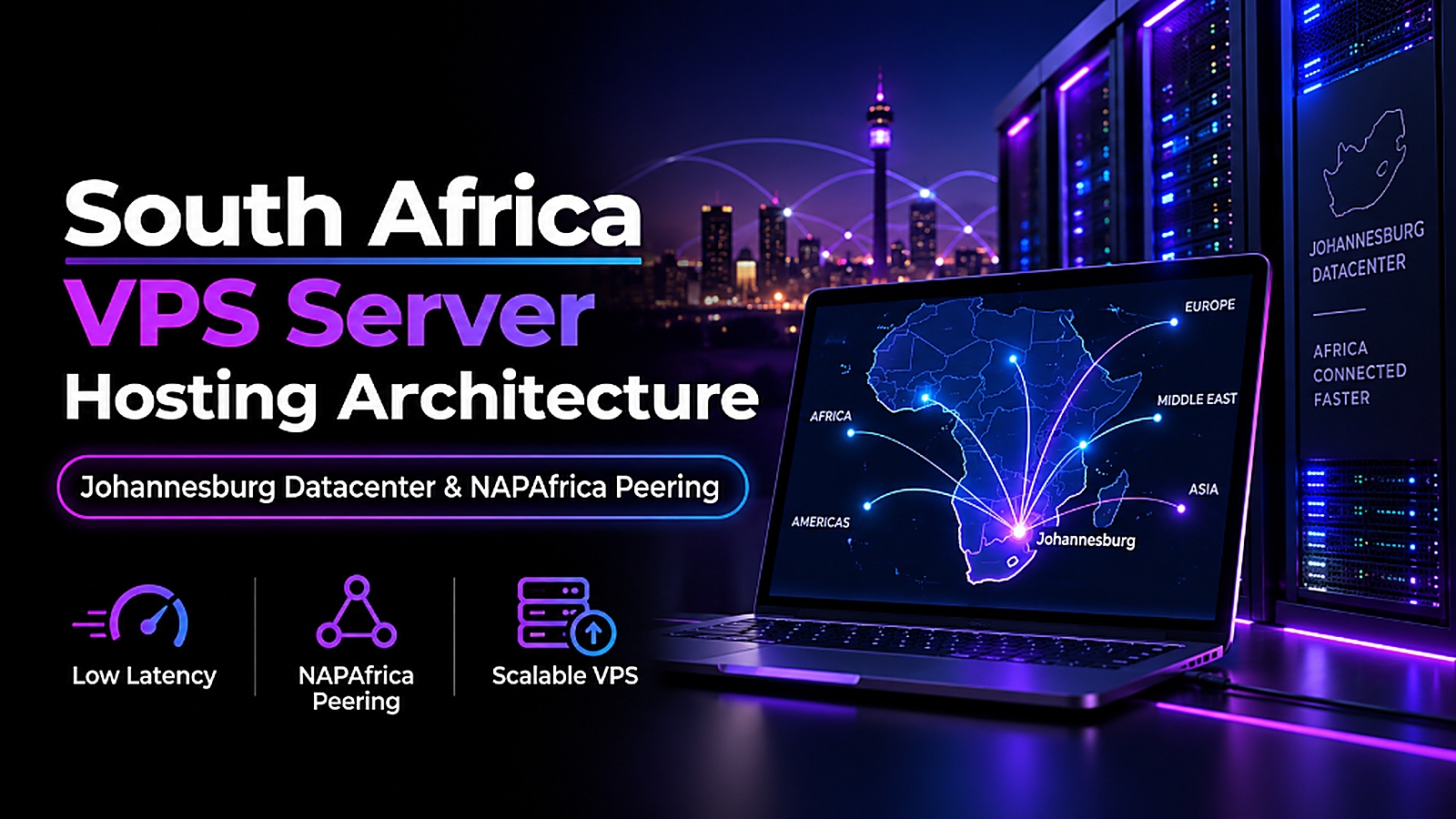
Choosing between a johannesburg vs cape town vps is a pivotal decision for digital enterprises. While South Africa spans over 1.2 million square kilometers, network traffic concentrates around two major hubs. Consequently, deploying your virtual server in the wrong facility can introduce unwanted latency for your core customer demographic.
Furthermore, hosting your web applications on enterprise south africa vps hosting requires balancing network routing, power grid reliability, and disaster recovery. Both Johannesburg (Teraco Isando) and Cape Town (Teraco Rondebosch) offer tier-grade facilities and carrier-neutral peering through NAPAfrica. However, each location possesses unique architectural characteristics that impact latency, subsea transit, and power continuity.
⚙️ Architectural Execution Framework
Verified Infrastructure Standards
Key Technical Architecture & Engineering Takeaways
Evaluating enterprise hosting infrastructure requires verifiable telemetry across compute isolation, hypervisor performance, and domestic carrier interconnects:
Demographic and Economic Landscape: Evaluating Johannesburg vs Cape Town VPS Workloads
To make an informed location choice, businesses must first examine where their users physically live and work. Specifically, Gauteng is South Africa’s economic engine room. Despite occupying less than 1.5% of national land, Gauteng houses over 16 million residents and accounts for roughly 35% of national gross domestic product.
In addition, Johannesburg hosts the Johannesburg Stock Exchange (JSE). It is also home to major commercial banks (Standard Bank, FNB, Absa, and Nedbank) and retail corporate headquarters. Therefore, if your virtual server powers enterprise B2B software or national retail logistics, a Johannesburg deployment is ideal. It guarantees that the vast majority of domestic transactions experience immediate, single-digit millisecond response times.
In contrast, Cape Town represents South Africa’s thriving technology startup capital, creative industry hub, and premier tourism destination. The Western Cape is home to major e-commerce leaders (such as Takealot), fintech innovators, digital media agencies, and international remote engineering teams. Consequently, if your platform targets coastal consumers, regional Western Cape retail, or European development partners, Cape Town hosting offers distinct local routing advantages.
Terrestrial Fiber Latency: Understanding Johannesburg vs Cape Town VPS Latency
The physical driving distance between Johannesburg and Cape Town is approximately 1,400 kilometers along the N1 national route. However, telecommunications fiber optic cables do not follow straight lines. Instead, national backbones follow road reserves, rail easements, and power line corridors across the Karoo desert. These lines are operated by Liquid Intelligent Technologies, Openserve, Broadband Infraco, and Dark Fibre Africa (DFA).
Colocating servers in South African coastal or inland facilities ensures responsive performance by avoiding intercontinental submarine cable delays that degrade user experience on offshore servers.
Because light slows down when traveling through glass fiber cores, each 100 kilometers of terrestrial fiber introduces roughly 1 millisecond of optical delay. Specifically, one-way optical transit time between Teraco Isando in Johannesburg and Teraco Rondebosch in Cape Town is roughly 9ms. This results in a predictable two-way round-trip time (RTT) of 16ms to 22ms.
As the latency table proves, while an 18ms delay across the Karoo is modest, high-frequency database queries and chatty API architectures multiply this delay. For example, if a single page render requires 15 sequential database calls across an un-cached connection, that 18ms latency accumulates into an additional 270 milliseconds of page generation delay. Consequently, keeping compute instances close to your primary database and user cluster is paramount.
Subsea Cable Landings: Equiano, 2Africa, and International Gateway Routing
While Johannesburg dominates domestic commerce, Cape Town holds an undisputed physical advantage in international connectivity. Specifically, the Western Cape coast serves as the primary landing zone for subsea fiber. These massive optical cables connect Southern Africa to Europe, West Africa, and the Americas.
Regional routing fabrics across Johannesburg and Cape Town follow the IETF Internet Exchange Point operational standards for bilateral and multilateral traffic exchange.
In particular, major subsea cables make direct landfall near Cape Town. These systems include Google Equiano, Meta 2Africa, WACS, and SAT-3. Because these cables plug directly into coastal facilities, European traffic departs directly from Cape Town. Consequently, packets avoid traveling 1,400 kilometers inland to Johannesburg first.
When a Cape Town server communicates with London or Frankfurt, round-trip latency clocks in at roughly 135ms to 145ms. In contrast, a Johannesburg server must first route packets down the terrestrial backbone. This adds roughly 18ms to 20ms to the international journey. For APIs requiring frequent overseas handshakes, Cape Town provides a measurable speed advantage.
Conversely, East Coast subsea cables (such as EASSy and Seacom) make landfall at Mtunzini in KwaZulu-Natal. Traffic from Mtunzini routes directly inland to Teraco Isando in Johannesburg over dedicated terrestrial routes. Therefore, Johannesburg maintains direct, balanced access to both Atlantic and Indian Ocean cable systems.
Power Grid Reliability and Municipal Load Shedding Mitigation
No analysis of South African IT infrastructure is complete without addressing electrical grid stability and Eskom load shedding. Across both cities, enterprise colocation facilities employ comprehensive backup generation infrastructure. However, the municipal operating environments differ in meaningful ways.
Both Johannesburg and Cape Town datacenters insulate critical services from municipal load shedding through resilient 2N backup generator infrastructure and rotary flywheel UPS units.
First, consider Cape Town’s unique municipal power advantage. The City of Cape Town owns and operates the Steenbras Hydro Pumped Storage Scheme. During periods of national load shedding, the municipality can generate up to 180 megawatts of hydro-electric peaking power. Consequently, Cape Town municipal residents and commercial zones frequently enjoy load shedding schedules that are one to two stages lower than the rest of South Africa.
Second, consider Johannesburg’s industrial datacenter scale. Teraco Isando operates multi-megawatt redundant diesel generator farms configured in N+1 and 2N topologies. In addition, the campus maintains on-site bulk fuel reserves capable of running continuously for over 48 hours without refueling. These reserves are backed by strict SLA-bound fuel replenishment contracts.
Therefore, whether you choose Johannesburg or Cape Town through Onlive Server, your virtual server remains 100% insulated from Eskom power cuts. Uninterruptible Power Supply (UPS) battery arrays absorb the initial transfer, while heavy diesel turbines synchronize within seconds, guaranteeing continuous server uptime.
Dual-Region Active-Passive Disaster Recovery Architecture
Rather than viewing Johannesburg and Cape Town as competitors, forward-thinking enterprise architects deploy both locations in tandem. In modern IT resilience planning, multi-region deployments protect against regional cable cuts and severe municipal substation faults.
Enterprises prioritizing direct connectivity to national financial transaction backbones can provision Teraco Isando enterprise host nodes with unmetered domestic bandwidth.
Specifically, Teraco Isando in Johannesburg and Teraco Rondebosch in Cape Town are connected via low-latency Layer 2 wavelength services. This dedicated inter-facility connection allows database engines to replicate data securely across the country without traversing public internet links.
Moreover, this multi-region architecture satisfies strict compliance standards mandated by the Financial Sector Conduct Authority (FSCA) and the Protection of Personal Information Act (POPIA). Because both nodes reside within South African borders, data sovereignty is preserved while achieving carrier-grade disaster recovery.
Additionally, modern multi-site deployments employ latency-based Anycast or GeoDNS routing. For example, when a visitor in Cape Town resolves your domain, GeoDNS steers them to the Cape Town cluster. Conversely, visitors in Johannesburg, Pretoria, and Durban route directly to the Johannesburg node. Consequently, this architecture guarantees optimal response times for every visitor nationwide.
Frequently Asked Questions
Core Technical Specifications
Is there any pricing difference between Johannesburg and Cape Town VPS hosting?
What is the exact round-trip latency between Johannesburg and Cape Town?
Does Cape Town have better international internet connectivity than Johannesburg?
Can I migrate my VPS from Johannesburg to Cape Town later if needed?
Deployment & Operational Inquiries
How does POPIA compliance apply to hosting in Johannesburg vs Cape Town?
Should a financial technology startup host its primary VPS in Johannesburg or Cape Town?
Can I deploy a high-availability active-passive disaster recovery pair between Johannesburg and Cape Town?
Strategically Place Your Workloads Across Gauteng and Western Cape
Furthermore, balance financial sector connectivity with subsea landing station reach through dual-metro South African server nodes.
