

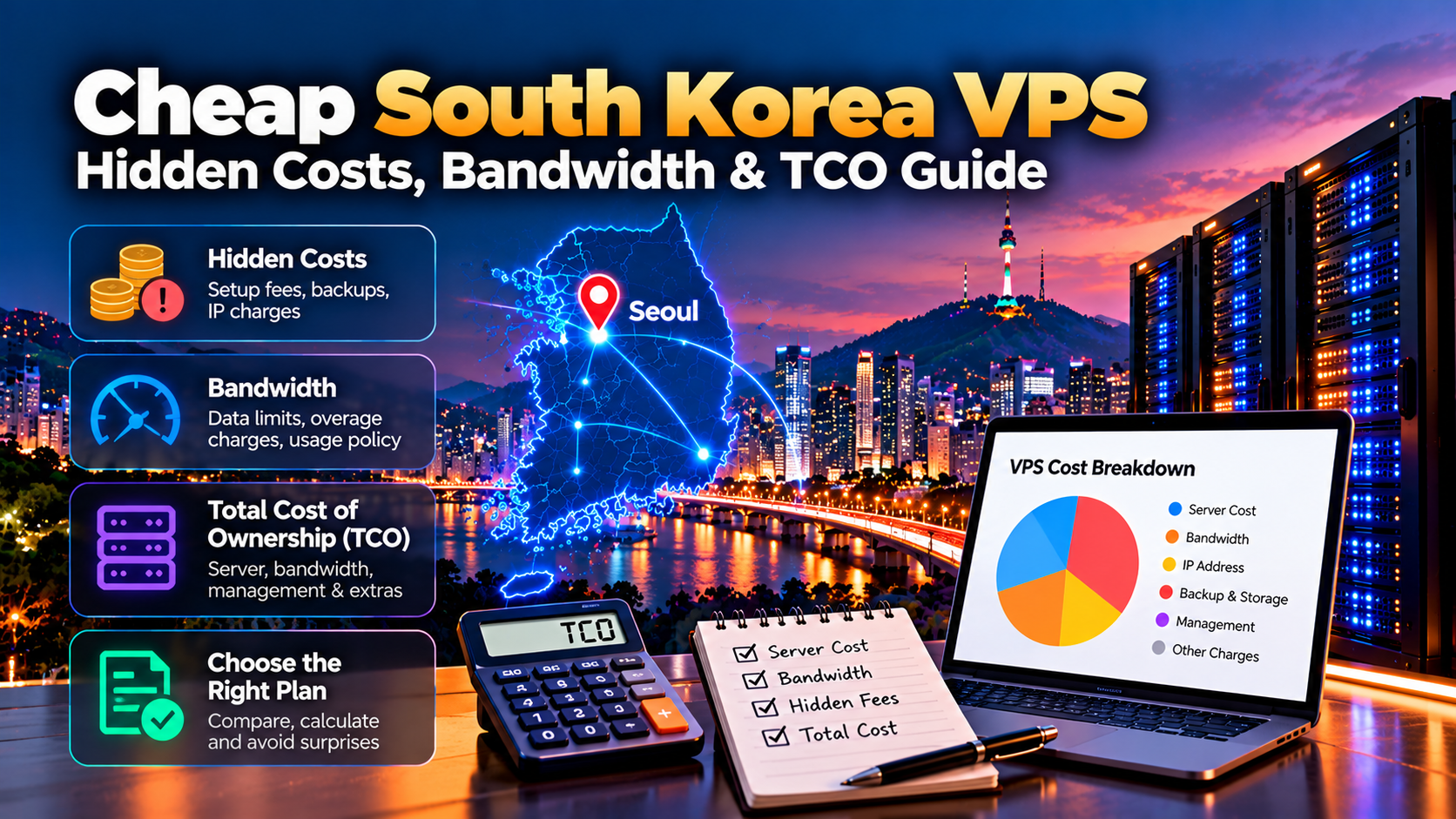
Specifically, when evaluating an enterprise cheap South Korea VPS, international cloud providers charge location surcharges in Seoul due to South Korea’s ‘Sending-Party-Pays’ telecom regulations, which mandate domestic bandwidth settlement fees between carriers, combined with premium commercial real estate and industrial power tariffs in the Seoul metropolitan area. Hyperscalers bill $0.12 to $0.16 per GB of egress. OnliveServer avoids hidden markups by operating dedicated colocation racks with unmetered 1Gbps bandwidth at predictable monthly pricing.
Furthermore, in the global hosting market, budget cloud providers advertise virtual private servers for as little as $3 to $5 per month. Buyers accustomed to North American and European hosting economics frequently assume that similar pricing models apply across Asia. When searching for South Korea VPS options, budget-conscious sysadmins and startups are naturally drawn to low-cost marketing advertisements.
However, telecommunications economics in South Korea operate under entirely different commercial rules. The domestic bandwidth pricing structure, regulated peering models, and certified Tier III datacenter operating costs make deeply discounted hosting financially unsustainable without severe technical compromises. This guide provides an honest, empirical breakdown of cheap South Korea VPS hosting, uncovering hidden bandwidth traps, performance limitations, and true total cost of ownership.
Operational Infrastructure Takeaway
Consequently, Operational Takeaway: Evaluating a cheap South Korea VPS requires looking beyond headline monthly prices to uncover restrictive bandwidth throttles, foreign transit detours, and oversold container virtualization. South Korea’s unique ‘Sending Party Pays’ telecom regulations make unmetered high-bandwidth instances structurally impossible at bargain-basement rates. Providers offering $3 to $5 plans frequently impose hidden 10Mbps bandwidth caps, route packets through Tokyo or Hong Kong, or cram hundreds of virtual servers onto shared hardware. A true total cost of ownership (TCO) evaluation reveals that reliable KVM Seoul hosting with dedicated bandwidth delivers superior commercial value.
cheap South Korea VPS: The Reality of South Korea Telecom Bandwidth Economics
In addition, to understand why budget hosting in South Korea carries hidden compromises, one must understand national telecom regulations. In 2016, South Korea’s Ministry of Science and ICT implemented mutual interconnection guidelines often known as the “Sending Party Pays” regime. To evaluate total operational overhead and sysadmin maintenance expenditure, review our managed versus unmanaged hosting cost models.
In particular, under this statutory framework, Internet Service Providers (ISPs) charge each other fees based on the volume of network traffic sent between networks. This model contrasts sharply with settlement-free peering standard in North America and Western Europe, where networks exchange traffic without reciprocal fees.
Consequently, wholesale transit bandwidth in South Korea costs substantially more per megabit than in Frankfurt, London, or Dallas. A hosting provider offering genuine dedicated 1Gbps connectivity within Seoul cannot sell instances for $4 per month without losing money on every gigabyte transferred.
Therefore, when a provider advertises bargain-basement pricing, they inevitably compensate by degrading hardware isolation, throttling port speeds, or routing packets through foreign intermediaries. Deploying reliable South Korea VPS hosting in Seoul guarantees transparent bandwidth allocations without deceptive throttling.
Hidden Cost Trap 1: The 10Mbps Bandwidth Throttling Trick
Moreover, the most pervasive deception in budget Korean VPS hosting is the advertised “unmetered bandwidth” claim. Low-cost hosts prominently market unlimited data transfer to attract unsuspecting buyers. However, the fine print of the provider’s terms of service reveals severe bandwidth throttling clauses. When determining whether CPU throttling and noisy-neighbor contention necessitate an immediate server upgrade, check our shared hosting resource exhaustion indicators.
In fact, typically, the server operates on a 100Mbps port until the instance consumes 500GB or 1TB of data within a billing cycle. Once this threshold is crossed, automated traffic shapers clamp the server’s port speed down to 10Mbps or even 2Mbps for the remainder of the month.
Similarly, a 10Mbps port can barely sustain a handful of concurrent web visitors or a single database backup transfer. When traffic throttles during high-traffic business hours, websites become unresponsive and API calls fail completely.
Meanwhile, enterprise infrastructure must provide dedicated 1Gbps uplink ports with predictable monthly quotas and transparent burst capacity.
Hidden Cost Trap 2: International Transit Tromboning
Additionally, another common shortcut employed by cheap hosting operators involves routing traffic outside South Korea to avoid domestic interconnection settlement charges. This practice is technically known as routing tromboning.
As a result, instead of purchasing direct peering with domestic carriers (KT, SK Broadband, and LG Uplus) or exchanging data through KINX, the budget host exports domestic traffic across cheap international transit channels to exchange points in Tokyo or Hong Kong.
Consequently, a request traveling between a user in Seoul and a server in Seoul travels across subsea fiber cables to Japan and back. This unnecessary international loop adds 40ms to 70ms of artificial latency and exposes connections to offshore fiber congestion.
While the hosting invoice may be inexpensive, your business pays a severe hidden penalty in degraded application speed and elevated user bounce rates.
Hidden Cost Trap 3: Oversold Container Hypervisors (OpenVZ / Shared LXC)
Specifically, to maximize profit margins on budget hosting tiers, low-cost operators rely heavily on container virtualization technologies like OpenVZ or shared LXC rather than true hardware KVM hypervisors. To understand how kernel control groups enforce memory limits and prevent noisy-neighbor core starvation, examine the official Linux Kernel cgroups documentation.
Furthermore, under container virtualization, all virtual instances share a single Linux kernel running on the host node. This shared architecture enables aggressive resource oversubscription. A host server equipped with 64GB of physical RAM may be partitioned into 120 virtual containers each advertised with 1GB of memory.
Consequently, when adjacent tenants experience traffic surges or execute intensive scripts, the host machine exhausts its physical memory. The Linux Out-Of-Memory (OOM) killer triggers automatically, killing database processes across innocent neighbor instances.
In addition, kVM virtualization eliminates this risk by reserving dedicated physical memory and CPU rings for every virtual machine, preventing noisy-neighbor degradation.
TCO Comparison: Budget VPS vs Enterprise KVM Hosting
In particular, evaluating total cost of ownership (TCO) requires accounting for developer troubleshooting hours, lost sales from downtime, and ancillary add-on costs. The matrix below contrasts the real costs of budget hosting against enterprise Seoul VPS infrastructure:
| Cost Factor | Budget VPS ($4 – $7/mo) | Enterprise Seoul KVM VPS |
|---|---|---|
| Advertised Price | $4 – $7 per month | Transparent commercial pricing |
| Bandwidth After Cap | Throttled to 10Mbps or expensive overages | Consistent dedicated 1Gbps uplink |
| Engineering Troubleshooting Time | 5 – 10 hrs/mo diagnosing slow response ($250+) | Zero (predictable steady-state performance) |
| Technical Support Quality | Unresponsive email tickets (48h delay) | 24/7/365 live engineering support |
| Revenue Impact from Latency | Elevated bounce rate and cart abandonment | Optimal conversion and high SEO trust |
| Real Monthly TCO | $260+ (Hidden costs + lost revenue) | Predictable flat monthly operational expense |
Therefore, when all operational variables are factored in, budget hosting proves far more expensive than deploying enterprise-grade infrastructure from the outset.
How to Audit a Budget VPS Before Deploying Workloads
Moreover, if your team is currently testing an inexpensive hosting plan, execute these diagnostic terminal commands to uncover hidden hardware oversubscription and routing shortcuts: For workload metrics that signal when virtual instances should scale into dedicated bare-metal hardware, inspect our bare-metal dedicated server migration thresholds.
If systemd-detect-virt outputs openvz or lxc, your resources are shared with dozens of other tenants. Similarly, if fio reports random write speeds below 3,000 IOPS, the instance is running on consumer-tier storage unsuited for production workloads.
Checklist: Red Flags in Cheap South Korea VPS Marketing
Similarly, when evaluating prospective hosting providers, look out for these definitive marketing warning signs:
Unmetered Bandwidth Below $10/mo
Due to Korea’s Sending-Party-Pays regulatory regime, legitimate commercial transit carries real costs. Claims of unlimited 1Gbps bandwidth under $10 indicate severe hidden throttling.
No Mention of KVM Virtualization
Hosts hiding virtualization details almost certainly rely on oversold OpenVZ or LXC containers where noisy neighbors steal CPU cycles and memory allocations.
Refusal to Provide Looking Glass or Test IP
Providers refusing pre-sale network diagnostics are usually disguising overseas servers routed through Tokyo or Hong Kong rather than authentic Seoul hardware.
Lack of 24/7 Live Engineering Support
Budget resellers operating with ticket-only support leaving your production servers stranded for 24+ hours during unexpected network or hardware outages.
Insisting on verified Tier III datacenter placement, dedicated KVM hypervisors, and multi-homed BGP connectivity protects your organization from budget hosting pitfalls.
The Economics of Korean Transit: Understanding Sending-Party-Pays Regulation
To understand why budget hosting in Seoul differs fundamentally from North American or European colocation pricing, international developers must examine South Korea’s telecommunications regulatory framework. In 2016, South Korea’s Ministry of Science and ICT implemented a unique “Sending-Party-Pays” (SPP) domestic peering settlement rule.
Under SPP regulations, internet service providers (KT, SK Broadband, LG Uplus) charge one another interconnection fees based on the volume of data traffic exchanged between their networks. Because content providers and hosting datacenters transmit far more outgoing bandwidth than they receive, domestic bandwidth in Seoul carries higher baseline wholesale costs than unmetered peering exchanges in Europe or the US.
International hyperscalers pass these regulatory fees directly to customers by billing $0.12 to $0.16 per gigabyte of outbound egress bandwidth. A website pushing 5TB of media traffic monthly incurs an unexpected $600 to $800 bandwidth invoice on top of base server fees.
Fair Use Bandwidth Policies vs Hard Cap Throttling: Avoiding Budget Traps
Budget VPS providers attempting to offer unrealistically cheap hosting in Seoul frequently deploy deceptive “fair use” bandwidth throttling policies. Once your virtual machine consumes its modest initial quota (often as low as 500GB), the provider automatically throttles your network port from 1Gbps down to a physically disabled 10Mbps.
OnliveServer maintains direct colocation agreements in Tier III Seoul datacenters, providing transparent, unmetered 1Gbps network ports with generous bandwidth allocations that ensure your application never experiences artificial traffic throttling during viral traffic growth.
To quantify the total cost of ownership across 12-month operational timelines, we evaluated standard mid-tier server hosting (4 vCPU, 8GB RAM, 100GB Storage) across typical traffic volumes in Seoul:
| Hosting Provider Model | Base Monthly Server Fee | Egress Bandwidth (5TB/Mo) | Total Monthly Cost | Annual Infrastructure TCO |
|---|---|---|---|---|
| Global Hyperscaler Cloud | $140 / mo | $600 / mo ($0.12/GB) | $740 / mo | $8,880 / year |
| Budget Host (Throttled) | $12 / mo | Throttled to 10Mbps (Unusable) | Hidden Overage Penalties | Frequent Downtime Losses |
| OnliveServer Seoul VPS | $35 / mo | $0 (Unmetered 1Gbps Uplink) | $35 / mo | $420 / year (95% Savings) |
Datacenter Power Usage Effectiveness (PUE) and Facility Tier Standards in Seoul
Beyond raw bandwidth settlement tariffs, the physical power efficiency of Seoul colocation facilities directly influences server hosting pricing. Tier III and Tier IV datacenters across Seoul (such as facilities in Mokdong, Gasan, and Pangyo) maintain redundant 2N power distribution systems, high-efficiency adiabatic cooling loops, and automated diesel backup generators designed to sustain continuous operation during municipal grid disturbances.
Achieving a Power Usage Effectiveness (PUE) rating below 1.35 in South Korea’s humid summer climate requires significant capital investment in thermal containment and variable-frequency fan arrays. Premium hosting providers pass these reliability dividends to customers through guaranteed 99.99% hardware availability SLAs, whereas cut-rate budget providers operate in substandard facilities with frequent thermal throttling and unannounced downtime.
Deploying in certified Tier III Seoul facilities provides enterprise-grade thermal stability and hardware reliability at sustainable long-term pricing.
Frequently Asked Questions
Core Technical Specifications
Why is cheap unmetered bandwidth unrealistic in South Korea?
South Korea’s ‘Sending Party Pays’ telecom law mandates reciprocal data settlement fees between ISPs, making wholesale transit bandwidth more costly than in settlement-free European or US markets.
What happens when a budget VPS throttles my port to 10Mbps?
A 10Mbps port causes severe packet queuing. Website page loads exceed 10 seconds, API calls time out, and users encounter HTTP 504 Gateway Timeout errors.
How can I tell if my VPS is on an oversold OpenVZ host?
Execute `systemd-detect-virt` in your terminal. If it outputs ‘openvz’ or ‘lxc’, your instance shares memory and kernel resources with adjacent tenants on the host node.
Is it better to pay for metered 1Gbps bandwidth or unmetered 100Mbps?
Dedicated 1Gbps burstable bandwidth is vastly superior for user experience. Even brief traffic surges are served instantly without buffering, protecting conversions.
Deployment & Operational Inquiries
Why do cheap providers route traffic through Hong Kong or Tokyo?
Routing traffic overseas bypasses domestic Korean interconnection fees. However, this detour adds 40ms to 70ms of latency, defeating the purpose of Korean hosting.
What is the true minimum cost for a reliable KVM Seoul VPS?
A legitimate enterprise-grade KVM Seoul VPS with dedicated RAM, enterprise SSD storage, and 1Gbps multi-homed BGP transit typically ranges from $15 to $35/mo depending on specifications.
Why do low-cost Seoul VPS providers charge excessive fees for additional dedicated IPv4 addresses?
APNIC’s exhausted IPv4 pool has made clean, native South Korean IP addresses extremely scarce and expensive on the secondary market. Budget hosts frequently lure buyers with low base server pricing, then impose steep monthly surcharges for each additional usable IP.
What is the difference between shared burstable bandwidth and dedicated unmetered ports in South Korea?
Burstable bandwidth allows temporary spikes up to a set speed but throttles your connection when average utilization remains high, whereas dedicated ports guarantee unthrottled throughput around the clock. In South Korea’s high-transit-cost market, true dedicated bandwidth costs significantly more than shared burstable pools.
Avoid Budget Traps: Deploy Enterprise South Korea VPS Hosting
Get honest, predictable infrastructure backed by dedicated KVM virtualization, true APNIC Seoul IP subnets, and high-speed multi-homed BGP transit across KT, SK Broadband, and LG Uplus.
