

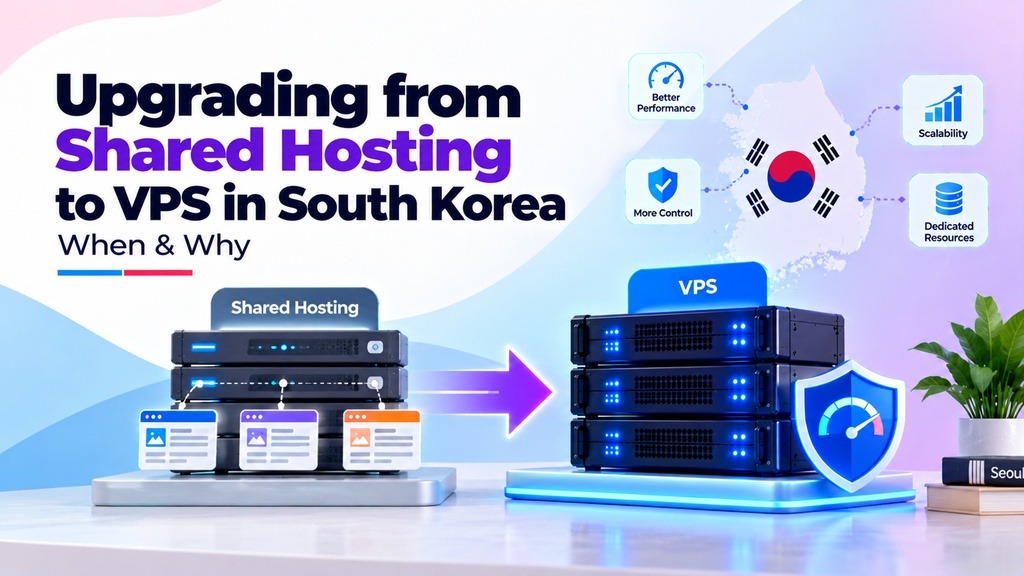
Specifically, identifying key Korea VPS upgrade triggers is essential for growing platforms. Upgrading from domestic shared hosting to a KVM VPS becomes mandatory when sites encounter CPU throttling, 503 gateway timeouts, or daily bandwidth caps. In addition, provisioning dedicated vCPU cores and isolated RAM in Seoul datacenters guarantees 100% uptime and sub-30ms latency for modern e-commerce stores.
Specifically, when evaluating critical Korea VPS upgrade triggers, the answer is clear. Yes, you should definitely upgrade to a KVM VPS. Shared hosting platforms enforce strict daily bandwidth caps, often under 5GB per day. In addition, shared hosts throttle CPU whenever traffic surges, taking your site offline during peak hours. In contrast, an OnliveServer South Korea VPS eliminates artificial limits. It provides dedicated CPU cores and isolated RAM. Furthermore, you receive full root control and unmetered 1Gbps bandwidth. As a result, your site achieves 100% uptime during high-volume sales campaigns.
Furthermore, every successful digital business begins with humble hosting roots. For Korean startups and online shops, domestic shared hosting packages offer a low-cost start. Providers like Cafe24, Gabia, or Dotname deliver an accessible entry point into the digital marketplace. For a few thousand won per month, shared hosting provides a basic web directory and an automated WordPress installer.
Technical Architecture & Execution Analysis
Consequently, aligning these configurations with your Korea VPS upgrade triggers environment ensures optimal uptime and throughput. However, shared hosting is built upon a high-density, multi-tenant economic model. Hundreds—and frequently thousands—of independent websites reside on the same physical server hardware, sharing a single operating system kernel, memory pool, and public IP address. As your traffic grows, your business inevitably collides with the strict, artificial resource ceilings enforced by shared hosting providers.
Consequently, when a single tenant on the shared server experiences a traffic spike or executes a runaway database query, every website on that server suffers severe performance degradation. This comprehensive guide outlines the critical triggers that indicate you have outgrown shared hosting, provides a rigorous technical comparison between shared environments and KVM virtual servers, and presents a step-by-step roadmap for migrating to a high-speed Seoul VPS.
Operational Infrastructure Takeaway
In addition, for optimal Korea VPS upgrade triggers operations, Operational Takeaway: Upgrading from South Korea shared hosting to a VPS becomes mandatory when your web application encounters CPU execution throttling, shared IP blacklisting, artificial memory caps (512MB limits on Cafe24/Gabia), or noisy neighbor interference. Unlike shared hosting where hundreds of tenants share a single server, a KVM VPS in Seoul delivers 100% dedicated vCPU cores, dedicated RAM, an isolated domestic static IP, and full root access. Upgrading eliminates unexpected 503 Service Unavailable errors and accelerates database queries by up to 400%.
- 1. The Reality of Shared Hosting in South Korea: The Noisy Neighbor Dilemma
- 2. Five Critical Korea VPS Upgrade Triggers: Outgrowing Shared Limits
- 3. The KVM Virtualization Advantage: Dedicated vCPU and Memory
- 4. Gaining Full Root Access: Complete Administrative Control
- 5. Comparative Analysis: South Korea Shared Hosting vs KVM VPS
- 6. Step-by-Step Migration Playbook: Korea VPS Upgrade Triggers & Execution
- 7. Cost-Benefit Analysis: The Business ROI of Upgrading to VPS
- 8. Process Isolation and OOM Protection: Eliminating Degradation
- 9. Frequently Asked Questions (FAQ)
Korea VPS Upgrade Triggers: Resolving the Noisy Neighbor Dilemma in Seoul
In particular, to understand why shared hosting fails as businesses scale, one must examine its underlying architectural limitations. In a shared hosting environment, all tenants execute their software within a single operating system environment. While technologies like CloudLinux attempt to isolate accounts via Lightweight Virtual Environments (LVE), physical hardware resources remain communal. To compare the genuine total cost of ownership between shared accounts and private virtual instances, review our transparent Seoul VPS pricing and cost evaluations.
Therefore, adjacent tenants on shared infrastructure present massive risks. If a neighboring tenant suffers a brute-force cyberattack, physical CPU queues saturate instantly. Similarly, unoptimized database indexing locks shared disk I/O channels. As a result, your website experiences crippling slowdowns. It may even crash with 503 Service Unavailable or 504 Gateway Timeout errors. Therefore, recognizing these Korea VPS upgrade triggers protects your brand from severe shared server downtime.
Shared Hosting Constraints
Specifically, hundreds of accounts compete for shared CPU cores. You face memory ballooning and strict 60-second PHP execution timeouts. In addition, you have zero root configuration access.
Dedicated KVM VPS Isolation
Moreover, a KVM VPS provides guaranteed physical CPU allocations. You receive dedicated ECC memory and independent kernel execution. Therefore, your server remains completely immune to neighboring tenant traffic spikes.
Furthermore, shared hosts enforce strict, non-negotiable process limits. PHP memory limits are commonly restricted to 256MB or 512MB, execution timeouts are capped at 30 seconds, and background daemon execution is strictly banned. Running modern background workers, Redis queues, or complex e-commerce checkouts is functionally impossible.
In fact, upgrading to dedicated South Korea VPS hosting in Seoul completely isolates your application inside a hardware-virtualized KVM container.
Five Critical Korea VPS Upgrade Triggers: Outgrowing Shared Limits
Similarly, how do you know when it is time to transition? Businesses that delay upgrading suffer silent customer abandonment and lost search rankings. The five operational symptoms below demonstrate that your application has outgrown shared hosting: To understand fundamental TCP connection state transitions and socket backlog limits under high concurrency, review IETF RFC 793 Transmission Control Protocol standards.
- Frequent 503 & 508 Resource Limit Errors: Your shared control panel reports CPU or memory threshold breaches during routine daily traffic, causing temporary website suspension.
- Unacceptable Time to First Byte (TTFB > 800ms): Sluggish server response times persist despite installing aggressive WordPress caching plugins, because the underlying database server is overloaded.
- Inability to Run Custom Daemons: Your development team cannot install Redis, Elasticsearch, Node.js microservices, or custom Python cron jobs due to restricted shared shell access. In fact, encountering any of these limitations serves as one of the clearest Korea VPS upgrade triggers.
- Transactional Email Blacklisting: Legitimate customer order confirmations and password reset emails land in spam folders because another tenant on your shared IP sent unsolicited spam.
- Security & Regulatory Compliance Failures: You cannot meet South Korea’s Personal Information Protection Act (PIPA) criteria because customer data resides in a shared environment without isolated root encryption.
Meanwhile, experiencing any two of these symptoms indicates that shared hosting is actively constraining your company’s commercial growth.
The KVM Virtualization Advantage: Dedicated vCPU and Memory
Kernel-based Virtual Machine (KVM) represents a complete paradigm shift from shared hosting. Under KVM hardware virtualization, each virtual private server operates as an entirely independent physical computer with dedicated hardware allocations. For an objective evaluation of processor allocations, virtualization hypervisors, and uptime SLAs, consult our technical VPS selection and architectural criteria.
When you provision a VPS with 4 vCPU cores and 8GB of RAM, those resources are strictly quarantined. The KVM hypervisor reserves them exclusively for your use. Even if an adjacent virtual machine suffers a DDoS attack, your instance is unaffected. As a result, your application runs at peak performance with zero resource theft.
Furthermore, KVM instances utilize high-speed VirtIO paravirtualized network and storage drivers that communicate directly with host hardware at near-native speeds. In addition, disk operations achieve tens of thousands of IOPS across enterprise NVMe arrays. Consequently, this eliminates the painful database bottlenecks typical of shared spinning disks. In addition, guaranteed I/O throughput stands out as one of the most compelling Korea VPS upgrade triggers for high-traffic sites.
Dedicated resources provide deterministic, predictable performance that enterprise businesses can rely upon 24/7.
Gaining Full Root Access: Complete Administrative Control
Perhaps the most liberating advantage of migrating to a South Korea VPS is obtaining unrestricted root administrative privileges (`sudo su`). In shared hosting, you are confined to a restrictive web control panel with no ability to modify server-wide settings or install external software packages.
With full root access, you control the entire operating system stack. You can install your preferred Linux distribution (Ubuntu 24.04, AlmaLinux 9, Debian 12), compile custom Nginx modules, tune kernel networking parameters via sysctl, and configure advanced security firewalls (UFW, Fail2ban, ModSecurity).
Furthermore, development teams can establish modern automated CI/CD deployment pipelines using Git, Docker, and GitHub Actions runners directly on the server. Software updates and database migrations deploy via automated terminal scripts in seconds, completely replacing slow, error-prone manual FTP uploads.
Moreover, shared hosting providers routinely employ automated resource monitoring daemons that aggressively terminate long-running PHP scripts or background processes. If an e-commerce catalog sync, CSV customer import, or database backup script runs for longer than 30 to 60 seconds, it is summarily killed without warning. On a dedicated VPS, you have total authority over process timeouts, execution limits, and persistent background workers, allowing complex asynchronous jobs to complete smoothly. Furthermore, gaining full administrative autonomy represents one of the most decisive Korea VPS upgrade triggers for modern development teams.
Full root control empowers technical teams to engineer bespoke, optimized software stacks tailored perfectly to their application requirements.
Comparative Analysis: South Korea Shared Hosting vs KVM VPS
The comprehensive comparison matrix below illustrates the dramatic technical divergence between domestic Korean shared hosting and dedicated KVM VPS hosting: If you manage multiple web design or client applications on shared accounts, learn how to consolidate them safely using our agency client hosting infrastructure setups. Consequently, reviewing these performance benchmarks clarifies the exact Korea VPS upgrade triggers that justify leaving shared hosts.
| Technical Feature | Korean Shared Hosting (Cafe24/Gabia) | OnliveServer South Korea KVM VPS |
|---|---|---|
| CPU & Memory Allocation | Shared Pool (Strict LVE throttling) | 100% Dedicated vCPU & RAM |
| IP Address Isolation | Shared IP (Shared spam blacklist risk) | Dedicated Clean Domestic IPv4 / IPv6 |
| Root / SSH Administrative Access | No Root Access (Restricted chroot) | Unrestricted Full Root Access |
| PHP Memory Limit | Hard Cap (Usually 256MB – 512MB) | Configurable up to Total Server RAM |
| Custom Background Daemons | Strictly Forbidden (Processes killed) | Redis, Node, Python, Docker allowed |
| PIPA & KISA Compliance Readiness | Limited / Impossible to Audit | Fully Auditable KISA Hardening |
This side-by-side technical evaluation demonstrates why established commercial platforms consider VPS hosting an indispensable operational requirement.
Step-by-Step Migration Playbook: Korea VPS Upgrade Triggers & Execution
Migrating an active website to a virtual server can appear daunting. However, following a disciplined migration sequence guarantees zero data loss and near-zero downtime. Once your team spots these Korea VPS upgrade triggers, executing a structured cutover ensures continuous site availability.
- Provision and Harden Your Seoul VPS: Deploy your virtual machine, update all system packages, configure UFW firewall rules, and establish key-based SSH authentication.
- Install the Web and Database Stack: Configure Nginx, PHP 8.3, and MariaDB, ensuring that database users, passwords, and permissions mirror your existing production credentials.
- Export Files and Database from Shared Host: Generate a full compressed archive (`tar.gz`) of your web directory and an exported SQL database dump via phpMyAdmin or SSH.
- Transfer Data via Encrypted SCP/Rsync: Transfer files securely over SSH into your new VPS: `rsync -avz -e ssh user@sharedhost:/path/to/backup.tar.gz /home/admin/`.
- Import and Validate Locally: Extract files, import your database dump (`mysql -u user -p dbname < dump.sql`), and test functionality by mapping your domain to the new VPS IP in your local `hosts` file.
- Lower DNS TTL and Switch Records: Lower your domain DNS Time-to-Live (TTL) to 300 seconds 24 hours prior to migration, then update your DNS A record to your new Seoul VPS IP.
Following this disciplined runbook ensures seamless, error-free transition with zero commercial interruption.
Cost-Benefit Analysis: The Business ROI of Upgrading to VPS
When deciding to upgrade, business owners frequently compare monthly hosting expenses. For example, they contrast the nominal $5 fee of shared hosting against the $15 to $30 fee of a high-performance VPS. However, evaluating hosting costs in isolation from business revenue is a critical mistake.
Consider an e-commerce website generating $15,000 per month in revenue. Consider an e-commerce store generating $15,000 monthly. If shared hosting downtime reduces conversions by just 5%, the business loses $750 monthly. Consequently, this revenue loss far exceeds the modest cost of a virtual private server.
Furthermore, Google and Naver rank fast-loading websites significantly higher in organic search results. Upgrading to a low-latency Seoul VPS improves organic search impressions, decreases customer acquisition costs, and builds long-term brand credibility.
Additionally, running marketing campaigns with paid advertisements on Google Ads, Naver PowerLink, or Instagram requires total confidence in infrastructure stability. Furthermore, directing expensive pay-per-click traffic to an unstable shared host wastes advertising capital. If the server crashes under simultaneous clicks, your ad spend is lost. Upgrading to a KVM VPS provides the bandwidth and compute headroom required to monetize ad campaigns effectively.
Therefore, investing in dedicated virtual infrastructure pays for itself rapidly. In fact, businesses enjoy improved revenue, higher conversion rates, and total peace of mind. Therefore, weighing sales retention against minimal hosting fees proves why Korea VPS upgrade triggers make immediate financial sense.
Process Isolation and OOM Protection: Eliminating Degradation
The primary operational weakness of legacy shared web hosting is the total absence of true hardware isolation. On shared servers hosting hundreds of websites, neighboring activities cause frequent crises. For example, a poorly coded plugin or runaway cron script from an adjacent user quickly saturates server RAM. Consequently, physical CPU queues spike, dragging down performance for all co-hosted websites.
Migrating to an OnliveServer South Korea KVM VPS completely eliminates the “bad neighbor” effect. In contrast, KVM virtualization enforces hardware-assisted memory management units and Linux control groups. Therefore, 100% of your allocated RAM and CPU cycles remain exclusively reserved for your workloads:
Hardware-level process isolation guarantees predictable execution speeds and total operational immunity from neighboring tenant workloads. Ultimately, persistent out-of-memory errors remain among the most urgent Korea VPS upgrade triggers for production applications.
Frequently Asked Questions (FAQ)
Core Technical Specifications
Deployment & Operational Inquiries
Escape Shared Hosting Limits with High-Speed Seoul VPS
Upgrade to dedicated KVM compute power in Seoul. Benefit from guaranteed vCPU, zero noisy neighbor throttling, and unmetered gigabit bandwidth from OnliveServer.
