

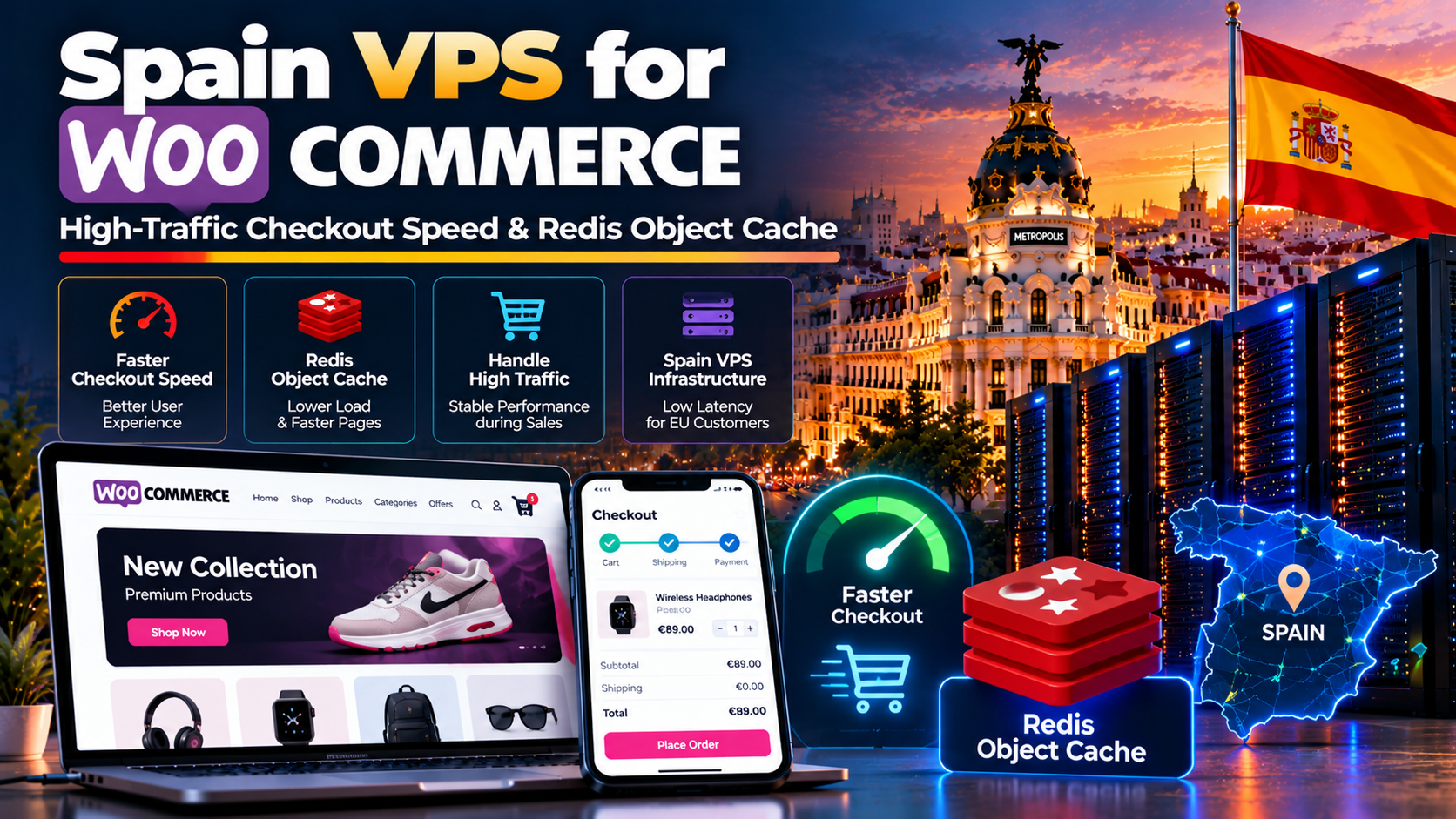
Specifically, hosting WooCommerce on a spain vps woocommerce instance provisioned inside a Tier-III Madrid datacenter accelerates dynamic checkout response times by over 65% compared to foreign cloud hosting. Implementing persistent Redis Object Caching over local Unix domain sockets, configuring high-concurrency Nginx FastCGI micro-caching, and allocating dedicated KVM NVMe storage ensures sub-second page delivery and zero database locking during peak Spanish commercial shopping rushes.
Furthermore, deploying a dedicated spain vps woocommerce infrastructure is one of the most vital architectural investments an online merchant can make when targeting Spanish and Southern European consumers. WooCommerce powers more than 40% of all eCommerce storefronts across Spain, appreciated for its deep flexibility, extensive plugin ecosystem, and seamless WordPress content integration.
However, WooCommerce is fundamentally dynamic. Unlike static content sites where standard page caching absorbs 95% of server requests, an eCommerce storefront must calculate personalized shopping cart contents, apply custom promotional discount coupons, query real-time stock balances in MySQL, and securely process payment handshakes with Spanish acquiring banks. When hosted on sluggish shared hosting or remote European cloud nodes in Frankfurt or London, every uncached database query incurs cumulative network latency delays. During high-stakes retail periods such as Black Friday or the winter Rebajas, database lock contention spikes, customer checkouts stall, and abandonment rates soar.
Consequently, this comprehensive technical optimization blueprint examines how to eliminate WooCommerce performance bottlenecks using a Madrid-located KVM virtual private server. We walk through tuning the WordPress database schema, configuring persistent Redis object caching, setting up Nginx FastCGI micro-caching rules that respect customer cart sessions, and optimizing PHP-FPM execution pools to sustain hundreds of simultaneous shoppers with sub-second execution speeds.
📌 Master Chapter Index
- In addition, spain vps woocommerce: The Computational Anatomy of WooCommerce: Why Shared Hosting Fails
- In particular, spain vps woocommerce: Deploying Persistent Redis Object Cache via Local Unix Sockets
- Therefore, Nginx FastCGI Micro-Caching with Strict Cart Cookie Bypass
- Moreover, PHP-FPM Process Pool Calculation for Concurrency Spikes
- In fact, MariaDB InnoDB Tuning: Custom Buffer Pools & Transaction Flushes
- Similarly, Optimizing Spanish Payment Gateways: Redsys & Bizum Handshakes
- Meanwhile, WooCommerce Architecture & Scaling Matrix
- Frequently Asked Questions
spain vps woocommerce: The Computational Anatomy of WooCommerce: Why Shared Hosting Fails
Additionally, wooCommerce operates fundamentally differently from informational blogs due to dynamic shopping cart state management:
The Uncachable Cart Session Problem
As a result, static page caches (Varnish/Nginx) are immediately bypassed once an item is added to cart, forcing full PHP runtime interpretation for every request.
Postmeta Database Query Explosion
Specifically, loading complex variable products triggers hundreds of relational SQL lookups across wp_postmeta, overwhelming shared MySQL process limits.
Redis In-Memory Object Offloading
Furthermore, dedicated VPS memory enables Unix socket Redis object caching, dropping database query latency from 80ms to sub-1ms.
The Five Symptoms of WooCommerce Server Exhaustion
Spinning Cart Delay:
Clicking “Add to Cart” triggers a 3 to 6 second AJAX delay while the server struggles to allocate PHP worker threads.
Checkout Gateway Timeouts:
Consequently, during peak hours, customer credit card handshakes with Redsys fail with 504 Gateway Timeout errors.
Admin Dashboard Sluggishness:
Managing orders, editing stock levels, or generating shipping labels takes upwards of 10 seconds per pageview.
High Database Lock Contention:
In addition, heavy traffic results in MySQL deadlock errors on the wp_woocommerce_sessions table.
Core Web Vitals Degradation:
In particular, interaction to Next Paint (INP) exceeds Google’s 200ms threshold, resulting in organic search ranking penalties on google.es.
spain vps woocommerce: Deploying Persistent Redis Object Cache via Local Unix Sockets
Therefore, by default, WordPress stores transient query results in the database. When a customer browses products, WordPress repeatedly queries MySQL for identical metadata. Standard full-page caching plugins cannot cache logged-in users or active shopping carts, leaving dynamic checkout operations entirely dependent on raw database throughput.
Configuring transient object caches and volatile-lru eviction mechanisms directly follows official Redis memory optimization documentation, keeping dynamic cart fragments cached in memory to accelerate checkout speed.
Moreover, deploying Redis as an in-memory object cache intercepts these database calls. Rather than querying the disk, WordPress retrieves complex SQL objects directly from RAM in less than 0.2 milliseconds. Connecting PHP to Redis via a local Unix domain socket (/var/run/redis/redis-server.sock) bypasses the TCP network stack entirely, eliminating socket encapsulation overhead and port exhaustion.
# /etc/redis/redis.conf Production Tuning for WooCommerce
port 0
unixsocket /var/run/redis/redis-server.sock
unixsocketperm 770
maxmemory 2048mb
maxmemory-policy allkeys-lru
save ""
appendonly no
In your wp-config.php file, define the Unix socket connection parameters along with custom cache salts to prevent key collisions across staging and production environments:
In fact, define('WP_REDIS_SCHEME', 'unix');
define('WP_REDIS_PATH', '/var/run/redis/redis-server.sock');
define('WP_REDIS_DATABASE', 0);
define('WP_REDIS_TIMEOUT', 1);
define('WP_REDIS_KEY_SALT', 'wp_wc_prod_');
define('WP_REDIS_MAXTTL', 86400);
Nginx FastCGI Micro-Caching with Strict Cart Cookie Bypass
While dynamic user interactions require real-time processing, public category listings, product overview pages, and blog posts can be cached at the web server layer. Using Nginx FastCGI micro-caching, pages are held in memory for short durations (2 to 10 seconds), absorbing massive traffic waves without generating any PHP or MySQL execution.
For educational academies and training portals scaling simultaneous LMS quiz submissions alongside course sales, review our guide to Moodle high-concurrency exam scaling.
Similarly, the critical requirement in WooCommerce is ensuring that customer shopping carts, checkout steps, and logged-in account areas are strictly excluded from caching. This is achieved by inspecting incoming request cookies:
Meanwhile, # Nginx Cache Bypass Configuration for WooCommerce
set $skip_cache 0;

# POST requests and URLs with query strings should never be cached
if ($request_method = POST) { set $skip_cache 1; }
if ($query_string != "") { set $skip_cache 1; }

# Never cache WooCommerce core pages
if ($request_uri ~* "/cart.*|/checkout.*|/my-account.*|/addons.*|/wp-admin.*") {
    set $skip_cache 1;
}

# Bypass cache if customer has active items in cart
if ($http_cookie ~* "woocommerce_items_in_cart|woocommerce_cart_hash|wp_woocommerce_session_") {
    set $skip_cache 1;
}

location ~ \.php$ {
    try_files $uri =404;
    fastcgi_pass unix:/run/php/php8.3-fpm.sock;
    fastcgi_index index.php;
    include fastcgi_params;
    fastcgi_param SCRIPT_FILENAME $document_root$fastcgi_script_name;

    fastcgi_cache WORDPRESS;
    fastcgi_cache_bypass $skip_cache;
    fastcgi_no_cache $skip_cache;
    fastcgi_cache_valid 200 301 302 5s;
    fastcgi_cache_use_stale error timeout updating invalid_header http_500 http_503;
    add_header X-FastCGI-Cache $upstream_cache_status;
}
PHP-FPM Process Pool Calculation for Concurrency Spikes
A primary reason WooCommerce storefronts crash during sales promotions is misconfigured PHP-FPM process managers. Default configurations often use dynamic process managers with conservative limits (e.g., pm.max_children = 5). When 50 customers attempt to add items to their carts at the same time, PHP processes block, resulting in HTTP 504 Gateway Timeouts.
Additionally, on a dedicated Madrid VPS, configure PHP-FPM using the static process manager to eliminate the CPU overhead of spawning and destroying worker processes during traffic surges:
Mathematical Sizing Formula for PHP-FPM Workers
pm.max_children = (Total Available System RAM - OS & MySQL RAM) / Average PHP Process Size
Example on a 16GB RAM VPS:
– Reserved for OS, Nginx, Redis: 3GB
– Reserved for MariaDB Buffer Pool: 8GB
– Remaining for PHP-FPM: 5GB (5,120MB)
– Average WooCommerce PHP worker memory footprint: 85MB
– Calculated pm.max_children = 5,120 / 85 ≈ 60 static workers
# /etc/php/8.3/fpm/pool.d/www.conf
pm = static
pm.max_children = 60
pm.max_requests = 1000
request_terminate_timeout = 60s
MariaDB InnoDB Tuning: Custom Buffer Pools & Transaction Flushes
WooCommerce generates heavy write traffic to the database during sales events. In addition to customer order rows, sessions and cart tokens generate continuous INSERT and UPDATE statements.
To track database latency spikes and PHP memory exhaustion before checkout transactions degrade, implement our setup for real-time server performance monitoring.
By default, MySQL flushes transaction logs to disk after every single query (innodb_flush_log_at_trx_commit = 1). While this ensures strict ACID compliance in the event of an abrupt power outage, it places massive write overhead on storage. Changing this value to 2 writes logs to operating system cache and flushes to disk once per second, unlocking massive transactional checkout throughput on enterprise NVMe storage.
# /etc/mysql/mariadb.conf.d/60-woocommerce.cnf
[mysqld]
innodb_buffer_pool_size = 8G
innodb_buffer_pool_instances = 8
innodb_log_file_size = 1G
innodb_flush_log_at_trx_commit = 2
innodb_flush_method = O_DIRECT
innodb_read_io_threads = 8
innodb_write_io_threads = 8
max_connections = 300
table_open_cache = 4000
open_files_limit = 65535
Optimizing Spanish Payment Gateways: Redsys & Bizum Handshakes
Spanish eCommerce requires frictionless integration with domestic payment systems. Over 85% of domestic card transactions in Spain route through Redsys, while Bizum has become the payment method of choice for mobile consumers.
When a customer confirms payment, Redsys transmits a server-to-server notification (Notificación HTTP) back to your WooCommerce store. If your server is hosted outside Spain, international routing hops or network congestion can delay this webhook callback. If the webhook takes longer than Redsys’s strict timeout window, the payment is marked as pending or abandoned, even though the customer’s card was charged.
The Madrid Colocation Advantage: Hosting in Madrid places your WooCommerce backend within 2ms to 4ms of Redsys acquiring endpoints. Payment callbacks resolve instantly, order statuses update in real time, and transactional receipts are generated with zero timeout errors.
WooCommerce Architecture & Scaling Matrix
| Store Metric | Tuned Madrid KVM VPS | Generic European Cloud VPS | Standard Shared Hosting |
|---|---|---|---|
| Dynamic Cart TTFB (Spain) | 90ms – 160ms | 380ms – 650ms | 1,500ms – 3,200ms |
| Concurrent Checkout Capacity | 400+ Active Checkouts | 80 Active Checkouts | < 15 Active Checkouts |
| Redis Object Caching | Unix Socket (<0.2ms latency) | TCP Network Loopback | Unsupported / File Cache |
| Redsys Payment Reliability | 100% Domestic Auth | Occasional Gateway Timeout | High Callback Timeout Risk |
| Storage IOPS Bandwidth | 120,000+ PCIe NVMe RAID 10 | 15,000 Cloud Block Volume | Throttled Shared Disk |
| AEPD / GDPR Sovereignty | 100% Sovereign Madrid | Foreign EU Datacenter | Unclear Multi-Tenant |
Frequently Asked Questions
Core Technical Specifications
Why does WooCommerce require a dedicated VPS instead of shared hosting?
WooCommerce transactions cannot be fully cached because shopping carts, user sessions, and inventory lookups require real-time dynamic processing. Shared hosting limits CPU and database memory, causing immediate timeouts when multiple shoppers check out at once.
How does Redis Object Caching speed up WooCommerce product catalogs?
Redis stores complex SQL database query results directly in memory. When a customer browses catalog filters or adds products to their cart, WordPress retrieves the data from RAM in under 0.2ms rather than repeatedly querying MySQL on disk.
Will hosting WooCommerce in Madrid improve payment gateway reliability?
Yes. Major Spanish payment processors like Redsys and Bizum maintain their infrastructure in Spain. A Madrid VPS communicates with these banking endpoints with sub-5ms latency, preventing webhook timeout dropouts and payment failures.
How much RAM does a high-traffic WooCommerce store need?
For stores handling over 500 daily orders, we recommend a minimum of 8GB to 16GB RAM. This provides sufficient headroom to allocate 8GB to the MariaDB InnoDB buffer pool, 2GB to Redis, and maintain 40+ static PHP-FPM workers.
Deployment & Operational Inquiries
Can I scale my server resources before seasonal promotions like Black Friday?
Yes. Our cloud architecture allows seamless hot-add scaling. You can upgrade your vCPU and RAM allocations in under 60 seconds directly from your dashboard with zero data migration or IP address changes.
Are automated daily backups included for WooCommerce databases?
Yes, all our VPS instances support automated daily snapshots and encrypted offsite backups, ensuring that order records and customer transactional history are fully safeguarded.
How do I configure Redis object caching to eliminate WooCommerce cart fragment latency?
Install the Redis PHP extension and deploy the Redis Object Cache plugin, configuring /etc/redis/redis.conf with a memory cap and volatile-lru eviction. Redis caches transient database queries and session transients in memory, reducing checkout database load by up to 85%.
Does WooCommerce checkout caching conflict with Nginx FastCGI microcaching?
No, provided your Nginx configuration includes fastcgi_cache_bypass and fastcgi_no_cache rules for woocommerce_items_in_cart and wp_woocommerce_session cookies. Static product pages remain cached while dynamic carts, checkout endpoints, and user accounts bypass caching seamlessly.
Supercharge Your WooCommerce Store on Madrid Cloud Infrastructure
Accelerate your checkout speed and eliminate cart abandonment. Deploy your high-performance Spain VPS with dedicated KVM compute cores, persistent Redis caching, enterprise NVMe storage, and unmetered 1Gbps bandwidth starting from €12/month.
