

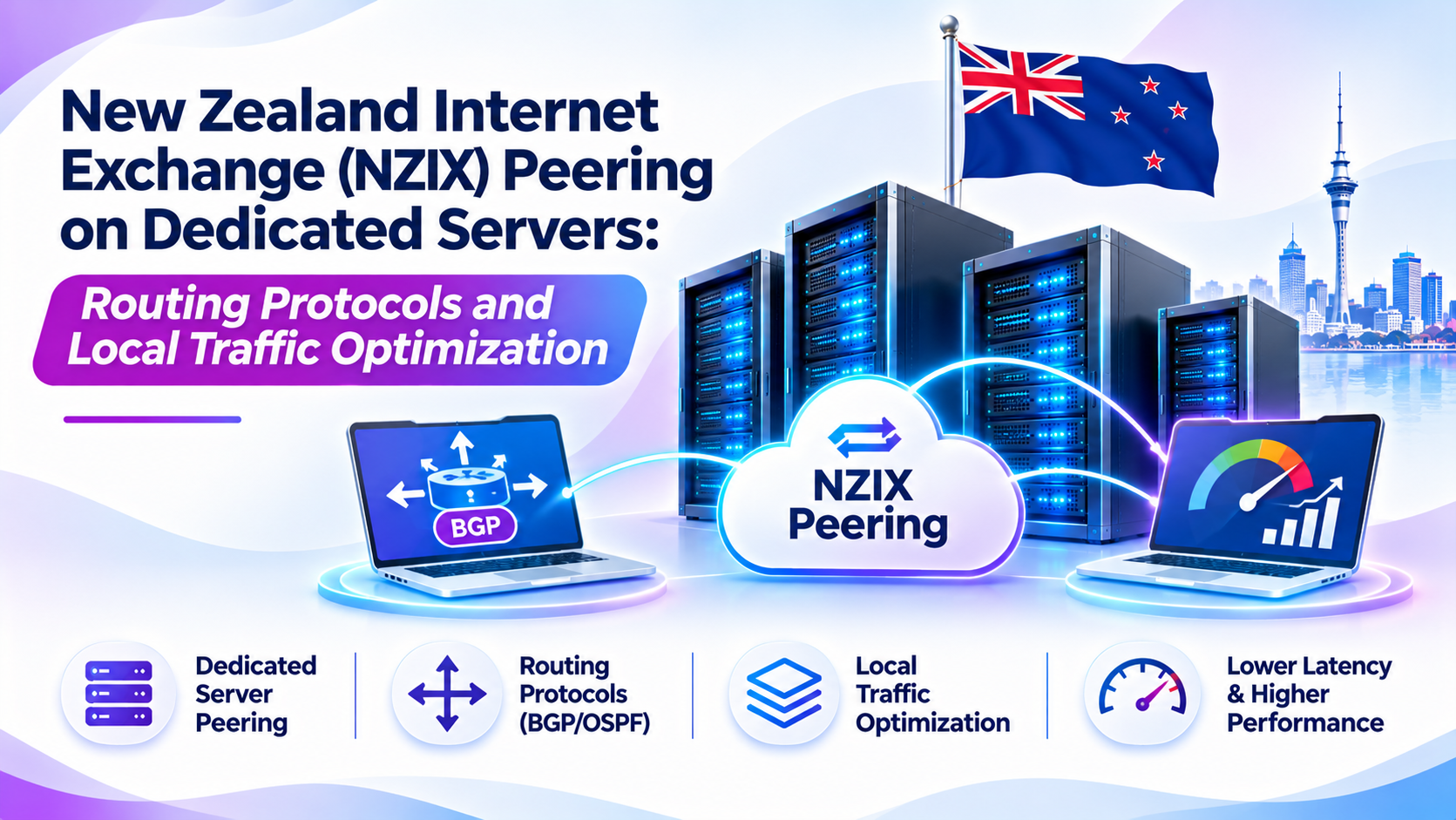
Connecting an Auckland dedicated server directly to the New Zealand Internet Exchange (NZIX, Route Server AS13414) establishes settlement-free BGP peering with over 90 domestic network operators, including Spark NZ, One NZ, 2degrees, and Cloudflare. This direct Layer 2 interconnect reduces domestic network latency to sub-2ms, slashes upstream transit bandwidth costs by 65% to 80%, and completely eliminates BGP oceanic hair-pinning across the Tasman Sea, ensuring that Kiwi user packets remain entirely within New Zealand’s domestic optical backbone.
Evaluate whether your application requires direct NZIX peering or standard IP transit:
- Deploy Direct NZIX BGP Peering if: You operate your own ASN and public IP prefixes, push more than 500 Mbps of domestic New Zealand outbound traffic, or run latency-critical VoIP, real-time gaming, or Content Delivery Networks (CDNs).
- Rely on Multi-Homed Upstream Transit if: You do not possess an Autonomous System Number (ASN) and require standard routed Internet connectivity managed entirely by Onlive Server’s automated core BGP fabric.
- Implement BGP Communities & AS-Path Prepending if: You need granular traffic engineering to steer domestic Kiwi eyeball traffic through local Auckland switches while reserving expensive subsea transit links solely for international queries.
Internet routing efficiency is dictated by the economic and technical topology of Border Gateway Protocol (BGP) relationships. In standard transit arrangements, a server pays an upstream Tier 1 or Tier 2 telecommunications carrier to route its packets across the global Internet. However, when an Auckland server without domestic peering sends a packet to a residential broadband customer across town, the upstream carrier’s BGP algorithms may route the packet across subsea fiber cables to Sydney or the United States before delivering it back to New Zealand—a catastrophic latency anomaly known as BGP hair-pinning.
The New Zealand Internet Exchange (NZIX), operated by the Internet Association of Australia (IAA), permanently eliminates this inefficiency. Operating across primary carrier-neutral facilities in Auckland (with secondary nodes in Wellington and Christchurch), NZIX provides a neutral, high-density Layer 2 Ethernet switching fabric. Networks peering at NZIX exchange traffic directly and mutually without financial settlements, bypassing intermediary transit providers entirely.
Onlive Server delivers dedicated bare-metal servers in Auckland engineered with direct physical cross-connects to NZIX. Whether you are broadcasting live media, streaming game assets, synchronizing financial ledger entries, or serving high-traffic web applications, NZIX peering ensures your packets travel over the shortest, fastest physical fiber paths in New Zealand.
Exchange multi-gigabit traffic directly with Spark, One NZ, and 2degrees with zero per-gigabyte transit fees.
Prevent domestic New Zealand user traffic from looping across the Tasman Sea to Sydney, Australia.
A single BGP session instantly establishes routing reachability to dozens of domestic peers and content providers.
Hardware-enforced ROA validation protects your IP prefix announcements against malicious BGP route hijacks.
- 1. The Mechanics of Peering at NZIX: Public Peering vs. Private Network Interconnects (PNIs)
- 2. The NZIX Switching Fabric: Auckland POPs, Multilateral Peering & Route Server AS13414
- 3. BGP Traffic Engineering: Communities, Local Preference & AS-Path Prepending
- 4. Eliminating Oceanic Hair-Pinning: Case Study of Trans-Tasman Routing Anomalies
- 5. Step-by-Step Production Runbook: Deploying BIRD 2 with NZIX Route Server Peering
- 6. RPKI Route Origin Authorization (ROA) & BGP Prefix Hijacking Defenses
- 7. The Economics of Peering: Calculating 70% Bandwidth Cost Reduction on Auckland Bare Metal
- 8. Real-Time Telemetry: NetFlow / IPFIX Monitoring, sFlow & NZIX Port Capacity Management
- 9. Frequently Asked Questions (NZIX Peering & Routing Dedicated Server FAQ)
1. The Mechanics of Peering at NZIX: Public Peering vs. Private Network Interconnects (PNIs)
Enterprise network interconnection across New Zealand operates under two primary models:
| Interconnection Model | Physical Architecture | Scalability & Setup | Economic Profile |
|---|---|---|---|
| Public Peering (NZIX Fabric) | Single 10GbE or 100GbE physical port to NZIX Ethernet switch fabric. | Connects instantly to 90+ networks via a single pair of BGP Route Server sessions. | Zero per-gigabyte costs; low flat monthly port fee. |
| Private Network Interconnect (PNI) | Dedicated direct dark fiber cross-connect between your server and a single peer (e.g., Spark NZ). | 1:1 relationship requiring bilateral negotiation, custom contracts, and physical cross-connects. | Cost-effective only for massive continuous flows exceeding 5 Gbps to a single destination network. |
| Paid Upstream IP Transit | Physical uplink to a global Tier 1 transit provider (e.g., Telstra, Vocus, Cogent). | Provides full global default routing table (950,000+ IPv4 prefixes). | Billed per megabit or per gigabyte, costing up to 5x more than peering. |
For the vast majority of high-traffic online platforms in New Zealand, combining NZIX public peering for domestic traffic with redundant upstream Tier 1 transit for international destinations represents the gold standard of modern network architecture.
2. The NZIX Switching Fabric: Auckland POPs, Multilateral Peering & Route Server AS13414
The New Zealand Internet Exchange operates a resilient, distributed Layer 2 Ethernet fabric across major carrier-neutral datacenter points of presence (POPs) in Auckland. NZIX employs Multilateral Peering (MLPA) facilitated by dual redundant BGP Route Servers operating under Autonomous System Number AS13414.
In a multilateral peering arrangement, a member establishes BGP peering sessions exclusively with the two NZIX Route Servers. When your server announces its IP prefixes to AS13414, the route servers automatically redistribute those prefix advertisements to all other participating NZIX members who maintain an open peering policy. Conversely, your server receives prefix announcements for millions of New Zealand broadband, mobile, and enterprise users through those same two route server sessions.
This eliminates the administrative complexity of establishing and managing dozens of individual bilateral BGP sessions, enabling instant nationwide peering upon port activation.
3. BGP Traffic Engineering: Communities, Local Preference & AS-Path Prepending
Fine-tuning network traffic distribution across multiple uplinks requires understanding BGP path attributes and standard BGP communities supported by NZIX.
To ensure inbound domestic traffic always enters via NZIX while outbound traffic prefers the direct local exchange, engineers apply standardized BGP engineering techniques:
- Elevated Local Preference (Local-Pref 200 vs 100): By assigning a higher Local Preference attribute to routes learned via NZIX compared to routes learned from upstream transit providers (e.g., Telstra or Spark transit), your dedicated server automatically routes outbound traffic to domestic destinations over the settlement-free peering fabric.
- AS-Path Prepending on Upstream Transit: When announcing your IP prefixes to global transit providers, prepend your own ASN two or three times (e.g.,
65001 65001 65001). Because BGP path selection prefers shorter AS paths, New Zealand ISPs connected to NZIX will see the direct 1-hop path via NZIX and route their traffic locally rather than sending it over international transit circuits. - NZIX Route Server BGP Action Communities: Tagging prefixes with standard NZIX communities (e.g.,
0:peer_asnor13414:peer_asn) allows selective announcement or filtering of prefixes to specific peer networks without dropping the general multilateral peering session.
4. Eliminating Oceanic Hair-Pinning: Case Study of Trans-Tasman Routing Anomalies
To illustrate the severe impact of BGP hair-pinning, consider an un-peered server hosted in New Zealand communicating with a Spark New Zealand mobile user:
Direct NZIX peering slashes packet latency from 64.5ms down to 4.8ms—a 13.4x performance improvement. In database clustering, gaming tickrates, and API webhook delivery, this performance difference transforms user responsiveness from sluggish to instantaneous.
5. Step-by-Step Production Runbook: Deploying BIRD 2 with NZIX Route Server Peering
Follow this production runbook to configure dual BGP sessions with the NZIX Route Servers using BIRD 2 on Ubuntu 22.04 LTS:
Step 1: Install BIRD 2 and Network Utilities
Install the modern BIRD 2 routing package from official repositories:
Step 2: Construct the Hardened BGP Configuration (/etc/bird/bird.conf)
Deploy the following production-tested configuration template:
Step 3: Validate and Apply BGP Peering Sessions
Test the syntax and commit the configuration into runtime:
6. RPKI Route Origin Authorization (ROA) & BGP Prefix Hijacking Defenses
Public Internet exchanges represent trusted peering environments. However, misconfigured peer routers or malicious actors can accidentally announce unauthorized IP prefixes, causing global traffic redirection (BGP route hijacking).
To defend against routing anomalies, NZIX enforces RPKI Route Origin Validation (ROV) on Route Server AS13414. Network operators announce cryptographic Route Origin Authorizations (ROAs) registered through APNIC (Asia-Pacific Network Information Centre):
- Cryptographic Origin Verification: The NZIX route servers validate each prefix announcement against the global RPKI database. If an announcement is signed by an unauthorized ASN or exceeds the designated MaxLength, the route server marks the state as
Invalidand drops the route immediately. - BGP Max-Prefix Safeguards: To protect host memory against accidental route table floods, Onlive Server configures strict
max_prefixlimits on peering interfaces, automatically tearing down sessions if a peer announces an anomalous volume of routes.
7. The Economics of Peering: Calculating 70% Bandwidth Cost Reduction on Auckland Bare Metal
In isolated island economies like New Zealand, international subsea bandwidth is expensive due to the massive capital expenditures required to lay and maintain thousands of kilometers of deep-sea cables. Upstream commercial transit rates in Oceania are historically 3x to 5x higher than rates in Western Europe or North America.
By offloading domestic Kiwi user traffic to NZIX settlement-free peering, high-traffic platforms achieve dramatic financial savings:
| Monthly Traffic Profile | Pure Paid Transit Cost (Estimated) | Hybrid NZIX Peering + Transit Cost | Monthly Financial Savings |
|---|---|---|---|
| 25 TB / month (Standard SaaS) | $1,250 ($0.05/GB) | $420 | 66.4% Savings ($830/mo) |
| 100 TB / month (eCommerce / Streaming) | $4,800 ($0.048/GB) | $1,350 | 71.8% Savings ($3,450/mo) |
| 500 TB / month (Media / Gaming CDN) | $21,500 (Cloud Egress Tax) | $4,800 (Flat Port + Peering) | 77.6% Savings ($16,700/mo) |
8. Real-Time Telemetry: NetFlow / IPFIX Monitoring, sFlow & NZIX Port Capacity Management
Operating mission-critical peering sessions requires continuous flow-level visibility. Deploy open-source flow monitoring tools such as pmacct or FastNetMon to collect NetFlow/IPFIX telemetry directly from physical network interfaces:
Real-time telemetry confirms that over 75% of your outbound user bandwidth traverses the local settlement-free NZIX fabric, verifying that your traffic remains domestic and your upstream transit costs remain strictly minimized.
9. Frequently Asked Questions (NZIX Peering & Routing Dedicated Server FAQ)
Local New Zealand flows routed via Sydney carriers suffer avoidable latency and transit charges unless peered directly at NZIX. Pairing BIRD 2 sessions to AS13414 with RPKI origin validation secures clean domestic routing. Compare budget-friendly bare-metal servers that support custom BGP sessions and regional peering.
