

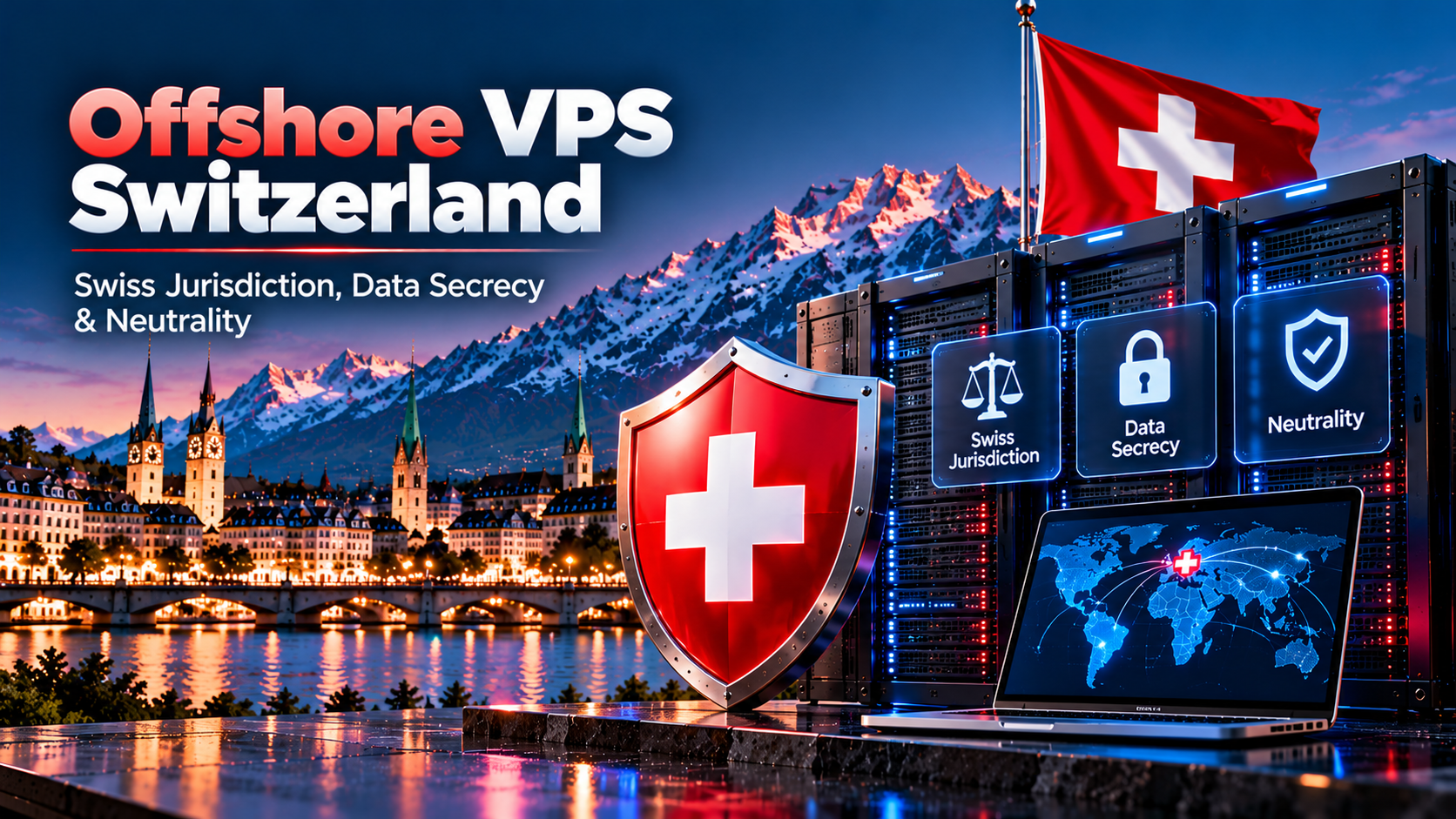
An offshore VPS in Switzerland provides unparalleled digital sovereignty anchored in Swiss constitutional neutrality and rigorous statutory privacy protections. Because Switzerland is outside the European Union and immune to the extraterritorial reach of the US CLOUD Act, data hosted on Swiss servers cannot be seized or inspected through foreign administrative subpoenas, ensuring complete immunity against warrantless international surveillance.
In an era of expanding global surveillance pacts, extraterritorial legal overreach, and warrantless cloud subpoenas, corporate data privacy has shifted from a secondary IT preference to an existential risk management priority. Organizations worldwide—ranging from fintech disruptors and legal firms to investigative journals and sovereign asset managers—are actively seeking jurisdictions where digital property rights are respected and legally inviolable. While traditional offshore tax havens frequently suffer from unstable power grids, poor network connectivity, and international banking blacklists, Switzerland offers a unique synthesis of non-aligned sovereignty, constitutional stability, and world-class Tier III telecommunications infrastructure. Choosing an Swiss offshore VPS hosting solution located in Zurich allows global businesses to insulate confidential databases, intellectual property, and communication archives from foreign jurisdiction snooping. Anchored by the Federal Constitution of the Swiss Confederation and fortified by Swiss revDSG compliance standards, Switzerland represents the gold standard for global data hosting. For enterprises exploring sovereign transactions, you can also buy Swiss VPS with Bitcoin and crypto to preserve end-to-end privacy. This technical analysis investigates Swiss legal protections, immunity from foreign search warrants, Zurich bunker datacenter security, and practical server hardening runbooks.
Key Technical Takeaways
- Constitutional Privacy Mandate: Article 13 of the Swiss Federal Constitution legally guarantees the right of every person to privacy in their personal correspondence and telecommunications.
- Immunity from US CLOUD Act: Operating entirely outside US jurisdiction, independent Swiss hosting providers cannot be compelled by American CLOUD Act warrants to surrender client data without Swiss court approval.
- Non-EU Sovereign Neutrality: Switzerland maintains total independence from EU surveillance directives, GDPR cross-border transfer compromises, and European data-sharing agreements.
- Strict Mutual Legal Assistance Treaties (MLAT): Foreign law enforcement agencies must satisfy rigorous double-incrimination standards in Swiss courts before any server logs can be legally inspected.
- Physical Bunkers and Tier III Resilience: Zurich hosting facilities feature biometric multi-factor authentication, perimeter isolation, and EMP-shielded military-grade datacenter envelopes.
- The Legal Foundation of Swiss Data Sovereignty: Constitutional Protections
- Immunity from Foreign Jurisdictions: The US CLOUD Act and EU Directives
- Mutual Legal Assistance Treaties (MLAT) and the Dual-Criminality Principle
- Physical Datacenter Security: Zurich Cold War Bunkers and Tier III Standards
- Cryptographic Privacy Runbook: Full Disk LUKS Encryption on KVM VPS
- Offshore Hosting Jurisdiction Comparison: Switzerland vs. Iceland vs. Panama
- Zero-Knowledge Architecture: Ephemeral Logs, RAM Disks, and Forward Secrecy
- Frequently Asked Questions About Offshore VPS Switzerland
- Deploy a Sovereign Offshore Swiss VPS in Zurich Today
The Legal Foundation of Swiss Data Sovereignty: Constitutional Protections
In addition, data protection in Switzerland is not merely an administrative policy; it is an entrenched constitutional right. Under Article 13 of the Federal Constitution of the Swiss Confederation, every individual possesses an inalienable right to privacy in their private and family life, home, and telecommunications.
Unlike many common-law jurisdictions where government agencies can issue administrative subpoenas or secret National Security Letters (NSLs) without judicial oversight, Swiss federal law strictly prohibits warrantless state surveillance.
When data is physically stored on solid-state drives located within Swiss borders, it is governed exclusively by Swiss law. A hosting provider that surrenders client data, access credentials, or cryptographic keys to any third party—including domestic intelligence services or foreign governments—without a formal judicial warrant approved by a Swiss federal judge commits a criminal offense under the Swiss Penal Code.
Immunity from Foreign Jurisdictions: The US CLOUD Act and EU Directives
In particular, the passage of the United States Clarifying Lawful Overseas Use of Data (CLOUD) Act in 2018 fundamentally altered global cloud security. The CLOUD Act grants US federal law enforcement the legal authority to compel American technology companies (including Amazon Web Services, Microsoft Azure, and Google Cloud) to disclose customer data stored on their servers—regardless of whether those physical servers are located in Germany, France, Ireland, or Japan.
The Hyperscale Cloud Vulnerability
Therefore, if an organization hosts sensitive commercial records on an AWS or Azure datacenter in Frankfurt or Dublin, the US government can serve a subpoena to the American parent corporation in Seattle or Redmond. The parent company must legally comply, completely bypassing European privacy protections.
The Sovereign Swiss Defense
Moreover, onliveServer is a completely independent, privately managed hosting provider operating within Switzerland. We maintain zero corporate parentage, subsidiaries, or legal entities within the United States. Consequently, US courts possess zero legal jurisdiction over our infrastructure. An American CLOUD Act order served on a foreign provider has zero legal standing in Zurich; foreign agents attempting to enforce foreign orders on Swiss territory commit an illegal act on behalf of a foreign state under Article 271 of the Swiss Criminal Code.
Mutual Legal Assistance Treaties (MLAT) and the Dual-Criminality Principle
In fact, for a foreign government or multinational law enforcement body (such as Interpol) to access server logs or data hosted in Switzerland, they must proceed through formal diplomatic channels via a Mutual Legal Assistance Treaty (MLAT).
Similarly, the MLAT process in Switzerland is governed by the strict principle of Dual Criminality:
Dual Criminality Requirement
Meanwhile, the alleged conduct under foreign investigation must constitute a severe criminal offense under both foreign law AND the Swiss Penal Code. Switzerland does not recognize foreign political crimes, speech infractions, intellectual property trolling, or civil litigation subpoenas as valid grounds for legal assistance.
Judicial Review and Right to Appeal
Additionally, even if a foreign request satisfies dual criminality thresholds, it must be submitted to the Swiss Federal Department of Justice and Police (FDJP) and reviewed by a cantonal judge. The server owner has the constitutional right to be notified and can appeal the decision through the Swiss Federal Supreme Court before any data disclosure occurs.
Physical Datacenter Security: Zurich Cold War Bunkers and Tier III Standards
As a result, legal sovereignty is ineffective if physical datacenter facilities are vulnerable to physical intrusion, espionage, or utility outages. OnliveServer houses Swiss VPS nodes inside specialized Tier III enterprise datacenters and decommissioned Swiss military alpine bunkers in the greater Zurich metropolitan area.
Biometric and Multi-Layer Perimeter Security
Access to physical host node corridors requires passing five discrete physical security checkpoints:
EMP and Environmental Hardening
Facilities built within reinforced subterranean bedrock provide complete electromagnetic pulse (EMP) shielding, seismic isolation dampeners, redundant N+1 UPS battery banks, and dual rotary diesel generators with 72-hour on-site fuel reserves, ensuring uninterruptible server availability.
Cryptographic Privacy Runbook: Full Disk LUKS Encryption on KVM VPS
To achieve a mathematically unbreachable privacy posture, technical architects should never rely solely on legal protections. Encrypting virtual disk volumes at the kernel level ensures that even if physical drives are stolen, raw data cannot be decrypted without your private passphrase.
The following runbook configures Linux Unified Key Setup (LUKS) using AES-XTS-256 full disk encryption inside your KVM virtual machine:
“`bash
# Initialize LUKS encrypted volume on secondary data block device
sudo cryptsetup luksFormat –type luks2 –cipher aes-xts-plain64 –key-size 512 –hash sha512 /dev/vdb
# Open the encrypted LUKS container
sudo cryptsetup luksOpen /dev/vdb secure_data
# Format the decrypted block device with ext4
sudo mkfs.ext4 -L secure_store /dev/mapper/secure_data
# Mount the encrypted volume to confidential directory
sudo mkdir -p /mnt/secure
sudo mount /dev/mapper/secure_data /mnt/secure
“`
By managing encryption keys client-side and unmounting volumes during idle periods, your data remains cryptographically impenetrable to all external parties.
Offshore Hosting Jurisdiction Comparison: Switzerland vs. Iceland vs. Panama
The following comparative evaluation assesses global offshore hosting jurisdictions across legal privacy, infrastructure reliability, and international compliance standing.
Switzerland stands apart as the only jurisdiction combining sovereign non-aligned privacy with world-class Tier III digital infrastructure and AAA-grade geopolitical stability.
Zero-Knowledge Architecture: Ephemeral Logs, RAM Disks, and Forward Secrecy
A hardened offshore server should be engineered to retain zero residual forensic evidence. Systems administrators can implement zero-knowledge logging policies directly in the Linux kernel:
Volatile RAM Disks for Temporary Files (
tmpfs) Mount volatile directories (such as /tmp and /var/run) entirely into physical RAM, ensuring all temporary records are instantly erased during a system reboot: “bash # Add volatile RAM disk mounts to /etc/fstab tmpfs /tmp tmpfs rw,noexec,nosuid,size=2G 0 0 tmpfs /var/log tmpfs rw,noexec,nosuid,size=1G 0 0 `
Disabling Persistent Systemd Journal Logs
Configure /etc/systemd/journald.conf to store logs purely in volatile memory rather than writing to non-volatile disk blocks: `ini [Journal] Storage=volatile RuntimeMaxUse=100M “ This operational architecture ensures that even in the unlikely event of physical node seizure, memory contents dissipate within milliseconds of power disconnect.
Frequently Asked Questions About Offshore VPS Switzerland
Deploy a Sovereign Offshore Swiss VPS in Zurich Today
Secure your digital assets under Swiss constitutional privacy. Deploy KVM compute in Zurich Tier III datacenters with total immunity from foreign subpoenas and warrantless surveillance.