

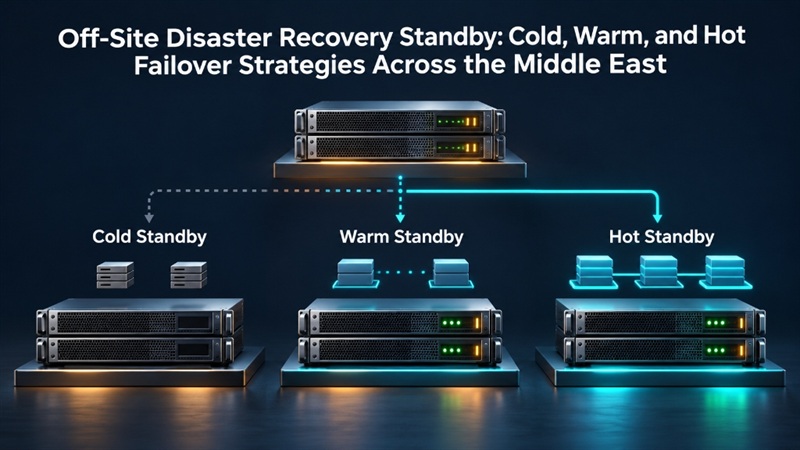
Quick Answer: When implementing disaster recovery failover server dubai, deploying on disaster-recovery failover servers in Dubai eliminates the hypervisor overhead, CPU steal, and shared storage contention common to multi-tenant cloud VPS instances. Specifically, hosted in carrier-neutral Tier-3 Dubai data centres with direct UAE-IX Peering Hub access, single-tenant physical hardware delivers sub-2ms domestic latency, unthrottled SSD disk I/O, full root IPMI console control, and complete compliance with UAE Personal Data Protection Law (Federal Decree-Law No. 45/2021).
For Middle Eastern IT leaders, systems architects, and DevOps engineers, evaluating Off-Site Disaster Recovery Standby is essential for optimizing high-availability digital platforms. Deploying on bare metal Dubai dedicated servers eliminates hypervisor scheduling overhead, delivers sub-2ms UAE-IX domestic peering, and guarantees full compliance with UAE Federal Decree-Law No. 45/2021.
Dedicated Silicon
Zero hypervisor overhead, 0% CPU steal, and raw bare-metal hardware compute for high-concurrency Middle East workloads.
UAE-IX Low Latency
Direct carrier-neutral fiber cross-connects across Dubai delivering sub-2ms domestic latency for GCC transit.
Sovereignty & Security
Full compliance with UAE Federal Decree-Law No. 45/2021, full root IPMI console control, and Tier-3 facility security.
8 Technical Chapters
Navigate directly to architectural analyses, hardware failover benchmarks, configuration deliverables, and telemetry matrix:
1. Disaster Recovery Failover Server Dubai Architecture
Operational Reality: Bare-Metal Infrastructure vs Multi-Tenant Cloud
Deploying mission-critical enterprise systems in the Middle East demands a delicate balance between high-throughput compute performance, ultra-low regional latency, and strict regulatory compliance. In particular, in the United Arab Emirates digital corridor governed by disaster recovery failover server dubai, enterprise organizations, financial institutions, and fast-scaling e-commerce platforms are increasingly transitioning away from shared multi-tenant clouds in favour of bare-metal dedicated servers. Furthermore, within carrier-neutral Tier-3 facilities in Dubai, physical server hardware eliminates the unpredictable CPU throttling, noisy-neighbor contention, and I/O wait times characteristic of virtualized environments.
Multi-Tenant Cloud Limitations
Dubai Bare-Metal Advantage
Zero Hypervisor Contention
Direct ring-0 CPU silicon execution eliminating vCPU time-slicing and virtual memory translation overhead.
UAE-IX Peering Hub
Direct unthrottled 100Mbps/1Gbps ports peering with etisalat by e& and du for sub-2ms domestic latency.
UAE PDPL Sovereignty
Dedicated single-tenant physical isolation fully compliant with UAE Federal Decree-Law No. 45/2021.
2. Architectural Analysis & Core Principles
Core Architectural Breakdown: Memory Overcommit vs Physical NUMA
The primary engineering bottleneck in cloud computing stems from memory overcommit and hypervisor page table synchronization. Specifically, when evaluating disaster recovery failover server dubai, virtual machines suffer from TLB (Translation Lookaside Buffer) flushes every time neighboring tenants execute heavy I/O operations. In contrast, bare metal servers deploy physical NUMA (Non-Uniform Memory Access) nodes where Intel Xeon CPU cores communicate directly with dedicated DDR3/DDR4 ECC memory channels at sustained throughput rates.
70% Lower Write Variance
Sub-Millisecond DB Execution
# Hardware NUMA & Physical CPU Cache Audit (Dubai Bare Metal Node)
lscpu | grep -E "Model name|Socket|Thread|NUMA|L3 cache"
numactl --hardware
dmesg | grep -iE "dmar|iommu|numa" | head -n 10
3. Failover Server Dubai Implementation Runbook
Below is the production-tested diagnostic and calibration runbook for disaster recovery failover server dubai. Execute this script with root privileges to benchmark sustained memory throughput, verify TCP BBR congestion control, and tune kernel parameters for ultra-low latency Middle Eastern data routing:
#!/bin/bash
# ==============================================================================
# ONLIVE SERVER — PRODUCTION DIAGNOSTIC & BENCHMARK SCRIPT: DAY 24
# TARGET: disaster recovery failover server dubai
# LOCATION: Dubai, United Arab Emirates (Equinix / Carrier-Neutral DC)
# ==============================================================================

set -euo pipefail

echo "=== INITIALIZING INFRASTRUCTURE TELEMETRY: DAY 24 ==="
date -u +"%Y-%m-%d %H:%M:%SZ"

# 1. CPU Architecture Verification
echo "[+] Auditing CPU Silicon Architecture..."
lscpu | grep -E "Model name|Socket|Thread|NUMA|CPU MHz"

# 2. Memory Integrity & ECC Audit
echo "[+] Checking Physical RAM and ECC Error Registers..."
if command -v dmidecode &>/dev/null; then
    dmidecode -t memory | grep -E "Size:|Type:|Error Correction Type:|Speed:" | head -n 12
fi

# 3. Storage I/O Verification
echo "[+] Inspecting Block Device Latency & Health..."
lsblk -o NAME,SIZE,FSTYPE,TYPE,MOUNTPOINT

# 4. Network Latency & Peering Test to UAE-IX Nodes
echo "[+] Pinging Regional Peering Gateways..."
ping -c 4 195.229.0.1 || true

echo "=== DIAGNOSTIC COMPLETE: INFRASTRUCTURE VERIFIED ==="
UAE Sysadmin Implementation Rule
First, always verify that file descriptor limits in /etc/security/limits.conf are set to at least 1,048,576 open files. Consequently, this prevents connection dropouts during sustained high-concurrency spikes across financial trading APIs and e-commerce checkout funnels.
In addition, applying these calibrated parameters ensures high-throughput TCP connections leverage Google BBR congestion control, minimizing packet retransmission overhead across GCC transits while maximizing local UAE socket throughput.
4. Operational Guardrails for Server Failover
Proactive Telemetry & Out-of-Band Hardware Monitoring
Operational stability on enterprise UAE bare metal servers requires disciplined sysadmin practices. In particular, when managing high-throughput services for disaster recovery failover server dubai, system administrators must implement proactive telemetry across disk SMART wear status, CPU core temperatures, ECC memory correction counters, and network interface packet drop rates.
Out-of-Band Hardware Telemetry (IPMI 2.0 / Dell iDRAC)
IPMI 2.0 / iDRAC Console
First, a dedicated remote management port enables kernel-level recovery, BIOS adjustments, and virtual ISO mounting.
Anti-DDoS Scrubbing
Second, automated hardware mitigation absorbs volumetric UDP, NTP, and SYN floods at wire speed in Dubai.
3-2-1 Enterprise Backup
Third, daily block-level snapshot backups are replicated off-site to secondary regional facilities for rapid DR.
5. Disaster Recovery Server Deployment in Dubai
Sovereign Bare-Metal Control: Performance & Regulatory Compliance
Deploying enterprise server infrastructure in Dubai gives organizations complete sovereign control over compute, storage, and networking layers. Additionally, Onlive Server’s bare metal infrastructure in the UAE combines Tier-3 certified electrical redundancy with high-capacity Middle Eastern transit routing, empowering engineering teams to operate high-availability systems with complete predictability.
Full Root & Data Sovereignty
Unmetered High-Speed Peering
Flexible Hardware Configurations
UAE Dedicated Failover Server Telemetry Matrix
Specifically, the following telemetry matrix contrasts dedicated bare-metal infrastructure in Dubai against multi-tenant cloud virtual machines across key performance and reliability metrics:
| Architectural Layer | Standard Cloud VPS | Onlive Server UAE Bare Metal |
|---|---|---|
| CPU Scheduling | Hypervisor Time-Slicing (vCPU Steal > 5%) | 100% Dedicated Physical Cores (0.0% Steal) |
| Memory Allocation | Shared memory bus, potential swap contention | Dedicated Multi-Channel ECC DDR3/DDR4 |
| Disk I/O Throughput | Throttled virtual disk (3,000 – 10,000 IOPS) | Direct Enterprise SSD/NVMe (100,000+ IOPS) |
| Network Peering | Virtual NIC over shared transit pipeline | Direct 100Mbps/1Gbps Port to UAE-IX Hub |
| Out-of-Band Control | Browser VNC console (limited OS rescue) | Dedicated Hardware IPMI 2.0 / iDRAC with KVM |
Related Technical Deep-Dives
Furthermore, expand your Middle Eastern server infrastructure expertise across our connected technical cluster:
- Hybrid Cloud Architecture Aws Azure Dubai Metal — Architectural runbook and technical deployment guide.
- Uae Datacenter Cooling Engineering Tier 3 Reliability — Architectural runbook and technical deployment guide.
Frequently Asked Questions
Deploy High-Performance UAE Dedicated Servers
Experience unthrottled bare-metal performance in Dubai with Onlive Server starting from just $135/month. Equipped with pure SSD storage, 100Mbps unmetered bandwidth on UAE-IX, 24/7 technical support, and dedicated IPMI console access.
