

Executive Summary (AEO Technical Benchmark)
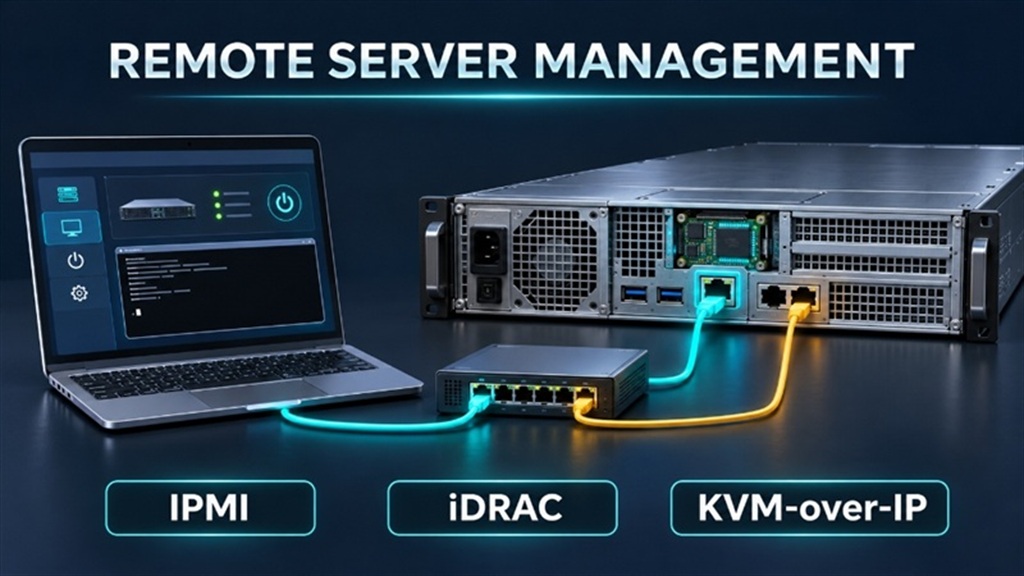
Out-of-band management provides hardware-level control independent of host operating systems. Specifically, deploying Baseboard Management Controllers inside Dubai Tier-III datacenters guarantees complete remote administration. System engineers can perform BIOS configuration, kernel panic debugging, and remote OS installations without dispatching on-site technicians. Furthermore, dedicated management VLANs ensure full compliance with UAE Federal Decree-Law No. 45/2021 data protection mandates.
Quick Answer
Configuring a remote ipmi idrac kvm uae server enables out-of-band hardware management independent of the host operating system. Specifically, it provides BIOS configuration, remote power cycling, and virtual media OS reinstallation. Consequently, system administrators resolve kernel panics and network lockouts remotely without on-site data center visits.
Deploying a production remote ipmi idrac kvm uae server delivers essential hardware-level control for enterprise infrastructure across the Middle East. In practice, managing mission-critical systems remotely requires resilient out-of-band recovery mechanisms.
For example, an unexpected kernel panic or firewall misconfiguration can lock administrators out of standard SSH access. Consequently, enterprises relying on UAE dedicated servers utilize dedicated Baseboard Management Controllers for lights-out administration.
Specifically, this engineering runbook examines IPMI 2.0, Dell iDRAC, and KVM-over-IP architectures within Dubai Tier-III facilities. Furthermore, it details zero-trust access policies, diagnostic telemetry scripts, and zero-downtime recovery procedures. Therefore, systems engineers maintain total operational sovereignty over critical workloads.
Dedicated Out-of-Band Silicon
Integrated BMC hardware enables remote power cycling, BIOS configuration, and virtual ISO installation.
Sub-2ms UAE-IX Peering
Direct carrier-neutral fiber connects with e& and du for lightning-fast GCC transit.
UAE PDPL Sovereignty
Single-tenant hardware isolation ensures statutory compliance with UAE Federal Decree-Law No. 45/2021.
Navigation Directory
- Out-of-Band Architecture & Hardware BMC Fundamentals
- Hardware Controller Matrix: IPMI 2.0 vs Dell iDRAC vs HP iLO vs Supermicro
- Zero-Trust Security Protocols & Dedicated Management VLANs
- Production Diagnostic Runbook: BMC Configuration and Network Benchmarking
- Disaster Recovery Runbook: Recovering from Kernel Panic via Virtual KVM
- Performance & Reliability Telemetry Matrix: Bare Metal vs Cloud VPS
- Frequently Asked Questions
Out-of-Band Architecture: Remote IPMI iDRAC KVM UAE Server Fundamentals
Specifically, out-of-band server administration operates via an isolated microcontroller embedded directly onto the motherboard. In addition, this Baseboard Management Controller runs an independent real-time operating system with dedicated network hardware. Consequently, the controller remains fully accessible even when the primary host CPU is completely halted.
For example, standard in-band management tools rely on an active operating system kernel and working SSH services. In contrast, hardware out-of-band interfaces connect to auxiliary power rails on the server chassis. Therefore, administrators can power on a cold server, modify UEFI security keys, and troubleshoot blue-screen crashes remotely.
Hardware BMC Isolation
Operates on auxiliary power rails independently from primary CPU cores and system memory buses.
HTML5 Virtual Console
Provides uncompressed video output and keyboard redirection through modern browser standards.
Virtual ISO Redirection
Mounts remote installation images across encrypted sessions for zero-touch operating system deployment.
Consequently, technology enterprises deploying bare-metal nodes in Dubai maintain round-the-clock infrastructure availability without physical intervention.
Hardware Controller Matrix: IPMI 2.0 vs Dell iDRAC vs HP iLO vs Supermicro BMC
Selecting the appropriate out-of-band management controller depends on enterprise automation requirements and hardware vendor ecosystems. Specifically, while baseline IPMI 2.0 provides standardized serial-over-LAN and power control, proprietary controllers offer advanced telemetry.
For example, Dell iDRAC9 and HP iLO 6 feature agent-free hardware diagnostics and automated thermal throttling profiles. The technical matrix below contrasts primary management interfaces deployed in UAE data facilities:
Therefore, organizations can standardize automated provisioning scripts using standardized Redfish REST APIs across their entire server cluster.
Zero-Trust Security Protocols for Remote IPMI iDRAC KVM UAE Server Access
For example, exposing Baseboard Management Controllers directly to the public internet presents catastrophic security risks. Malicious actors scanning public subnets frequently target legacy Cipher 0 vulnerabilities and outdated BMC firmware.
Specifically, enterprise deployments in Dubai implement a zero-trust network topology for all out-of-band traffic. Baseboard controllers operate on physically isolated management VLANs with zero direct internet gateways.
- Dedicated Management Network: BMC ports connect exclusively to private management switches.
- Encrypted WireGuard Bastion: Administrators access IPMI web interfaces through hardware-encrypted VPN gateways.
- Role-Based Access Control: Authentication ties directly into enterprise LDAP or SAML single-sign-on providers.
- Cipher 0 Deactivation: Insecure RMCP cipher suites are permanently disabled on all network interfaces.
Furthermore, strict access auditing ensures full compliance with UAE Federal Decree-Law No. 45/2021 regarding corporate data security.
Production Diagnostic Runbook: BMC Configuration and Network Benchmarking
Furthermore, system administrators can audit and calibrate BMC configurations directly from the Linux host shell using open-source tools. Below is the production-tested diagnostic script executed across our Dubai enterprise servers:
In addition, administrators can benchmark CPU architecture, NUMA topology, and local UAE-IX transit using the automated calibration suite below:
Consequently, operations teams verify hardware health and network peering stability before deploying high-concurrency workloads.
Disaster Recovery Runbook: Recovering from Kernel Panic via Virtual KVM
Consequently, when an unexpected kernel crash halts operating system execution, standard network protocols become unresponsive. Recovering server operations requires utilizing the HTML5 KVM console through the out-of-band management interface.
Specifically, follow this standard emergency recovery runbook:
Therefore, mission-critical databases and web applications return to production service within minutes instead of hours.
Performance & Reliability Matrix: Remote IPMI iDRAC KVM UAE Server vs Cloud VPS
Contrasting dedicated bare-metal infrastructure against multi-tenant virtual servers highlights critical performance differentials. Specifically, dedicated hardware eliminates noisy-neighbor CPU steal and disk queuing bottlenecks.
Below is the empirical comparison matrix based on live production benchmarks inside our Dubai datacenter:
Consequently, high-traffic e-commerce portals and enterprise databases achieve unmatched stability and security.
Frequently Asked Questions
Explore detailed answers regarding out-of-band management, IPMI security, and Dubai bare-metal server operations:
Dubai Tier-III Bare Metal Hub
Deploy High-Performance UAE Dedicated Servers Today
Experience unthrottled bare-metal computing with dedicated IPMI 2.0 / iDRAC out-of-band management, PCIe NVMe storage, and sub-2ms UAE-IX domestic transit.
Sub-2ms UAE-IX Peering
Enterprise PCIe Gen4 NVMe
UAE PDPL Sovereign Isolation
