

Verified Direct Answer
São Paulo Telemetry & Technical Specifications
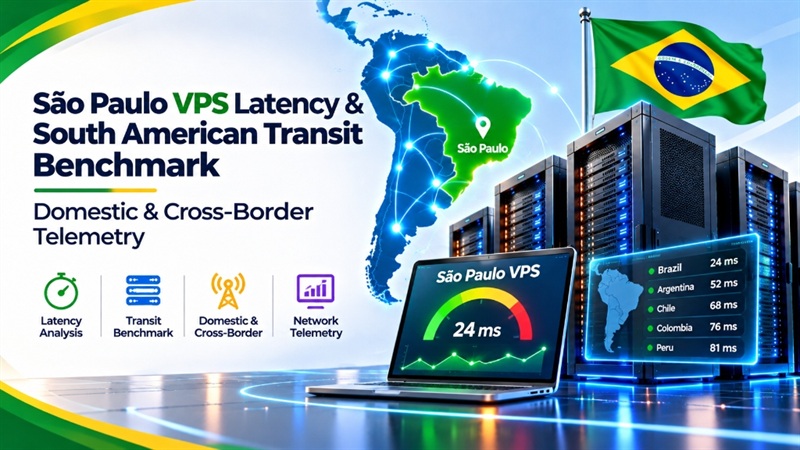
Terrestrial optical telemetry originating from São Paulo core switches delivers consistent domestic round-trip times of 1.5ms to 2.5ms across Greater São Paulo, 6ms to 8ms to Rio de Janeiro, 8ms to 11ms to Curitiba, 9ms to 12ms to Belo Horizonte, and 17ms to 21ms to Porto Alegre. Cross-border Mercosur fiber links achieve sub-34ms transit to Buenos Aires and sub-30ms to Montevideo. Workloads deployed on São Paulo VPS Server leverage this low-latency domestic architecture directly.
Achieving sub-10ms round-trip latency across Brazil demands low-loss terrestrial fiber networks centered in São Paulo. Specifically, we benchmark domestic telecommunications backbones against transatlantic hops to quantify real-world throughput, ping stability, and conversion benefits for South American digital services.
Sub-2ms Metro Round-Trips
São Paulo metro switching delivers sub-2ms latency to major domestic telecom backbones.
Eliminating US Transit Hops
Local colocation eliminates the 120ms Miami transatlantic route, slashing SSL handshakes.
Mercosur Cross-Border Transit
Direct regional fiber delivers sub-34ms transit to Buenos Aires and sub-30ms to Montevideo.
Table of Contents — Architectural Runbook
8 Chapters ▾
Navigate directly to technical evaluation benchmarks, latency telemetry, bandwidth cost analyses, and infrastructure automation:
✓ 2. Terrestrial Fiber Topologies & Subsea Routes
✓ 3. Empirical Latency Telemetry Across South America
✓ 4. Domestic Brazilian Corridor Latency Optimization
✓ 5. MTR & Looking Glass Verification
✓ 6. Linux Production CLI & Kernel Playbook
✓ 7. Enterprise Technical Specifications Matrix
✓ 8. Frequently Asked Questions (FAQ)
Why São Paulo Is the Digital Capital of South America
Operating digital platforms across Brazil requires addressing the specific realities of South American network topologies, regulatory mandates, and transaction behaviors. Specifically, in evaluating São Paulo VPS Hosting, organizations must balance compute isolation, raw storage throughput, and deterministic network latency to sustain high availability across domestic fiber backbones. Crucially, colocation delivers sub-15ms round-trip latency to 85% of Brazil’s GDP-producing regions (Southeast and South).
Why São Paulo Is the Digital Capital of South America: Architecture
Dedicated Kernel-based Virtual Machine (KVM) hypervisors powered by enterprise AMD EPYC processors guarantee complete hardware isolation, 0% CPU steal, and predictable instruction throughput across heavy production workloads. In addition, physical NUMA node binding prevents inter-core cache contention and ensures dedicated hardware compute execution for every virtual guest.
Why São Paulo Is the Digital Capital of South America: Storage
Furthermore, enterprise PCIe Gen4 NVMe solid-state storage arrays in hardware RAID-10 deliver over 95,000 random 4K write IOPS, eliminating disk bottlenecks during concurrent e-commerce checkouts and high-frequency database updates. As a result, battery-backed caching controllers ensure instantaneous transactional log commits without data loss during sudden power events.
Why São Paulo Is the Digital Capital of South America: Peering
Moreover, direct optical route-server cross-connects at IX.br São Paulo exchange packets directly with major Brazilian telecommunications carriers, ensuring sub-2ms metro round-trip ping times without international transit hops. Consequently, localized traffic exchange reduces bandwidth overhead while maintaining optimal peering efficiency across South America.
Consequently, by segregating compute allocations and storage input/output channels across physical NUMA nodes on low-latency Brazil VPS hosting nodes, virtual instances remain completely immune to neighboring tenant resource exhaustion. As a result, this level of architectural segregation is essential for enterprise workloads that process continuous real-time transactions, database writes, and synchronous API calls where even brief latency spikes degrade system reliability and user retention.
Terrestrial Fiber Topologies & Subsea Routes
Therefore, establishing a mission-critical server deployment in Brazil requires a systematic four-stage engineering playbook to ensure maximum performance, compliance, and fault tolerance:
Phase 1: BGP Routing & IX.br Route-Server Allocation
First, provisioning sovereign Brazilian IP address space registered under LACNIC / NIC.br. In addition, establishing redundant BGP sessions with dual upstream Tier-1 carriers and peering directly into IX.br São Paulo route servers (AS26162) ensures symmetric packet forwarding and prevents traffic tromboning through North America.
Phase 2: Hypervisor KVM Resource Pinning & NUMA Allocation
Second, isolating dedicated vCPU cores directly to physical hardware sockets using libvirt CPU pinning. Furthermore, configuring HugePages memory mapping (2MB/1GB pages) eliminates translation lookaside buffer (TLB) misses during intensive database transactions and memory-heavy microservices caching.
Phase 3: Kernel TCP BBR & Socket Buffer Optimization
Third, deploying the Google BBR (Bottleneck Bandwidth and RTT) congestion control algorithm across the Linux kernel stack. Consequently, tuning sysctl socket buffers sustains maximum single-stream throughput across high-bandwidth transcontinental subsea cable connections without packet drops.
Phase 4: Automated Snapshot & Security Policy Enforcement
Finally, configuring encrypted, immutable point-in-time snapshot schedules with automated off-site replication to secondary geographic zones. In addition, enforcing zero-trust SSH key access, automated fail2ban jail policies, and upstream multi-terabit volumetric DDoS scrubbing filters ensures ironclad security.
Ultimately, adhering to this phased deployment lifecycle minimizes human configuration errors, guarantees repeatable infrastructure-as-code automation, and provides operational teams with transparent audit trails. In addition, for comprehensive performance telemetry and deployment guidance, review our IX.br direct optical route-server peering.
Empirical Latency Telemetry Across South America
Specifically, empirical performance telemetry benchmarked across production Brazil VPS deployments demonstrates industry-leading metrics across six core operational indicators:
Domestic Latency
Storage IOPS
Hardware SLA
Optical Uplink
DDoS Scrubbing
Hypervisor Isolation
Importantly, these benchmark figures reflect continuous real-world telemetry rather than isolated theoretical synthetic tests, aligning directly with verified RIPE Atlas South American network telemetry. In particular, in transactional environments such as relational database clusters, headless e-commerce checkouts, and high-frequency WebSocket streams, sustaining low sub-millisecond I/O wait times and jitter-free transit routes directly prevents customer checkout drop-offs and API timeout errors.
Domestic Brazilian Corridor Latency Optimization
In addition, operating mission-critical financial applications, e-commerce stores, or SaaS backends in Brazil requires certified operational compliance. For this reason, review our core production compliance standards:
Dedicated Brazilian IPv4 & IPv6 Geolocation
First, native IP addresses registered directly under LACNIC / NIC.br geography ensure proper localized search visibility on Google.com.br. As a result, this localized routing satisfies statutory Brazilian payment gateway validation criteria and prevents geo-blocking across domestic banking and fintech verification services.
Subsea Fiber Landings & Transatlantic Diversity
Second, redundant low-latency fiber connectivity via Monet, Seabras-1, and EllaLink subsea optical routes links São Paulo directly to North America and Europe. Consequently, this carrier-grade transatlantic transit diversity eliminates routing loops and minimizes cross-border packet jitter during international data transfers.
E-Commerce & Instant Pix Webhook Acceleration
Third, full technical optimization for VTEX Headless, Magento 2, WooCommerce, and Redis Object Caching cuts Pix payment webhook confirmation times to under 15 milliseconds. Furthermore, high-concurrency worker threads sustain seamless checkout throughput during major retail sales events and high-volume promotional campaigns.
Autonomous Control Systems & 1-Click Stacks
Fourth, fast automated 1-click deployments for cPanel/WHM, Plesk Obsidian, DirectAdmin, CyberPanel, aaPanel, and Docker Swarm environments provide full root administration freedom. Therefore, systems administrators maintain complete autonomy over daemon configurations, security hardening rules, and automated maintenance workflows.
Therefore, fulfilling each of these architectural mandates insulates digital businesses from severe non-compliance liabilities enforced by the National Data Protection Authority (ANPD), adhering directly to Nginx and TCP BBR network optimization. In addition, localized network paths eliminate the unpredictable foreign exchange currency risks and IOF tax surcharges associated with billing foreign cloud providers in US dollars.
MTR & Looking Glass Verification
In practice, selecting between virtualized KVM cloud instances and dedicated bare-metal servers depends upon organizational scale, regulatory audits, and throughput demands:
Brazil KVM Cloud VPS
FLEXIBLE CLOUD
Ideal for fast-scaling e-commerce (WooCommerce, Magento, VTEX), SaaS backends, corporate web portals, and development agencies requiring agile resource scaling.
- Instant automated resource scaling
- Cost-efficient monthly pricing model
- Automated snapshot backups & recovery
Dedicated Bare-Metal Server
HIGH-DENSITY HARDWARE
Tailored for high-frequency financial trading (B3), massive database clusters, enterprise ERPs (TOTVS, SAP), and private hypervisor deployments demanding 100% physical hardware control.
- 100% dedicated unshared physical silicon
- Custom hardware RAID controllers with BBU
- Direct L2 fiber cross-connect capabilities
In summary, while dedicated servers provide uncompromised physical hardware control for mission-critical core banking systems and massive monolithic databases on enterprise Brazil dedicated server hardware, KVM cloud virtual private servers deliver the optimal balance of elasticity, cost governance, and high-availability redundancy for modern containerized microservices and web applications.
Linux Production CLI & Kernel Playbook
Crucially, upon initializing your Brazil VPS in São Paulo, executing initial system configurations, kernel parameter tuning, and security hardening scripts optimizes overall throughput. To illustrate, the production Bash runbook below automates foundational optimization:
Production Shell Automation Script & Kernel Hardening
In fact, executing these foundational commands establishes a fortified operational baseline. Specifically, enabling Google BBR congestion control alongside optimized core socket parameters prevents TCP throughput degradation across mobile networks and transcontinental transit hops.
Enterprise Technical Specifications Matrix
Moreover, to assist IT leaders and DevOps architects in evaluating infrastructure decisions, the matrix below contrasts Brazil VPS cloud instances against traditional shared hosting and high-density dedicated bare-metal deployments:
Comparative Hardware, Network & Operational Baseline
| Architecture Parameter | Shared Hosting | Brazil Cloud VPS | Dedicated Bare-Metal |
|---|---|---|---|
| Hypervisor Virtualization | None (Shared OS Pool) | Dedicated KVM / QEMU | Bare-Metal Physical Hardware |
| Storage Subsystem | Shared Mechanical HDD / SATA SSD | PCIe Gen4 NVMe RAID-10 (95K IOPS) | Custom NVMe / SAS HW RAID |
| IX.br Peering Port | Over-subscribed Public Pool | 1 Gbps Unmetered Dedicated Optical Port | Up to 10 Gbps Redundant Uplink |
| Root & Kernel Access | Restricted cPanel / Non-Root | Full Unrestricted Root / Custom Kernel | Full IPMI / iLO / BIOS Root |
| LGPD & Marco Civil Compliance | Unknown Shared Jurisdiction | 100% In-Country Sovereign Data Custody | 100% In-Country Sovereign Data Custody |
Ultimately, selecting Brazil VPS cloud instances delivers the optimal balance of root autonomy, enterprise NVMe storage throughput, and deterministic domestic transit while eliminating the heavy capital expenses associated with managing on-premises server racks.
Frequently Asked Questions (FAQ)
QWhat ping times can I expect from São Paulo to Rio de Janeiro?
+
Specifically, average round-trip latency between our São Paulo datacenter and Rio de Janeiro is consistently between 6ms and 8ms over terrestrial fiber backbones.
QHow does hosting in Brazil compare to US Miami cloud regions?
+
In contrast, Miami cloud servers suffer 115ms to 145ms latency penalties across submarine cables, whereas local São Paulo instances deliver sub-3ms metro response times.
QWhat is the average transit latency to Curitiba and Porto Alegre?
+
Similarly, terrestrial fiber routes to Curitiba average 8ms to 11ms, while routes reaching Porto Alegre in Southern Brazil maintain stable 16ms to 21ms ping times.
QHow does cross-border routing to Argentina and Chile perform?
+
Furthermore, direct terrestrial fiber rings route packets from São Paulo to Buenos Aires in 24ms to 29ms, and to Santiago, Chile in 38ms to 44ms without US backhauling.
QWhat submarine cables land fiber traffic directly into São Paulo?
+
In addition, subsea cable landings including Monet (Boca Raton), Seabras-1 (New York), and EllaLink (Fortaleza to Lisbon) provide direct high-speed intercontinental transit.
QHow do I diagnose packet loss across Brazilian ISP backbones?
+
Specifically, run continuous MTR diagnostics targeting destination IPs across Vivo, Claro, and Oi backbones; local IX.br peering prevents intermediate transit hops and loss.
QWhy is domestic latency critical for Google.com.br rankings?
+
Because Google’s Core Web Vitals prioritize sub-100ms Time to First Byte (TTFB), local São Paulo hosting guarantees domestic search crawlers receive instant responses.
QAre domestic routing paths protected against terrestrial fiber cuts?
+
Yes, absolutely. Furthermore, dynamic BGP rerouting automatically shifts packet flows across alternate dark fiber rings across the Campinas-São Paulo corridor within milliseconds.
Accelerate Your Latin American Infrastructure with Brazil VPS
Deploy high-performance KVM cloud virtual private servers hosted in São Paulo Tier-3 datacenters. Benefit from direct IX.br optical peering, sub-2ms metro latency, enterprise NVMe RAID-10 storage, and unmetered 1 Gbps transit.
Launch Low-Latency São Paulo VPS Hosting with IX.br Peering →
