

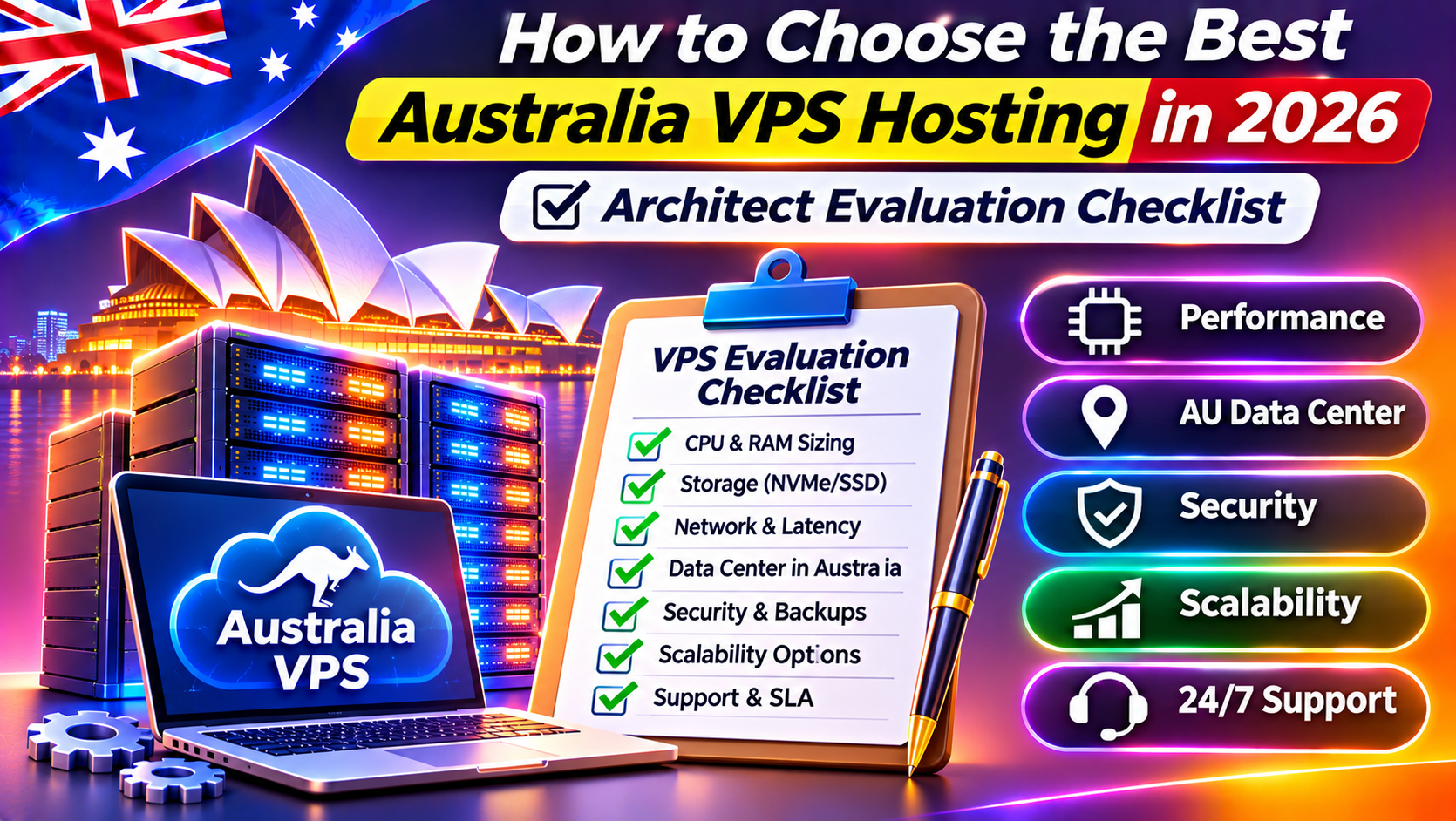
Selecting the Best Australia VPS Hosting in 2026 requires verifying seven non-negotiable architectural criteria: physical colocation in certified Tier-3 Sydney or Melbourne datacenters, guaranteed Type-1 KVM hardware isolation with 0% CPU steal, enterprise PCIe Gen4 NVMe arrays delivering over 90,000 random 4K IOPS, multi-homed BGP peering directly into Mega-IX and IX Australia, transparent fixed monthly subscriptions that eliminate hyperscaler per-gigabyte bandwidth egress taxes, and sovereign data residency fully compliant with the Australian Privacy Act 1988.
Ultimately, selecting the optimal Australian cloud infrastructure in 2026 requires an empirical evaluation spanning hardware hypervisor isolation, raw NVMe IOPS, and domestic Privacy Act compliance. Separate commodity marketing claims from genuine enterprise-grade hardware with this architectural benchmark checklist.
Zero CPU Steal SLA
In particular, demand hardware KVM isolation that guarantees 0% CPU steal time during peak Australian trading hours, preventing neighbor contention.
True Oceanic Peering
Furthermore, ensure your provider peers directly at Mega-IX Sydney or Melbourne, providing sub-12ms transit across major Australian capitals.
No Egress Bandwidth Trap
Consequently, avoid hyperscaler per-GB data transfer charges that can double or triple hosting costs for media and e-commerce platforms.
Zero Egress Billing Shock
Instead, choose predictable flat-rate bandwidth allocations over hyperscalers’ punitive per-gigabyte data transfer surcharges.
Table of Contents: Architect Navigation Index8 Chapters ▾
Navigate directly to technical evaluation benchmarks, latency telemetry, bandwidth cost analyses, and infrastructure automation:
The 2026 Australian Hosting Landscape
In general, the Australian cloud infrastructure marketplace presents a stark contrast between massive global hyperscalers and local specialized VPS providers. Specifically, hyperscalers like AWS, Google Cloud, and Microsoft Azure operate expansive datacenter regions in Sydney and Melbourne, but their complex pricing matrices impose severe penalties on data transfer. Australian bandwidth egress remains among the most expensive in the industrialized world, with hyperscalers charging upwards of \$0.09 to \$0.14 per gigabyte of outbound traffic. Therefore, building a resilient cloud foundation in Australia begins with exploring reliable Australia VPS hosting environment designed for high-concurrency workloads.
Hyperscaler Reality
Specifically, high hourly compute costs compounded by aggressive per-gigabyte Australian network egress charges that inflate monthly operational expenses.
Budget Cloud Pitfalls
Severe CPU oversubscription, shared container kernels, unbuffered SATA storage, and zero domestic internet exchange peering.
The Optimal Balance
Hardware-level KVM virtualization on enterprise NVMe hardware with unmetered domestic transit and direct Mega-IX peering.
Sovereign Infrastructure & Low-Latency Routing
In contrast, commodity low-cost hosting providers frequently cut corners on server hardware density. Specifically, by oversubscribing physical CPU cores on container-based virtualization platforms (such as OpenVZ or unmetered LXD), these budget hosts expose customer workloads to severe noisy-neighbor contention. Consequently, when an adjacent tenant compiles code or experiences a traffic spike, your virtual server suffers from elevated CPU steal percentages (%st), causing web responses to stall and database transaction queues to lock.
In order to navigate these pitfalls, infrastructure architects must adopt a systematic procurement model. In practice, the ideal Australia VPS hosting provider delivers bare-metal KVM virtualization, dedicated hardware resource quotas, local Tier-3 datacenter presence, and predictable, transparent billing that safeguards operational budgets against unforeseen scaling penalties.
Latency Realities
Network latency is fundamentally constrained by the speed of light through optical fiber and the physical routing topology connecting endpoints. For example, when an Australian user in Sydney or Melbourne requests a webpage from a server located in Singapore, the packet must traverse subsea cable systems such as SeaMeWe-3, APNG-2, or the Australia-Singapore Cable (ASC). Consequently, this geographical distance imposes an unavoidable physical round-trip time (RTT) of 90ms to 125ms. Hardware redundancy and power assurance are guaranteed by anchoring workloads in inter-capital network transit times across Australia. System administrators and network engineers can verify these foundational parameters against the IETF RFC 8961 latency guideline.
Measure Geographical Distance
First, identify your primary user base across NSW, Victoria, Queensland, and Western Australia to establish target ping thresholds.
Trace Subsea Cable Paths
Second, avoid offshore routing that forces domestic Australian traffic to cross international waters and foreign internet gateways.
Verify Direct IX Peering
Third, ensure your VPS provider participates directly in Mega-IX Sydney or NSW-IX route servers to keep packets local.
Audit Core Web Vitals
Finally, measure TTFB and LCP improvements directly from Australian vantage points using synthetic Lighthouse and real-user monitoring.
Substation Power Distribution & Climate Engineering
Similarly, if the infrastructure is hosted on the United States West Coast (such as Oregon or Los Angeles), packets traveling via the Southern Cross Cable or Hawaiki incur an RTT penalty of 140ms to 180ms. For modern web applications utilizing HTTPS, HTTP/2, and dynamic REST API endpoints, every TCP and TLS handshake requires multiple round trips before application data can be rendered on the client browser. This latency compounding deteriorates Time to First Byte (TTFB), drags down Largest Contentful Paint (LCP), and directly suppresses e-commerce checkout completion rates.
In contrast, colocating compute infrastructure in a Sydney Tier-3 datacenter resolves this physical barrier. Local packets exchange within 1ms to 2ms in the Sydney metro area, reach Melbourne and Brisbane in 10ms to 14ms, and cross the Tasman Sea into Auckland in 24ms. This deterministic performance ensures that database-driven web pages render instantaneously for Australian consumers.
Seven Non-Negotiable Criteria
Before committing enterprise applications to any Australia VPS provider, systems architects should audit the host platform against seven non-negotiable technical requirements. First and foremost is true Type-1 KVM virtualization. KVM ensures hardware-assisted isolation, dedicated memory mappings, and independent kernel execution, protecting your instance from kernel panics or resource hoarding caused by other virtual machines on the physical chassis. Eliminating noisy-neighbor interference and latency spikes is achieved by configuring enterprise VPS security architecture.
KVM Hypervisor
PCIe NVMe RAID-10
Peering Fabric
Data Sovereignty
Transparent Cost
Engineering Support
Dedicated Hypervisor Isolation & VirtIO Storage Virtualization
Second is the storage subsystem. Enterprise production workloads require solid-state drives operating on the PCIe Gen4 or Gen5 NVMe protocol organized in redundant hardware RAID-10. SATA SSDs or networked block storage without IOPS guarantees frequently bottle-neck during database write-heavy operations. Providers should demonstrate sustained random 4K read/write IOPS of at least 80,000 with sub-millisecond I/O latency under continuous fio benchmarking.
Third is network interconnectivity. The hosting provider must maintain multi-homed BGP routing with direct peering sessions into major Australian internet exchanges (Mega-IX Sydney, IX Australia) and Tier-1 transit backbones (Telstra, Optus, Vocus, Aussie Broadband). This multi-homed fabric guarantees automatic failover and optimal routing paths for all domestic visitors.
Analyzing Bandwidth Egress and Sizing Traps
Furthermore, when calculating Total Cost of Ownership (TCO) for cloud hosting in Australia, the headline price of virtual CPU and RAM represents only a fraction of the total expenditure. In fact, the single largest hidden expense in hyperscaler cloud deployments is bandwidth egress. For instance, an e-commerce store or digital agency delivering 5TB of monthly traffic on AWS Sydney will incur hundreds of dollars in data transfer fees alone, completely distorting infrastructure economics. Long-term production agility and governance are ensured through Total Cost of Ownership (TCO) for cloud hosting in Australia.
Zero Bandwidth Egress Surcharges
Specifically, predictable monthly hosting fees without per-gigabyte data transfer billing traps common to international hyperscalers.
Predictable 3-Year Sizing Modeling
Consequently, stable infrastructure budgeting allows financial teams to forecast digital operations without volatile cloud spikes.
Optional Managed Server Automation
Furthermore, automated snapshot backups, OS security updates, and control panel management reduce in-house DevOps labor costs.
Flexible Vertical Hot-Scaling
Additionally, easily scale vCPU and RAM allocations upwards as your Australian traffic expands without complex architectural rebuilds.
Autonomous System Routing & Trans-Tasman Ocean Connectivity
OnliveServer Australia VPS eliminates this egress penalty by bundling generous unmetered or predictable fixed monthly bandwidth quotas over high-capacity 1Gbps to 10Gbps uplinks. This transparent cost model allows Australian enterprises, digital agencies, and startup founders to forecast operational expenses with 100% precision, ensuring that sudden traffic surges during marketing promotions or viral campaigns do not trigger catastrophic billing overages.
Additionally, architects must account for operational management overhead. For example, deploying on an Australia VPS equipped with optional automated cPanel, Plesk, or CloudPanel management reduces the engineering hours required for routine patching, SSL provisioning, and database backups. Ultimately, calculating TCO over a 36-month horizon consistently reveals that high-performance KVM VPS hosting delivers up to 65% cost savings compared to equivalent hyperscaler instances.
Decision Matrix & Enterprise Procurement
In summary, to synthesize the evaluation process, engineering leads should map their specific workload characteristics against server tiers. For example, small corporate portals and lightweight web applications can comfortably thrive on 2 vCPUs and 4GB RAM, provided the instance resides on PCIe NVMe storage. Meanwhile, medium-scale WooCommerce installations, Magento e-commerce stores, and active SaaS APIs require 4 to 8 vCPUs paired with 16GB to 32GB ECC RAM to ensure database query buffers remain fully cached in high-speed system memory.
- ✔Entry Tier (2 vCPU / 4GB RAM): Corporate websites, staging nodes, and low-traffic blogs.
- ✔Mid Tier (4 vCPU / 8-16GB RAM): WooCommerce stores, dynamic membership portals, and REST APIs.
- ✔Enterprise Tier (8+ vCPU / 32GB+ RAM): High-traffic Magento, multi-tenant agency hosting, and databases.
- ✔Storage Recommendation: Always insist on enterprise PCIe NVMe RAID-10 arrays.
- ✔Demand live traceroute confirmation to Mega-IX Sydney and IX Australia route servers.
- ✔Run independent FIO and sysbench benchmarks immediately upon server provisioning.
- ✔Confirm Australian legal entity status and Privacy Act 1988 data residency commitments.
- ✔Verify 24/7 technical support accessibility via ticket, email, and live engineering channels.
Regulatory Sovereignty & ASD Essential Eight Hardening
In particular, for high-concurrency environments handling critical financial transactions or enterprise ERP systems (such as MYOB Premier or Xero API sync daemons), architects should specify dedicated CPU pinning and NVMe direct-passthrough configurations. Furthermore, ensuring that memory ballooning is disabled guarantees that the guest operating system has permanent, exclusive ownership of its physical memory pages.
Finally, verify that your prospective hosting provider offers a binding Service Level Agreement (SLA) with guaranteed hardware replacement windows and network uptime exceeding 99.95%. As a consequence, pairing enterprise hardware SLAs with local Sydney technical support ensures rapid issue resolution without time zone delays.
Australia VPS CLI Playbook
In addition, system administrators auditing a newly provisioned Australia VPS should immediately run synthetic benchmarking scripts to verify CPU scheduling performance, memory bandwidth, and storage IOPS before placing the node into production. Specifically, the following bash commands execute standardized sysbench CPU tests, verify zero CPU steal time, and measure random 4K NVMe write latency:
Enterprise Specifications Matrix
Evaluating prospective hosting options using this structured technical comparison matrix reveals how OnliveServer Australia VPS outperforms generic alternatives across critical architectural dimensions:
| Specification Dimension | OnliveServer Australia VPS | Commodity Budget Cloud | Hyperscaler Instances (AWS/Azure) |
|---|---|---|---|
| Core Virtualization | Hardware KVM (Dedicated Kernel) | Shared Kernel Container (OpenVZ) | Proprietary Hyper-V / Nitro |
| CPU Steal Ratio (%st) | 0.0% Guaranteed SLA | Variable 5% – 25% Steal | Throttled on T-series instances |
| Storage Architecture | PCIe Gen4 NVMe RAID-10 (No IOPS Limits) | Shared SATA SSD (Throttled) | EBS gp3 (Separate IOPS Billings) |
| Domestic IX Peering | Direct Mega-IX Sydney & NSW-IX | No IX Peering (Transit Only) | Transit Hops with High Egress |
| Australian Egress Pricing | Unmetered / Predictable Quota | Strict Caps with Penalties | $0.09 – $0.14 per GB Tax |
| Data Privacy Jurisdiction | Australian Privacy Act 1988 & APPs | Often Offshored to US / Asia | US CLOUD Act Exposure |
Frequently Asked Questions
Q What is the primary factor when choosing an Australia VPS?
The most critical factor is true hardware KVM virtualization coupled with a physical datacenter presence in Sydney or Melbourne. Hardware KVM guarantees dedicated CPU threads and RAM without noisy neighbor interference, while local physical presence guarantees sub-12ms domestic latency across Australia.
Q How do I verify if a hosting provider oversubscribes CPUs?
Specifically, run ‘vmstat 1 10’ or ‘htop’ in your terminal during peak hours. Examine the CPU steal percentage (indicated as ‘%st’). If this value rises above 0% or spikes to 5%-15%, the host node is oversubscribed and your CPU cycles are being stolen by neighboring virtual machines.
Q Why is bandwidth egress expensive on hyperscalers in AU?
Historically, Australia is geographically isolated, requiring vast subsea fiber optic networks to connect overseas. Hyperscalers monetize this geographical reality by charging premium per-GB egress rates (often 3x to 5x higher than US/EU rates). OnliveServer includes generous or unmetered bandwidth to insulate clients from these charges.
Q Is PCIe Gen4 NVMe storage significantly faster than SATA SSDs?
Yes. Enterprise PCIe Gen4 NVMe drives deliver random 4K read/write speeds exceeding 90,000 IOPS and sustained sequential speeds over 5,000 MB/s. In contrast, SATA SSDs top out around 500 MB/s and 50,000 IOPS, causing substantial bottlenecks during database queries and caching rebuilds.
Q Why is Australian data sovereignty and Privacy Act compliance essential for local businesses?
Data sovereignty ensures that digital information collected from Australian citizens is stored, processed, and maintained within Australian legal boundaries. This guarantees compliance with APP 8 and APP 11 under the Privacy Act 1988, protecting sensitive customer records from foreign subpoena powers such as the US CLOUD Act.
Q Why does KVM virtualization deliver better stability and control than container virtualization?
Because KVM operates as a genuine Type-1 hardware hypervisor, each VPS runs an isolated kernel with guaranteed dedicated resources. You have complete root control over your independent virtual machine, enabling you to compile custom kernels, load WireGuard or nftables modules, and configure custom sysctl parameters without host-level restrictions or noisy neighbor interference.
Q How much RAM is required for production WooCommerce or Magento?
In practice, for a production WooCommerce store with 1,000+ products, we recommend a minimum of 4 vCPUs and 8GB to 16GB of dedicated ECC RAM. Magento 2 stores require at least 8 vCPUs and 16GB to 32GB RAM to support Elasticsearch/Opensearch, Redis caching, and PHP-FPM worker pools without swapping.
Q What SLA should I expect for an enterprise Australia VPS?
In addition, enterprise hosting should provide a binding Service Level Agreement of at least 99.95% network and hardware uptime, accompanied by 24/7 technical support escalations and rapid hardware replacement guarantees in premier Tier-3 Sydney datacenters.
Equip your enterprise with true KVM hardware isolation, PCIe Gen4 NVMe arrays, and direct Mega-IX peering for guaranteed 0% CPU steal and sub-2ms Sydney latency.
Deploy the Best Australia VPS Hosting Architecture →