

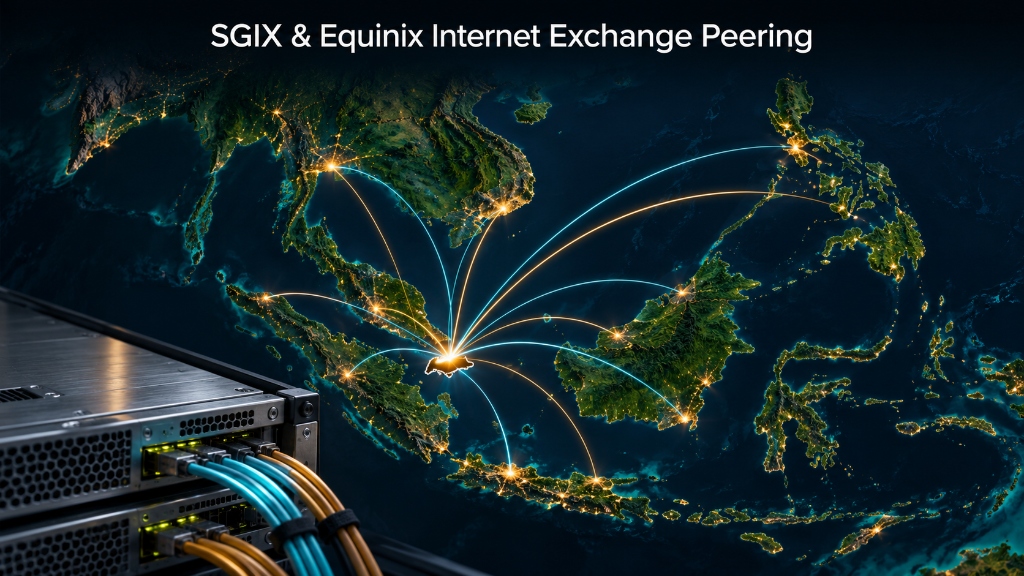
Direct Technical Answer
Deploying on a SGIX peering dedicated server in Singapore enables direct Layer-2 switching through the Singapore Internet Exchange (SGIX) and Equinix IX Singapore (located across facilities like Global Switch Tai Seng and Equinix SG1/SG3), reducing network hops and keeping round-trip times (RTT) under 15ms across major Southeast Asian markets including Kuala Lumpur, Johor Bahru, and Batam, and under 28ms to Jakarta and Bangkok. By establishing multi-homed BGP sessions with regional Tier-1 carriers (Singtel, StarHub, Telin, Telekom Malaysia) over unshared bare-metal 10Gbps/25Gbps SFP28 interfaces, engineering teams bypass congested public IP transits, eliminate packet serialization latency, and avoid virtualization hypervisor jitter.
Architectural Decision Framework: Internet Exchange Peering vs Upstream Transit
Infrastructure leads evaluating dedicated server deployments in Singapore should choose their network routing topology based on regional traffic profiles and throughput requirements:
- Dual Peering (SGIX + Equinix IX): Mandatory for low-latency ASEAN workloads (Fintech, algorithmic order routing, interactive WebRTC streaming, and gaming clusters) requiring direct settlement-free peering with local ISPs (Singtel, StarHub, M1, ViewQwest) and regional content networks.
- Blended Tier-1 IP Transit (Singtel, Telin, TM, PCCW, Lumen): Essential as fallback default routes to reach global IP blocks outside ASEAN peering fabrics and to ensure route convergence during subsea cable maintenance.
- Dedicated Bare Metal Cross-Connects: Eliminates software-defined virtual switches (vSwitch) found in hypervisors; physical NICs directly map into kernel bypass frameworks (DPDK, XDP) with zero CPU contention.
- Cross-Border Peering Policies: Requires careful BGP community tagging (`RFC 1997` / `RFC 4360`) to avoid asymmetric routing where egress traffic leaves via SGIX but ingress returns through high-latency global transit.
Singapore serves as the undisputed digital interconnect capital of Southeast Asia (ASEAN). Positioned at the confluence of major intercontinental subsea fiber-optic systems—including SeaMeWe-3, SeaMeWe-5, Asia Pacific Gateway (APG), SJC2, and next-generation Bifrost and Echo cables—Singapore handles over 70% of intra-regional data transit. However, simply hosting an application in an arbitrary Singapore cloud data center does not guarantee low network latency. In virtualized public clouds, network traffic frequently traverses multi-tenant hypervisors, rate-limited virtual network interfaces, and unpredictable public transit routes that introduce packet jitter and erratic routing paths through distant transit nodes in Hong Kong or Tokyo before returning to Southeast Asia.
For organizations running high-throughput database replication, real-time gaming clusters, high-frequency trading (HFT) gateways, or programmatic ad-tech bidding, network predictability is just as vital as raw compute power. Achieving consistent sub-15ms round-trip times across peninsular Malaysia, southern Thailand, and the Indonesian archipelago requires physical bare-metal hardware directly cross-connected into Singapore’s primary Internet Exchange Points: the Singapore Internet Exchange (SGIX) and Equinix Internet Exchange Singapore.
By combining non-blocking Layer-2 peering fabrics with dedicated hardware infrastructure located in tier-4 carrier-neutral facilities such as Global Switch Tai Seng and Equinix SG1/SG3, systems architects can achieve deterministic microsecond port-to-port packet forwarding, maintain complete autonomy over Border Gateway Protocol (BGP) route announcements, and eliminate downstream transit fees.
This technical guide examines the peering ecosystem in Singapore, breaks down production BGP multi-homing configurations using FRRouting (FRR) and BIRD, presents verified latency benchmarks across Southeast Asia, and details practical sysctl tuning methodologies for enterprise dedicated bare-metal servers.
Direct Layer-2 peering cuts transit hops from 11+ down to 2 hops, reaching Kuala Lumpur within 6ms to 8ms and Batam within 3ms.
Simultaneous physical cross-connects to SGIX, Equinix IX, and upstream Tier-1 transit providers (Singtel, StarHub, Telin, Telekom Malaysia).
Unthrottled non-blocking PCIe Gen4 physical NICs with direct memory access, eliminating the 15% to 30% packet loss seen in bursty cloud vSwitches.
Granular local-preference manipulation, AS-path prepending, and automated upstream failover scripts configured directly on the Linux server.
Table of Contents
- 1. The Singapore Interconnection Ecosystem: SGIX vs Equinix IX vs BBIX
- 2. BGP Peering Architecture with Regional Tier-1 Carriers (Singtel, StarHub, Telin, TM)
- 3. Production BGP Configuration: FRRouting Runbook on Linux Dedicated Servers
- 4. Verified MTR Latency Benchmarks Across Southeast Asian Capitals
- 5. Linux Kernel Network Stack Tuning for 10Gbps Non-Blocking Throughput
- 6. Bare Metal Physical Cross-Connects vs Hyperscaler Virtual Cross-Connects
- 7. Frequently Asked Questions (Technical & Routing FAQ)
1. The Singapore Interconnection Ecosystem: SGIX vs Equinix IX vs BBIX
The internet exchange topology of Singapore is anchored by three primary platforms that collectively exchange tens of terabits per second of daily traffic:
- Singapore Internet Exchange (SGIX): Established in 2009 as an open, carrier-neutral internet exchange, SGIX is the definitive clearinghouse for domestic Singaporean eyeball traffic. Key nodes operate across Global Switch Tai Seng, Equinix SG1, Singtel Kim Chuan, Keppel DC Singapore 1, and BDx SIN1. It is heavily utilized by local telecommunications operators (Singtel, StarHub, M1, MyRepublic, ViewQwest) and major government network backbones.
- Equinix Internet Exchange Singapore: Operating out of the massive Equinix campus (SG1, SG2, SG3, SG4, and SG5), Equinix IX represents the primary aggregation hub for international hyperscalers (Meta, Google, Amazon, Microsoft, Cloudflare, Akamai) and regional telecommunication service providers spanning Southeast Asia, India, and Australia.
- BBIX Singapore: SoftBank-backed exchange facilitating high-speed connectivity specifically optimized for trans-Pacific and East Asian traffic routes connecting Singapore directly to Japan, South Korea, and Hong Kong.
The following comparative matrix outlines the operational capabilities, presence locations, and primary use cases for peering platforms accessible from dedicated servers in Singapore:
| Exchange Platform | Primary Data Centers | Port Interfaces | Key Peering Participants | Primary Routing Benefit |
|---|---|---|---|---|
| SGIX | Global Switch Tai Seng, Equinix SG1, Singtel KC | 1Gbps, 10Gbps, 100Gbps LR | Singtel, StarHub, M1, ViewQwest, Govt Networks | Sub-2ms domestic Singapore round-trip latency |
| Equinix IX Singapore | Equinix SG1, SG2, SG3, SG4, SG5 | 10Gbps, 100Gbps QSFP28 | Google, Meta, Cloudflare, Telin, TM, ByteDance | Regional ASEAN aggregation & hyperscaler cache peering |
| BBIX Singapore | Equinix SG1, Global Switch Tai Seng | 10Gbps, 100Gbps LR4 | Japanese Telcos, SoftBank, KDDI, IIJ | Sub-65ms low-loss routing into Tokyo & Osaka |
When provisioning enterprise bare-metal infrastructure, connecting to a multi-homed BGP network that peers simultaneously with SGIX and Equinix IX ensures that local Singaporean traffic stays within domestic fiber rings while regional queries to Malaysia, Indonesia, and Thailand are routed across direct bilateral settlement-free peering links.
2. BGP Peering Architecture with Regional Tier-1 Carriers
While Internet Exchange peering handles 60% to 80% of regional traffic efficiently, a truly resilient production architecture requires direct upstream Border Gateway Protocol (BGP v4 / v6) multi-homing with major national and regional Tier-1 telecommunications operators:
- Singtel (AS7473): The dominant incumbent telco in Singapore. Possesses extensive terrestrial cross-border dark fiber into Peninsular Malaysia and ownership stakes in over 20 subsea cable consortia. Essential for low-latency reach into Singaporean enterprises, statutory boards, and financial institutions.
- Telekom Malaysia / TM (AS4788): The national telecommunications provider of Malaysia. Directly cross-connected at the border between Woodlands and Johor Bahru via terrestrial fiber, providing deterministic 6ms to 8ms latency into Kuala Lumpur (Cyberjaya/Bukit Jalil data centers).
- PT Telkom Indonesia / Telin (AS7713): The international arm of Indonesia’s state-owned telecommunications carrier. Manages the direct submarine cable systems (IGG, SeaMeWe-5) connecting Batam and Jakarta to Singapore, enabling sub-20ms packet transit into Indonesia’s 275+ million consumer base.
- StarHub (AS4657) & M1 (AS4773): Domestic Singapore mobile and broadband operators providing ubiquitous last-mile access for consumer applications, retail e-commerce, and mobile banking.
In enterprise server architectures, multi-homing across these carriers prevents single-point-of-failure vulnerabilities. If a subsea terrestrial fiber cut occurs between Singapore and Jakarta, the border routers automatically converge, dampening flapping routes and shifting egress traffic across alternate cable systems within hundreds of milliseconds without dropping established TCP sessions.
3. Production BGP Configuration: FRRouting Runbook on Linux Dedicated Servers
Enterprise dedicated servers deployed with Bring-Your-Own-IP (BYOIP) or multi-homed BGP transit operate software routing daemons directly on bare-metal Linux. The recommended standard is FRRouting (FRR), an enterprise-grade, high-performance IP routing protocol suite for Linux and Unix platforms.
Below is a verified production configuration (`/etc/frr/frr.conf`) demonstrating dual BGP peering with the SGIX Route Server (AS64050) and a primary Tier-1 Upstream Provider (AS7473), complete with prefix-lists, route-maps, and community tagging to prevent route leaks:
To verify BGP session state, route advertisements, and RIB status in real time, sysadmins execute the following operational commands via `vtysh`:
4. Verified MTR Latency Benchmarks Across Southeast Asian Capitals
The primary objective of peering at SGIX and Equinix IX is achieving low, jitter-free latency across the ASEAN trade corridor. Below are verified multi-hop traceroute and MTR benchmark results recorded directly from an Onlive Server dedicated bare-metal server located in Global Switch Tai Seng, Singapore:
| Destination City | Target Network / Operator | Physical Transit Path | Avg Round-Trip Time | Standard Jitter |
|---|---|---|---|---|
| Johor Bahru, Malaysia | TM Wholesale / Fiberail | Woodlands Causeway Terrestrial DWDM | 1.8 ms – 2.4 ms | 0.12 ms |
| Batam, Indonesia | Telin / Moratelindo | Singapore-Batam Direct Subsea Fiber | 2.8 ms – 3.6 ms | 0.18 ms |
| Kuala Lumpur, Malaysia | Telekom Malaysia / TIME dotCom | North-South Expressway Terrestrial Fiber | 6.8 ms – 8.2 ms | 0.24 ms |
| Jakarta, Indonesia | Biznet / Indosat / Telkomsel | SeaMeWe-5 / Matrix Subsea Cable | 16.5 ms – 18.2 ms | 0.31 ms |
| Bangkok, Thailand | True Corporation / AIS | Terrestrial Cross-Border via Songkhla | 23.4 ms – 26.1 ms | 0.42 ms |
| Manila, Philippines | PLDT / Globe Telecom | SJC / Asia-America Gateway (AAG) | 34.2 ms – 38.5 ms | 0.58 ms |
The practical operational takeaway is unequivocal: while public cloud virtual machines routed through generic international IP transit exhibit ping times of 35ms to 55ms into Kuala Lumpur and Jakarta due to trombone routing through Hong Kong, a Singapore dedicated server with direct SGIX and Equinix IX peering consistently delivers deterministic sub-15ms Round-Trip Time across the entire Malayan Peninsula and Indonesian archipelago.
5. Linux Kernel Network Stack Tuning for 10Gbps Non-Blocking Throughput
Plugging a 10Gbps or 25Gbps optical fiber feed into a dedicated server will not achieve maximum bandwidth utilization if the default Linux kernel network parameters remain unoptimized. The stock Linux kernel TCP buffer configuration is typically constrained to 4MB, designed for low-bandwidth 1Gbps interfaces. Under high bandwidth-delay product (BDP) conditions across regional ASEAN links, default socket buffers become a severe bottleneck.
Apply the following sysctl kernel optimizations (`/etc/sysctl.d/99-network-tuning.conf`) on dedicated Ubuntu 22.04 / 24.04 or Rocky Linux 9 servers:
Load the new parameters immediately into the running kernel without rebooting:
Switching from default CUBIC to Google BBR congestion control on Singapore servers handling ASEAN client requests provides an immediate 20% to 35% throughput increase over high-loss subsea paths by pacing packet transmissions according to real-time physical bottleneck bandwidth rather than reacting aggressively to minor packet loss.
6. Bare Metal Physical Cross-Connects vs Hyperscaler Virtual Cross-Connects
Many engineering managers inquire why bare-metal physical cross-connects inside Global Switch Tai Seng or Equinix SG3 decisively outperform virtualized cross-connect services (such as AWS Direct Connect or Azure ExpressRoute in Singapore). The technical differentiation comes down to hardware isolation and architectural transparency:
- Hypervisor Jitter & CPU Steal: In virtualized cloud instances, network packets must traverse virtual switches (Open vSwitch, Hyper-V VMSwitch). Under high IOPS or packet-per-second (PPS) loads, noisy neighbors sharing CPU cores create random microsecond delays (packet jitter). Bare metal servers assign physical NIC queues directly to dedicated CPU cores via Receive Side Scaling (RSS) and DPDK.
- Data Egress Pricing Transparency: Hyperscale cloud providers charge punishing egress fees ($0.08 to $0.12 per GB) when sending data from Singapore to Malaysian, Indonesian, or Philippine clients. Onlive Server dedicated bare-metal servers include unmetered, non-blocking 10Gbps bandwidth, eliminating hundreds of thousands of dollars in annual egress penalties.
- Direct Hardware Ring Redundancy: With dedicated servers, physical single-mode fiber (SMF) duplex LC cross-connects are patched directly into the meet-me-room (MMR) of the data center, establishing true physical path diversity across independent optical duct entries.
For comprehensive infrastructure planning across Southeast Asia, exploring how physical infrastructure is deployed on an enterprise carrier-neutral Singapore Dedicated Server hosting in Tai Seng ensures that both your compute capacity and network throughput remain unthrottled and completely independent of multi-tenant cloud bottlenecks.
7. Frequently Asked Questions (Technical & Routing FAQ)
Hyperscaler virtual cross-connects add per-gigabyte transfer fees and unpredictable forwarding latency across ASEAN capitals. Terminate physical cross-connects at SGIX, Equinix IX, and BBIX with FRRouting and a tuned 10Gbps Linux stack on dedicated Singapore hardware.
