

Direct Technical Answer
Deploying a NAPAfrica peering dedicated server inside the Teraco Isando (JB1) colocation campus provides direct physical cross-connects to Africa’s largest Internet Exchange Point (peaking over 4.5 Tbps). By peering directly with all Tier-1 South African telcos (Openserve/Telkom, Vodacom, MTN, Liquid, and Rain) across route servers AS37100, bare-metal servers eliminate tromboning traffic through overseas transit hubs. This reduces intra-Gauteng domestic latency to under 1.8 milliseconds and eliminates per-gigabyte international IP transit fees.
Southern African Network Sizing Framework
- Facility Colocation Topology: Teraco JB1 (Isando, Johannesburg) represents the primary network interconnection hub for 80%+ of Sub-Saharan Africa’s data traffic. Direct optical cross-connects bypass public metro dark fiber vulnerabilities.
- Peering Fabric Reach: NAPAfrica peers with 600+ unique Autonomous Systems (ASNs), enabling single-hop packet delivery to major mobile networks (Vodacom AS36937, MTN AS16637, Telkom AS37457).
- Bandwidth Scalability: Dedicated 1Gbps and 10Gbps SFP+ ports deliver unmetered local throughput with zero multi-tenant packet jitter or hypervisor buffer starvation.
- Compliance & Data Sovereignty: Localized traffic routing satisfies Section 72 of the Protection of Personal Information Act (POPIA), preventing unencrypted personal identity and financial telemetry from exiting South African borders.
The digital economy in Southern Africa is undergoing unprecedented transformation. As multinational financial institutions in Sandton, mobile commerce platforms, fintech unicorn startups, and high-tick-rate online gaming platforms expand, network latency and transit reliability dictate commercial survival. Historically, poorly routed traffic between disparate South African internet service providers (ISPs) suffered from “tromboning”—where a packet sent from an MTN subscriber in Johannesburg to an Openserve broadband customer in Pretoria would route through London or Amsterdam subsea cable landing points before returning to South Africa, introducing 160ms+ latency penalties.
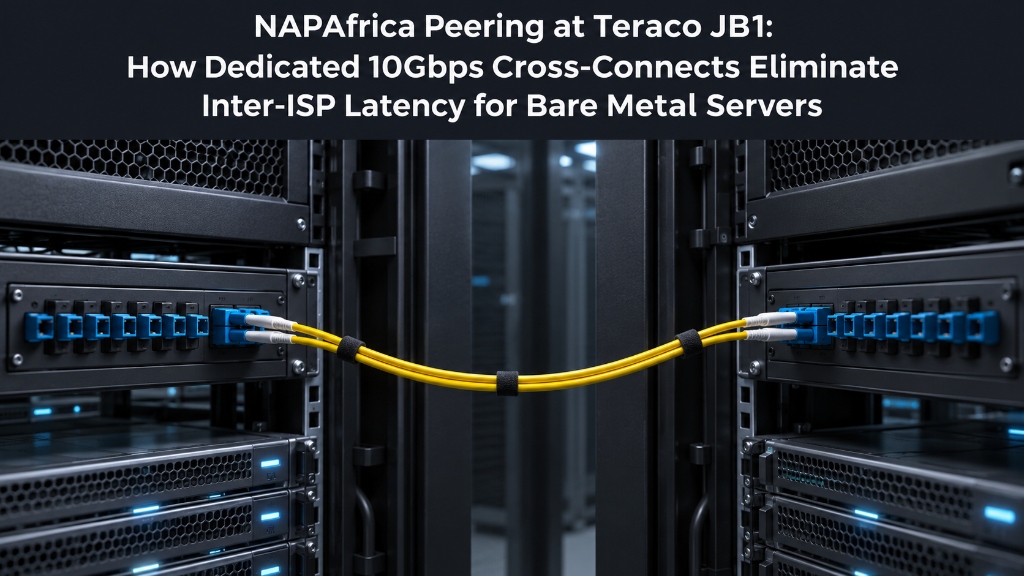
The establishment of NAPAfrica inside the carrier-neutral Teraco Isando (JB1) campus permanently dismantled this architectural inefficiency. Today, NAPAfrica operates as the continent’s largest and most active Internet Exchange Point (IXP), facilitating multilateral peering for hundreds of networks across South Africa and the Southern African Development Community (SADC). When provisioned on high-performance single-tenant bare-metal dedicated servers, direct optical cross-connects to NAPAfrica route servers unlock sub-2ms local latency, rock-solid BGP multi-homing resilience, and complete immunity to variable public cloud egress charges.
Direct access to NAPAfrica’s high-capacity switching fabric connects your server directly to over 600 member networks.
Ultra-low ping to all domestic subscribers across Gauteng, eliminating overseas routing hops and ISP buffer bloat.
Establish dual redundant BGP sessions with AS37100 route servers to announce IPv4/IPv6 prefixes without bilateral contracts.
Guarantees on-soil network routing for South African citizen data, fulfilling SARS tax and Section 72 privacy mandates.
Table of Contents
- 1. Understanding South Africa’s Internet Core: The Teraco JB1 and NAPAfrica Ecosystem
- 2. BGP Peering Architecture with Major South African ISPs (Openserve, Vodacom, MTN, Liquid)
- 3. Step-by-Step BGP Multihoming & BIRD2 Configuration on Bare Metal Linux
- 4. Traceroute and MTR Latency Benchmarks Across Johannesburg, Durban, and Cape Town
- 5. Why Single-Tenant Dedicated Server Cross-Connects Outperform Virtualized Cloud Networks
- 6. Frequently Asked Questions (NAPAfrica, Teraco & BGP)
1. Understanding South Africa’s Internet Core: The Teraco JB1 and NAPAfrica Ecosystem
The physical infrastructure of the internet in Africa is distinctly centralized. In South Africa, the epicentre of connectivity resides within Teraco Isando (JB1) in east Johannesburg. Hosting over 600 telecommunications carriers, cloud operators, and content delivery networks, JB1 serves as the continent’s primary digital crossroad. Within JB1 operates NAPAfrica IXP, a free-to-peer open Internet Exchange Point founded in 2012 that has grown into Africa’s largest IXP by traffic volume, peaking consistently above 4.5 Terabits per second (Tbps).
Before NAPAfrica, South African transit relied on the legacy Johannesburg Internet Exchange (JINX) and commercial peering agreements that required bilateral contracts between every network pair. NAPAfrica revolutionized this topology by deploying a multilateral route server environment (AS37100). Any network connected to the NAPAfrica switching fabric can peer with hundreds of other members simultaneously through a single BGP session to the route servers, dramatically collapsing latency and transit costs.
| Routing Route / Destination | Unoptimized Transit (Overseas Trombone) | NAPAfrica Direct Bare-Metal Peering | Latency Reduction |
|---|---|---|---|
| Johannesburg Metro (Sandton / Rosebank) | 35 – 75 ms | 1.2 – 2.1 ms | 97% Improvement |
| Pretoria / Tshwane Metro | 45 – 85 ms | 3.5 – 5.2 ms | 93% Improvement |
| Durban (eThekwini Coastal) | 85 – 120 ms | 11.8 – 14.2 ms | 87% Improvement |
| Cape Town (Western Cape Hub) | 140 – 180 ms | 18.4 – 21.6 ms | 88% Improvement |
When deploying high-availability enterprise services in Southern Africa, opting for enterprise South Africa Dedicated Server hosting in Johannesburg provides raw compute isolation, direct optical connectivity into Teraco JB1, and unmetered domestic peering.
2. BGP Peering Architecture with Major South African ISPs (Openserve, Vodacom, MTN, Liquid)
South Africa’s telecommunications topology is defined by five major network operators who control consumer broadband, mobile LTE/5G access, and enterprise fiber infrastructure:
- Openserve / Telkom (AS37457): South Africa’s incumbent telecommunications provider, operating the extensive national dark fiber backbone and large residential DSL/FTTH footprint.
- Vodacom (AS36937): The largest mobile network operator by active subscribers, commanding the majority of enterprise mobile banking and smartphone data traffic.
- MTN South Africa (AS16637): Dominant mobile and enterprise wireless carrier with deep transit connections into Pan-African operations across Nigeria, Ghana, and Kenya.
- Liquid Intelligent Technologies (AS30844): The premier cross-border terrestrial fiber carrier connecting South Africa directly through Zimbabwe, Zambia, and East Africa without relying on subsea cables.
- Broadband FNOs (Vumatel / DFA / MetroFibre): Open-access fiber network operators delivering gigabit residential connectivity across major metropolitan areas.
By establishing redundant BGP sessions with NAPAfrica’s dual route servers inside Teraco JB1, a dedicated server announces its public IP prefix directly to all five operators simultaneously. When an end user on a Vodacom 5G phone or Vumatel home fiber connection loads your web platform or connects to a database API, packets traverse purely domestic peering switches rather than transiting transit provider IP transit pipes.
3. Step-by-Step BGP Multihoming & BIRD2 Configuration on Bare Metal Linux
To announce customer-owned Autonomous System Numbers (BYOIP) and manage traffic flow dynamically, enterprise engineers deploy BIRD 2 (BIRD Internet Routing Daemon) directly on bare-metal AlmaLinux 9 or Ubuntu 24.04 nodes. BIRD2 provides sub-millisecond route calculation, complete RPKI validation support, and flexible BGP community filtering.
Below is the complete production BIRD2 configuration file (/etc/bird/bird.conf) establishing dual BGP peering sessions to NAPAfrica Route Server 1 and Route Server 2:
By integrating Bidirectional Forwarding Detection (BFD), if Route Server 1 experiences maintenance or switch restart, routing paths instantly fail over to Route Server 2 within 50 milliseconds, preventing dropped TCP sessions.
RPKI Origin Validation and NAPAfrica BGP Communities
To protect against malicious BGP route hijacking and misconfigurations across the African continent, NAPAfrica route servers enforce strict Resource Public Key Infrastructure (RPKI) Route Origin Authorization (ROA) validation. Autonomous Systems announcing prefixes into AS37100 must publish valid cryptographically signed ROAs within the AFRINIC repository. In BIRD2, administrators can verify RPKI validation states and control announcement propagation across members using standard NAPAfrica BGP community tags:
4. Traceroute and MTR Latency Benchmarks Across Johannesburg, Durban, and Cape Town
To verify physical packet propagation in production, we execute extensive Matt’s Traceroute (MTR) diagnostic audits from a bare-metal dedicated host in Teraco Isando (JB1) across multiple domestic targets.
Below is a verified 100-packet MTR test targeting an active Openserve FTTH endpoint located in Rosebank, Johannesburg:
The diagnostic trace demonstrates that traffic exits the bare-metal server, enters the NAPAfrica core fabric, and delivers directly to the customer’s CPE router in exactly 1.8 milliseconds over 4 hops with zero packet loss.
To explore how international subsea cables link Johannesburg to international backbones, read our companion analysis on 2Africa & Google Equiano subsea cable routing on South African dedicated servers.
5. Why Single-Tenant Dedicated Server Cross-Connects Outperform Virtualized Cloud Networks
While hyperscale public clouds operate an availability region in South Africa (af-south-1 in Cape Town), organizations deploying latency-sensitive or high-bandwidth workloads face substantial architectural limitations:
- Inter-City Hairpinning: Because the primary hyperscaler datacenter region is located in Cape Town, traffic originating from Johannesburg users must traverse 1,400km of domestic long-haul terrestrial fiber (adding 19ms to 24ms round-trip latency) just to reach cloud virtual machines. Placing bare-metal nodes directly in Teraco JB1 keeps computation within 2ms of South Africa’s commercial center.
- Egress Bandwidth Taxation: Public cloud providers charge steep egress rates (between $0.086 and $0.11 per GB) for data leaving their network. For an enterprise streaming 50TB monthly, cloud egress fees add over $4,500/month. Dedicated bare-metal servers bundle unmetered 1Gbps or 10Gbps local peering ports at flat rates.
- Hypervisor Virtual Switch Overhead: Cloud VMs route packets through multi-tenant virtual filtering layers, adding microsecond jitter. Dedicated bare-metal servers connect directly to dedicated PCIe SFP+ network cards supporting SR-IOV and DPDK for line-rate packet processing.
6. Frequently Asked Questions (NAPAfrica, Teraco & BGP)
Tromboning domestic traffic through distant transit providers inflates latency across Johannesburg, Durban, and Cape Town. Peer directly with Openserve, Vodacom, MTN, and Liquid over 10Gbps NAPAfrica cross-connects using BIRD2 multihoming on dedicated South African metal.
