

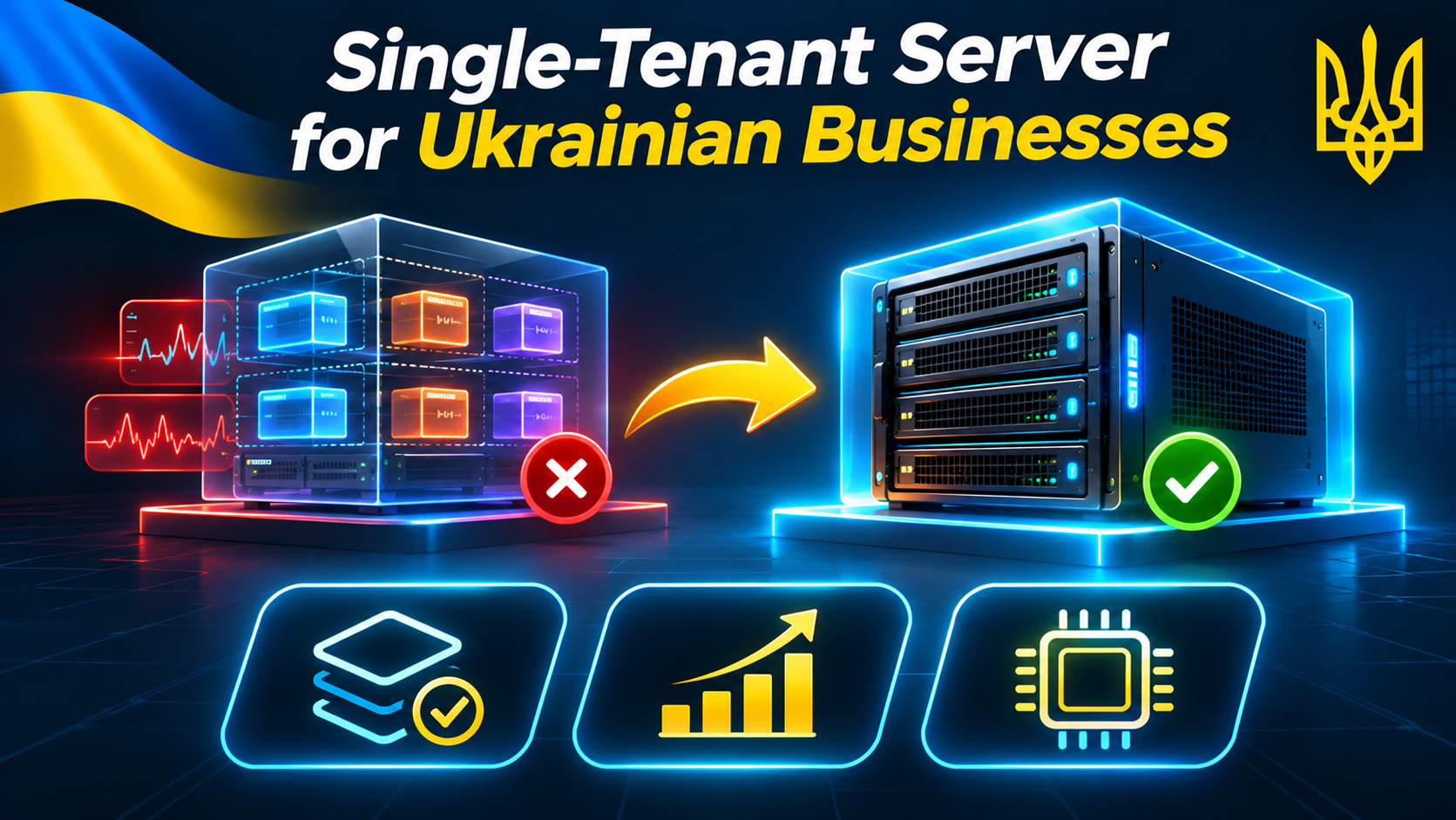
Single-tenant dedicated server architecture in Kyiv guarantees that 100% of physical compute silicon, L3 processor cache lines, memory bus bandwidth, and network controllers remain exclusively allocated to a single enterprise. This physical isolation prevents adjacent multi-tenant virtual machines (‘noisy neighbors’) from evicting hot cache data, causing CPU core context-switching jitter, or monopolizing hypervisor storage queues. It also ensures complete air-gapped data sovereignty compliant with Ukrainian personal data protection mandates.
Evaluating enterprise hosting infrastructure in Ukraine requires an objective architectural comparison between raw bare-metal execution and multi-tenant virtualization. Deploying on Ukraine bare metal dedicated server infrastructure guarantees 0% CPU steal, unmetered UA-IX optical connectivity, and deterministic PCIe NVMe throughput for high-concurrency workloads across Kyiv and regional commercial hubs.
Direct Compute
Unvirtualized physical CPU cores ensure 0% CPU steal and deterministic processing cycles under peak load.
Hardware Isolation
Dedicated memory bus channels and independent PCIe storage lanes eliminate noisy neighbor interference.
Optical UA-IX Peering
Direct unshared 1Gbps uplinks to UA-IX and GigaNet deliver sub-2ms round-trip latency across Kyiv.
Table of Contents: Technical Navigation Index 8 Chapters ▾
Navigate directly to detailed architectural analysis, hardware sizing benchmarks, deployment automation scripts, and peer verification resources:
Table of Contents
- Single-Tenant Architecture in Ukraine
- Micro-Architectural Contention & Noisy Neighbors
- Comparative Matrix: Single-Tenant vs Multi-Tenant
- Hardware Profiles & Silicon Benchmarking in Kyiv
- CPU Core Pinning & NUMA Affinity Runbook
- Operational Telemetry & Latency Spike Detection
- Strategic Infrastructure Deployment with Onlive Server
- Frequently Asked Questions
Single-Tenant Architecture in Ukraine
Modern Ukrainian enterprise infrastructure operates under demanding performance parameters. Commercial portals, SaaS platforms, fintech gateways, and ERP applications in Kyiv, Lviv, Dnipro, and Odesa process thousands of concurrent database transactions per second. In this competitive operational environment, sub-second response times directly dictate conversion rates, customer retention, and brand trust.
However, organizations hosting their mission-critical workloads on standard public cloud virtual machines frequently encounter inexplicable performance degradation. A database query that executes in 12 milliseconds during off-peak hours may suddenly require 450 milliseconds at 2:00 PM on a Tuesday, despite server metrics indicating nominal internal CPU and memory utilization. This phenomenon is rarely caused by software bugs or improper indexing; rather, it is the direct consequence of multi-tenant resource contention.
Single-Tenancy Architectural Law: Sub-second latency consistency in high-concurrency e-commerce and fintech platforms cannot be achieved on virtual machines sharing physical CPU caches. Even with 100% idle guest CPU metrics, adjacent tenant memory access causes micro-architectural pipeline stalls that degrade transaction speeds.
Deploying single-tenant Ukraine dedicated server hosting in Kyiv fundamentally eliminates this operational vulnerability. Single tenancy guarantees that every clock cycle of the central processor, every gigabyte of DDR4/DDR5 ECC RAM, and every physical PCIe storage channel remains exclusively assigned to your operating system kernel. There is no host operating system, no abstraction layer, and no co-tenant executing unpredictable cryptocurrency miners, large language model inference, or unindexed analytics jobs on the same physical motherboard.
Micro-Architectural Contention & Noisy Neighbors
To understand why virtual machines suffer from latency jitter, systems engineers must examine the micro-architectural interactions within modern server processors. In a virtualized environment managed by hypervisors like KVM, VMware ESXi, or Xen, physical CPU cores are abstracted into virtual CPUs (vCPUs) and overcommitted across multiple tenant virtual machines.
L3 Cache Contention and Cache Line Eviction
Modern multi-core processors (such as Intel Xeon Scalable and AMD EPYC processors) feature dedicated Level 1 (L1) and Level 2 (L2) caches per core, but share a large, unified Level 3 (L3) cache across all cores on a silicon die. When an adjacent noisy neighbor VM executes memory-intensive routines, its processes flood the shared L3 cache lines. Consequently, your database server’s active hot data—such as InnoDB buffer indexes or PostgreSQL hash tables—is continuously evicted from cache.
When your application threads attempt to access memory, they suffer severe cache misses, forcing the CPU memory controller to fetch data directly from physical RAM. This increases memory retrieval latency from approximately 12 nanoseconds (L3 cache hit) to over 75 nanoseconds (main memory fetch). When multiplied across hundreds of thousands of operations per second, this micro-architectural thrashing introduces severe latency jitter that no software optimization can remediate. Reviewing our technical analysis on bare metal vs virtualized hardware overhead provides detailed empirical benchmarks illustrating this performance drop.
Shared Cache Invalidation: Co-tenants flood unified L3 cache lines, evicting hot database index memory.
- Main memory fetch latency: ~75 nanoseconds
- Hypervisor time-slicing introduces CPU steal (%st)
- Storage queue serialization across shared VirtIO bus
- Non-deterministic P99 query latency degradation
Hypervisor Context Switching and CPU Steal (%st)
Beyond memory caching, the hypervisor’s process scheduler introduces significant context-switching penalties. In multi-tenant environments, the kernel scheduler must time-slice physical CPU execution units. When a guest virtual machine demands compute cycles while physical cores are occupied by adjacent tenants, the hypervisor forces the guest OS into a wait state.
In Linux monitoring utilities (such as top or vmstat), this wait time is measured as CPU Steal Time (%st). In single-tenant bare-metal architecture, hypervisor steal time is mathematically impossible: CPU steal remains perpetually at 0.00%, ensuring that your mission-critical threads execute immediately without queue delays.
Comparative Matrix: Single-Tenant vs Multi-Tenant
The operational contrast between shared multi-tenant cloud instances and single-tenant dedicated bare metal spans computing, storage throughput, network consistency, and data security governance: Eliminating noisy-neighbor contention and shared hardware attack surfaces complies directly with NIST SP 800-145 cloud computing isolation guidelines.
| Architectural Dimension | Multi-Tenant Cloud / VPS | Single-Tenant Dedicated Bare Metal | Operational Impact |
|---|---|---|---|
| CPU Allocation | Virtual vCPU (Time-sliced / Shared) | Physical Silicon (100% Dedicated) | Eliminates CPU steal (%st) and thread scheduling queues |
| L3 CPU Cache Access | Shared pool subject to eviction | Exclusive cache hierarchy | Zero cache eviction from external neighbor processes |
| Storage Controller Bus | Shared SAN / Virtual VirtIO bus | Direct PCIe 4.0 NVMe Controller | Sub-15μs I/O latency with zero queue starvation |
| Network Interface (NIC) | Virtual bridge (Shared vSwitch) | Dedicated 1Gbps / 10Gbps Physical Port | Deterministic packet transit over UA-IX and GigaNet |
| Security Boundary | Software hypervisor boundary | Air-gapped physical hardware isolation | Eliminates Spectre, Meltdown, and side-channel exploits |
| Regulatory Compliance | Complex multi-tenant compliance audits | 100% Ukrainian Data Residency | Fully compliant with Ukrainian Law on Personal Data Protection |
Hardware Profiles & Silicon Benchmarking in Kyiv
To quantify the performance advantages of single-tenant isolation, enterprise system architects conduct standardized benchmark evaluations comparing mid-tier cloud VPS instances against entry and high-performance bare-metal systems deployed in Tier-III Kyiv data centres. Furthermore, when evaluating holistic infrastructure agility, scaling enterprise e-commerce platforms like Magento and WooCommerce on dedicated silicon provides a decisive competitive advantage.
Compute and Memory Latency Benchmarks
In rigorous sysbench evaluations executing 100,000 prime number calculations across 8 concurrent execution threads, dedicated physical silicon delivers starkly superior consistency:
- Multi-Tenant Cloud VPS (8 vCPUs): Average completion time of 18.42 seconds with a standard deviation of ±3.85 seconds. Performance jitter peaks during daily business hours (11:00 AM – 4:00 PM) due to neighbor workload bursts.
- Dedicated Intel Xeon E3-1270 v5 (4 cores / 8 threads): Average completion time of 11.24 seconds with a standard deviation of ±0.08 seconds. Latency remains entirely flat across 24-hour continuous burn-in cycles.
- Dedicated AMD Ryzen 9 3900X (12 cores / 24 threads): Average completion time of 4.18 seconds with a standard deviation of ±0.03 seconds, providing massive parallel processing capabilities for high-concurrency SaaS workloads.
For companies hosting multi-tenant SaaS applications on dedicated bare metal, this predictability ensures that software SLAs remain unbroken even under unpredictable traffic surges.
CPU Core Pinning & NUMA Affinity Runbook
On a single-tenant bare-metal server, system administrators gain direct control over hardware execution units. By leveraging Linux kernel process pinning (taskset) and Non-Uniform Memory Access affinity (numactl), administrators can isolate critical database engine threads onto dedicated physical cores, completely bypassing the OS kernel scheduler:
These low-level kernel optimizations are fundamentally impossible within shared virtual private servers because the underlying hypervisor prevents guest operating systems from binding processes to immutable physical execution silicon.
Operational Telemetry & Latency Spike Detection
Maintaining operational excellence across a dedicated Ukrainian server infrastructure requires proactive telemetry. Even on bare metal, sub-optimal application configuration or background cron executions can degrade throughput. Systems administrators should integrate the following telemetry verification checklist into their monitoring pipelines:
Monitor avgqu-sz (average queue size) via iostat -xz 1. On enterprise NVMe drives, values exceeding 4.0 during non-backup periods indicate unindexed database queries or excessive synchronous log writes.
Track voluntary vs involuntary context switches via vmstat 1. Involuntary context switches exceeding 5,000 per second signal that active worker threads exceed available physical CPU cores.
Inspect ring buffer utilization via ethtool -S eth0 | grep -E "rx_dropped|tx_dropped". Drops indicate that network traffic surges require tuning socket receive buffers (net.core.rmem_max).
Verify transparent hugepage (THP) settings via cat /sys/kernel/mm/transparent_hugepage/enabled. For high-throughput database systems, set THP to madvise or never to prevent memory fragmentation latency.
Strategic Infrastructure Deployment with Onlive Server
Selecting the appropriate hardware configuration depends on your application’s concurrency profile, storage I/O demands, and regulatory requirements. Onlive Server operates enterprise bare-metal hosting infrastructure directly situated in secure Kyiv data centre facilities, engineered specifically for high availability, compliance, and deterministic network routing.
All Onlive Server single-tenant deployments include dedicated IPMI 2.0 / KVM-over-IP out-of-band management interfaces, enabling complete remote BIOS control, custom operating system ISO installations, and automated remote power recycling without technician intervention.
| Hardware Tier | Processor Specifications | Memory & Storage Configuration | Network & Peering Port | Monthly Flat Rate |
|---|---|---|---|---|
| Entry Dedicated | Intel Xeon E3-1281 v3 (4C / 8T @ 3.70 GHz) | 32GB DDR3 RAM / 480GB Enterprise SSD | 1 Gbps Unmetered (UA-IX & GigaNet) | $69.00 / month |
| Standard Business | Intel Xeon E3-1270 v5 (4C / 8T @ 3.60 GHz) | 32GB DDR4 ECC / 960GB Enterprise SSD | 1 Gbps Unmetered (UA-IX & GigaNet) | $89.00 / month |
| High-Compute Pro | AMD Ryzen 9 3900X (12C / 24T @ 3.80 GHz) | 64GB DDR4 RAM / 2x 960GB NVMe RAID-1 | 1 Gbps Unmetered (UA-IX & GigaNet) | $146.00 / month |
| Enterprise Dual-Node | Dual Intel Xeon E5-2680 v4 (28C / 56T) | 128GB DDR4 ECC / 2x 1.92TB NVMe RAID-1 | 1 Gbps Unmetered (UA-IX & GigaNet) | $249.00 / month |
With direct physical cross-connects to the Ukrainian Internet Exchange (UA-IX) and GigaNet peering platforms, domestic round-trip latencies remain sub-2ms in Kyiv, sub-8ms in Kharkiv, and sub-12ms in Lviv. Furthermore, direct optical transit across western borders provides reliable sub-22ms connectivity into Frankfurt and Warsaw.
Frequently Asked Questions
What is the primary difference between a single-tenant dedicated server and multi-tenant cloud hosting?
How does the noisy neighbor effect degrade database performance in cloud environments?
Can single-tenant bare-metal servers eliminate hypervisor jitter entirely?
Why is single tenancy critical for Ukrainian data protection and regulatory compliance?
How does single tenancy improve network throughput and latency across Ukraine?
What remote management capabilities are included with Onlive Server Ukraine dedicated hosting?
How does L3 processor cache contention impact real-time Ukrainian fintech transactions?
Can multiple separate business departments share one single-tenant physical server securely?
Eliminate Noisy Neighbors with Single-Tenant Ukraine Dedicated Hardware
Guarantee 100% dedicated physical silicon, unmetered 1Gbps UA-IX / GigaNet network throughput, and deterministic database performance. Deploy enterprise bare-metal hosting in Kyiv starting at just $69.00/month.
