

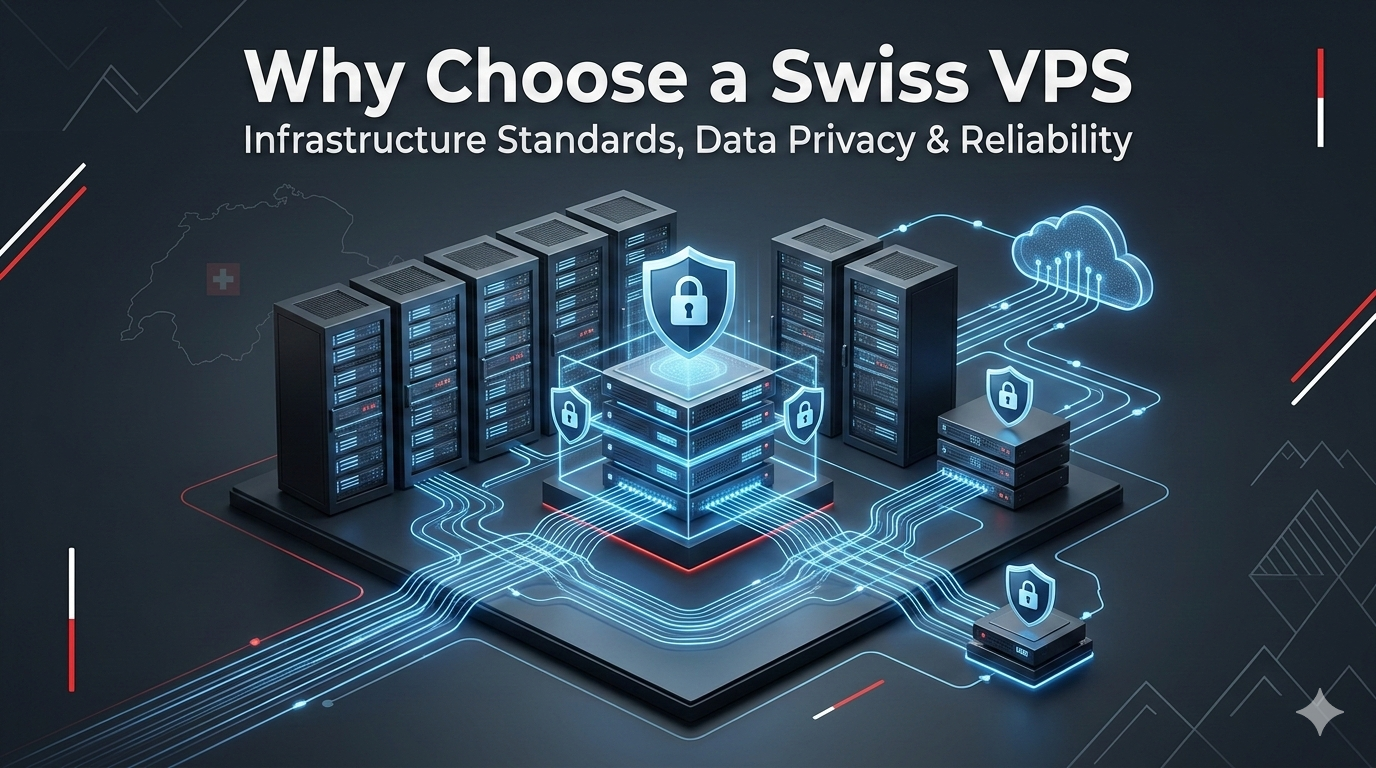
Choosing a Swiss VPS provides sovereign infrastructure isolation governed exclusively by the Swiss Federal Constitution and the revised Federal Act on Data Protection (revDSG/nFADP). Unlike servers located in the EU or US, Swiss virtual machines remain immune to extraterritorial discovery warrants like the US CLOUD Act. Deployed inside carrier-neutral Zurich Tier III facilities on pure KVM hypervisors with PCIe 4.0 NVMe arrays, a Swiss VPS combines rigorous confidentiality with 99.99% hydroelectric power uptime and sub-10ms latency across Central Europe.
Enterprises managing sensitive financial assets, confidential patient health records, and proprietary algorithms face mounting regulatory and surveillance risks across conventional hosting jurisdictions. As foreign governments expand extraterritorial subpoena powers, simply encrypting data on foreign cloud platforms no longer guarantees legal immunity. Switzerland has emerged as the premier international haven for sovereign compute infrastructure. By harmonizing strict domestic privacy laws with world-leading electrical grid reliability and central Alpine fiber routing, Swiss virtual private servers deliver an unmatched operational baseline. This technical guide analyzes the legal architecture, hardware standards, power resilience, and network routing mechanisms that make Swiss VPS hosting a vital asset for security-first organizations.
Key Technical Takeaways
- Sovereign Legal Shield: Physical hosting within Switzerland places corporate data beyond the reach of the US CLOUD Act and EU surveillance treaties, requiring Swiss court orders for lawful access.
- KVM Kernel Independence: Hardware-level KVM virtualization ensures dedicated virtual CPU scheduling, dedicated ECC RAM mapping, and complete isolation from host tenants.
- 99.99% Hydroelectric Power Grid: Swiss datacenters leverage a national power grid powered predominantly by domestic hydropower, guaranteeing operational stability and price predictability.
- Alpine Optical Fiber Peering: Stationing compute in Zurich unlocks direct layer-2 interconnects through SwissIX, delivering sub-5ms domestic latency and sub-10ms transit to Milan and Frankfurt.
- Exemption from Domestic VAT: Non-resident corporate clients purchasing Swiss hosting services enjoy full exemption from Switzerland’s domestic value-added tax (8.1% MWST).
- The Swiss Advantage: Neutrality, Sovereignty, and Legal Independence
- Understanding the Revised Swiss Data Protection Act (revDSG)
- Hardware Architecture: Enterprise KVM Nodes, DDR4/DDR5 RAM, and NVMe Arrays
- Swiss Power Infrastructure: 99.99% Reliability and Green Hydropower
- Network Sovereignty: Keeping Data Inside Swiss Optical Trunks
- Who Benefits Most: Fintech, Legal, Healthcare, and Privacy SaaS
- Frequently Asked Questions About Swiss VPS Hosting
- Secure Your Infrastructure with High-Performance Swiss VPS Hosting
The Swiss Advantage: Neutrality, Sovereignty, and Legal Independence
For over two centuries, Switzerland has maintained permanent political neutrality, codified through international treaties and reinforced by an independent federal constitution. In the digital age, this geopolitical positioning has evolved into a strategic architectural asset: digital sovereignty.
While member states of the European Union are subject to centralized European directives, cross-border intelligence-sharing pacts, and mutual assistance mechanisms that can bypass traditional judicial friction, Switzerland operates outside the EU and the European Economic Area (EEA). Swiss telecommunications law strictly prohibits unauthorized mass surveillance and state-mandated backdoors in commercial datacenters.
When an organization deploys a secure Swiss VPS hosting plans instance, its data becomes subject to the territorial sovereignty of the Swiss Confederation. Under Swiss procedural law, private property and digital assets enjoy constitutional protection under Article 13 of the Swiss Federal Constitution. Foreign law enforcement agencies—including US federal courts, intelligence agencies, or European ministries—possess zero direct legal jurisdiction on Swiss soil.
To obtain server logs, encrypted volumes, or tenant telemetry, a foreign entity must submit a formal petition under the Swiss Federal Act on International Mutual Assistance in Criminal Matters (IMAC). Swiss cantonal magistrates independently review every foreign request against strict dual-criminality standards. If the alleged offense is political, commercial, or does not constitute an extraditable crime under the Swiss Criminal Code, the request is summarily denied. This structural friction establishes a robust defense perimeter against extraterritorial data seizures.
Understanding the Revised Swiss Data Protection Act (revDSG)
On September 1, 2023, Switzerland enacted the revised Federal Act on Data Protection (revDSG, also known as the revised nFADP). This legislative overhaul updated Switzerland’s privacy regime to address modern cloud architecture, containerized workloads, and global data transfers while retaining the nation’s traditional emphasis on corporate confidentiality.
A critical consideration for international compliance officers is how the Swiss revDSG compares against the European General Data Protection Regulation (GDPR) and the United States CLOUD Act (Clarifying Lawful Overseas Use of Data Act):
Under the revDSG, corporate data controllers must implement proactive technical and organizational measures (TOMs). Deploying on a Swiss VPS simplifies this compliance requirement: because the European Commission has formally recognized Swiss data protection adequacy, EU-based organizations can transfer and process personal records on Swiss servers without executing complex Standard Contractual Clauses (SCCs) or conducting costly Transfer Impact Assessments (TIAs).
Hardware Architecture: Enterprise KVM Nodes, DDR4/DDR5 RAM, and NVMe Arrays
A sovereign legal framework is only as effective as the underlying hardware architecture supporting it. Budget hosting providers often market Swiss IP addresses while cutting corners on hypervisor technology, memory allocation, and storage bus designs.
Kernel-Based Virtual Machine (KVM) Architecture
The foundational pillar of secure virtualization is complete hypervisor isolation. OnliveServer exclusively implements Kernel-based Virtual Machine (KVM) virtualization across its Swiss server fleet.
In shared-kernel container environments (such as OpenVZ or LXC), all virtual instances share the host node’s underlying Linux kernel and process table. If a malicious actor on a neighboring container triggers a kernel vulnerability, or if a tenant monopolizes CPU timeslices, every instance on the host experiences performance degradation or potential memory leakage.
KVM provides true hardware-assisted virtualization (utilizing Intel VT-x and AMD-V instruction sets). Each virtual machine runs an independent, unmodified operating system kernel with dedicated virtual CPU (vCPU) execution threads and private virtual memory space. This architectural boundary prevents noisy-neighbor resource theft, permits custom kernel module compilation (such as WireGuard, custom iptables, or Docker daemon engines), and supports full hardware-level disk encryption without host interference.
Enterprise NVMe PCIe 4.0 Storage Subsystems
Database transactions, cryptographic processing, and modern microservices demand extreme storage I/O performance. Legacy SATA solid-state drives communicate across AHCI buses limited to a single command queue of 32 commands, capping throughput at 550 MB/s.
Enterprise Swiss VPS infrastructure utilizes Non-Volatile Memory Express (NVMe) solid-state drives operating across direct PCI-Express 4.0 lanes. Enterprise NVMe protocols support up to 64,000 independent command queues, each processing 64,000 concurrent commands. By deploying these drives in hardware RAID 10 configurations, the storage subsystem delivers over 800,000 random read/write IOPS with sub-15 microsecond latency while safeguarding data against multiple simultaneous disk failures.
Registered Error-Correcting Code (ECC) Memory
Memory corruption presents an insidious threat to mission-critical workloads. In virtualized production environments handling financial transactions or database writes, a single cosmic ray or electrical fluctuation can cause a bit-flip in RAM, resulting in silent database corruption or hypervisor kernel panics.
Swiss VPS nodes utilize registered ECC DDR4 and DDR5 memory modules. ECC hardware continuously detects and corrects single-bit errors in real time while flagging multi-bit anomalies. Furthermore, KVM hypervisors strictly pin dedicated physical memory addresses to each virtual instance, ensuring zero swap space overhead and eliminating memory exhaustion caused by neighboring workloads.
Swiss Power Infrastructure: 99.99% Reliability and Green Hydropower
High-availability hosting requires continuous, uninterrupted power. Even the most advanced hypervisor and storage array fail if electrical supply drops or voltage fluctuates.
Switzerland boasts one of the most stable and technologically advanced electrical grids in the world. The Swiss federal power transmission network, operated by Swissgrid, maintains an operational availability rating exceeding 99.99%. Over 60% of Swiss domestic electricity is generated by alpine hydroelectric power plants, supplemented by solar, wind, and run-of-river installations.
This reliance on domestic green energy provides two decisive advantages for Swiss VPS tenants:
- Energetic Independence: Unlike Central European countries that faced acute energy rationing, grid instability, and massive wholesale power price spikes during geopolitical crises, Switzerland’s domestic hydroelectric base insulates local datacenters from external supply shocks. – Predictable Infrastructure Costs: Stable, regulated renewable power generation shields Swiss datacenter operators from volatile fossil fuel surcharges, enabling long-term cost stability for VPS hosting contracts. Carrier-neutral Zurich datacenters complement this grid stability with industrial-grade physical redundancy. Facilities are engineered to Tier III and Tier IV reliability specifications, incorporating dual independent power feeds (A+B paths), N+1 to 2N rotary diesel generators with multi-day underground fuel reserves, and battery-backed Uninterruptible Power Supply (UPS) systems capable of seamless power conditioning during transient grid events.
Network Sovereignty: Keeping Data Inside Swiss Optical Trunks
A common misconception regarding cloud hosting is that network traffic travels in a straight line between the client and server. In reality, internet traffic traverses complex border gateway protocol (BGP) routing tables. If a datacenter utilizes low-tier transit carriers, packets destined for another domestic endpoint may be routed across international borders through transit nodes in Frankfurt or London before returning to Switzerland.
True data sovereignty requires network sovereignty: keeping domestic and regional traffic confined to verified, direct optical fiber paths.
The Swiss Internet Exchange (SwissIX) Ecosystem
Zurich serves as the telecommunications hub of the Swiss Confederation and houses the primary switching nodes of the Swiss Internet Exchange (SwissIX). SwissIX is an open, carrier-neutral layer-2 peering fabric interconnecting more than 200 international carriers, domestic internet service providers (Swisscom, Sunrise, Salt), financial institutions, and global cloud networks.
When your VPS is deployed inside a Zurich datacenter directly connected to SwissIX, regional data packets bypass public transit backbones entirely. Traffic between your virtual server and local Swiss enterprises, banks, and users exchanges directly over the local switching fabric. This eliminates intermediary transit hops, reduces latency to under 5 milliseconds across Swiss cantons, and prevents data packets from traversing foreign surveillance jurisdictions.
Trans-Alpine Dark Fiber Corridors
For pan-European operations, Zurich occupies an unrivaled geographic crossroads. Optical dark-fiber bundles traverse the Alpine tunnels directly into Northern Italy and follow the Rhine Valley corridor into Southern Germany:
- Zurich to Frankfurt (DE-CIX): Direct low-latency path delivering 6.8 ms to 8.5 ms round-trip time (RTT).
- Zurich to Milan (MIX): Trans-Alpine direct fiber delivering 7.2 ms to 9.4 ms RTT.
- Zurich to Paris (France-IX): Trans-continental fiber delivering 10.5 ms to 13.8 ms RTT.
- Zurich to London (LINX): Channel tunnel routing delivering 14.2 ms to 18.0 ms RTT.
These deterministic routing characteristics ensure that high-throughput database replication, real-time API transactions, and VPN tunnels maintain minimal latency and virtually zero jitter.
Who Benefits Most: Fintech, Legal, Healthcare, and Privacy SaaS
The unique combination of legal neutrality, hardware isolation, and network peering makes Swiss VPS hosting the architecture of choice for specialized commercial and technical sectors:
FinTech and Algorithmic Trading Platforms
Zurich ranks among the world’s leading financial capitals. Cryptocurrency exchanges, asset management platforms, algorithmic trading engines, and payment gateways deploy on Swiss VPS infrastructure to operate in close physical proximity to major European financial networks. Zurich datacenters meet the stringent operational outsourcing criteria established by the Swiss Financial Market Supervisory Authority (FINMA Circular 2018/3), providing the audited physical security, dual-redundant hardware, and business continuity planning required for banking-grade deployments.
Legal, Compliance, and Professional Services
International law firms, arbitration tribunals, and forensic accounting consultants handle highly confidential client disclosures, merger negotiations, and proprietary intellectual property. Hosting document management portals, Nextcloud instances, and private communication nodes on Swiss servers ensures that sensitive client communications cannot be intercepted via foreign administrative warrants or competitor discovery petitions.
Healthcare Innovators and Clinical Trials
Medical research institutes and digital health platforms process pseudonymized genomic records and clinical trial datasets governed by strict ethical and statutory constraints. Deploying within Switzerland satisfies revDSG requirements for processing sensitive personal data, providing immutable audit logging and cryptographic storage isolation.
Privacy-Preserving Software as a Service (SaaS)
Software vendors marketing end-to-end encrypted messaging, zero-knowledge cloud backups, privacy-first analytics, and secure email platforms leverage the “Hosted in Switzerland” trademark as a powerful trust differentiator. International buyers readily recognize Swiss infrastructure as a gold standard for commercial integrity and data privacy.
Frequently Asked Questions About Swiss VPS Hosting
Secure Your Infrastructure with High-Performance Swiss VPS Hosting
Deploy dedicated KVM compute inside Zurich’s premier Tier III datacenter ecosystem. Benefit from strict Swiss revDSG privacy protection, ultra-fast PCIe 4.0 NVMe storage, and direct SwissIX peering.
Explore Swiss VPS Plans →