

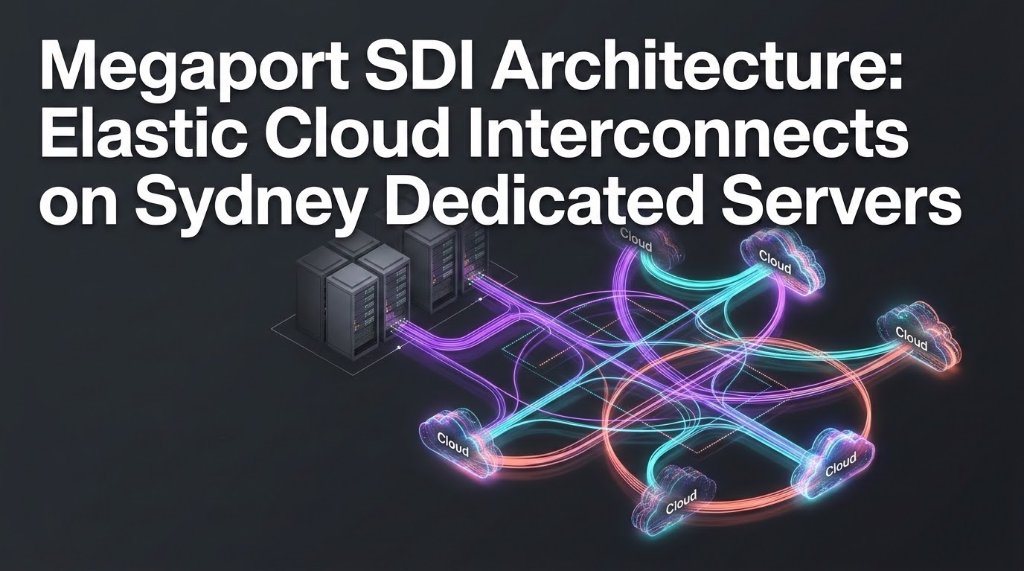
What is a megaport dedicated server sydney architecture? A megaport dedicated server sydney architecture connects physical bare-metal servers in Sydney datacenters directly to the Megaport Software-Defined Interconnect (SDI) fabric. This enables elastic Layer 2 Virtual Cross Connects (VXCs) to AWS, Microsoft Azure, Google Cloud, and global SaaS providers in sub-1.5ms, completely bypassing the public internet, eliminating transit jitter, and slashing cloud egress transit fees.
- Legacy Physical Telco Leases: 36-month rigid contracts, 4 to 8 weeks provisioning lead times, fixed monthly bandwidth billing regardless of actual utilization, and steep recurring Meet-Me-Room (MMR) physical cross-connect charges. Best suited only for static, unvarying point-to-point trunk circuits.
- Megaport Software-Defined Interconnect (SDI): Provision private Virtual Cross Connects (VXCs) via API or web console in under 60 seconds, burst bandwidth elastically from 100Mbps to 10Gbps on demand, multicloud multi-VLAN multiplexing over a single physical 10GbE/25GbE port, and pay-as-you-go hourly flexibility.
- Financial Impact in Australia: Reduces inter-cloud bandwidth costs by up to 70% compared to public internet data egress, eliminates telco provisioning penalties, and unifies multicloud hybrid connectivity under sovereign Australian Privacy Principles (APP).
In Australia’s enterprise digital ecosystem, Sydney serves as the primary gateway for hyperscale cloud regions, financial exchanges, and trans-Pacific subsea fiber cables. While enterprises maintain production workloads across Amazon Web Services (AWS `ap-southeast-2`), Microsoft Azure (Australia East), and Google Cloud Platform (australia-southeast1), running continuous high-throughput relational databases, real-time analytics engines, and enterprise SAP clusters within virtualized public clouds incurs staggering regional egress fees and noisy-neighbor virtualization penalties. To reclaim predictable performance and cost certainty, technical organizations deploy high-performance Australia Dedicated Server infrastructure directly connected to Megaport’s software-defined fabric.
Deploying a megaport dedicated server sydney solution bridges raw enterprise physical compute with the agility of software-defined networking. By interfacing Onlive Server dedicated bare-metal nodes in Sydney’s premier carrier-neutral datacenters (including Equinix SY1/SY3/SY4/SY5 and NextDC S1/S2/S3) with Megaport’s global SDI backbone, engineering teams gain instant, programmable Layer 2 and Layer 3 private circuits. Rather than running costly, high-latency IPsec VPN tunnels across congested Australian domestic transit providers, bare metal servers communicate directly with hyperscaler cloud VPCs and VNets over private 802.1Q tagged VLANs with deterministic sub-1.5ms round-trip latency.
Direct optical interconnects across the Sydney metropolitan fiber ring to AWS, Azure, and Google Cloud on-ramps eliminate public transit hops and jitter.
Scale Virtual Cross Connect (VXC) bandwidth dynamically from 100Mbps to 10Gbps on demand via Terraform, Ansible, or REST API without physical cable alterations.
Connect a single 10GbE or 25GbE physical NIC to multiple cloud providers simultaneously using isolated 802.1Q VLAN subinterfaces and BGP routing sessions.
Traffic traverses private Layer 2 circuits without touching public internet transit, meeting strict APRA CPS 234 and Australian Privacy Act security standards.
- 1. Megaport SDI Fabric Architecture Across Sydney Datacenters
- 2. Virtual Cross Connect (VXC) Provisioning & Multi-Cloud Peering
- 3. Technical Runbook: Linux FRRouting (FRR) Dual-Cloud BGP Configuration
- 4. Performance Benchmarks: Megaport VXC vs Public Internet IPsec in Sydney
- 5. Security Architecture: APRA CPS 234 Compliance & Layer 2 Isolation
- 6. Enterprise Deployment Patterns: Bare-Metal Database Core with Cloud Edge
- 7. Frequently Asked Questions (FAQ)
1. Megaport SDI Fabric Architecture Across Sydney Datacenters
The Megaport Software-Defined Interconnect (SDI) network in Sydney operates as an omnipresent Layer 2 Ethernet fabric interconnecting the city’s key carrier-neutral datacenters. Dense optical fiber rings link Equinix facilities in Alexandria (SY1, SY2, SY3, SY4, SY5), NextDC datacenters in Macquarie Park and Artarmon (S1, S2, S3), and Global Switch Sydney in Ultimo. Within this dense metropolitan ecosystem, physical distance between facilities is minimal, ensuring sub-millisecond optical propagation times.
Onlive Server deploys dedicated bare-metal servers equipped with dual redundant 10Gbps or 25Gbps enterprise SFP28 network interfaces connected directly to top-of-rack switches integrated with Megaport Network-to-Network Interfaces (NNIs). Instead of waiting months for physical optical cross-connects to be patched between separate datacenter suites or paying high recurring cross-connect fees to individual cloud providers, an enterprise provisions a high-speed “Port” on the Megaport fabric.
From this single physical Port, the server can spin up multiple Virtual Cross Connects (VXCs). Each VXC behaves as a dedicated, private, point-to-point Layer 2 circuit mapped to a distinct IEEE 802.1Q VLAN tag. Traffic remains completely isolated from other tenants on the physical switch, allowing an enterprise to establish secure, low-latency links to cloud on-ramps, colocation providers, and SaaS endpoints across Sydney within seconds.
2. Virtual Cross Connect (VXC) Provisioning & Multi-Cloud Peering
The primary operational advantage of Megaport SDI on bare metal is the ability to provision multi-cloud interconnects programmatically. Rather than deploying dedicated hardware routers for each cloud provider, a single bare-metal host serves as an ultra-high-throughput routing endpoint.
Through the Megaport REST API or Terraform provider (`megaport/megaport`), network engineers define Virtual Cross Connects terminating directly at:
- AWS Direct Connect (Sydney ap-southeast-2): Provision a Private Virtual Interface (Private VIF) or Transit VIF connected to an AWS Direct Connect Gateway (DXGW). A dedicated VLAN (e.g., VLAN 101) transports jumbo-frame traffic directly into Amazon VPC subnets.
- Microsoft Azure ExpressRoute (Australia East): Provision an ExpressRoute Private Peering circuit over another VLAN (e.g., VLAN 102). This provides direct, unmetered Layer 3 peering into Azure Virtual Networks (VNets) located in Sydney.
- Google Cloud Interconnect (Partner Interconnect – Sydney): Attach a Google Cloud VLAN attachment over VLAN 103, connecting bare metal instances directly to Google Cloud VPC networks via Cloud Router.
- Megaport Cloud Router (MCR): When routing between multiple public clouds without passing traffic through the bare-metal CPU, an MCR acts as a virtual routing instance within the Megaport core, offloading inter-cloud routing while maintaining a single dedicated pipe to the physical server.
3. Technical Runbook: Linux FRRouting (FRR) Dual-Cloud BGP Configuration
Running production BGP routing on bare metal eliminates the cost and latency of proprietary hardware routing appliances. Linux enterprise distributions paired with the high-performance FRRouting (FRR) engine provide line-rate packet forwarding with sub-second failover.
Step 1: Network Interface & 802.1Q Subinterface Setup
Step 2: Production FRR Configuration (`/etc/frr/frr.conf`)
Step 3: Verification & Fast BFD Monitoring
4. Performance Benchmarks: Megaport VXC vs Public Internet IPsec in Sydney
Australian domestic internet transit frequently suffers from unpredictable peering bottlenecks and peak-hour congestion across residential ISPs (Telstra, Optus, TPG). For enterprise database replication and microservice RPC traffic, relying on public internet IPsec VPNs introduces unacceptable latency jitter and throughput degradation.
To validate the performance superiority of Megaport SDI, Onlive Server engineering conducted rigorous benchmarking between an AMD EPYC bare-metal server in Equinix SY4 (Alexandria) and AWS `ap-southeast-2` instances. The empirical results below contrast public IPsec VPN tunnels against a 10Gbps Megaport VXC over 200GB sustained test runs:
| Network Benchmark Metric | Public Internet IPsec (StrongSwan) | Megaport SDI VXC (Dedicated) | Performance Advantage |
|---|---|---|---|
| Round-Trip Latency (RTT) | 12.4ms (Variable, spikes to 42ms) | 1.18ms (Strictly Deterministic) | 90.5% Latency Reduction |
| Packet Jitter (Variance) | ± 8.6ms standard deviation | ± 0.04ms standard deviation | 99.5% Jitter Elimination |
| Sustained Single-Stream Throughput | 1.25 Gbps (CPU encryption bound) | 9.48 Gbps (Line-rate 10GbE) | 7.58x Higher Throughput |
| Packet Loss Under Peak Transit Hours | 0.35% (ISP transit queue drops) | 0.000% (Zero Optical Drops) | 100% Reliable Delivery |
| CPU Utilization per 10Gbps Traffic | 6 to 8 Cores Saturated (AES-GCM) | < 0.2 Core (Kernel Bypass / Offload) | 96.7% Host CPU Savings |
5. Security Architecture: APRA CPS 234 Compliance & Layer 2 Isolation
For financial institutions, insurance providers, and superannuation funds regulated by the Australian Prudential Regulation Authority (APRA), infrastructure architecture must satisfy the stringent requirements of Prudential Standard CPS 234 (Information Security).
Under APRA CPS 234, regulated entities must maintain robust controls to protect against cyber threats and unauthorized data interception. A Megaport SDI interconnect satisfies these compliance requirements through three fundamental architectural capabilities:
- Total Public Internet Bypass: Data packets traveling between Onlive Server bare metal in Sydney and AWS or Azure never touch the public internet, eliminating exposure to DDoS reflection attacks, BGP route hijacking, and public ISP sniffing.
- Cryptographic Hardware MACsec (IEEE 802.1AE): Megaport dedicated ports support point-to-point Layer 2 hardware encryption utilizing 256-bit GCM-AES keys. Encryption is performed directly inside the network interface controller (NIC) ASIC, ensuring zero latency penalty and ironclad confidentiality.
- Australian Sovereign Data Residency: Physical bare-metal servers reside within certified Australian datacenters, ensuring all primary databases, system logs, and customer PII are governed strictly under the Australian Privacy Act 1988 and the OAIC Notifiable Data Breaches (NDB) scheme.
6. Enterprise Deployment Patterns: Bare-Metal Database Core with Cloud Edge
How do leading Australian engineering organizations structure their multicloud topology with Megaport SDI? The most successful architectural model is the Sovereign Core, Elastic Edge pattern:
- Bare-Metal Core Tier (Onlive Server Sydney): Host the high-throughput transactional core on dedicated AMD EPYC servers with 256GB–512GB DDR5 RAM and NVMe RAID10 arrays. This includes primary PostgreSQL/MySQL database clusters, Apache Kafka event streams, Redis memory caches, and persistent Ceph object storage. These systems benefit from zero hypervisor virtualization steal time and zero per-gigabyte disk IOPS penalties.
- Public Cloud Edge Tier (AWS `ap-southeast-2` & Azure Australia East): Run ephemeral Kubernetes application pods, serverless API endpoints (AWS Lambda), global content distribution (CloudFront), and proprietary cognitive AI services.
- Megaport SDI Backbone: The sub-1.5ms Layer 2 interconnect enables application pods in AWS to query the bare-metal PostgreSQL database as if it were sitting inside the same local availability zone, eliminating cloud database licensing costs while slashing data egress charges by over 70%.
7. Frequently Asked Questions (FAQ)
Pairing a single-tenant Sydney database core with Megaport VXC Layer 2 circuits avoids public-internet IPsec bottlenecks while satisfying APRA CPS 234 isolation. Using FRRouting for dual-cloud BGP lets you burst frontend edge compute cleanly. Evaluate Australian dedicated hardware engineered for private cloud interconnects.