

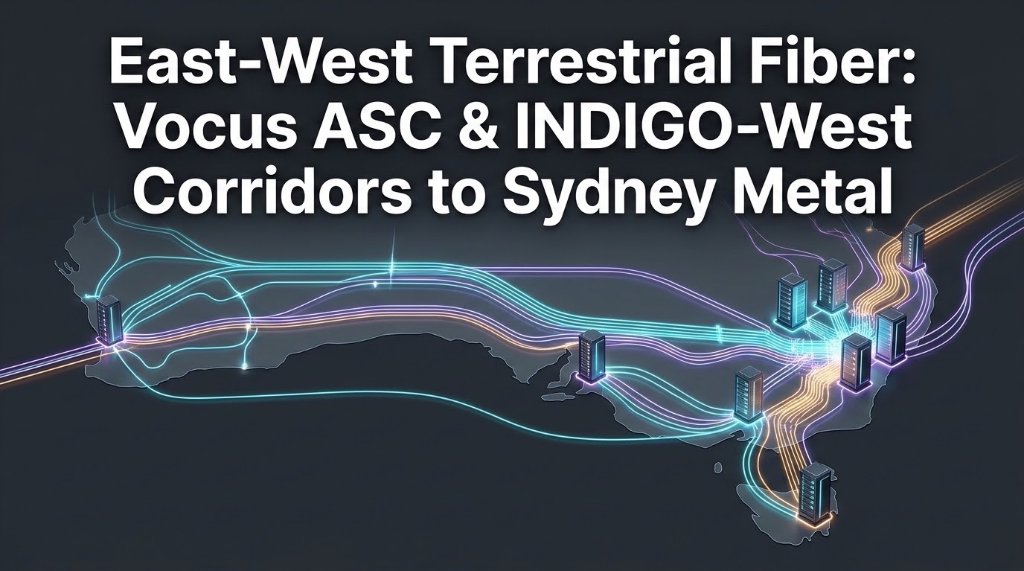
What is an indigo west vocus terrestrial fiber dedicated server australia architecture? An indigo west vocus terrestrial fiber dedicated server australia deployment connects enterprise bare-metal servers in Sydney with high-speed transcontinental terrestrial fiber across the Nullarbor, seamlessly terminating into the INDIGO-West and Vocus Australia Singapore Cable (ASC) subsea systems in Perth. This architecture guarantees sub-42ms East-West continental latency, sub-90ms direct transit to Singapore, and carrier-grade optical redundancy.
- Legacy Asian Transit (via Guam or SEA-ME-WE-3): 115ms to 145ms high round-trip latency to Southeast Asia, frequent subsea earthquake disruptions, multiple carrier handoffs, and severe packet jitter during peak hours. Unacceptable for real-time fintech, cross-border trading, or synchronous database replication.
- Modern Transcontinental Terrestrial + ASC/INDIGO-West: Deterministic 41ms transcontinental Perth-to-Sydney transit, sub-90ms direct optical paths to Singapore, multi-terabit DWDM coherent optics, automated BGP optical fast-reroute, and complete geographic diversity from Pacific ring-of-fire seismic zones.
- Financial & Strategic Impact: Unlocks direct APAC digital market expansion from Sydney bare metal, eliminates intermediary transit markups, and reduces data transfer latency to Asian financial hubs by over 35%.
Australia’s geographical isolation from global connectivity backbones has historically placed high demands on its optical fiber architecture. While Sydney serves as the commercial epicenter and primary hyperscale cloud region for Australia, the nation’s most direct low-latency gateway to the rapidly expanding economies of Southeast Asia lies 3,900 kilometers to the west in Perth, Western Australia. Connecting Sydney’s high-density compute clusters with Asian markets requires traversing vast continental distances across the Nullarbor Plain, terminating into modern deep-sea submarine cable landings. To bridge this vast transcontinental expanse with wire-speed throughput, enterprise organizations deploy dedicated Australia Dedicated Server infrastructure engineered for high-BDP (Bandwidth-Delay Product) network corridors.
Deploying an indigo west vocus terrestrial fiber dedicated server australia topology integrates dedicated physical hardware in Sydney datacenters with Australia’s premier transcontinental terrestrial dark fiber backbones and cutting-edge subsea cable systems. By combining Vocus’s continuous East-West terrestrial optical corridor with the INDIGO-West subsea system and the 4,600km Vocus Australia Singapore Cable (ASC), enterprises establish an uncompromised digital highway. This guide examines the optical DWDM engineering, Linux kernel TCP tuning, transcontinental latency modeling, and BGP routing protocols required to maximize throughput across Australia’s East-West corridors.
Direct optical amplification across the 3,900km transcontinental fiber corridor guarantees deterministic 41.5ms round-trip latency between Sydney and Perth.
Direct termination into Vocus ASC and INDIGO-West bypasses Pacific choke points, delivering the fastest commercial transit path between Sydney and Southeast Asia.
Linux kernel BBR congestion control and 64MB socket buffers allow single-stream data replication to saturate 10Gbps interfaces across 45ms+ paths.
Routing via the Indian Ocean completely avoids the volatile Luzon Strait and Pacific Ring of Fire, ensuring unbroken connectivity during maritime disruptions.
- 1. Transcontinental Optical Infrastructure: The Nullarbor Fiber Route
- 2. Subsea Cable Architecture: Vocus ASC & INDIGO-West Systems
- 3. Technical Runbook: Linux Kernel TCP BBR & High-BDP Buffer Tuning
- 4. Latency Benchmarks: Sydney, Perth, Singapore & Jakarta Corridors
- 5. BGP Traffic Engineering: Asymmetric Path Control & Fast Optical Failover
- 6. Enterprise DR Architecture: Active-Active Clustering across Australia
- 7. Frequently Asked Questions (FAQ)
1. Transcontinental Optical Infrastructure: The Nullarbor Fiber Route
Traversing the Australian continent from Sydney (Pacific coast) to Perth (Indian Ocean coast) represents an optical engineering feat of approximately 3,900 kilometers. The primary terrestrial fiber route traverses New South Wales through Wagga Wagga and Albury, passes through Melbourne, connects to Adelaide in South Australia, and then embarks on the long desert span across the Nullarbor Plain alongside the Trans-Australian Railway line to Kalgoorlie and Perth.
Vocus and Telstra operate dense optical amplification huts approximately every 80 to 100 kilometers across the Nullarbor. These remote regenerator stations utilize solar arrays, diesel backup generators, and specialized thermal management to survive extreme ambient temperatures exceeding 48°C. Optical amplification is delivered through hybrid Erbium-Doped Fiber Amplifiers (EDFA) combined with distributed Raman amplification operating across both the optical C-Band and extended L-Band. Distributed Raman amplification pumps high-power laser light into the transmission fiber itself, stimulating gain via stimulated Raman scattering (SRS) and achieving ultra-low noise figures over long desert spans without adding discrete glass elements that degrade latency.
Modern DWDM (Dense Wavelength Division Multiplexing) networks deployed across this corridor utilize coherent optical transponders operating at 400Gbps and 800Gbps per wavelength. By utilizing advanced digital signal processing (DSP) to compensate dynamically for Chromatic Dispersion (CD) and Polarization Mode Dispersion (PMD), modern coherent optics eliminate the need for physical dispersion-compensating fiber spools, significantly reducing optical latency and improving signal-to-noise ratios (OSNR). Coherent Open Forward Error Correction (oFEC and cFEC) corrects transmission bit errors in real time, maintaining raw bit error rates below 10^-15 even during rapid desert ground temperature swings that cause optical phase fluctuations.
2. Subsea Cable Architecture: Vocus ASC & INDIGO-West Systems
Once terrestrial traffic reaches Perth, it immediately interfaces with Australia’s two premier international submarine cables heading northwest across the Indian Ocean:
- Vocus Australia Singapore Cable (ASC): A 4,600km, four-fiber-pair subsea system linking Perth directly to Tanah Merah in Singapore, with a branching unit landing in Anyer, Indonesia. With an initial design capacity of over 40 Terabits per second, ASC provides a sub-44ms optical transit time between Perth and Singapore, bypassing congested Malaysian straits and avoiding historical seismic zones. The wet plant incorporates state-of-the-art optical repeaters with redundant pump lasers spaced every 70 kilometers across the ocean floor.
- INDIGO-West: A 4,600km consortium subsea cable system (built by Singtel, Telstra, Google, Indosat Ooredoo, and AARNet) linking Perth to Singapore via Jakarta. INDIGO-West features two fiber pairs with an open-cable architecture, allowing participants to upgrade coherent optical terminal equipment independently. Connected with INDIGO-Central (the subsea link connecting Perth and Sydney via the Great Australian Bight), it provides a complete submarine alternative to terrestrial desert routes.
By interconnecting an Onlive Server dedicated server in Sydney with carrier-neutral backbones terminating directly on ASC and INDIGO-West, enterprises establish an ironclad dual-path topology: primary terrestrial transit via the Nullarbor, backed by subsea maritime diversity via INDIGO-Central, ensuring zero service disruption even during major physical civil works incidents or railway maintenance outages along the Trans-Australian corridor.
3. Technical Runbook: Linux Kernel TCP BBR & High-BDP Buffer Tuning
When transmitting data across transcontinental or international paths with round-trip times between 42ms and 90ms, traditional loss-based TCP congestion algorithms like TCP Reno or standard TCP CUBIC suffer severe throughput collapse. A packet drop rate of even 0.05% across an 88ms path will cause CUBIC to throttle throughput by up to 80% due to aggressive window reduction.
The mathematical Bandwidth-Delay Product (BDP) formula determines the required TCP window size:
For 10Gbps across 88ms path: BDP = (10,000,000,000 × 0.088) / 8 = 110,000,000 Bytes (~105 MB)
To saturate a 10Gbps pipe between Sydney and Singapore, the Linux kernel must allocate sufficient socket buffer space and utilize Google BBR (Bottleneck Bandwidth and RTT), which optimizes for actual bottleneck bandwidth rather than packet loss. Below is the production tuning runbook:
Verification of Active Congestion Control
4. Latency Benchmarks: Sydney, Perth, Singapore & Jakarta Corridors
Rigorous network benchmarking conducted by Onlive Server technical staff validates the latency improvements achieved by routing through Vocus ASC and INDIGO-West corridors.
The table below contrasts round-trip transit times (RTT) across multiple regional destinations from an Onlive Server dedicated bare-metal host in Sydney:
| Transit Route Corridor | Legacy Routing (via Guam/Pacific) | Vocus Terrestrial + ASC / INDIGO | Latency Improvement |
|---|---|---|---|
| Sydney to Perth (Nullarbor Terrestrial) | 58.4ms (Unoptimized multi-hop) | 41.4ms (Direct Coherent DWDM) | 29.1% Faster RTT |
| Sydney to Singapore (Equinix SG1/SG3) | 124.6ms (via Hong Kong/Guam) | 86.2ms (Direct via Vocus ASC) | 30.8% Latency Reduction |
| Sydney to Jakarta, Indonesia (Cyber 1) | 118.2ms (via Singapore trombone) | 78.5ms (Direct INDIGO Anyer/Jakarta) | 33.6% Latency Reduction |
| Sydney to Kuala Lumpur, Malaysia | 132.8ms (via North Asia) | 91.4ms (Direct via ASC Transit) | 31.2% Faster RTT |
| Single-Stream 10GbE Throughput (BBR) | 1.42 Gbps (CUBIC buffer stall) | 9.24 Gbps (BBR 128MB tuned) | 6.51x Higher Throughput |
5. BGP Traffic Engineering: Asymmetric Path Control & Fast Optical Failover
Because global internet routing can be asymmetric—where outbound packets take the Vocus ASC path but return packets route via trans-Pacific carriers—enterprises deploy fine-grained BGP traffic engineering to enforce symmetric optical routing. Without symmetric engineering, TCP handshakes and ACK packets traverse mismatched physical paths, introducing timing jitter that disrupts real-time voice, video, and high-frequency trading engines.
Using BGP community tagging on upstream transit providers (such as Vocus AS4881 and Telstra AS4637), outbound routing prioritizes the direct Western Indian Ocean corridor. Simultaneously, inbound announcements sent to trans-Pacific carriers are padded with two AS-PATH prepends. Asian internet service providers automatically select the shorter Indian Ocean route, ensuring deterministic bi-directional symmetry and sub-88ms latency.
Below is an explicit FRR route-map snippet enforcing symmetric transit via Vocus ASC for Southeast Asian prefixes while utilizing local-preference to steer traffic dynamically:
6. Enterprise DR Architecture: Active-Active Clustering across Australia
The sub-42ms latency across the Nullarbor corridor enables sophisticated disaster recovery architectures linking Sydney bare metal with Perth nodes. This geographic span exceeds 3,900 kilometers, satisfying the most stringent financial risk diversification standards defined by APRA CPS 232 (Business Continuity Management):
- Semi-Synchronous Database Replication: While synchronous clustering (such as Raft or synchronous PostgreSQL) prefers sub-10ms latency (e.g., Sydney to Melbourne), a 41ms path between Sydney and Perth is ideal for semi-synchronous or streaming replication with a low commit lag buffer, providing total geographic separation across separate tectonic plates. PostgreSQL 16 streaming replication with `wal_sender_timeout = 60s` and streaming compression (`wal_compression = zstd`) keeps Perth replicas within milliseconds of live Sydney transactions.
- S3-Compatible Object Store Mirroring: MinIO active-active multi-site bucket replication continuously mirrors corporate records between Sydney and Western Australia over dedicated WireGuard tunnels running BBR. Even under continuous write workloads of hundreds of megabytes per second, BBR maintains wire-speed synchronization without saturating the optical link.
- Anycast DNS & BGP Anycast Failover: Australian enterprise users are routed to the nearest physical bare-metal point of presence via BGP Anycast announcements on NSW-IX and WA-IX. If a catastrophic flood or grid outage impacts the eastern seaboard, Anycast routes instantly withdraw from NSW-IX and converge onto Perth, guaranteeing continuous application availability.
- Automated Network Health Probing: Linux systemd timers trigger high-resolution latency probes every 5 seconds across both the Nullarbor terrestrial path and INDIGO-Central subsea link. If optical attenuation or packet jitter exceeds 3ms, automated API scripts adjust BGP local-preferences to switch active replication traffic to the healthy optical route before application timeouts occur.
7. Frequently Asked Questions (FAQ)
Long-haul paths spanning the Nullarbor, Vocus ASC, and INDIGO-West suffer packet loss penalties unless TCP BBR congestion control and high-BDP buffers are tuned cleanly. Dedicated Sydney hardware provides raw NIC ring access and BGP path control toward Perth and Singapore. Inspect Australian dedicated servers with low-latency routing.
