

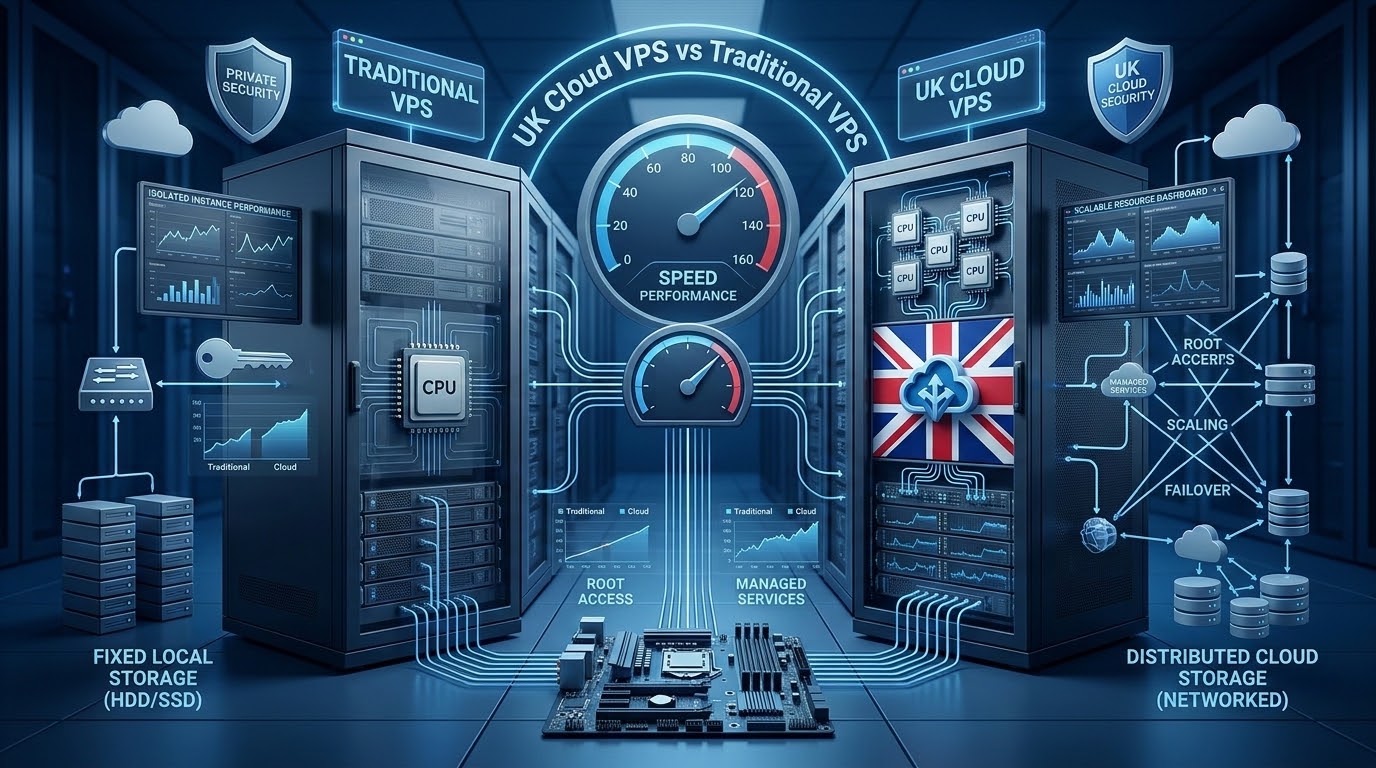
A Traditional VPS runs on a single physical host node where hardware failure causes server downtime until physical repairs are completed. In contrast, a Cloud VPS operates across a distributed multi-node SAN/Ceph storage cluster. As a result, it enables automatic instant failover and live migration to an alternate node if an underlying physical server experiences a hardware fault.
Demystifying Hosting Buzzwords: Cloud VPS vs Traditional VPS
Deploying mission-critical web applications across the British Isles requires predictable compute performance, dedicated input/output throughput, and verified legal data sovereignty. Therefore, when evaluating infrastructure options, choosing reliable UK cloud VPS infrastructure ensures your digital assets benefit from unshared vCPU compute cycles and sub-15ms round-trip network routing to end users across England, Scotland, Wales, and Northern Ireland.
Why the Cloud vs Standard VPS Distinction Matters
It is important to clarify the confusing marketing jargon around ‘Cloud VPS’ vs ‘Standard VPS’ and understand how redundant storage and localized London networking keep businesses online. Specifically, by deploying isolated KVM hardware profiles backed by PCIe Gen4 NVMe storage arrays, modern UK virtual private servers eliminate neighbor contention. Consequently, they safeguard system responsiveness during high-concurrency traffic surges.
Storage Architecture: Local NVMe Drives vs Distributed SAN/Ceph Storage
The decision between local and distributed storage hinges on the fundamental balance between financial overhead, administrative control, and resource elasticity. Furthermore, each virtualization and hosting architecture serves distinct operational phases in a digital business’s lifecycle. Therefore, understanding both approaches is essential before committing to an infrastructure strategy.
Distributed Ceph Storage and High-Availability Clusters
Distributed cloud infrastructure replicates disk images across redundant storage pools, as detailed in the official Ceph Block Device documentation for high-availability clusters. Moreover, distributed cloud architectures maximize read/write performance when coupled with high-speed PCIe NVMe enterprise storage across redundant storage nodes.
When to Choose Each Storage Model
While lightweight web assets can operate within shared constraints, scaling e-commerce platforms and multi-tenant applications demand strict compute isolation. Specifically, assessing your application concurrency against guaranteed RAM limits ensures optimal capital efficiency. As a result, you avoid unexpected system downtime and unplanned infrastructure costs.
Fault Tolerance & Automated Hardware Failover Mechanisms
Building a hosting environment engineered for continuous reliability requires carrier-grade hardware equipped with enterprise AMD EPYC or Intel Xeon processors. These processors guarantee stable CPU clock cycles across all running instances. Furthermore, their performance characteristics make them particularly suited for high-computational-density workloads under sustained load.
London Peering and UK Broadband Transit Uplinks
In addition, colocation within primary London telecommunications hubs provides resilient transit uplinks to major UK consumer broadband networks. These include BT, Virgin Media, Sky, and TalkTalk. Consequently, end users across the country receive an exceptional browsing experience regardless of their ISP or geographic location within the British Isles.
| Feature / Architecture | Generic Budget VPS Host | OnliveServer Tier-3 UK VPS |
|---|---|---|
| Virtualization Type | OpenVZ / LXC (Oversold Shared Memory) | ✓ Hardware KVM (Guaranteed RAM & vCPU) |
| Storage Array | SATA SSD / Mixed Arrays | ✓ Pure Enterprise PCIe Gen4 NVMe |
| Network Uplink | Shared 100Mbps with Data Caps | ✓ 1Gbps Unmetered Port with LINX Peering |
| Data Centre Hub | Vague European Routing | ✓ London Tier-3 (Equinix / Telehouse) |
| Compliance & Law | Unspecified Jurisdiction | ✓ 100% UK GDPR & Data Protection Act 2018 |
Cost Structure: Predictable Monthly Billing vs Dynamic Cloud Metering
The decision between predictable billing and dynamic cloud metering hinges on the fundamental balance between financial overhead, administrative control, and resource elasticity. Specifically, each virtualization and hosting architecture serves distinct operational phases in a digital business’s lifecycle. Therefore, choosing the wrong model can lead to either budget overruns or performance bottlenecks.
Backup and Disaster Recovery Considerations
High availability at the hypervisor layer should always be paired with automated snapshot backup and disaster recovery policies to protect against application corruption. Consequently, even in worst-case failure scenarios, your data remains recoverable and business continuity is maintained.
Scaling E-Commerce and Multi-Tenant Applications
While lightweight web assets can operate within shared constraints, scaling e-commerce platforms and multi-tenant applications demand strict compute isolation. Furthermore, assessing your specific application concurrency against guaranteed RAM limits ensures optimal capital efficiency. As a result, unexpected system downtime is avoided without overspending on idle resources.
Which Option Delivers Better Value for UK Small Businesses?
Selecting between Cloud VPS and Traditional VPS requires a hosting environment engineered for continuous reliability and high computational density. Specifically, deploying on carrier-grade hardware equipped with enterprise AMD EPYC or Intel Xeon processors guarantees stable CPU clock cycles across all running instances. Therefore, both architecture types can serve UK businesses well when matched correctly to their workload requirements.
Guaranteed Isolation vs Shared Resource Pools
For small to mid-sized UK businesses, the critical differentiator is resource guarantee. Specifically, traditional VPS offers a cost-effective entry point for low-traffic sites. However, cloud VPS delivers superior resilience for revenue-generating applications. Furthermore, colocation within primary London telecommunications hubs provides resilient transit uplinks to major UK consumer broadband networks including BT, Virgin Media, Sky, and TalkTalk. As a result, end-user experience is consistently excellent regardless of which architecture is chosen, provided the right tier is selected.
UK GDPR and Data Sovereignty Requirements
Additionally, UK GDPR and the Data Protection Act 2018 mandate that customer personal data must be stored and processed under ICO oversight. Consequently, hosting within certified UK-sovereign datacenters is not merely a performance decision but a legal requirement for businesses serving British consumers. Therefore, always verify the physical data location before signing any hosting contract.
📌 Key Architectural Takeaways
- Guaranteed Hardware Allocation: Strict KVM hypervisor isolation ensures your assigned vCPU cores and system RAM cannot be throttled or contended by external neighbor workloads.
- Sub-Millisecond I/O Throughput: Enterprise PCIe Gen4 NVMe arrays eliminate storage wait bottlenecks during high-frequency database commits and dynamic application executions.
- Domestic London Peering: Data centre placement with direct links to the London Internet Exchange (LINX) ensures sub-15ms round-trip latency across the British Isles.
- Regulatory Sovereignty: Storing customer records within UK national borders fulfills the Data Protection Act 2018 and UK GDPR requirements under ICO oversight.
Demand Automatic Failover & Distributed Ceph Storage Redundancy?
Safeguard your mission-critical web applications with UK Cloud VPS hosting. Benefit from distributed multi-node SAN arrays, live snapshotting, and seamless vertical scaling.
