

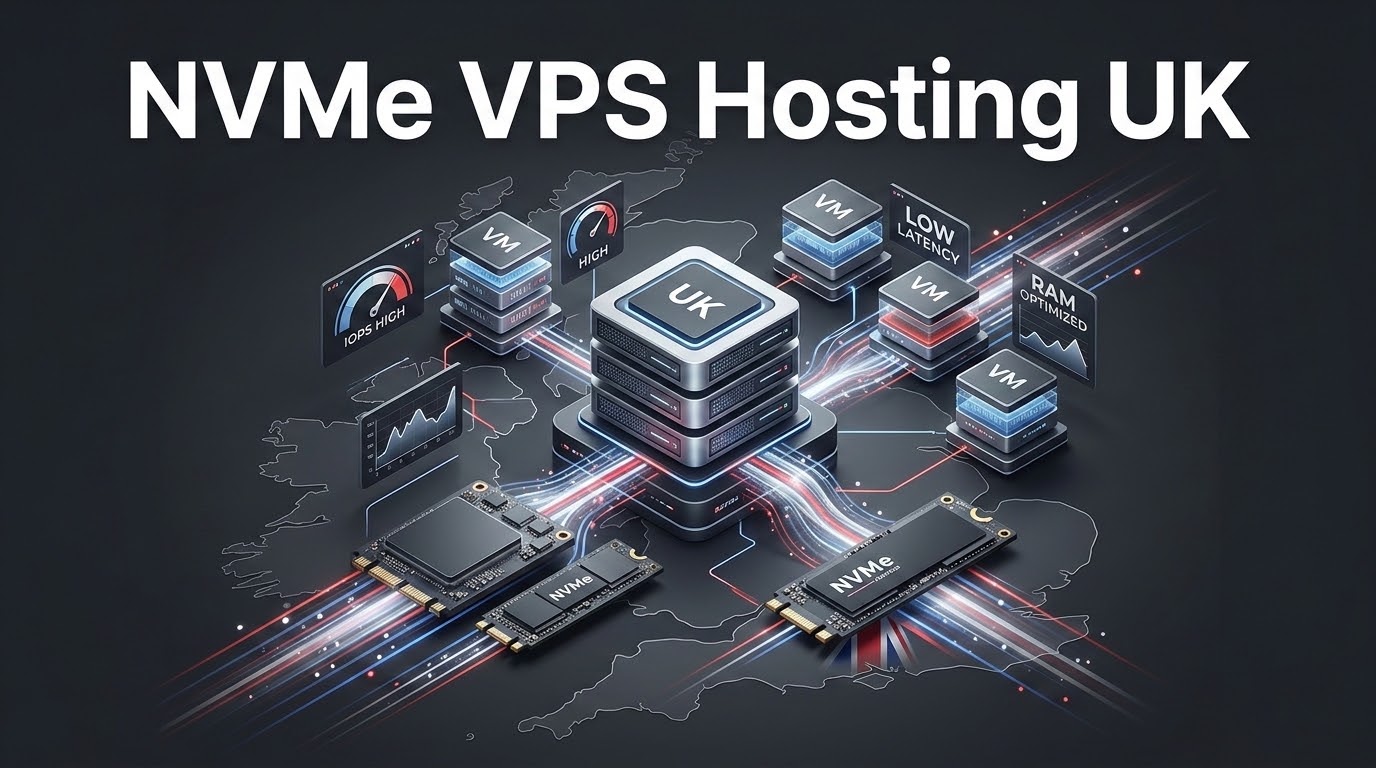
Specifically, when planning an enterprise deployment for nvme vps hosting uk, pCIe Gen4 NVMe delivers read/write throughput up to 7,000 MB/s and over 500,000 IOPS, compared to SATA SSDs capped at 550 MB/s and ~75,000 IOPS. For relational databases (MySQL/PostgreSQL), NVMe storage eliminates disk I/O wait bottlenecks, completing random transactional writes up to 6x faster under heavy traffic loads.
nvme vps hosting uk: Why Storage Speed is the Real Bottleneck on Modern Virtual Servers
Furthermore, deploying mission-critical web applications across the British Isles requires predictable compute performance, dedicated input/output throughput, and verified legal data sovereignty. When evaluating infrastructure options, choosing reliable NVMe-powered UK VPS ensures your digital assets benefit from unshared vCPU compute cycles and sub-15ms round-trip network routing to end users in England, Scotland, Wales, and Northern Ireland.
Consequently, aligning these configurations with your nvme vps hosting uk environment ensures optimal uptime and throughput. Break down the engineering reality behind modern storage protocols, demonstrating why NVMe SSDs completely outshine legacy SATA drives for database workloads. By deploying isolated KVM hardware profiles backed by PCIe Gen4 NVMe storage arrays, modern UK virtual private servers eliminate neighbor contention and safeguard system responsiveness during high-concurrency traffic surges.
nvme vps hosting uk: Technical Deep Dive: SATA AHCI Protocol vs PCIe NVMe Architecture
Consequently, aligning these configurations with your nvme vps hosting uk environment ensures optimal uptime and throughput. When analyzing Technical Deep Dive: SATA AHCI Protocol vs PCIe NVMe Architecture, the decision hinges on the fundamental balance between financial overhead, administrative control, and resource elasticity. Each virtualization and hosting architecture serves distinct operational phases in a digital business’s lifecycle.
Consequently, unlike traditional SATA storage limited to 32 commands in a single queue, enterprise NVMe storage scales to 64,000 queues pursuant to the official NVM Express architectural specifications.
In addition, direct hardware pass-through and unshared disk controllers maximize hypervisor storage throughput in KVM environments over traditional container setups.
Consequently, aligning these configurations with your nvme vps hosting uk environment ensures optimal uptime and throughput. While lightweight web assets can operate within shared constraints, scaling e-commerce platforms and multi-tenant applications demand strict compute isolation as highlighted in Technical Deep Dive: SATA AHCI Protocol vs PCIe NVMe Architecture. Assessing your specific application concurrency against guaranteed RAM limits ensures optimal capital efficiency without risking unexpected system downtime.
Real-World Benchmark: FIO Read/Write IOPS Comparison
In particular, when analyzing Real-World Benchmark: FIO Read/Write IOPS Comparison, the decision hinges on the fundamental balance between financial overhead, administrative control, and resource elasticity. Each virtualization and hosting architecture serves distinct operational phases in a digital business’s lifecycle.
While lightweight web assets can operate within shared constraints, scaling e-commerce platforms and multi-tenant applications demand strict compute isolation as highlighted in Real-World Benchmark: FIO Read/Write IOPS Comparison. Assessing your specific application concurrency against guaranteed RAM limits ensures optimal capital efficiency without risking unexpected system downtime.
| Feature / Architecture | Legacy SATA SSD VPS | Enterprise PCIe Gen4 NVMe VPS |
|---|---|---|
| Interface Protocol | Legacy SATA III (AHCI Protocol) | ✓ PCIe Gen4 x4 Bus (Direct to CPU) |
| Sequential Read Speed | Max 550 MB/s | ✓ Up to 7,000 MB/s (12x Faster) |
| Random 4K IOPS | ~75,000 IOPS Maximum | ✓ Over 500,000 IOPS |
| Storage Queue Depth | 1 Command Queue (32 Commands) | ✓ 64,000 Queues (64,000 Commands Each) |
| Database Latency | 1.2ms to 2.5ms Access Time | ✓ Sub-0.2ms Ultra-Low Latency |
Impact on Dynamic Database Queries: MySQL Index Scanning & Complex Joins
Therefore, addressing the challenges associated with Impact on Dynamic Database Queries: MySQL Index Scanning & Complex Joins requires a hosting environment engineered for continuous reliability and high computational density. Deploying on carrier-grade hardware equipped with enterprise AMD EPYC or Intel Xeon processors guarantees stable CPU clock cycles across all running instances.
Moreover, discover how enterprise solid-state disk arrays integrate within a high-availability cloud VPS cluster architecture to deliver redundant distributed block storage.
In addition, colocation within primary London telecommunications hubs provides resilient transit uplinks to major UK consumer broadband networks including BT, Virgin Media, Sky, and TalkTalk, delivering an exceptional end-user experience for Impact on Dynamic Database Queries: MySQL Index Scanning & Complex Joins workloads across the country.
Hardware Transparency: How OnliveServer Provisions Gen4 NVMe Drives
Addressing the challenges associated with Hardware Transparency: How OnliveServer Provisions Gen4 NVMe Drives requires a hosting environment engineered for continuous reliability and high computational density. Deploying on carrier-grade hardware equipped with enterprise AMD EPYC or Intel Xeon processors guarantees stable CPU clock cycles across all running instances.
In addition, colocation within primary London telecommunications hubs provides resilient transit uplinks to major UK consumer broadband networks including BT, Virgin Media, Sky, and TalkTalk, delivering an exceptional end-user experience for Hardware Transparency: How OnliveServer Provisions Gen4 NVMe Drives workloads across the country.
- In fact, Guaranteed Hardware Allocation: Strict KVM hypervisor isolation ensures your assigned vCPU cores and system RAM cannot be throttled or contended by external neighbor workloads.
- Sub-Millisecond I/O Throughput: Enterprise PCIe Gen4 NVMe arrays eliminate storage wait bottlenecks during high-frequency database commits and dynamic application executions.
- Domestic London Peering: Data centre placement with direct links to the London Internet Exchange (LINX) ensures sub-15ms round-trip latency across the British Isles.
- Regulatory Sovereignty: Storing customer records within UK national borders fulfills the Data Protection Act 2018 and UK GDPR requirements under ICO oversight.
Suffering from Disk Wait Bottlenecks and Slow SQL Query Queues?
Experience up to 10x faster disk I/O and over 200,000 random 4K IOPS with enterprise PCIe Gen4 NVMe arrays, completely eliminating disk contention during traffic surges.
