

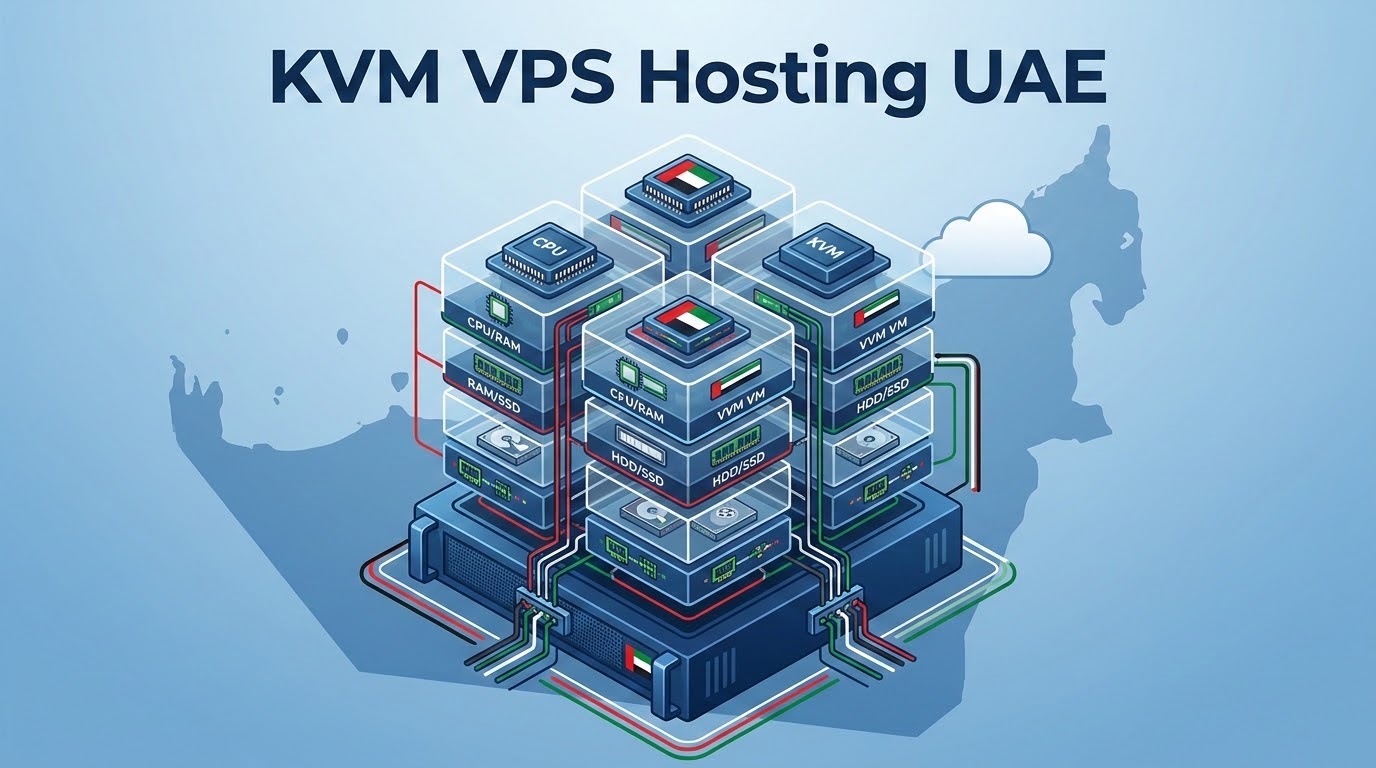
Why Does KVM Kernel-Level Virtualization Outperform Containerized Hosting on UAE Cloud?
Specifically, when planning an enterprise deployment for KVM VPS hosting UAE, kVM (Kernel-based Virtual Machine) provides true hardware-assisted Type-1 hypervisor virtualization, assigning dedicated physical RAM blocks and isolated virtual CPU cores that prevent resource overselling. Unlike shared containers (OpenVZ/LXC), KVM guarantees sub-0.5% CPU steal times, unthrottled NVMe IOPS, and full support for custom kernels and WireGuard VPNs.
- Consequently, aligning these configurations with your KVM VPS hosting UAE environment ensures optimal uptime and throughput. True Hardware Virtualization: Kernel-based Virtual Machine (KVM) turns the Linux host kernel into a Type-1 hypervisor, assigning dedicated virtual hardware (vCPU, RAM, NVMe storage) with absolute process isolation.
- Consequently, aligning these configurations with your KVM VPS hosting UAE environment ensures optimal uptime and throughput. Zero Resource Overselling: Unlike container-based virtualization (OpenVZ/LXC) where host memory is shared dynamically, KVM hard-allocates physical RAM blocks, eliminating “noisy neighbor” syndrome during Gulf traffic surges.
- Furthermore, Custom Kernel Modules: KVM allows tenants to load custom kernel modules, run WireGuard VPNs, enable BBR congestion control, and boot any operating system from custom ISO images.
- Consequently, High-Performance Infrastructure: Deploying OnliveServer hardware-isolated UAE KVM VPS hosting on pure KVM hypervisors ensures sub-1% CPU steal times, unthrottled NVMe IOPS, and tier-1 GCC latency.
KVM VPS hosting UAE: Introduction: The Critical Role of Hypervisor Architecture in Gulf Cloud Computing
In addition, as digital transformation accelerates across the United Arab Emirates, corporate enterprises, government suppliers, and high-growth startups are migrating mission-critical applications from legacy shared hosting and unmanaged dedicated servers into cloud environments. However, many infrastructure engineers overlook the foundational layer of cloud computing: the hypervisor virtualization technology separating guest virtual machines from physical server silicon.
In particular, in low-cost hosting environments, budget hosting providers frequently deploy OS-level container virtualization (such as OpenVZ, Virtuozzo, or shared LXC). While cost-effective for hosting providers, container virtualization forces all virtual environments to share a single host kernel and common RAM allocation pool. When a single co-located tenant experiences a massive traffic spike, database lockup, or denial-of-service attack, all neighboring websites on the physical node suffer CPU starvation, memory throttling, and severe latency degradation.
Therefore, for mission-critical Gulf workloads—including high-volume e-commerce storefronts, fintech payment gateways, and PropTech portals—true hardware-assisted virtualization via KVM VPS hosting UAE is non-negotiable. Kernel-based Virtual Machine (KVM) architecture ensures complete process isolation, dedicated physical hardware allocation, and independent operating system execution, providing the deterministic performance required for enterprise success.
Moreover, hardware virtualization extensions and hypervisor process isolation principles are documented in the official Linux KVM documentation.
KVM VPS hosting UAE: Technical Comparison: KVM vs OpenVZ/LXC vs VMware ESXi
In fact, understanding the structural distinctions between leading virtualization platforms is critical when evaluating hosting proposals in Dubai and Abu Dhabi:
| Architectural Feature | KVM (Kernel-based Virtual Machine) | OpenVZ / Shared LXC Containers | VMware ESXi (Enterprise) |
|---|---|---|---|
| Virtualization Type | Full Hardware Virtualization (Type-1/Type-2 hybrid) | OS-Level Shared Containerization | Type-1 Bare-Metal Hypervisor |
| RAM Allocation | Dedicated, non-swappable physical RAM mapping | Dynamic shared memory (High overselling risk) | Dedicated physical reservation |
| Kernel Autonomy | 100% Independent (Custom kernels, BBR, WireGuard) | Locked to host kernel (No custom modules) | 100% Independent guest kernel |
| OS Compatibility | Any OS (Linux, Windows Server, BSD, Custom ISO) | Linux only (Must match host distribution tree) | Broad multi-OS support |
| I/O Virtualization | VirtIO paravirtualized drivers (Near bare-metal speed) | Shared host file system layer | VMXNET3 / Paravirtual SCSI |
| Licensing Overhead | Open Source (Zero hypervisor licensing pass-through) | Low / Open Source | Extremely High (Broadcom subscription licensing) |
Similarly, workloads requiring physical CPU pass-through and maximum single-tenant control can upgrade to dedicated bare-metal UAE server hosting.
The Perils of Container Overselling vs Guaranteed KVM Isolation
Meanwhile, the primary commercial reason hosting providers utilize container virtualization (such as OpenVZ) is economic: it allows aggressive resource overselling. Because containers share the host kernel memory space, a hosting company can provision 128 virtual servers with 4GB RAM on a physical server that possesses only 128GB of actual RAM. Under the assumption that not all tenants will consume their allocated memory simultaneously, hosting providers maximize profit margins at the expense of infrastructure stability.
However, this model breaks down completely during peak regional commerce periods in the Middle East. When major shopping campaigns like White Friday, Ramadan evening sales, or national holiday promotions occur, dozens of websites on the same physical host experience simultaneous traffic spikes. On containerized platforms, the physical server’s RAM exhausts instantly, triggering the Linux Out-Of-Memory (OOM) killer daemon. The OOM killer abruptly terminates high-memory processes—most commonly MySQL databases and PHP-FPM workers—causing catastrophic website crashes across all co-hosted tenants.
Additionally, kVM virtualization completely prevents this vulnerability through hardware-level memory pinning and QEMU hypervisor architecture. When an OnliveServer UAE VPS is allocated 8GB of RAM, the underlying KVM hypervisor reserves that exact 8GB block of physical ECC memory exclusively for your virtual machine instance. No other tenant can claim your allocated memory, guaranteeing that your database queries, Redis caches, and web applications maintain 100% uptime regardless of external activity.
Custom Kernel Modules, BBR Congestion Control & Network Stacks
As a result, a crucial technical advantage of KVM virtualization is full administrative control over the guest operating system kernel. On containerized virtual private servers, the guest environment is restricted to the specific kernel compiled by the host node administrator. Tenants cannot load custom kernel modules, alter core networking parameters, or run advanced tunneling protocols.
Specifically, with an enterprise KVM VPS, your virtual instance boots its own isolated Linux kernel (e.g., Linux 6.8+ on Ubuntu 24.04 LTS). This architectural freedom unlocks several vital performance capabilities for UAE-based digital platforms:
1. Google BBR (Bottleneck Bandwidth and RTT) Congestion Control: Traditional TCP congestion algorithms (like Cubic) interpret packet loss as network congestion, drastically throttling throughput. Google’s BBR algorithm models network bandwidth dynamically, delivering up to 30% higher throughput and lower round-trip latency over mobile 4G/5G connections across the GCC.
2. Native WireGuard VPN Integration: WireGuard operates directly within the Linux kernel space, processing encrypted network traffic with microsecond latency. Containerized servers cannot load WireGuard kernel modules, forcing users into slow userspace implementations or outdated OpenVPN protocols.
3. Docker & Kubernetes Containerization: Running Docker inside KVM is seamless because your guest operating system possesses full control over cgroups v2 and user namespaces. Running Docker inside OpenVZ requires fragile “nested containerization” hacks that often fail during production workloads.
VirtIO Drivers: Delivering Near Bare-Metal Disk and Network Throughput
Furthermore, early iterations of hardware virtualization suffered from I/O emulation overhead, where the hypervisor had to simulate physical hardware registers (such as IDE controllers or Realtek network chips) for the guest operating system. This software emulation incurred substantial CPU penalties and restricted storage input/output operations per second (IOPS).
Consequently, modern KVM virtualization circumvents hardware emulation using VirtIO paravirtualized drivers. VirtIO establishes a standardized cooperative abstraction layer between the guest operating system and the hypervisor host. When your guest system performs a disk read or network transmit operation, VirtIO transmits the request directly through shared memory rings without intermediate register emulation.
In addition, coupled with enterprise PCIe Gen4 NVMe solid-state storage arrays, OnliveServer KVM instances achieve random read/write speeds exceeding 150,000 IOPS and raw throughput surpassing 3,200 MB/s. This enables enterprise databases (PostgreSQL, MariaDB, MySQL) to execute complex analytical queries and handle thousands of concurrent transactions with sub-millisecond response latency.
Production Runbook: Auditing Hypervisor CPU Steal Time & Storage IOPS
In particular, systems administrators must proactively verify that their cloud hosting provider is not overselling physical CPU cores. The definitive metric for identifying oversold hypervisors is CPU Steal Time (%st), which measures the percentage of time a virtual CPU core spent waiting for the physical processor to service it while the hypervisor attended to another tenant.
Below is an executable Linux diagnostic runbook to audit CPU steal time, measure NVMe storage IOPS, and enable Google BBR congestion control on your UAE VPS instance:
On enterprise OnliveServer KVM infrastructure in Dubai, CPU steal time consistently registers below 0.5%, proving that physical hypervisor cores remain dedicated to your production workloads without contention.
KVM hypervisors provide the ideal foundational layer for running containerized microservices orchestration with Docker Swarm and Traefik.
Live Hypervisor Migration & Multi-AZ Snapshot Resiliency
In enterprise cloud operations, physical compute nodes require periodic maintenance—including BIOS microcode updates, hypervisor kernel patches, and hardware component upgrades. On legacy or containerized virtualization platforms, hypervisor maintenance forces scheduled downtime, interrupting client services and dropping active TCP connections.
Enterprise KVM architecture overcomes this limitation through QEMU Live Migration. By synchronizing guest physical RAM pages iteratively across high-speed 100Gbps InfiniBand cluster backplanes, the hypervisor transfers the entire running state of a virtual machine to an adjacent physical host node in milliseconds. The final execution cutover occurs in sub-10-millisecond windows—well below TCP connection timeout thresholds—ensuring that live e-commerce shoppers, database transactions, and active API streams experience zero service interruption.
Furthermore, KVM supports non-blocking QCOW2 storage snapshots. Production databases can be snapshotted in real-time without locking database tables or degrading NVMe I/O operations, providing ironclad disaster recovery checkpoints aligned with UAE banking and enterprise resilience standards.
Frequently Asked Questions (FAQ)
Core Technical Specifications
Ensure 100% Resource Isolation with True Kernel-Level Virtualization
Eliminate noisy-neighbor performance degradation with dedicated vCPU cores, isolated RAM allocations, and root-level hypervisor access.
