

CPU Steal (%steal)
LINX London RTT
Dedicated Silicon
Uptime Commitment
⚡ Hypervisor Variance
Production web applications and high-concurrency databases inevitably encounter architectural ceilings on virtualized infrastructure. While a Virtual Private Server (VPS) offers an agile launchpad for early workloads, multi-tenant virtualization introduces hypervisor latency, shared storage contention, and CPU scheduling variance. When transaction volumes multiply and database locks degrade user experience across the UK, engineering teams must evaluate physical hardware isolation.
🛡️ Empirical Benchmarks
Consequently, evaluating UK dedicated server vs VPS hosting requires objective telemetry analysis rather than guesswork. By evaluating system metrics such as hardware context switching, storage IOPS saturation, and network packet throughput, infrastructure managers can establish empirical tipping points. This comprehensive engineering guide examines the operational mechanisms, performance benchmarks, financial crossover thresholds, and practical migration runbooks required to successfully upgrade from a UK VPS to enterprise bare-metal hosting.
Key Architectural Takeaway: Deploying single-tenant bare-metal hardware combined with dual 2N power feeds and direct LINX optical cross-connects ensures sub-5ms UK domestic latency, eliminates hypervisor CPU steal time completely, and guarantees uncompromised data sovereignty under the UK Data Protection Act 2018.
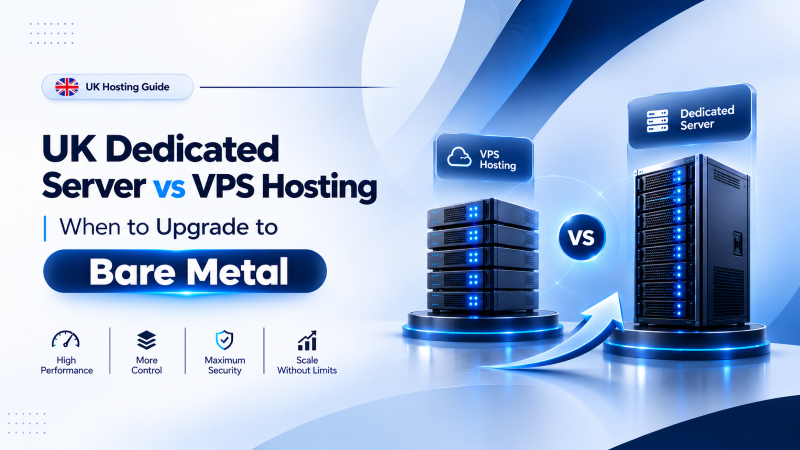
Bare-Metal Architecture: UK Dedicated Server vs VPS Hosting
⚙️ Hypervisor Layer
Evaluating migration from virtualized hosting to dedicated hardware begins with analyzing the physical boundaries of both architectures. A Virtual Private Server partitions a host machine into isolated virtual instances using a hypervisor (such as KVM or VMware ESXi). Each VPS receives allocated vCPUs, memory, and virtual storage slices. However, underneath this abstraction layer, virtual machines share physical CPU sockets, motherboard buses, storage controllers, and network interface cards.
⚡ 100% Bare Metal
In contrast, a dedicated bare-metal server grants exclusive, single-tenant ownership of the entire physical machine with zero intermediary hypervisors arbitrating hardware access. Your operating system interacts directly with bare-metal silicon, enterprise DDR5 memory channels, PCIe Gen4/Gen5 NVMe arrays, and dedicated optical network links.
Hypervisor Context Switching vs Bare-Metal Direct Execution
⚡ 384MB Dedicated Buffer
Furthermore, modern enterprise processors incorporate massive Level 3 cache buffers measuring up to 384MB. In a shared VPS environment, competing virtual machines continuously invalidate these cache lines, resulting in expensive memory fetches from system RAM. In contrast, bare-metal servers dedicate 100% of on-die CPU cache hierarchies to your operating system, keeping hot database index trees resident in high-speed hardware cache.
Telemetry Benchmarks: When Your UK VPS Has Reached Its Scalability Limits
Therefore, engineering teams should never base their server infrastructure migrations on speculative traffic estimates. Production monitoring telemetry provides clear, indisputable signals when a virtualized environment is suffocating your workload. When evaluating UK dedicated server vs VPS hosting, system administrators monitor three primary kernel metrics: CPU steal time, storage I/O wait, and hypervisor memory reclamation.
Specifically, when running virtualized web clusters, reviewing the comparative operational differences helps isolate whether latency spikes stem from code inefficiency or multi-tenant physical hardware starvation.
Virtualization Limits vs Bare-Metal Direct Execution Benchmarks
-
⚡
CPU Steal Time: Permanently fixed at 0.0%. All physical CPU cycles belong exclusively to your operating system kernel.
-
🔒
Disk I/O Wait (%iowait): Stays consistently below 1.5% under heavy database concurrency due to dedicated NVMe PCIe channels.
-
📊
Cache Hierarchy: Unshared 100% dedicated L1, L2, and L3 CPU cache lines ensure zero cache invalidation from third-party code.
-
🛠️
Compliance Security: Single-tenant physical boundary eliminates cross-VM microarchitectural side-channel attack vectors entirely.
-
🛡️
CPU Steal Time: Vulnerable to noisy neighbors. Experiences unpredictable steal spikes between 3% and 15% during peak host contention.
-
⚡
Disk I/O Wait (%iowait): Shared virtual storage queues lead to I/O wait spikes above 10%, causing database commit stalls.
-
📸
Cache Hierarchy: Virtual machines share on-die cache buffers, leading to frequent CPU cache misses and RAM fetch delays.
-
🗜️
Compliance Security: Multi-tenant memory boundaries require complex shared-responsibility attestations under UK GDPR frameworks.
As a result, if your telemetry dashboard records sustained CPU steal exceeding 3% to 5% or disk I/O wait exceeding 8% to 10%, tuning application queries yields diminishing returns. Upgrading to a dedicated bare-metal server removes the hypervisor layer, restoring instantaneous CPU responsiveness and deterministic storage operations.
London Low-Latency Transit: UK Dedicated Server vs VPS Hosting
🌐 LINX & LONAP Peering
Furthermore, datacenter geography and optical transit engineering determine the ultimate responsiveness of any digital platform operating across the United Kingdom. London occupies an exceptionally advantageous topological position within the European telecommunications grid, functioning as the primary terrestrial interconnect between domestic British consumers and North American subsea cable landings.
Consequently, our high-performance infrastructure is stationed within certified Tier-3 datacenters in London and Slough, providing direct cross-connects to the London Internet Exchange (LINX) and LONAP.
Carrier-Neutral London Optical Interconnects
LINX London Interconnect
Direct peering via redundant 100 Gbps optical uplinks to LINX at Telehouse Docklands provides zero-hairpin transit to over 900 autonomous systems. Consequently, British traffic stays entirely local without traversing congested international transit gateways.
Tier-1 British Carrier Blend
BGP4 dynamic multi-homed transit routes domestic packets across BT, Virgin Media, Lumen, and Arelion, ensuring continuous failover protection. Therefore, automated failover guarantees sub-millisecond route convergence during unexpected carrier fiber cuts.
Sub-5ms UK Domestic RTT
Low-latency fiber corridors deliver sub-5ms round-trip latency to London, Manchester, and Birmingham, and sub-12ms to Dublin and Amsterdam. As a result, financial exchanges, live API endpoints, and e-commerce platforms maintain razor-sharp user responsiveness across Britain.
In contrast, running production workloads on a generic virtual private server often subjects your traffic to shared virtual network cards and unpredictable transit hops. Deploying an enterprise UK Dedicated Server unlocks dedicated 1Gbps to 25Gbps physical uplinks with unmetered domestic bandwidth and deterministic packet delivery.
Linux Kernel Tuning & Runbook: UK Dedicated Server vs VPS Hosting
⚡ Root Sysctl Authority
Moreover, transitioning to bare-metal infrastructure gives systems engineers complete authority over Linux kernel network buffer parameters, storage scheduler queues, and TCP congestion algorithms. Unlike a virtual machine where the host hypervisor restricts kernel sysctl tuning, dedicated hardware allows precise calibration for high-concurrency database and web transaction throughput.
Specifically, applying Google BBR congestion control combined with expanded TCP socket buffers guarantees maximum bandwidth utilization across high-speed optical fiber links without dropping packets during traffic surges.
# Step 1: Create enterprise kernel network optimization profile
cat << 'EOF' > /etc/sysctl.d/99-uk-baremetal.conf
# Enforce Google BBR Congestion Control for low-latency UK and EU routing
net.core.default_qdisc = fq
net.ipv4.tcp_congestion_control = bbr

# Expand network socket buffer maximums for 10GbE / 25GbE optical interfaces
net.core.rmem_max = 67108864
net.core.wmem_max = 67108864
net.ipv4.tcp_rmem = 4096 87380 67108864
net.ipv4.tcp_wmem = 4096 65536 67108864

# Increase connection backlog and prevent SYN flood drops under heavy traffic
net.core.netdev_max_backlog = 250000
net.core.somaxconn = 65535
net.ipv4.tcp_max_syn_backlog = 3240000

# Memory management: Prevent aggressive disk swapping on high-RAM servers
vm.swappiness = 10
vm.dirty_ratio = 15
vm.dirty_background_ratio = 5
EOF

# Step 2: Apply sysctl parameters immediately without server reboot
sysctl --system

# Step 3: Verify active TCP congestion control algorithm
sysctl net.ipv4.tcp_congestion_control
net.ipv4.tcp_congestion_control = bbr
Additionally, setting the storage I/O scheduler to 'none' on enterprise NVMe block devices bypasses legacy elevator sorting algorithms, routing database read/write requests directly to physical controller queues with sub-microsecond latency.
Hardware Sizing Matrix: Workload Qualification & Tier Selection
📊 Production Sizing Matrix
Therefore, choosing the appropriate bare-metal configuration requires balancing compute concurrency, storage endurance, and network throughput against organizational workload requirements. Whether hosting Magento stores or high-concurrency microservices, selecting verified hardware specifications ensures cost-efficient scaling. Specifically, the following hardware sizing matrix outlines verified enterprise deployment tiers optimized for production operations across the United Kingdom, matching specific database workloads to dedicated processor families and NVMe channel configurations.
Furthermore, each tier incorporates out-of-band IPMI / iLO management with KVM-over-IP console access, allowing engineers to perform OS reinstalls, BIOS adjustments, and hardware diagnostics independently.
Step-by-Step Zero-Downtime Migration: Upgrading from VPS to Dedicated
Migrating production services from a virtual private server to physical bare metal requires structured execution to prevent transactional data loss and user disruption. By leveraging live database replication and progressive DNS routing, infrastructure teams achieve seamless zero-downtime cutover. Specifically, the following five-stage deployment pipeline details the verified sequence for migrating UK web platforms, protecting transaction logs while testing throughput.
Deploy Linux distribution on destination dedicated hardware, configure RAID 1/10 arrays, and execute hardware burning benchmarks using fio and memtester to certify silicon stability. Furthermore, lock down SSH keys, disable root password login, and configure local hardware monitoring daemons.
Execute initial rsync file sync across static assets, web application directories, and configuration trees while the legacy VPS remains fully live and serving production traffic. Consequently, this background transfer pre-populates 98% of total file volume with zero application impact.
Establish encrypted master-replica database streaming (MySQL GTID or PostgreSQL WAL) between legacy VPS and dedicated bare metal to maintain real-time transactional synchronization. Therefore, continuous binary replication ensures that every commit made by live users is instantly mirrored to the dedicated server storage array.
Validate application rendering, payment gateway integrations, and API response latency on the bare-metal server using local hosts file mapping prior to public DNS rerouting. In addition, run automated functional regression test suites to confirm database query plan execution and cache warmup performance.
Briefly set the legacy VPS database to read-only, confirm replication lag is zero seconds, promote the dedicated server database to primary, and update authoritative DNS records to the dedicated IP. As a result, live production traffic shifts smoothly onto bare-metal compute with absolute zero transactional data loss.
Consequently, this progressive migration strategy eliminates checkout stalls and transactional corruption, ensuring zero service disruption during infrastructure transition. Furthermore, keeping the legacy VPS online during verification provides an instantaneous rollback mechanism, allowing teams to execute platform migrations with complete confidence.
Regulatory Compliance, UK GDPR & Sovereign Data Governance
⚖️ ICO / UK GDPR
Beyond raw compute velocity, infrastructure decisions across Britain are strictly governed by statutory compliance frameworks. Organizations processing personal identifiable information (PII) or financial transactions operate under the UK Data Protection Act 2018 and UK GDPR, supervised by the Information Commissioner's Office (ICO).
🛡️ Sovereign Isolation
Under these guidelines, multi-tenant VPS clouds introduce compliance complexities because virtual machines share physical memory banks and storage backplanes. A dedicated server guarantees single-tenant physical custody, ensuring NVMe storage arrays, memory registers, and processor channels remain exclusively dedicated to your enterprise, simplifying statutory ICO audits.
⚡ Edge Protection
Furthermore, automated hardware DDoS mitigation systems inspect edge traffic in real time, neutralizing volumetric floods and Layer-7 attacks up to multi-terabit capacity within milliseconds to protect mission-critical British businesses.
Frequently Asked Questions
Q
What is the primary difference between UK dedicated server vs VPS hosting?
What is the primary difference between UK dedicated server vs VPS hosting?
The core distinction lies in virtualization and tenancy. A UK VPS operates as a software-defined virtual slice within a shared host, where compute and storage are shared among tenants via a hypervisor. In contrast, a UK dedicated server provides exclusive single-tenant physical bare metal. This grants your operating system direct access to CPU execution pipelines, physical ECC memory, and dedicated NVMe arrays without virtualization overhead.
Q
How do I know if my UK VPS degradation is caused by noisy neighbors?
How do I know if my UK VPS degradation is caused by noisy neighbors?
You can identify noisy-neighbor interference by monitoring CPU steal (%steal) and disk I/O wait (%iowait) using Linux tools like top or vmstat. If your application experiences latency spikes while internal CPU usage is low, but %steal consistently exceeds 3% to 5%, adjacent virtual machines on the host are starving your cycles. On dedicated hardware, CPU steal is permanently 0.0%.
Q
What specific CPU steal percentage indicates it is time to upgrade to bare metal?
What specific CPU steal percentage indicates it is time to upgrade to bare metal?
Any production environment registering sustained CPU steal exceeding 3% to 5% during peak hours has outgrown virtual hosting. While micro-bursts of 1% steal are normal in shared clouds, sustained steal directly impairs application throughput, inflates API tail latency, and triggers database lock timeouts that code optimization cannot resolve.
Q
Can I upgrade my UK VPS to a dedicated server without experiencing downtime?
Can I upgrade my UK VPS to a dedicated server without experiencing downtime?
Yes. By deploying the target dedicated server in advance, synchronizing application directories using incremental rsync transfers, and establishing master-replica database replication over an encrypted tunnel, data remains synchronized in real time. During the scheduled cutover window, the legacy VPS database is briefly transitioned to read-only status, the replica is promoted to primary, and DNS records are updated, achieving a seamless zero-downtime transition.
Q
At what monthly cloud budget does a dedicated server become cheaper than a high-end VPS?
At what monthly cloud budget does a dedicated server become cheaper than a high-end VPS?
The financial tipping point typically occurs between £150 and £250 per month. When scaling a cloud VPS to 8 or 16 vCPUs and 32GB to 64GB of RAM, cloud providers charge steep premiums for virtual expansion. At this spending level, an enterprise bare-metal dedicated server delivers significantly higher CPU performance, unshared DDR5 memory, NVMe RAID arrays, and unmetered network uplinks for a predictable flat monthly fee.
Q
How does bare-metal hosting assist UK companies with GDPR compliance?
How does bare-metal hosting assist UK companies with GDPR compliance?
Under the UK Data Protection Act 2018 and regulatory frameworks enforced by the Financial Conduct Authority (FCA), organizations must prove robust data governance and physical security safeguards. Multi-tenant VPS architectures share physical silicon and memory registers, which can expose workloads to microarchitectural side-channel vulnerabilities. Bare-metal servers provide verifiable physical data segregation, single-tenant cryptographic isolation, and clear custody boundaries that streamline institutional compliance audits.
Q
Why does LINX peering matter when choosing between UK hosting architectures?
Why does LINX peering matter when choosing between UK hosting architectures?
The London Internet Exchange (LINX) interconnects over 900 networks at carrier-neutral London hubs like Telehouse Docklands. Hosting your server with direct LINX optical peering ensures network packets bypass congested transit providers, delivering deterministic sub-5ms domestic latency across England, Scotland, and Wales for transaction-heavy enterprise applications.
⚡ Sub-5ms UK Domestic Latency
🔒 UK GDPR & Tier-3 Certified Facility
